Address
304 North Cardinal St.
Dorchester Center, MA 02124
Work Hours
Monday to Friday: 7AM - 7PM
Weekend: 10AM - 5PM

Address
304 North Cardinal St.
Dorchester Center, MA 02124
Work Hours
Monday to Friday: 7AM - 7PM
Weekend: 10AM - 5PM
Prime Rogue reported through the night. This page will be updated as new information emerges, including any response from DND, an official casualty count or cause, and Sunday afternoon’s satellite passes. Our next scheduled check is after DND’s 6 p.m. MT response deadline.
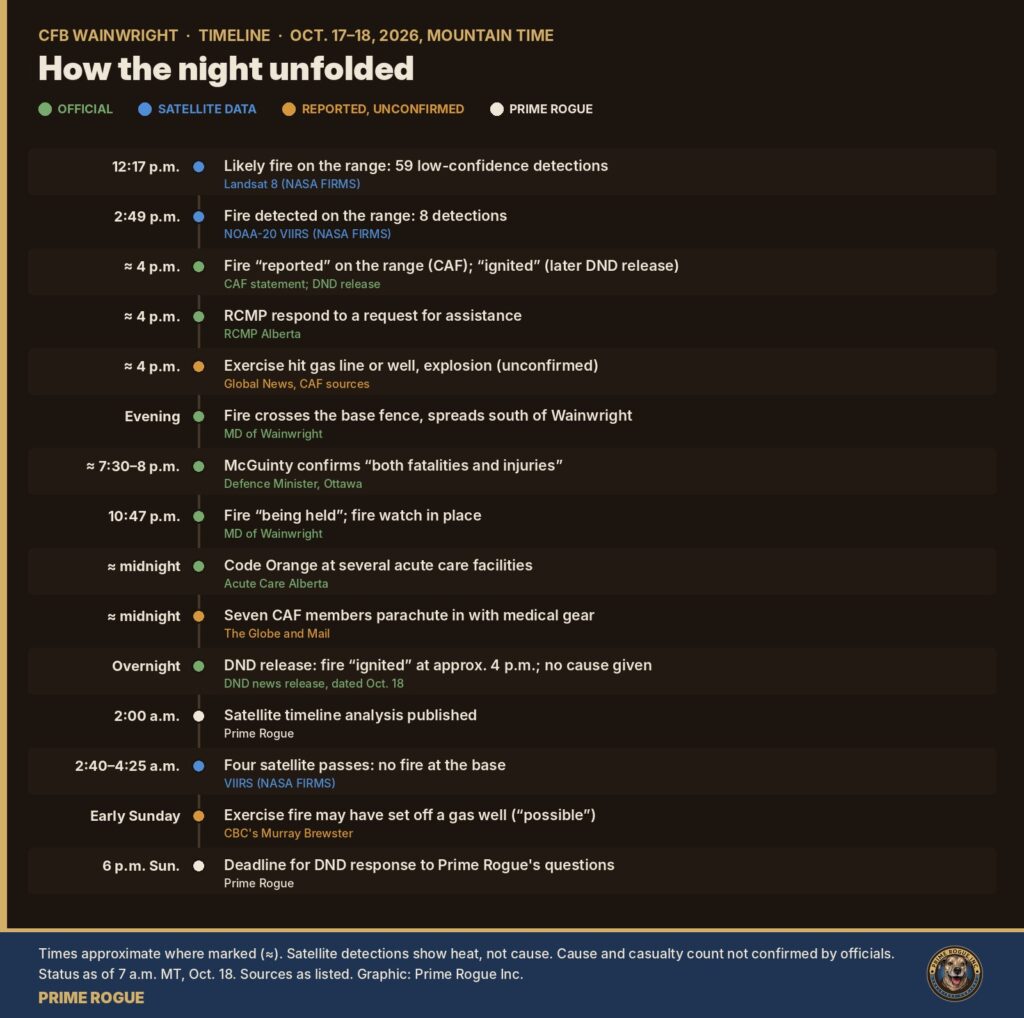
NASA satellites detected fire on the CFB Wainwright range at 2:49 p.m. Saturday, and likely as early as 12:17 p.m., before the approximately 4 p.m. time DND says a fire “ignited.” Four overnight passes found no active fire at the base. That record is consistent with an unconfirmed scenario, raised by CBC’s Murray Brewster, in which an exercise fire set off a gas well.
Original analysis (2 a.m. MT) · Follow-up (7 a.m. MT)
An incident at Canadian Forces Base Wainwright in east-central Alberta on Saturday started a fire that killed and injured an unknown number of people. Driven by high winds, the fire spread beyond the base fence. Defence Minister David McGuinty has confirmed “both fatalities and injuries.” No casualty figures, cause or victim identities have been released.
If you are a family member: CAF Family Information Line (24/7): 1-800-866-4546. Canadian Forces Member Assistance Program: 1-800-268-7708. DND Public Affairs: 819-531-8618.
That record is consistent with a scenario raised on air by CBC News senior defence writer Murray Brewster, in which a fire from the exercise set off a gas well. The scenario has not been confirmed, and DND has not named a cause. Satellites show heat, not cause.
Prime Rogue has sent DND a further request for comment, including what “ignited” at 4 p.m. refers to and whether Range Control knew of fire in the training area earlier in the afternoon, with a deadline of 6 p.m. MT. The raw NASA data is published with the analysis. Read the follow-up.
CBC News senior defence writer Murray Brewster said on air early Sunday that it is possible a fire that was part of the exercise set off a gas well, which he said would explain the chain of events. He said it had not been confirmed by authorities. That scenario is consistent with NASA satellite detections of fire on the range at 2:49 p.m., and likely 12:17 p.m., before the roughly 4 p.m. incident. DND has not confirmed a cause.
Separately, The Globe and Mail reported that around midnight, seven CAF members parachuted onto the high-school field beside the Wainwright hospital with medical equipment. That appears to explain the parachutes CTV reported earlier. Prime Rogue has not confirmed which aircraft they jumped from – although the Hercules documented around the incident site is a likely candidate.
Prime Rogue analyzed NASA FIRMS data downloaded at about 4:27 a.m. Four overnight VIIRS passes appear to have covered the Wainwright area: Suomi-NPP at about 2:42 a.m., NOAA-20 at about 3:02 a.m., NOAA-21 at about 3:46 a.m. and Suomi-NPP again at about 4:22 a.m. Each recorded fires elsewhere on both sides of Wainwright, but none recorded a fire detection within 40 kilometres of the base. The only detections at the base remain the 12:17 p.m. and 2:49 p.m. detections reported earlier. The result is consistent with the MD of Wainwright’s statement that the fire was being held. It does not prove the fire is out: smouldering ground fire, or fire under cloud or smoke, can fall below what the satellites can detect. Our full satellite analysis.
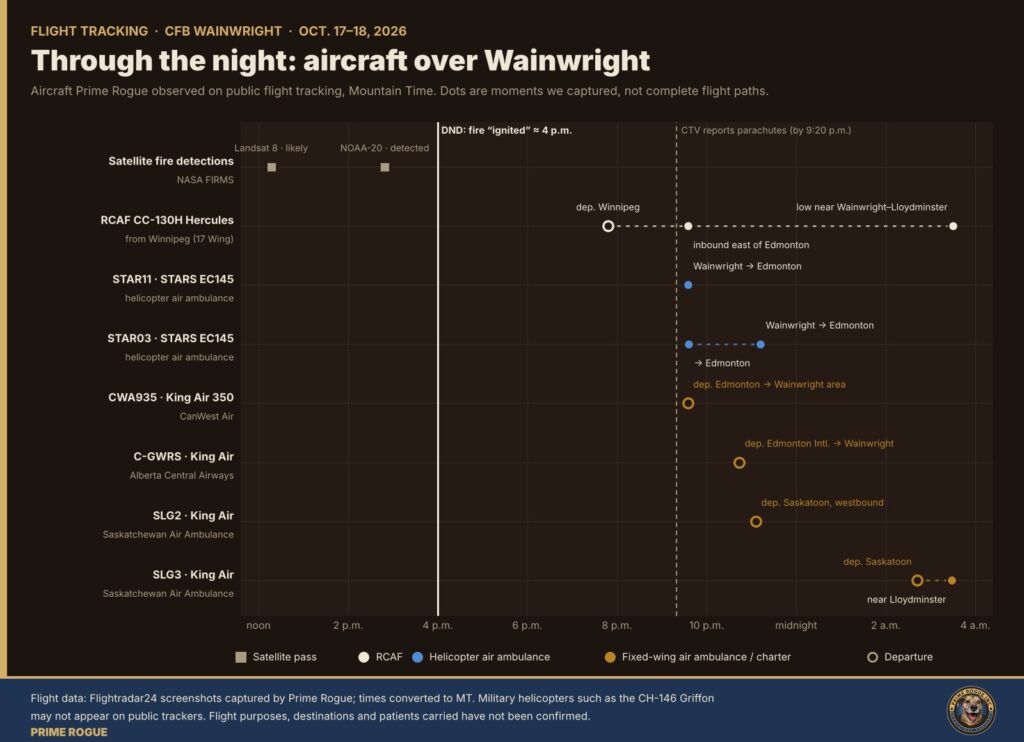
Public flight tracking reviewed by Prime Rogue shows a Royal Canadian Air Force CC-130H Hercules that flew from Winnipeg to the Wainwright area overnight. Winnipeg is home to 17 Wing and 435 Transport and Rescue Squadron, which flies the CC-130H in a search-and-rescue role. As of about 3:30 a.m., the aircraft was flying at low altitude near Edgerton, Wainwright and Lloydminster, repeatedly dropping in and out of public tracking. That is consistent with low-level flying below the coverage of ground receivers; it does not by itself indicate the aircraft switched off its transponder. DND has not said what the aircraft is doing.
CTV News reported that helicopters and two aircraft landed at a medevac site near Wainwright High School, which sits beside the Wainwright Health Centre, and that “parachutes could be seen coming in from the sky to the school.” CTV did not say who saw them or what they carried. RCAF search-and-rescue technicians are parachute-qualified medics, and the CC-130H can airdrop supplies, but Prime Rogue has not confirmed that either happened at Wainwright, or that the aircraft tracked overnight was involved. Prime Rogue has asked DND whether personnel or supplies were dropped by parachute.
Separately, a Saskatchewan Air Ambulance King Air left Saskatoon at about 2:40 a.m. and flew west toward the Lloydminster area. Saskatchewan Premier Scott Moe said the province had deployed emergency help to Alberta. Prime Rogue has not confirmed the flight’s destination or whether it is connected to the Wainwright response.
CBC News aired NASA’s FIRMS fire map early Sunday, and CTV News published a NASA satellite image of the Wainwright area Saturday night. CBC mischaracterized the images as showing a “domino effect” as it apparently did not examine the timestamps showing that these satellite imagery passes occurred prior to DND’s stated ignition time. As of this update, Prime Rogue has not seen another outlet report when NASA’s satellites detected the fire relative to DND’s stated ignition time of about 4 p.m. Prime Rogue’s analysis found detections at 2:49 p.m., and likely at 12:17 p.m. Read the analysis, methodology and data.
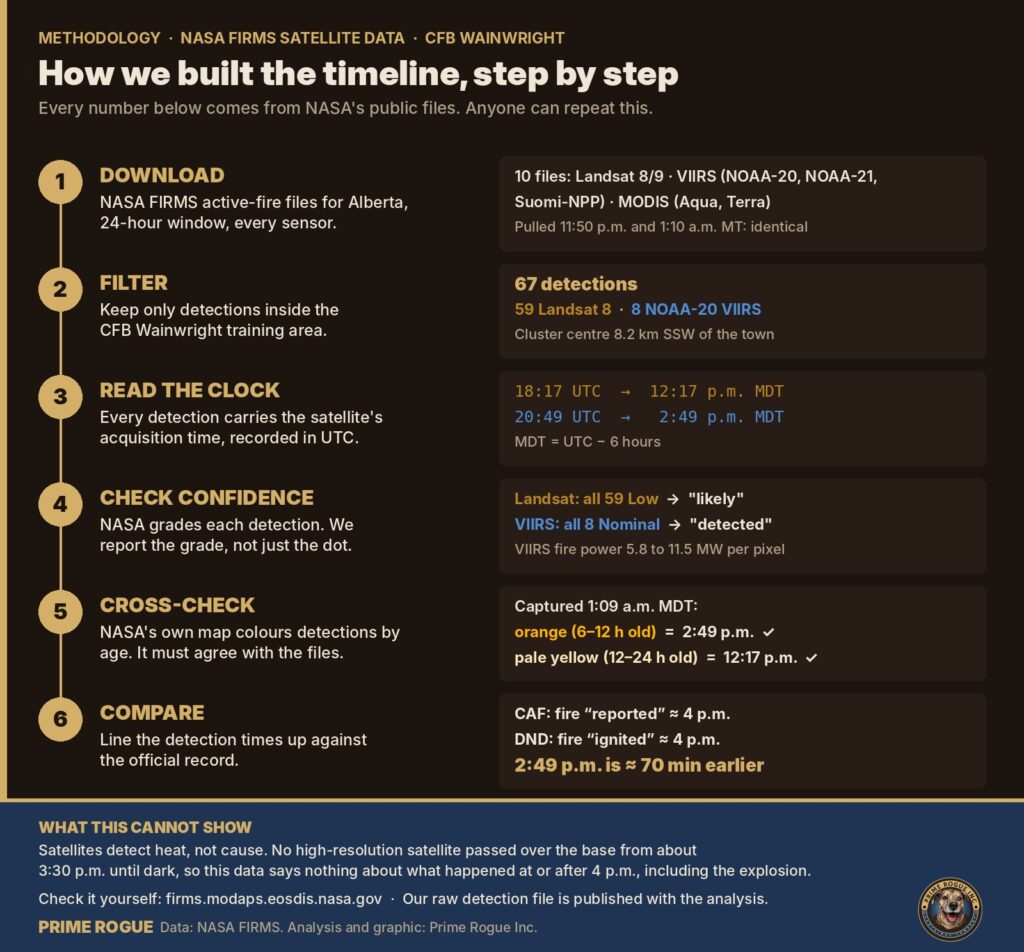
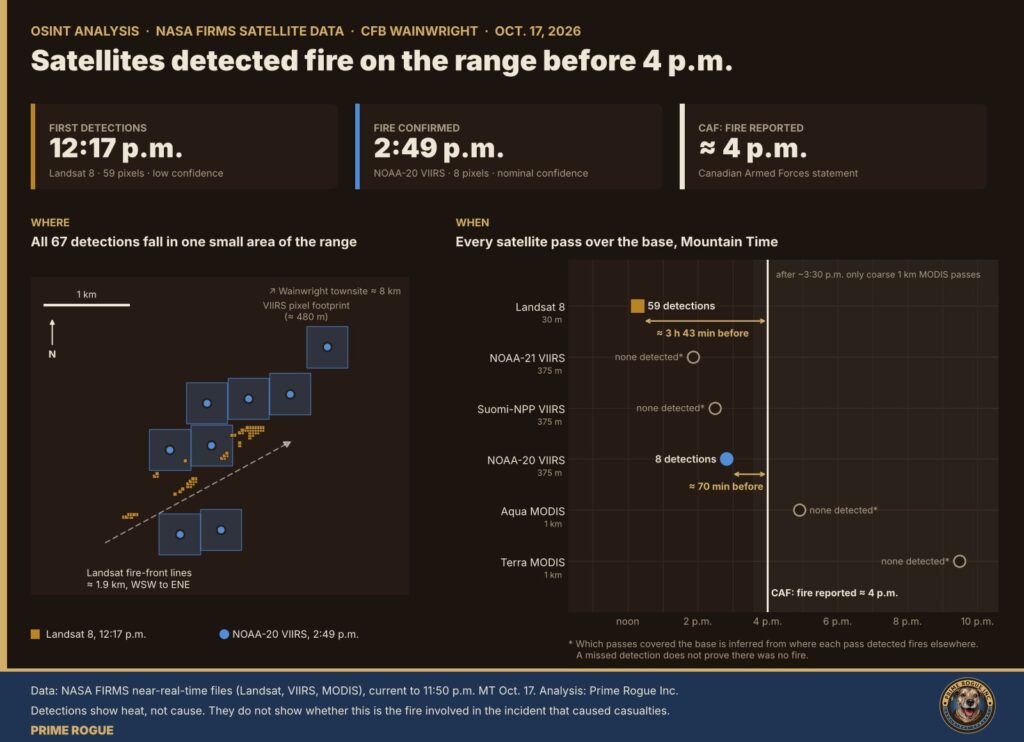
Prime Rogue published its full analysis of NASA satellite fire data for CFB Wainwright, including methodology and the raw detection file. Satellites saw fire on CFB Wainwright range hours before DND says it ignited.
NASA satellite data analyzed by Prime Rogue shows fire on the CFB Wainwright range at 2:49 p.m. MDT Saturday, about 70 minutes before the approximately 4 p.m. time the Canadian Armed Forces gave for when a fire was reported, and before the explosion that Global News, citing CAF sources, places at around 4 p.m. Lower-confidence Landsat detections at the same spot at 12:17 p.m. appear to trace the lines of an advancing fire. The data does not show what caused the fire, or whether it is the same fire involved in the incident. Prime Rogue has asked DND to explain. Full details, graphic and method are below, and in our full analysis of the entire daily fire matrix at CFB Wainwright
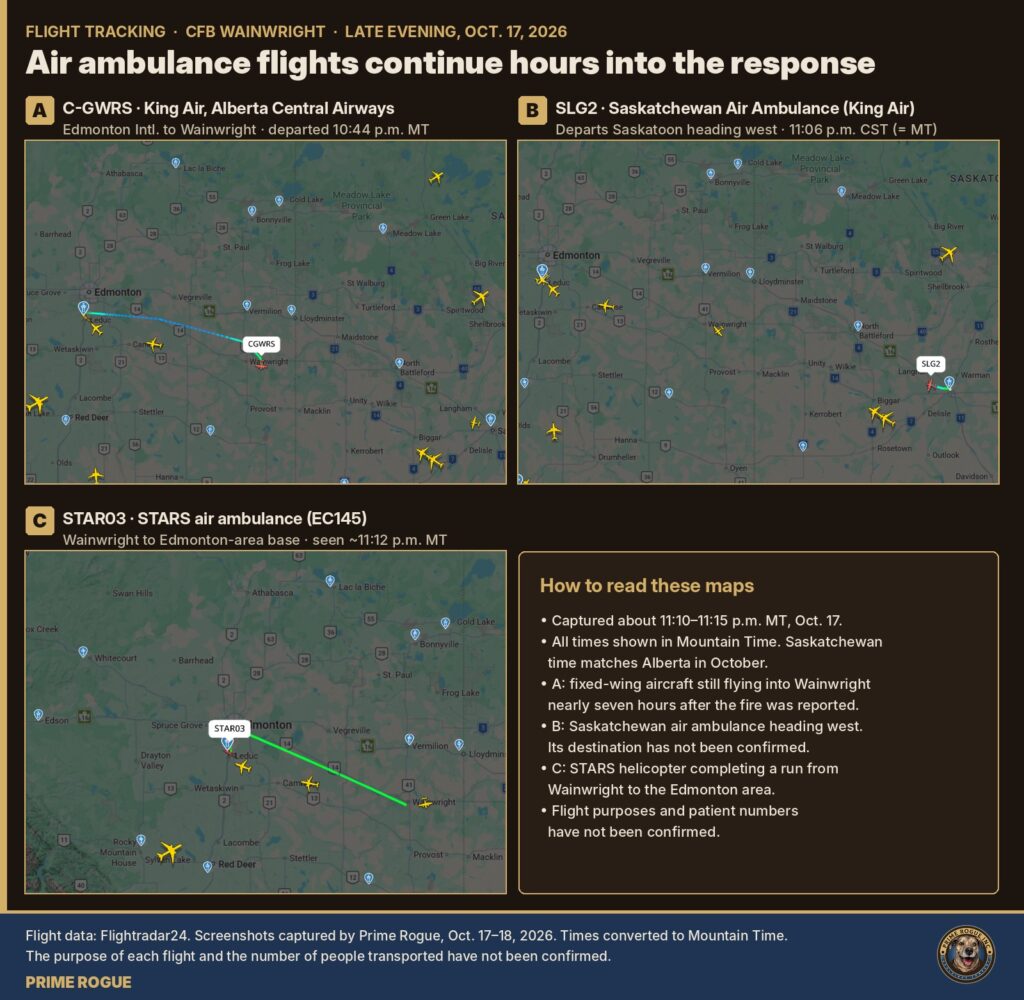
Flight-tracking data reviewed by Prime Rogue shows a King Air operated by Alberta Central Airways departing Edmonton International Airport at 10:44 p.m. and flying to Wainwright, nearly seven hours after the fire was reported. A Saskatchewan Air Ambulance King Air departed Saskatoon at 11:06 p.m., heading west toward Alberta. Saskatchewan Premier Scott Moe said earlier that his province had deployed resources to assist. A STARS helicopter seen leaving the Wainwright area at about 9:35 p.m. has since completed its flight to the Edmonton area. Prime Rogue has not confirmed the purpose of these flights, their destinations beyond what the tracking shows, or how many people they carried.
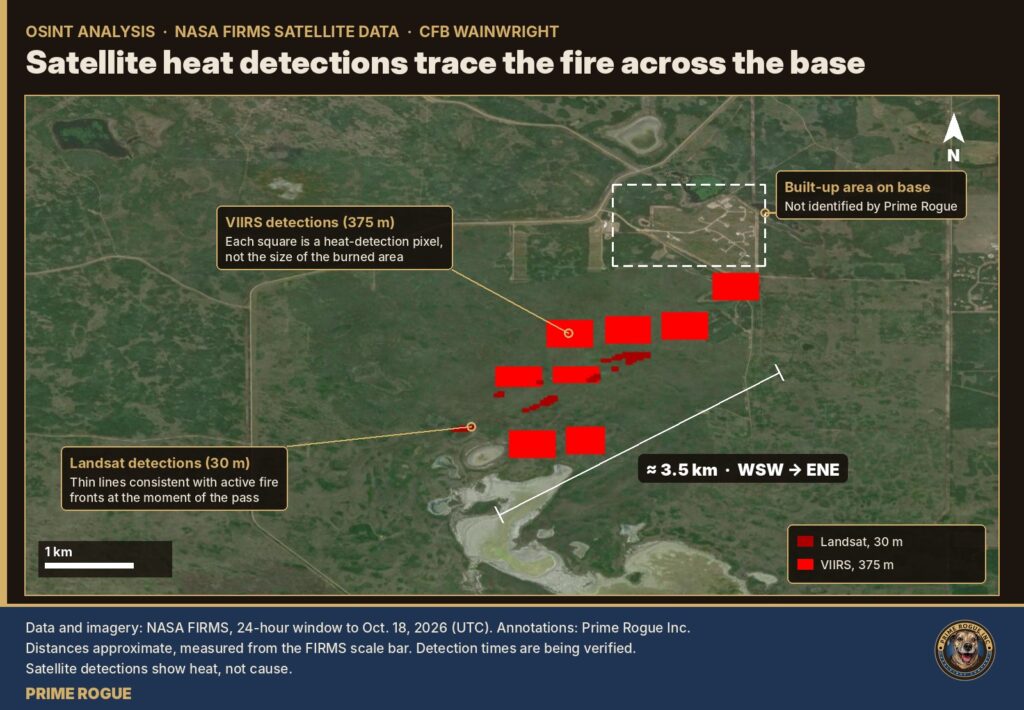
NASA satellite fire data shows one area of heat detections on CFB Wainwright forming a narrow band about 3.5 kilometres long, running west-southwest to east-northeast, with its northeast end within roughly half a kilometre of a built-up area on the base. We assess with moderate confidence that this pattern reflects a wind-driven grass fire, and that this part of the fire most likely spread toward the east-northeast. That assessment could change if local wind records show otherwise, or if the band turns out to follow the layout of a firing range. We cannot estimate the burned area from heat detections alone. We assess with low confidence that the total fire is larger than this band: the Municipal District of Wainwright places the active fire south of Township Road 44-0, several kilometres from the detections we reviewed. That suggests either additional fire areas or significant spread beyond what satellites captured in this window. Satellite data shows where heat was detected, not what caused it, and nothing in it confirms or rules out any cause. Prime Rogue will update this estimate as satellite detection times are verified and new passes come in.
Some social media posts have pointed to energy infrastructure on CFB Wainwright as a possible factor. The base’s range is shared land: a 2014 Western Producer report described about 180 buried natural gas wells on the 148,000-acre base, pipelines buried twice the usual depth to withstand armoured vehicles, roughly 6,600 cattle grazed each year by local patrons, and seasonal hunting draws. Officials have not linked any of this to Saturday’s fire, and nothing reported so far identifies a cause. The Canadian Armed Forces says the fire was reported “on the range,” and the RCMP describes “a fire at a training area.” Prime Rogue is asking whether any wells, pipelines, livestock or civilian users of the range were affected.
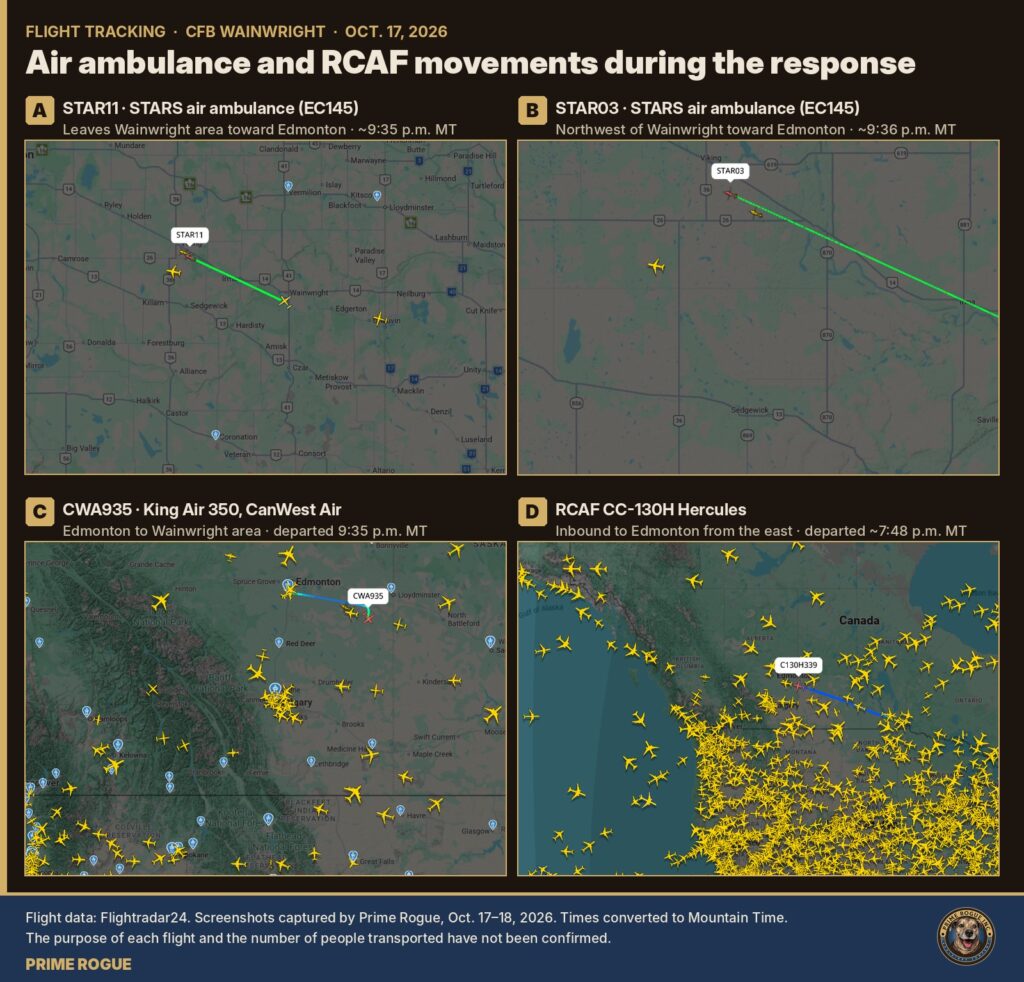
10:05 p.m. | Air ambulances shuttling between Wainwright and Edmonton. Publicly available flight-tracking data reviewed by Prime Rogue shows two STARS air ambulance helicopters departing the Wainwright area toward Edmonton at about 9:35 p.m. MT, more than five hours after the fire was first reported. A fixed-wing King Air operated by CanWest Air departed Edmonton for the Wainwright area at the same time. Earlier in the evening, a Royal Canadian Air Force CC-130H Hercules was tracked inbound to Edmonton.
The movements are consistent with ongoing patient transfers from Wainwright to Edmonton hospitals. Prime Rogue has not confirmed the purpose of any flight, the number of people transported, or the RCAF aircraft’s tasking. We are reviewing the full flight history since 4 p.m. and have asked STARS how many missions it has flown in response to the incident. We will update this entry.
9:50 p.m. | Patients arriving at Wainwright hospital. Two sources told Prime Rogue the Wainwright Health Centre has received an influx of patients from the incident. The health centre told Prime Rogue it had no comment. The account is consistent with McGuinty’s statement that the Wainwright community is providing hospital support, and with the MD of Wainwright’s request that residents avoid the health centre except for critical needs. Prime Rogue has not confirmed how many patients have been treated or transferred.
Taken together, official statements show the response now extends well beyond the base. The fire crossed the base fence, firefighters from multiple jurisdictions are responding, Saskatchewan has deployed resources, and civilian EMS, STARS and the local hospital are supporting casualty care.
9:44 p.m. | DND responds to Prime Rogue. In an email, DND spokesperson Suzanne Lalande said the department is “aware of an incident in Wainwright, Alberta,” that “the safety and security of our personnel, their families, and members of the surrounding community remain our highest priority,” and that DND will “provide additional information as it becomes available and can be confirmed.” The statement did not address Prime Rogue’s questions about casualty numbers, whether live-fire training or ammunition was involved, the units involved, or investigative lead. It did not reference the fatalities and injuries the defence minister confirmed earlier in the evening. Prime Rogue has sent follow-up questions.
~9:20 p.m. | No casualty figures yet. National coverage continues to describe an unknown number of fatalities and injuries. CTV reports McGuinty did not confirm whether weapons or ammunition were involved.
Just before 9 p.m. | Saskatchewan sends help. Saskatchewan Premier Scott Moe said the province “has deployed resources to Alberta and is ready to provide more if required.” He did not specify what resources. B.C. Premier David Eby also offered assistance.
~8:45 p.m. | RCMP: called in around 4 p.m. In an email reported by CBC and CTV, Wainwright RCMP said it was asked to assist the base at around 4 p.m. and that “early reports were that there was a fire at a training area.” The RCMP said it “sent numerous resources to assist” and that “our initial involvement is winding down, though we still have resources available if needed.” That wording sits uneasily with the minister’s statement that the RCMP is involved in the investigation. Prime Rogue has asked DND which agency holds investigative lead.
Evening | Chief of the Defence Staff. Gen. Jennie Carignan: “We are dealing with a serious incident at CFB Wainwright, and are fully engaged with federal, provincial and local authorities. Our priority remains the welfare of our members, their families and their community.”
~8 p.m. | Defence minister confirms deaths. Speaking in Ottawa, McGuinty confirmed “both fatalities and injuries.” He called it “a very, very active and delicate situation” and said: “I cannot recall an incident like this in recent memory.” He said the CAF, DND and federal partners are working with Alberta and municipalities to “mobilize all necessary support.” He gave no casualty figures and no cause.
~7:30 p.m. | No evacuation order for residents, according to CTV, citing the MD of Wainwright.
~7:10 p.m. | MP reports “significant casualties.” Conservative MP Dane Lloyd (Sturgeon River–Parkland) posted that “an explosion and fire during these high winds has resulted in significant casualties.” Lloyd is the source of the “explosion” description in much national coverage. Officials have not confirmed an explosion. Canadian Press reported STARS dispatched two air ambulances, from Saskatoon and Edmonton.
~7 p.m. | Fire crosses base fence. The MD of Wainwright opened an Emergency Coordination Centre and said the fire south of Wainwright “crossed the base fence earlier today and is being actively managed,” with the active fire area south of Township Road 44-0. There was no evacuation order. Residents were asked to avoid the Wainwright Health Centre unless they had a critical medical need.
6:15 p.m. | Premier and Opposition leader react. Premier Danielle Smith: “We are learning of a significant and tragic fire at CFB Wainwright today that is affecting many of our brave military personnel.” Opposition Leader Pierre Poilievre, whose Battle River–Crowfoot riding includes Wainwright: “Pray for Wainwright, everyone. There has been a serious incident that caused a fire at CFB Wainwright.”
Just after 6 p.m. | Prime Minister. Mark Carney: “A serious incident creating a major fire has occurred at CFB Wainwright, in Alberta. Our thoughts are with all the brave women and men affected.” Acute Care Alberta said EMS was on scene supporting care and transport.
~6 p.m. | CAF statement. The Canadian Armed Forces said: “At approximately 1600 on 17 October 2026, a fire was reported on the range at Canadian Armed Forces Base Wainwright. The fire has extended beyond the boundary of the training area and emergency services are responding. The situation remains ongoing.” Base public affairs told The Border Pulse: “There has been an incident on the base. Emergency personnel are attending the scene.”
~5:20 p.m. | First local reports. The Border Pulse (Lloydminster) reported receiving tips describing an explosion and a large number of injuries, which it had not independently confirmed. Wainwright Fire & Rescue said multiple agencies were responding to a fire south of Wainwright.
Just after 5 p.m. | MD alert. The MD of Wainwright warned that a large fire near the base “has spread rapidly due to high winds” and told residents not to travel toward the incident or attempt to view it.
~4 p.m. | Fire reported on the range, according to the CAF. The RCMP says it was called to assist at around the same time.
Earlier Saturday | Windstorm. Environment and Climate Change Canada had wind warnings across central and east-central Alberta, with gusts forecast up to 90 km/h. Edmonton International Airport recorded gusts of 98 km/h at about 2 p.m.
Everything in this section is unverified. We include it, clearly labelled, because it is circulating or because our own reporting points to it. None of it should be read as established fact.
Live-fire training and an ammunition burn: one source. A source with knowledge of the incident told Prime Rogue a live-fire drill ignited the fire, causing a significant ammunition burn, and that soldiers prioritized treating casualties as the fire spread. Prime Rogue has not independently confirmed this account. No official has confirmed or ruled out live fire or ammunition involvement; the official description of a fire “on the range” and at “a training area” is consistent with it, and the defence minister declined to say whether weapons or ammunition were involved.
Military helicopters: possible, not observed. Open-source flight tracker Steffan Watkins posted that multiple aircraft appeared to be inbound to CFB Wainwright, and noted that RCAF CH-146 Griffon helicopters, which may be among the first to respond, are too old to broadcast modern transponder signals and would not appear on public flight trackers. Watkins did not report seeing Griffons, and DND has not commented on air assets.
“150+ injured” and a school used for casualties: not verified. Posts on X claim more than 150 people were injured, that hospitals are full, and that a school is being used for casualties. Prime Rogue traced these claims to unsourced posts and replies whose figures climbed from “50+” to “100+” to “150+” with no new sourcing at any step. No official body has confirmed any casualty number or the use of a school or other civic facility. Prime Rogue is not reporting these figures. A separate claim circulating online that the town is being evacuated is false as of the MD’s latest update.
CFB Wainwright, formally 3rd Canadian Division Support Base Detachment Wainwright, sits just outside the town of Wainwright, about 200 kilometres southeast of Edmonton. Canadian Press describes it as one of the country’s busiest military training bases. It is home to the Canadian Manoeuvre Training Centre, which prepares units to operate together in realistic battlefield conditions, and the 3rd Canadian Division Training Centre, which provides basic infantry training. CBC describes it as the principal base for live-fire training exercises.
The base has seen fatal training incidents before. In October 2020, Cpl. James Choi, a 29-year-old reservist with the Royal Westminster Regiment, was fatally shot during a live-fire exercise in the base’s training area; a negligence charge against another soldier was later dropped by military prosecutors without explanation.
DND ran fuel-reduction burns on the base this spring, from April 10 to May 5, 2026, to reduce grassy overgrowth that could fuel uncontrolled grassfires.
Range fires have escaped Canadian training areas before. In September 2017, a fire at CFB Suffield in southeastern Alberta, sparked while soldiers were destroying an unexploded artillery shell, burned tens of thousands of hectares, including land outside the base. Nothing reported so far establishes a link between that incident and this one.
Prime Rogue intends to file access-to-information requests for Range Control logs, fire-danger and weather records for Oct. 17, the relevant exercise and range orders, and any Board of Inquiry terms of reference.
CAF families concerned about a loved one can contact the CAF Family Information Line at 1-800-866-4546 (24/7, bilingual). The Canadian Forces Member Assistance Program is available at 1-800-268-7708.
Next-of-kin notification is under way through the chain of command. Prime Rogue will not publish the name of anyone killed or injured until DND releases it officially. Please do not share unverified names on social media.
This is a fast-moving story. Prime Rogue separates on-the-record statements from named officials and agencies; claims by individuals, such as MP Dane Lloyd’s report of “significant casualties”; and unconfirmed information, including our own sourcing, open-source flight data and social media claims, which appear only in the labelled section above. Many headlines describe an “explosion”; no official has confirmed one. We do not speculate about fault, sabotage or terrorism, and nothing reported so far points to any of them. Times are approximate and in Mountain Time.
Prime Rogue contacted DND Media Relations by phone and email. DND provided a general statement and has not yet responded to specific questions. The Wainwright Health Centre said it had no comment. Corrections will be clearly labelled.
Have information? Contact Kevin J.S. Duska Jr. through Prime Rogue’s secure channels.
 Satellite record fits scenario that an exercise fire was burning before the CFB Wainwright incident
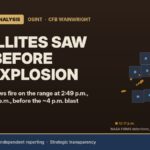 Satellites saw fire on CFB Wainwright range hours before DND says it ignited
 Base Profile: Al Watiya Air Base (Libya) — How Turkey Rewrote the Rules of Air War
 Canada’s F-35 Review, Portugal’s Exit, and the NATO Breakaway: European Jets Rise as U.S. Grip Weakens



[…] Qatar captain Hassan Al-Haydos pulled one back before the break. If you’re scanning the live tables and see Bosnia within shouting distance of Canada on points, the instinct is to panic. […]
[…] Ongoing coverage: CFB Wainwright fire: live updates. […]