Address
304 North Cardinal St.
Dorchester Center, MA 02124
Work Hours
Monday to Friday: 7AM - 7PM
Weekend: 10AM - 5PM

Address
304 North Cardinal St.
Dorchester Center, MA 02124
Work Hours
Monday to Friday: 7AM - 7PM
Weekend: 10AM - 5PM
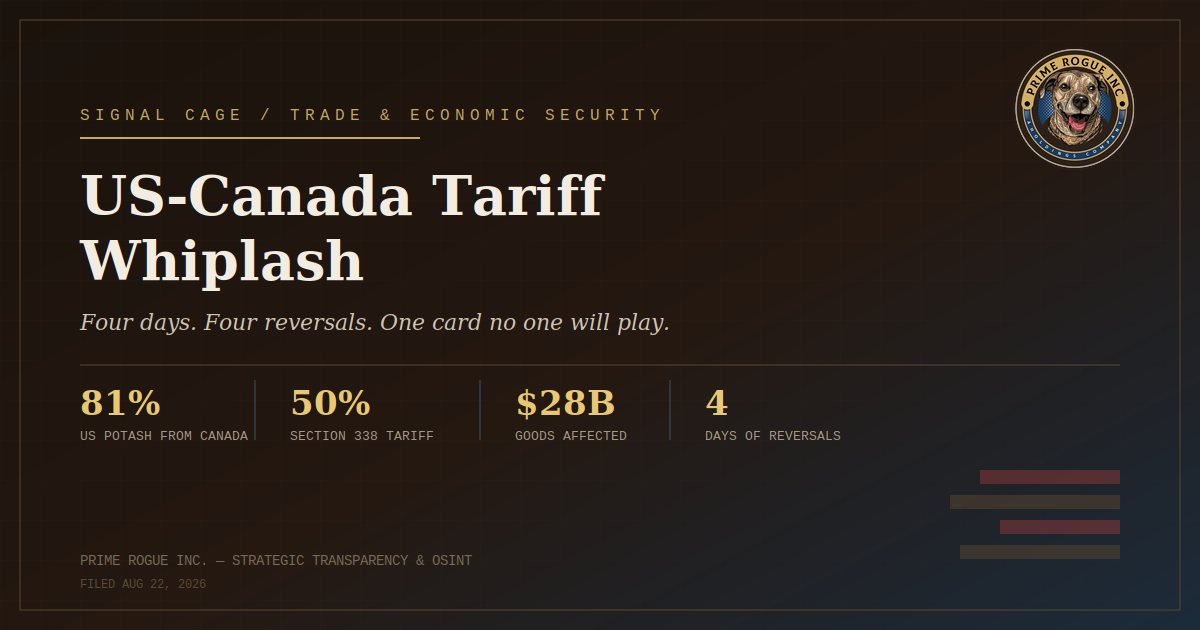
In four days, Canada-US trade talks went from a tentative agreement and a Keystone XL tease to suspended negotiations and matching 50% tariffs. The real story isn’t the whiplash. It’s the leverage both governments know exists and neither will touch.
Canadians who tuned out of the U.S.-Canada trade file for even a week came back to whiplash. On Tuesday, President Donald Trump paused a threatened 50 percent tariff on Canadian goods, citing a “tentative agreement” and floating a revival of the Keystone XL pipeline. By Friday night, that agreement had evaporated. Prime Minister Mark Carney suspended negotiations, recalled Canada’s negotiating team, and let the tariffs take effect at midnight. By Saturday morning, he’d pledged to match them “dollar for dollar.”
That is the news cycle. It is not, on its own, the interesting part.
Here is what actually happened, in sequence, stripped of spin from either capital:
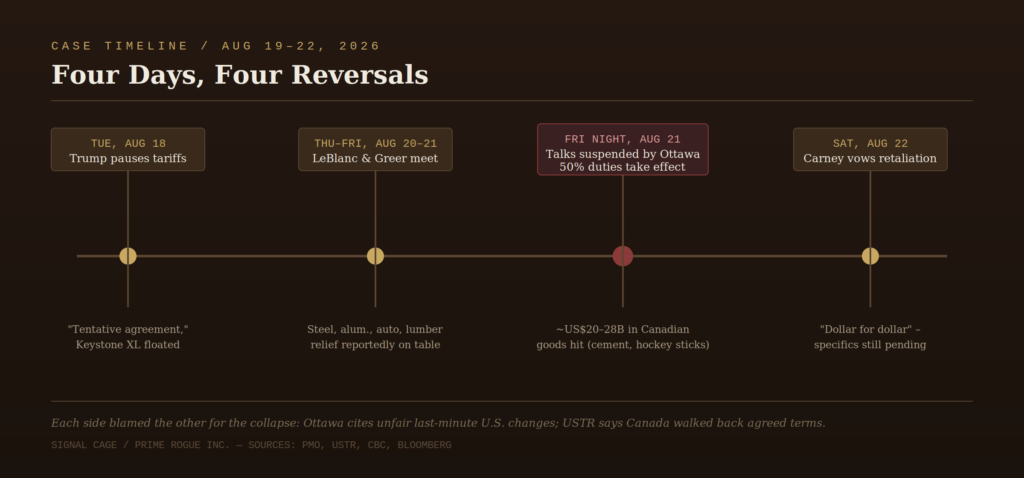
Ottawa’s version: the U.S. changed the terms at the last minute after weeks of good-faith progress, leaving Canada no choice but to walk away. Washington’s version, delivered by USTR Greer, is close to the opposite — that Canada “declined to finalize” terms already agreed to earlier in the week and made new demands that “upended the careful balance” both sides had reached.
Both accounts can’t be fully true, and the gap between them is where the actual accountability story lives. Somewhere in Global Affairs Canada and the Privy Council Office, there is a paper trail of exactly what changed between Tuesday’s “tentative agreement” and Friday’s collapse — term sheets, negotiating instructions, internal readouts. Whichever government moved the goalposts will eventually show up in that record, redactions notwithstanding.
THE TELL
Trump set the original deadline. He extended it once, unilaterally. He let it lapse a second time, on his terms. Carney’s “I suspended negotiations” framing is doing real rhetorical work — but a retaliatory tariff is, by definition, a response to an action already taken. It didn’t prevent anything. Track who controlled the clock all week, not just who threw the last punch.
The new 50 percent tariffs, covering an estimated $20–28 billion in Canadian goods including cement and hockey sticks, carry a carve-out list that’s just as telling as what’s included: energy products, critical minerals, fish, goods already under existing Section 232 tariffs — and potash.
Potash isn’t a minor omission. It is the input North American industrial agriculture cannot function without on any near-term timeline, and Canada supplies the overwhelming majority of what the United States uses.
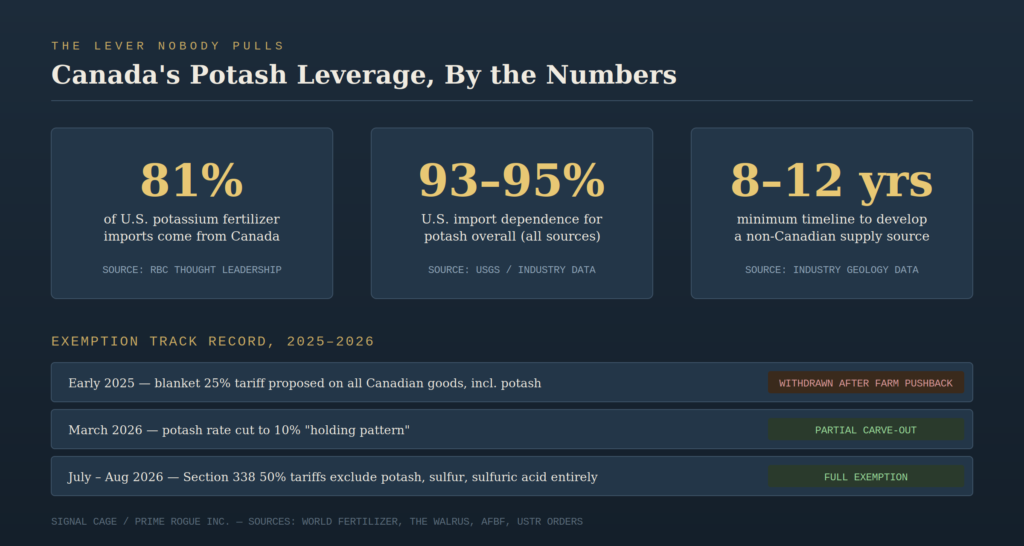
Look at the pattern across three separate tariff rounds. Early 2025’s blanket 25 percent proposal on Canadian goods was walked back for potash after farm-group pushback. By March 2026, the rate had been cut to a 10 percent “holding pattern.” By this summer’s Section 338 orders, potash, sulfur, and sulfuric acid were excluded outright. Washington has pre-emptively protected this input every single time, without Ottawa ever having to say the word “export tax” out loud.
Given the dependency numbers, it’s a fair question: why doesn’t Canada simply impose an export tax or non-tariff barrier on potash and end this in a week? A few structural reasons keep it off the table on both sides of the border.
Saskatchewan’s potash sector is a major employer and export earner. An export tax hits Nutrien and Mosaic’s Canadian operations and provincial revenue directly — this isn’t a costless lever for Ottawa to pull.
Carney’s framing all week has been “measured, dollar-for-dollar response to unfair U.S. behavior.” Threatening the fertilizer supply behind American food production is a different order of escalation — and a much easier target for U.S. political messaging (“Canada is holding our farmers hostage”) than a like-for-like tariff match.
Every prior round shows Washington self-deterring on potash without Canada lifting a finger. There’s a real argument that saying it out loud would be counterproductive — it would only accelerate the diversification (Belarusian supply, domestic alternatives) that erodes the leverage for good. An understood threat that never needs to be stated is often more durable than one that does.
Potassium is a non-negotiable plant nutrient, but whether a given farm needs to buy potash this season depends heavily on existing soil-test levels. Extension agronomists routinely advise growers on high-testing soil to skip or reduce potash applications. That flexibility means a real shock hits some regions and operations hard while others absorb it for a year or more — which blunts its use as a uniform, instant-crisis lever even as it remains a genuine structural risk.
CALIBRATION
Potash leverage is not a “nuclear option.” A 20 percent price shock adds roughly $8–12 per acre on top of $700–900+ in total per-acre operating costs for row crops — real, but not by itself catastrophic. Its actual power is political amplification: it doesn’t need to bankrupt farms, it needs to generate enough noise from farm-state senators fast enough, ahead of planting season, to move Washington. Think chokepoint tax, not detonation — valuable chiefly for being credible and left unused.
Three threads are worth tracking as this develops:
Is potash included in the new U.S. tariffs on Canada?
No. Potash, along with energy products, critical minerals, fish, and goods already under Section 232 tariffs, is explicitly excluded from the 50 percent Section 338 tariffs that took effect August 22, 2026.
What does “dollar for dollar” mean in Carney’s statement?
Carney has pledged that Canada’s retaliatory tariffs will match the value of the new U.S. duties — roughly $20–28 billion — rather than escalating beyond it. The specific list of targeted U.S. goods had not been published as of this writing.
How dependent is the U.S. on Canadian potash?
Canada supplies roughly 81 percent of U.S. potassium fertilizer imports, and the U.S. is 93–95 percent import-dependent for potash overall. Developing a comparable non-Canadian supply source would take a minimum of eight to twelve years.
The tariff whiplash makes for an easy headline. The more durable story is the one nobody in Ottawa or Washington wants to narrate out loud: a leverage card both governments know is real, both know is asymmetric, and both have every incentive to leave sitting on the table — for now.




[…] a force nearly triple its current reserve. Internal DND planning documents obtained by CBC, and Prime Rogue Inc, confirm a signed mobilization directive and a new director-general position exist. […]
[…] is what the Prime Rogue Intelligence Index does. One country per entry. A standing rubric — collection, […]
[…] second was the Jared Kushner-Gary Cohn globalist project: free trade maintenance, immigration flexibility on skilled workers and visa programs, institutional norm […]
[…] tariffs on Canadian aluminum, steel, lumber, and agricultural products, reigniting the Canada-U.S. trade war that defined his first […]
[…] Norway plays its cards right or gets played remains to be […]
[…] Warfare – Canada is already facing crippling U.S. tariffs and retaliatory trade restrictions. The fentanyl WMD designation will provide Trump with another justification to expand […]
[…] all of this happens while the United States is openly threatening annexation, Canada is in a live trade war, and Ottawa’s entire Cabinet structure is […]
[…] Rights Unclear – If the U.S. and Canada start playing hardball over water flows, Indigenous communities will be caught in the […]
[…] Panama now finds itself in a precarious position—one where it’s heavily invested in Chinese financing and infrastructure but still relies on the U.S. for trade and […]
[…] challenge its dominance:✅ Tariffs and trade restrictions – The U.S. imposed steel and aluminum tariffs on Canada in 2018 to force concessions on NAFTA renegotiations.✅ Financial weaponization – Countries like […]
[…] In effect, a U.S. withdrawal from NATO wouldn’t just alter military alliances—it would accelerate the realignment of global trade and finance. […]
[…] specific, and almost entirely unreported exposure to this crisis — one that intersects with the US-Canada trade talks collapse in a way nobody else is […]
[…] Prime Rogue Inc. has modeled four plausible scenarios for the next 30–90 days based on current posture, historical precedent, and real-time OSINT indicators. These futures are not exclusive — the lines between them may blur — but each represents a distinct trajectory with its own risk vectors, outcomes, and strategic implications. […]
[…] that “Greenland belongs to its people” and any forcible change would undermine the world order. Canada’s Prime Minister joined this chorus, affirming support for “the sovereignty and territorial integrity of […]
[…] Trudeau faced political pressure to retaliate after Trump’s tariffs on Canada. […]
[…] of respect for personal safety and investigative integrity, Prime Rogue Inc. is withholding exact street address and phone number details until such information is formally […]
[…] off, the CAF stops functioning immediately.✅ The U.S. has already used economic blackmail against Canada. A few well-placed tariffs and financial blacklists, and Canada’s economy goes into a death spiral within weeks.✅ The U.S. […]
[…] U.S. President Donald Trump’s recent comments about annexing Canada and doubling tariffs on Canadian goods have triggered diplomatic […]
[…] Nyemcsik, Project Lead for Blockchain Resilience at Prime Rogue Inc., emphasized the need for a secure and resilient infrastructure:“Foreign aid mismanagement isn’t […]
[…] also play a vital role in maintaining Vatican finances. The generosity of the faithful contributes significantly. Peter’s Pence is one notable fund […]
[…] Trump’s tariffs are not a one-off event—they are a preview of a future where American economic instability directly threatens Canada’s survival. The U.S. economy is a house of cards, bloated by debt, geopolitical overreach, and internal political chaos. Any nation that relies too heavily on it will suffer catastrophic consequences when that house finally collapses. […]
[…] Mark Carney does not need to win Alberta—he just needs to flip enough seats to weaken Poilievre’s dominance and secure a viable Liberal foothold in the province. The question is: Where can he win? And what strategy will allow him to break through Alberta’s Conservative wall? […]