Address
304 North Cardinal St.
Dorchester Center, MA 02124
Work Hours
Monday to Friday: 7AM - 7PM
Weekend: 10AM - 5PM

Address
304 North Cardinal St.
Dorchester Center, MA 02124
Work Hours
Monday to Friday: 7AM - 7PM
Weekend: 10AM - 5PM
When four soldiers of C Company, 3rd Battalion, Princess Patricia’s Canadian Light Infantry died on a CFB Wainwright range on Oct. 17, no electronic system appears to have been logging where each of them stood.
That is not a scandal in itself. It is the reason the investigation into the deaths of Sgt. Morgan Wong, Pte. Shaun Farrell, Pte. Aidan Goulding and Pte. Hayden Lykkemark will rest on paper and radio: Range Control’s logs, the base fire hall’s dispatch records, the range safety radio net and the base weather station. Eleven days after the fire, the Department of National Defence has not said whether those records were preserved, or when.
This piece is part of Prime Rogue’s ongoing coverage. For the full timeline, see our CFB Wainwright fire live updates.
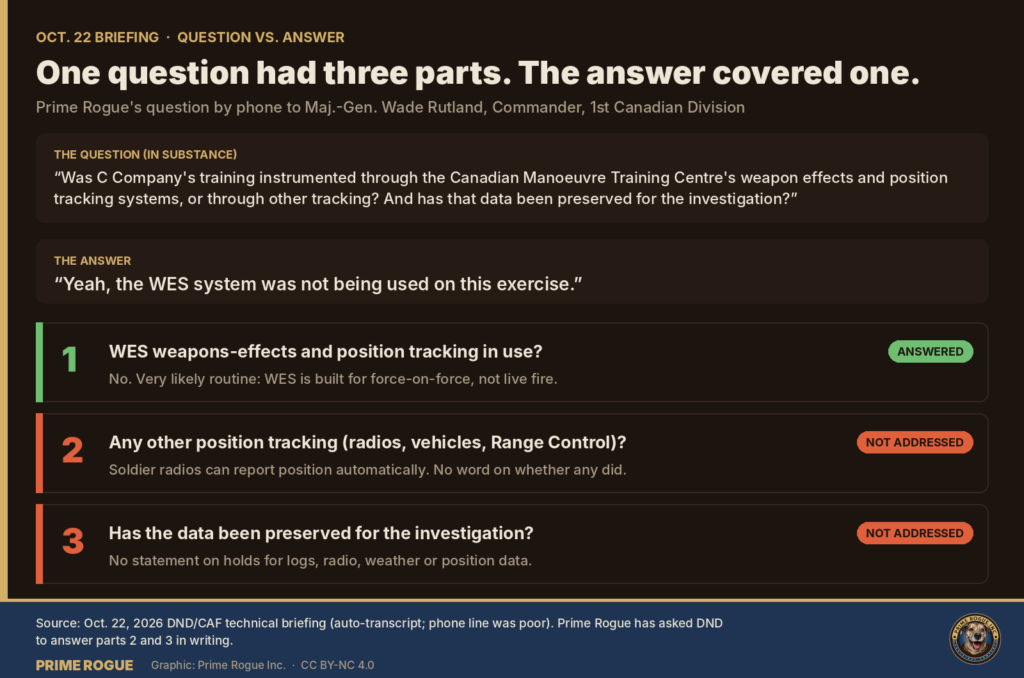
At the Oct. 22 technical briefing, Prime Rogue asked by phone whether C Company’s training was instrumented through the Canadian Manoeuvre Training Centre’s weapons-effects and position-tracking systems, or any other tracking. We also asked whether that data had been preserved for the investigation.
Maj.-Gen. Wade Rutland, Commander of 1st Canadian Division, answered: “Yeah, the WES system was not being used on this exercise.”
He did not address other tracking. He did not address preservation. The phone line was poor, and Rutland had asked us to repeat the question once already, so the narrow answer may reflect what he heard rather than an intent to dodge.
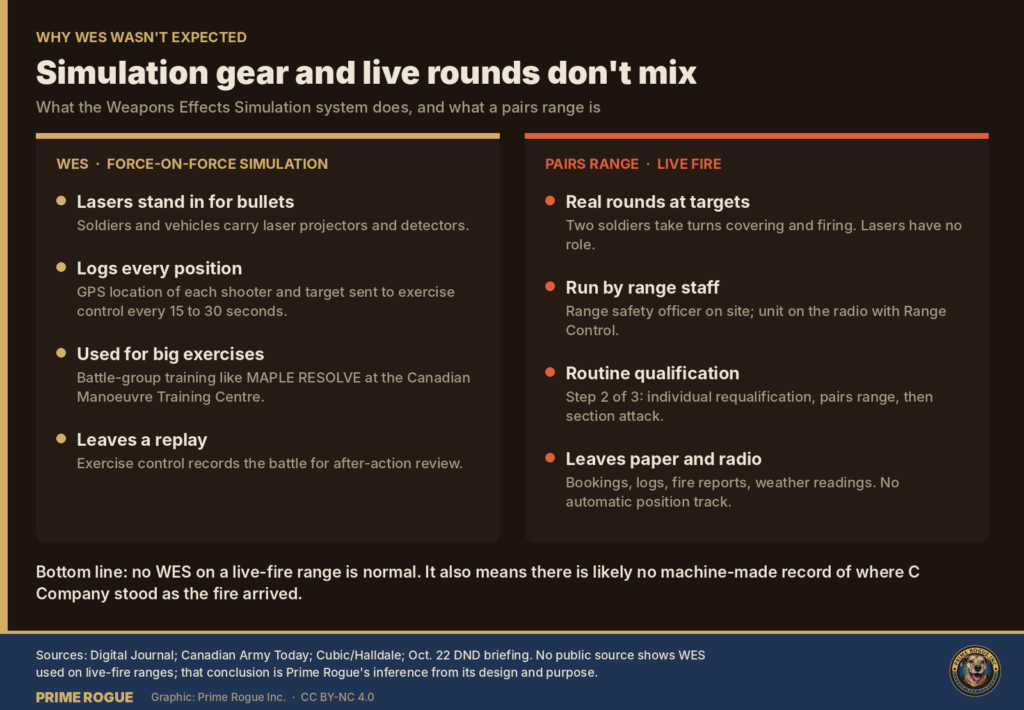
Rutland’s answer is very likely accurate, and routine. The Weapons Effects Simulation system, built by Cubic, is designed for large force-on-force exercises such as MAPLE RESOLVE at the Canadian Manoeuvre Training Centre in Wainwright. Soldiers and vehicles carry laser projectors and detectors in place of live rounds.
When it runs, it is a recording machine. Digital Journal reported that the system broadcasts the GPS location of every shooter and target to exercise control every 15 to 30 seconds. Canadian Army Today has described exercise control packaging that data into replays for after-action reviews. The army renewed support for the system in 2025, covering Gagetown, Valcartier, Petawawa and Wainwright, according to Halldale.
A pairs range is the opposite case. Two soldiers take turns covering and firing live rounds at targets. Rutland said it is the middle step of a progression: individual requalification, then pairs, then section attack. Prime Rogue found no public source showing WES used on a live-fire range.
So the absence of WES data is what one would expect. But it matters. There is likely no continuous, machine-made track of where C Company’s soldiers were as the fire approached.
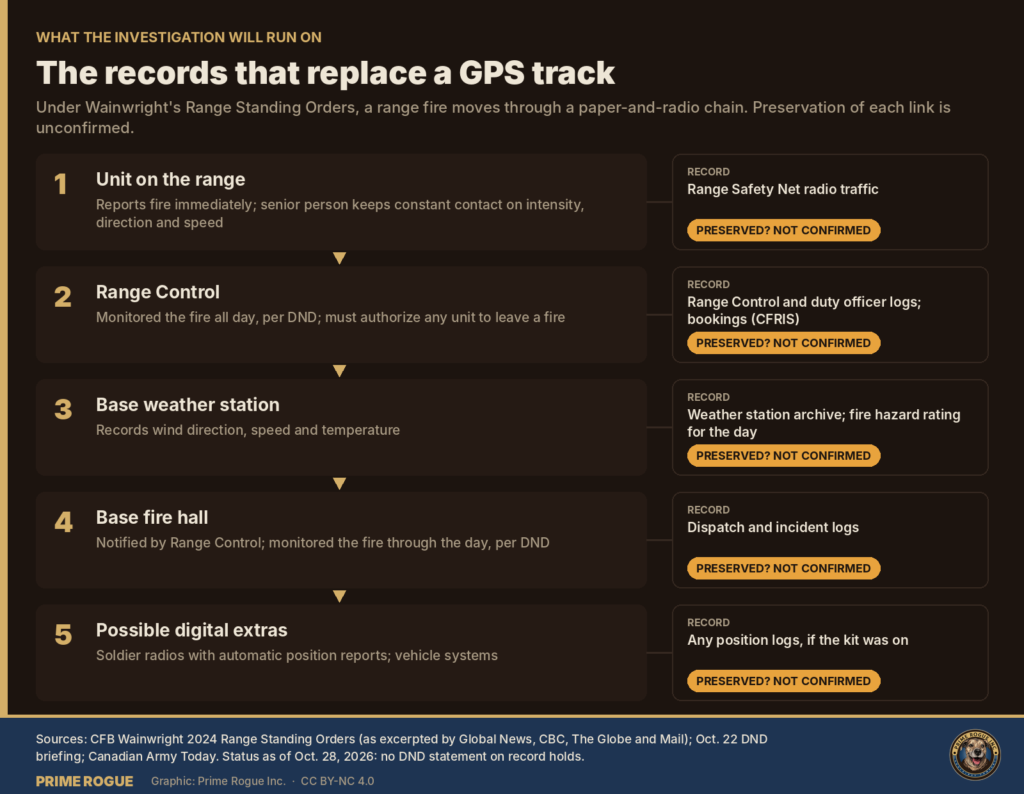
Wainwright’s own 2024 Range Standing Orders describe a paper-and-radio system. As excerpted by Global News, CBC and The Globe and Mail, any grass or brush fire must be reported immediately to Range Control. Range Control then notifies the fire department and the Range Warden. The senior person present must keep reporting the fire’s intensity, direction and speed, and units may not leave a fire until Range Control authorizes it.
Officials have already leaned on those records. At the briefing, Provost Marshal Brig.-Gen. Vanessa Hanrahan said the fire was “monitored throughout the day by both range control and the base fire hall.” She also said the evidence to date indicates communication among everyone in the training area. If documented, each of those statements lives in a log, a radio record or a dispatch sheet.
There may be digital records too. The army’s Integrated Soldier System radios automatically generate position location information, according to Canadian Army Today. But in early 2025 a General Dynamics representative told Canadian Army Today that the army did not have that kind of positional awareness fielded outside Latvia. That is a vendor’s statement and it is dated. 3 PPCLI was preparing to deploy to Latvia. Whether any position-reporting kit was switched on at Wainwright is a question, not a finding.
Precedent suggests investigators will work from the conventional record. Prime Rogue found no published Canadian Board of Inquiry, military police finding or court-martial decision that relied on WES or GPS tracking data. When Cpl. James Choi was killed in a 3 PPCLI live-fire exercise at Wainwright in 2020, a negligence charge was laid and later dropped. Cases like it have turned on witnesses, photos, video and logs.
Investigators are clearly gathering records. Gen. Jennie Carignan told CBC they are reconstructing the scene at different moments. The Board of Inquiry, which Canadian Press reported had not yet been launched as of Oct. 23, will be able to compel evidence once convened.
What no official has said is whether, and when, Range Control logs, radio recordings, fire hall dispatch records, weather station data and any device position data were secured. Timing matters. Radio recordings and device logs on many systems overwrite on a cycle. A dated preservation hold shows someone thought to ask.
DND’s access-to-information office has told Prime Rogue twice in writing that records “forming part of an ongoing investigation may be subject to withholding” until the investigation ends. That is lawful and common. It also means the public may not see the underlying records for a year or more. The CAF told CTV News its Board of Inquiry could take up to a year.
None of that prevents DND from saying now whether the records were kept. Confirming that a log exists and is secured reveals nothing about what it says.
Prime Rogue’s access request A-2026-01576 seeks Range Control and duty officer logs for Oct. 17, the first significant incident report, fire dispatch logs, range bookings and the fire hazard assessments in force that day. Every release will be published in full in our public archive on GitHub.
We also sent DND Media Relations these questions, with a deadline of 5 p.m. MT on Tuesday, Oct. 27:
DND did not respond by the deadline.
The soldiers on that range were training for a dangerous job. Their families are owed an account built on records that still exist. DND can settle one part of that now without touching the investigation: say whether the logs were kept.
Have records, documents or information about the CFB Wainwright fire? Reach Prime Rogue on Signal (Rubicon49.50) or by Proton Mail. Sources are credited or protected according to their wishes, under the Canadian Association of Journalists’ ethics guidelines.
Prime Rogue’s data, analysis and graphics are licensed CC BY-NC 4.0.
 Satellites saw fire on CFB Wainwright range hours before DND says it ignited
 CFB Wainwright Deaths: Alberta Says Its Medical Examiner’s Investigation is Separate from Military’s
 The storm line, then the fire: every satellite record of the CFB Wainwright fire, on one map
 Exclusive: CFB Wainwright Satellite Images Show The CFB Wainwright Pairs Range After The Fire


[…] her 2016 report, Provincial Court Judge Jody Moher wrote that National Defence and the Canadian Armed Forces took part only in establishing the circumstances of Collins’s death. She wrote that they […]
[…] Wainwright at 12:17 p.m. and 2:49 p.m. MDT on Oct. 17, before the approximately 4 p.m. time in the Canadian Armed Forces statement. The data shows heat, not cause, and does not show whether this is the fire involved in […]
[…] Canadian Armed Forces members were killed and 39 injured on Oct. 17, 2026, when a grass fire on the CFB Wainwright range […]
[…] Canadian Department of National Defence has deployed the same playbook for all three […]