Address
304 North Cardinal St.
Dorchester Center, MA 02124
Work Hours
Monday to Friday: 7AM - 7PM
Weekend: 10AM - 5PM

Address
304 North Cardinal St.
Dorchester Center, MA 02124
Work Hours
Monday to Friday: 7AM - 7PM
Weekend: 10AM - 5PM

There is a category error built into how most people think about national power. The instinct is to rank states by population, GDP, or military hardware, and assume influence follows in roughly that order. By that math, Qatar should be a footnote — a peninsula of around three hundred thousand citizens (plus several million resident foreign workers who don’t figure into its political calculus), with a military that exists mostly on paper and a land area smaller than Connecticut. Instead, Qatar has hosted peace talks between the United States and the Taliban, mediated hostage releases across half a dozen conflict zones, bankrolled political movements across the Arab world, built one of the most-watched news networks on the planet, and survived a multi-year blockade by its much larger neighbours without making a single substantive concession. That is not an accident of geology. It’s a foreign policy architecture, built deliberately, and it’s worth understanding on its own terms — not as a curiosity, but as a template that other small states have studied closely and that several are now trying to copy.
It’s tempting to credit Qatar’s leverage entirely to natural gas, and the gas matters enormously — Qatar built much of its modern wealth on liquefied natural gas exports and has spent decades as one of the world’s largest LNG suppliers, giving it relationships with energy-hungry economies from Japan to Germany that have nothing to do with the Arab world’s internal politics. But plenty of resource-rich states never convert that wealth into independent foreign policy weight. The difference is what Qatar’s ruling family chose to do with the money once it arrived, which was to build instruments of influence that have almost nothing to do with energy exports and everything to do with making Qatar indispensable to a wide range of actors who otherwise have no reason to care what happens to a small Gulf peninsula.
The clearest of those instruments is the sovereign wealth fund. The Qatar Investment Authority manages a portfolio that runs into the hundreds of billions of dollars and holds significant stakes in trophy assets across Europe, North America, and Asia — real estate landmarks, stakes in major banks and luxury brands, infrastructure projects, sports clubs. This is not just a savings account. It is a deliberate diversification of dependency: when a state owns meaningful pieces of London real estate, European football, and American infrastructure, the governments hosting those investments develop a quiet stake in that state’s stability and goodwill that has nothing to do with energy contracts and everything to do with capital flows they’d rather not disrupt.
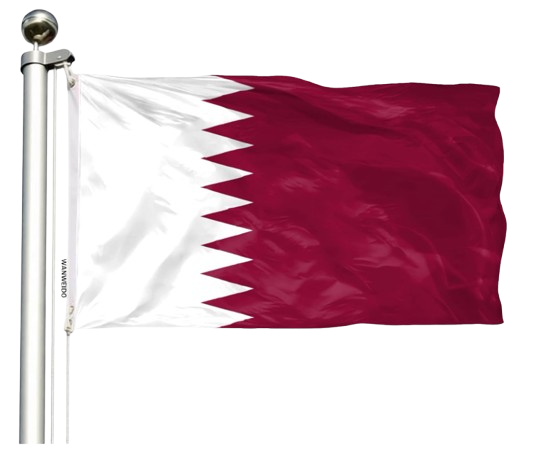
The single most distinctive feature of Qatar’s foreign policy is its refusal to choose sides in disputes most countries would consider mutually exclusive. Qatar hosts a major American military base that serves as a central hub for U.S. operations across the Middle East and South Asia — a relationship that gives Washington a direct and durable interest in Qatari security. At the same time, Qatar has maintained channels to the Taliban, to Hamas, to Iran, and to a range of Islamist political movements across the region that Qatar’s own Gulf neighbours regard as dangerous or illegitimate. Most states would treat hosting an American base and maintaining open lines to Hamas as a contradiction that eventually forces a choice. Qatar has run both relationships simultaneously for years, and the apparent contradiction is, in practice, the entire value proposition: Qatar can talk to people Washington needs to talk to but can’t talk to directly, which makes Qatar useful to Washington precisely because of the relationships that would otherwise look like a liability.
This is the mediation model in miniature, and it has produced real results that are easy to verify from open reporting alone: a role facilitating contact and negotiations around the U.S.–Taliban talks that preceded the 2021 withdrawal from Afghanistan, a recurring role as an intermediary in ceasefire and hostage negotiations involving Hamas and Israel, and even the Houthis, as well a long pattern of quiet involvement in conflicts from Lebanon to Sudan to Venezuela where having a channel to an otherwise-isolated actor is valuable to someone. None of this requires Qatar to win anything in the conventional sense. It requires Qatar to remain the venue and the channel, while using social engineering and information operations, which is a much easier position to sustain than picking a side and defending it.
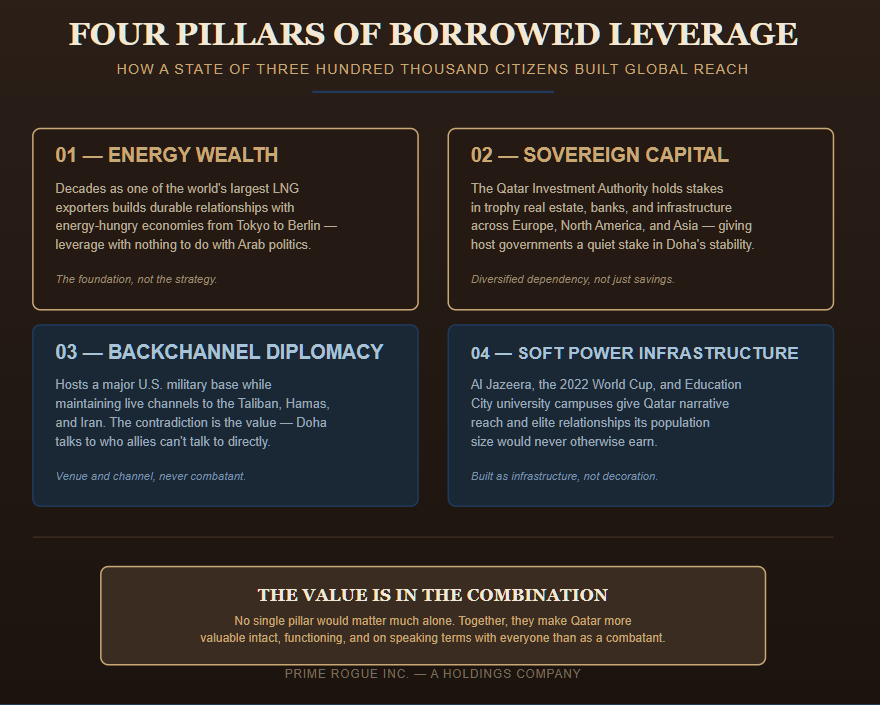
Most discussions of soft power treat it as a nice-to-have layered on top of the real foreign policy. Qatar, similar to the Vatican, built it as core infrastructure. Al Jazeera, launched in the late 1990s, gave Qatar something almost no other small state has: a globally recognized media platform capable of shaping how the rest of the world understands events across the Middle East, often in direct tension with the narratives its own larger neighbours would prefer. That’s not a public relations exercise — it’s an independent foreign policy instrument that operates on a daily news cycle, and its reach gives Qatar a seat at the narrative table that its population size would never otherwise earn.
The same logic shows up in Qatar’s relationship with international sport and culture. Hosting the 2022 FIFA World Cup was, on the surface, a sporting event; underneath, it was a multi-billion-dollar exercise in forcing the entire world’s media, corporate sponsors, and several hundred thousand visiting fans to engage directly with Qatar on Qatar’s terms, for a sustained period, in a way that no embassy or trade delegation could replicate. The same applies to its university partnerships — branch campuses of major American and European universities now operate inside Qatar’s “Education City,” which builds a different kind of relationship with the next generation of regional elites than any traditional diplomatic posting could.
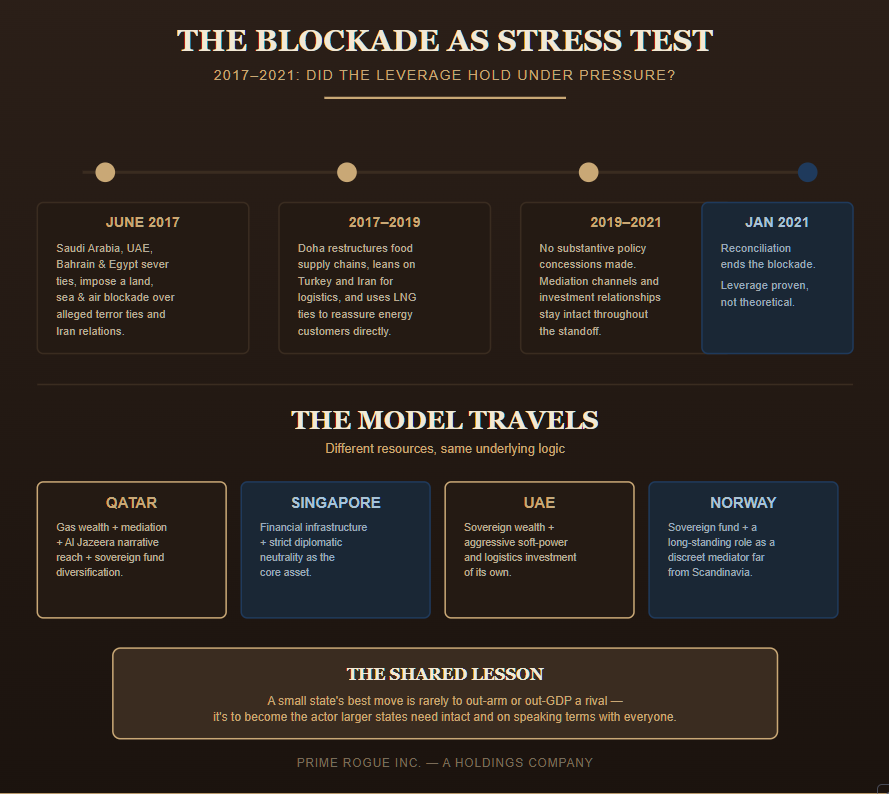
The clearest demonstration that this architecture works under pressure came in 2017, when Saudi Arabia, the UAE, Bahrain, and Egypt severed diplomatic relations with Qatar and imposed a land, sea, and air blockade, accusing Doha of supporting terrorism and maintaining ties with Iran. By the conventional power calculus, Qatar should have folded within months — it shares its only land border with one of the states blockading it, and a younger or less prepared government might well have. Instead, Qatar restructured its food supply chains, leaned on its relationship with Turkey and Iran for logistics workarounds, used its LNG relationships to reassure energy customers that supply wouldn’t be disrupted, and waited. The blockade lasted more than three years and ended in 2021 with a reconciliation that extracted no meaningful concessions from Qatar on the issues that triggered it in the first place.
That outcome mattered far beyond the immediate dispute. It demonstrated, in the most concrete way possible, that the dependency Qatar had spent two decades building — energy customers who needed Qatari gas, great powers who valued the base and the mediation channel, investment partners holding Qatari capital — was real leverage, not theoretical leverage. States considering whether to pressure Qatar in the future now have a recent, well-documented case study showing that the pressure doesn’t work, which is itself a deterrent that requires no further demonstration.
None of this should be read as a case that small-state hedging is risk-free. The same multi-alignment that gives Qatar leverage also means Doha is permanently one bad miscalculation away from alienating a patron it can’t afford to lose, and the 2017 blockade demonstrated exactly how exposed that position can become before it resolves in your favour rather than against you. Qatar’s relationships with Islamist movements that other governments — including some of its own security partners — regard as a threat remain a live source of friction that resurfaces in different forms across changes of government in Washington, London, and elsewhere. And the entire architecture depends on a level of sustained, centralized, long-horizon decision-making that is easier for a small absolute monarchy to execute consistently than it would be for a state with rotating governments and competing domestic constituencies pulling foreign policy in different directions every election cycle. The model is real, but it isn’t free, and it isn’t easily transplanted into a different kind of political system without losing the very consistency that makes it work.
What makes Qatar’s case worth studying past the Gulf-specific details is that the underlying logic isn’t actually about gas or geography. It’s a template: convert resource wealth into diversified global capital holdings rather than purely domestic spending, build a media and cultural platform that gives you narrative reach disproportionate to your population, maintain backchannels to actors your allies need but can’t approach directly, and use all three together to make yourself more valuable as a venue and intermediary than you would ever be as a combatant. Singapore built a comparable model around financial infrastructure and diplomatic neutrality rather than energy and mediation. The UAE has pursued a parallel strategy combining sovereign wealth diversification with aggressive soft-power and logistics investments of its own. Norway has run a quieter version of the same playbook through its sovereign fund and its long-standing role as a discreet mediator in conflicts far from Scandinavia.
What ties these cases together is the recognition that a small state’s best move is rarely to try to out-arm or out-GDP a larger rival. It’s to make itself the kind of actor that larger states need intact, functioning, and on speaking terms with everyone — which turns out to be a far more durable form of security than most small states ever attempt to build.
None of this requires inside access to track. Almost every layer of Qatar’s strategy leaves an open, observable trail for anyone willing to follow it across sources rather than relying on a single headline. Sovereign wealth fund disclosures, annual reports, and the regulatory filings of the companies it invests in show where Qatari capital is landing and how the portfolio shifts in response to regional tension. Diplomatic visit logs and state media readouts — even when each side frames the same meeting differently — reveal which channels are actively in use at any given moment, and a sudden flurry of visits to a particular capital is itself a signal worth noting before the substance of the meeting is ever made public. Al Jazeera’s own editorial choices, read comparatively against how the same events are covered by outlets aligned with Qatar’s regional rivals, map the boundaries of what Doha is and isn’t willing to say out loud. None of this is classified. It’s simply scattered across enough sources that nobody bothers to assemble it into a single picture — which is exactly the kind of gap an open-source approach is built to close.
Qatar’s foreign policy is frequently covered as a series of disconnected headlines — a mediation here, an investment there, a controversy over a World Cup or a media outlet’s coverage. Read individually, none of it looks like a strategy. Read together, over two decades, it’s one of the clearest examples in the contemporary world of a small state systematically converting a narrow resource advantage into durable, multidimensional leverage that has outlasted a regional blockade, multiple changes of government among its larger neighbours, and several complete cycles of the news stories that briefly made it look vulnerable. Understanding how that was built tells you more about the actual mechanics of power in the current international system than most conventional measures of military or economic size ever will.
Links to products on this page may provide Prime Rogue Inc with monetary compensation should you choose to purchase a product after clicking on such a link.
 Top 10 Times Plausible Deniability Was Canada’s Actual Foreign Policy
 The Rapid Toppling of Japan and France’s Prime Ministers: An OSINT Analysis of Causes and Foreign‑Policy Implications
 The Nation as Martyr: Serbia’s Victimhood Narrative and the Fracturing of State Identity Fractured States Series — Vol. I
 Ethiopia: Anatomy of a Fractured State — Ethnic Federalism, Civil War, and the Risk of Collapse – Fractured States Series — Vol. II



[…] to absorb. The Bank of Canada’s rate-setting decisions in the next 90 days will carry more geopolitical weight than at any point since the 2008 financial […]
[…] to Ukraine, the U.S. is moving in the opposite direction. Donald Trump’s increasingly erratic foreign policy pronouncements—ranging from NATO abandonment to outright threats of annexing Canada—have thrown […]
[…] Trump’s foreign policy playbook is about hard resets. Unlike previous administrations that tried to manage China’s rise, […]
[…] section of the playbook — politicizing clearance policy — isn’t just a bureaucratic maneuver. It’s an attack on the machinery of government itself. […]
[…] was largely received as Carlson being outrageously hyperbolic to make a point about perceived U.S. foreign policy double standards (i.e., “we defend Ukraine’s freedom but ignore Canada’s tyranny”). […]
[…] This kind of language — open talk of absorbing a democratic ally — would’ve triggered a foreign policy firestorm under any previous administration. In 2025, it drew little institutional […]
[…] decades of established diplomatic protocol, shattering the carefully maintained façade of American foreign policy rhetoric. Never before has a sitting U.S. President publicly cursed about a key ally’s […]
[…] been pulled into an emergency briefing or deployment – something’s up. Or if a cluster of foreign service staff all appear online at 2am from the same hotel, maybe an after-party intel opportunity presents […]
[…] from a post-Soviet aspirant to a competitive authoritarian regime aligned with Moscow on key foreign policy positions. It has refused to send lethal aid to Ukraine, repeatedly blocked EU and NATO decisions, […]
[…] the real danger: this isn’t some rogue faction. This is U.S. foreign policy now. JD Vance isn’t just a MAGA mascot — he’s one heartbeat away from the presidency. The […]
[…] geopolitical consequences. By contextualizing these attacks within the shifting landscape of U.S. foreign policy under Trump’s second term, we can better understand what this military campaign means—not just […]
[…] provided, and because if this thing is going to get cited in parliamentary committee hearings or foreign policy journals or—God help us—actual contingency planning documents, it should at least have […]
[…] and activist networks—spreading disinformation, weakening national identity, and ensuring that foreign interests dictate policy from within. While historically, the concept was associated with Soviet spies infiltrating Western […]
[…] However, this aid often came with strings attached, compelling recipient nations to align with U.S. foreign policy objectives. USAID’s programs were designed to integrate local economies into the global […]
[…] the evolving geopolitical landscape, growing nationalist sentiment in Panama, and a shift in U.S. foreign policy. The treaties were designed to address these concerns while ensuring the canal’s continued […]
[…] Asia by the United States, China’s Belt and Road Initiative, and Russia’s assertive foreign policy are all elements that could contribute to heightened […]
[…] in power, a U.S. strike on the Behshad would serve as one of the first major tests of Trump’s foreign policy approach in his second […]
[…] territory of the Kingdom of Denmark – self-governing in domestic affairs since 1948, but with foreign policy and defense reserved to Copenhagen (much like Greenland). The Faroese proudly manage their own […]
[…] now in his second term after the most disruptive comeback in American political history, sees his foreign policy legacy as unfinished business. During his first term, he launched the Soleimani strike, withdrew […]
[…] affairs—from education to healthcare, a system known as Home Rule—Denmark still controls foreign policy, defense, and currency. So, while Greenland’s government in its capital, Nuuk, would […]
[…] drug policy. Based on intelligence assessments, this order is likely designed to serve broader geopolitical and domestic policy […]
[…] decades, Canada has built its foreign policy, economy, and security under the assumption that the United States is a stable ally, a reliable […]
[…] Foreign policy continuity – with caveats. Under France’s constitution, foreign and defence policy falls largely within the president’s domaine réservé; thus, some analysts believe Macron can continue diplomatic initiatives. The German Marshall Fund notes that Macron’s approach to Ukraine and the “Coalition of the Willing” will likely remain intact. However, repeated cabinet reshuffles undermine partners’ confidence in France’s reliability. […]
[…] the importance of respecting Canada’s independence and signaling a potential pivot in foreign policy to reduce reliance on the United […]
[…] a few urban seats will depend on Alberta’s economic climate and whether Poilievre stumbles on foreign policy and trade. The battle for Alberta is not about whether Conservatives win—it’s about whether […]
[…] ultimatums. International bodies are enemies unless fully controllable.✔️ Narrative Supremacy: Foreign policy is performance. Strategy is subordinated to media optics, domestic political theatre, and personal […]
[…] topics, from security and diplomacy to economics and culture. As one of the top political websites, Foreign Policy features contributions from leading geopolitical thinkers and provides diverse perspectives on international […]
[…] reality. Analysts may feel pressured to produce intelligence that supports a government’s foreign policy stance rather than presenting unbiased […]
[…] war powers and military funding, presidents have historically claimed broad executive control over foreign policy. The Supreme Court has never ruled on the issue, meaning Trump—or any future isolationist […]
[…] powers in an era of resource-driven conflict. As the global supply chain fractures under the weight of geopolitical tensions, the question looms: can the West adapt quickly enough to safeguard its technological and […]
[…] also look at the influence of cultural and religious factors on geopolitical alignments. The use of geopolitics in foreign policy decision-making will be explored as […]
[…] Panama Canal became a central element of U.S. foreign policy in the region. It symbolized American technological prowess and strategic foresight. The canal […]
[…] have pledged to intensify economic sanctions against Russia and bolster defense capabilities. EU foreign policy chief Kaja Kallas and UK Foreign Minister David Lammy have discussed increasing economic pressure […]
[…] nationalist vs. globalist tension that produced the Bannon-Cohn war had not been resolved. The foreign policy tension between America First non-interventionists and hawkish interventionists had not been […]
[…] complicity through bureaucracy for decades. Plausible deniability isn’t a side effect of our foreign policy — it is the interface. We don’t pull triggers; we fund feasibility studies. We don’t stage […]
[…] geopolitical role is often framed as that of a small nation fighting for survival in a hostile region. But a closer examination reveals a far more […]
[…] and International Organizations Act, the government can grant certain immunities and privileges to foreign representatives and their staff during international conferences. For the 2025 G7, an Order in Council was issued to extend […]
[…] George W. Bush never publicly attacked Barack Obama, even when Obama dismantled key elements of Bush’s foreign policy. […]
[…] must do the same. Our foreign policy cannot continue to revolve around a declining empire that no longer commands respect. We need an […]
[…] between NATO and the U.S. under Trump’s foreign policy […]
[…] or deny. It is most often invoked pursuant to FOIA Exemption 1 (classified national defense or foreign policy information) or Exemption 7 (certain law enforcement records) when even admitting the existence or […]
[…] estimated likelihood is therefore fairly low. Yet even a small risk warrants attention: Canada’s foreign policy and economic decisions could conceivably be influenced if, say, a Cabinet minister was compromised […]
[…] the home economy may depend on, a constituency that influences how the host country’s foreign policy gets shaped, and a population that can be mobilized — through community organizations, religious […]
[…] examples illustrate how a few documents or data points in the hands of independent actors can punch far above their weight. A single ATIP release or OSINT finding can snowball into national news, parliamentary debate, or […]
[…] unpredictability of U.S. foreign policy, particularly under Trump’s second […]
[…] U.S. and allied assets.✔ Trump seeks a show of force ahead of 2024 election season to reinforce foreign policy […]
[…] drug dealers for a £500,000 ransom, bombing campaigns, cyber-attacks and seeking backing from a foreign state hostile to the UK. The operation produced a string of arrests and prosecutions, but MI5 and PSNI […]
[…] going further: if the standard for objection is “a state spends money to shape how foreigners see it,” virtually every government on earth fails that test, and several fail it far more […]
[…] was a Harvard fellow, a Brookings Institution associate, and remains a favorite among U.S. foreign policy […]
[…] leverage, and negotiation. When statecraft is reduced to memes and muscle memory, the only foreign policy left is the aesthetic kind: maps, flags, strongman declarations — the fetishization of conquest […]
[…] issued a special Privileges and Immunities Order for 2025, which extends diplomatic protections to foreign representatives and their staff during the event. Under this order and standard international practice, the Prime Minister of Japan […]
[…] steps are not completed, Canada will remain a country that cannot fight a war, enforce its own foreign policy, or defend itself without American […]