Address
304 North Cardinal St.
Dorchester Center, MA 02124
Work Hours
Monday to Friday: 7AM - 7PM
Weekend: 10AM - 5PM

Address
304 North Cardinal St.
Dorchester Center, MA 02124
Work Hours
Monday to Friday: 7AM - 7PM
Weekend: 10AM - 5PM
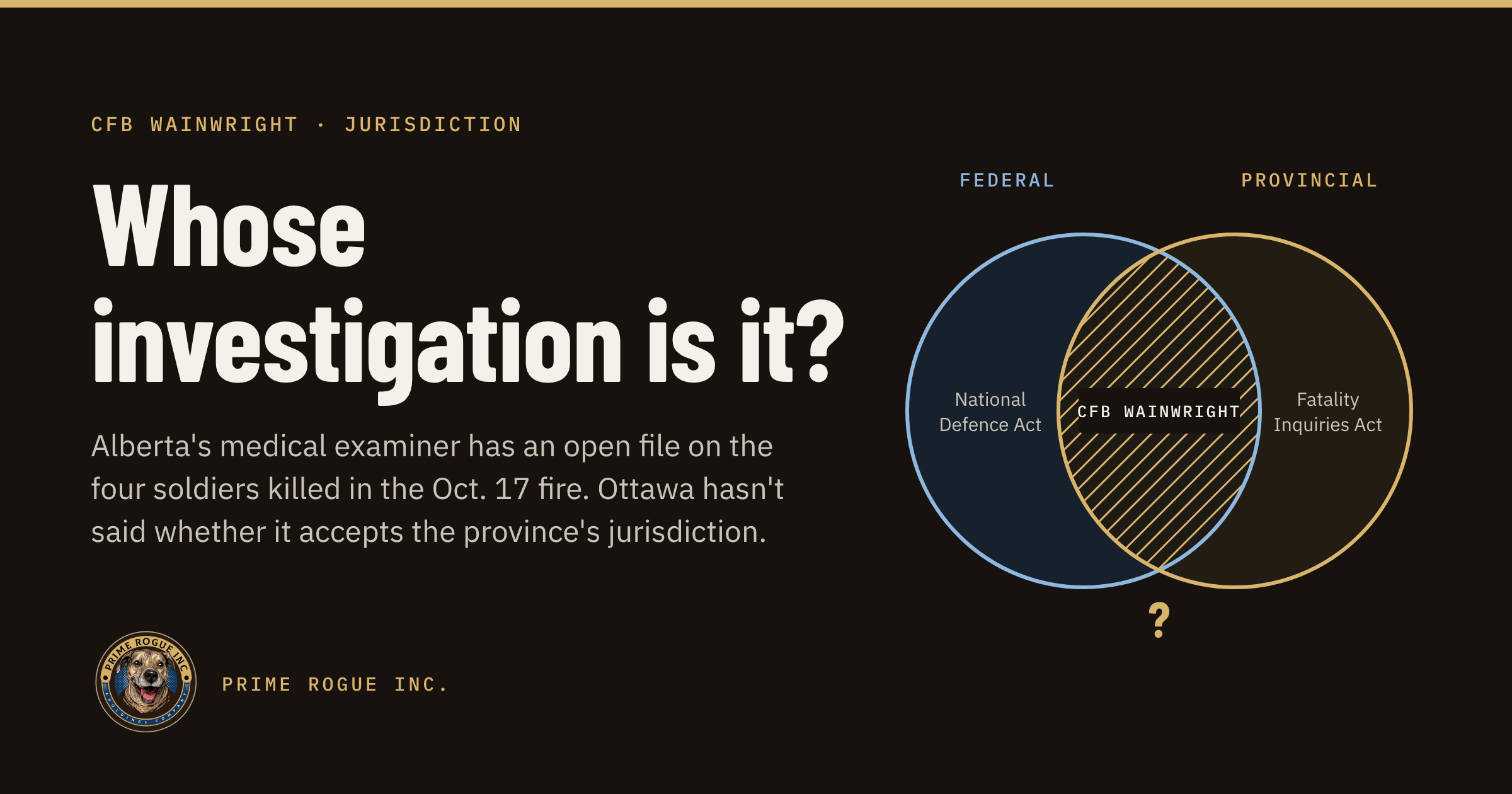
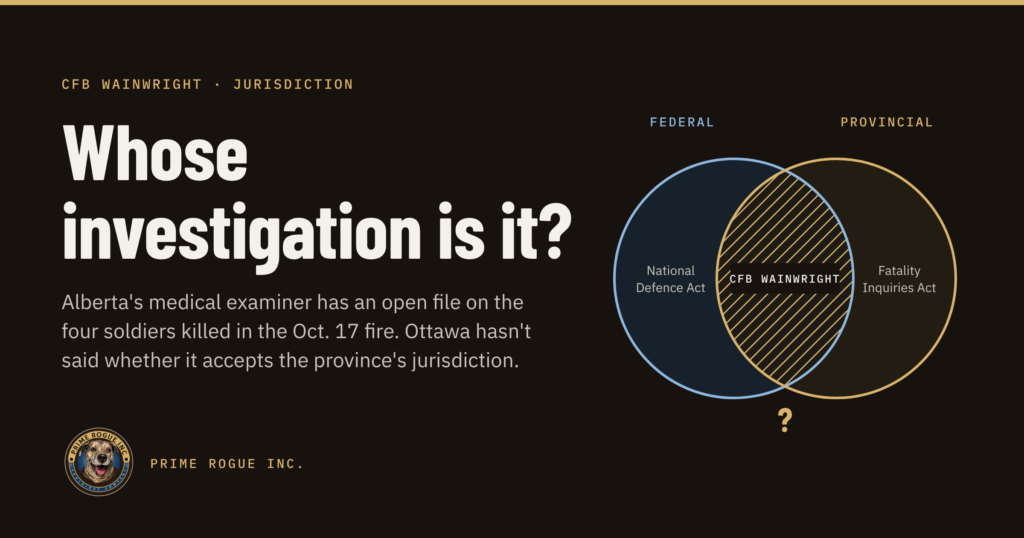
Alberta’s medical examiner is investigating the four deaths on its own file, while relying on military police co-operation to gather information. National Defence has not said whether it accepts the province’s jurisdiction.
Alberta’s Office of the Chief Medical Examiner (OCME) is conducting its own investigation into the CFB Wainwright deaths, separate from the Canadian Armed Forces, a provincial official with knowledge of the matter told Prime Rogue.
Four soldiers were killed when a fast-moving grass fire swept through a training area at the base on Oct. 17: Sgt. Morgan Wong, Pte. Shaun Farrell, Pte. Aidan Goulding and Pte. Hayden Lykkemark. Dozens more were injured. Prime Rogue is tracking developments on its CFB Wainwright fire live updates page.
The official, speaking on background, said the OCME will work co-operatively with the Canadian Forces National Investigation Service (CFNIS), the military police unit leading the federal investigation, to gather the information it needs under Alberta’s Fatality Inquiries Act.
The official said the Act applies to all deaths in Alberta, including those on Canadian Armed Forces bases, because federal and provincial legislation currently allow it. The official also noted that Alberta’s Justice Minister has the power to order a public fatality inquiry, separate from the province’s usual review process.
That places a civilian, provincial investigation alongside the military’s own. It also leaves a question National Defence has not answered: does it accept Alberta’s jurisdiction? In the only previous Alberta public fatality inquiry into a soldier’s death on a base that Prime Rogue could identify, National Defence declined to fully accept it.
Alberta’s account differs from how federal officials have described the medical examiner’s role.
On CBC’s Power & Politics, Chief of the Defence Staff Gen. Jennie Carignan listed three investigative tracks: a military board of inquiry, a technical investigation, and a civilian coroner’s investigation by the province of Alberta. CBC reported that the RCMP had been asked to assist Alberta’s medical examiner.
In an interview with CTV, Carignan described one of the investigations as “done jointly by the Canadian Forces National Investigation Service,” with military police, Alberta’s chief medical examiner and the RCMP all part of it. Prime Minister Mark Carney told the House of Commons that the CFNIS is leading the investigation with RCMP support. The Globe and Mail reported that the OCME is working alongside others on the probe.
Alberta now says plainly that the OCME’s investigation is separate from the military’s. The RCMP sits on both sides: Alberta law makes every RCMP officer a medical examiner’s investigator, so the same Mounties can serve both the military police and the OCME.
What Alberta’s statement leaves open is how much of the medical examiner’s evidence comes to it directly, and how much through military police. That matters because the CFNIS is a military unit investigating a military incident. Maj.-Gen. Wade Rutland has said range control knew there was a fire on the base for several hours, a timeline Prime Rogue has examined in detail. Whether a civilian investigator can test that account independently depends on what it can see for itself.
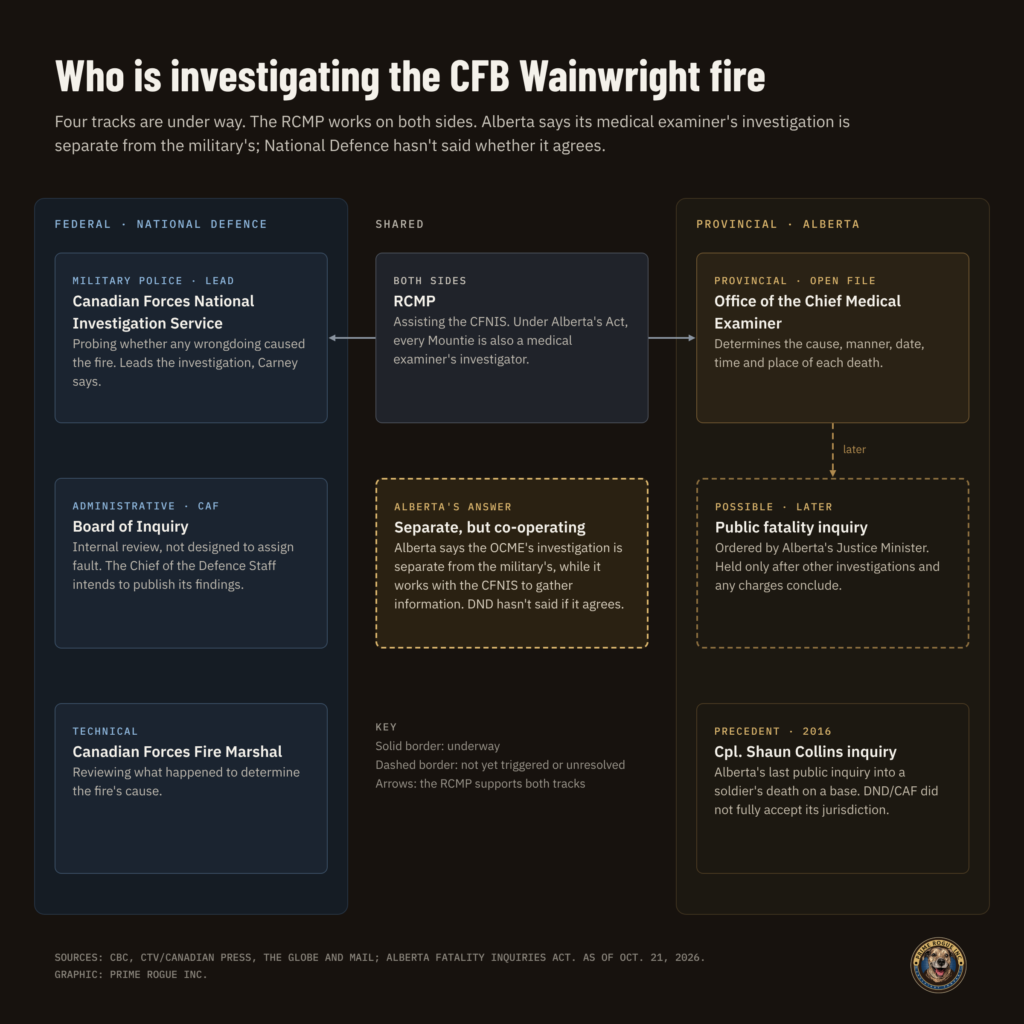
Alberta’s Fatality Inquiries Act contains no exemption for federal land. It requires deaths from violence or accident, and deaths resulting from a person’s employment, to be reported to a medical examiner. It lets the Chief Medical Examiner direct an investigation into any death at any place in the province.
The Act also sets out what the OCME must establish. For each death, a medical examiner determines the cause and manner of death, along with the date, time and place it occurred. National Defence has not publicly said where or when each of the four soldiers was pronounced dead.
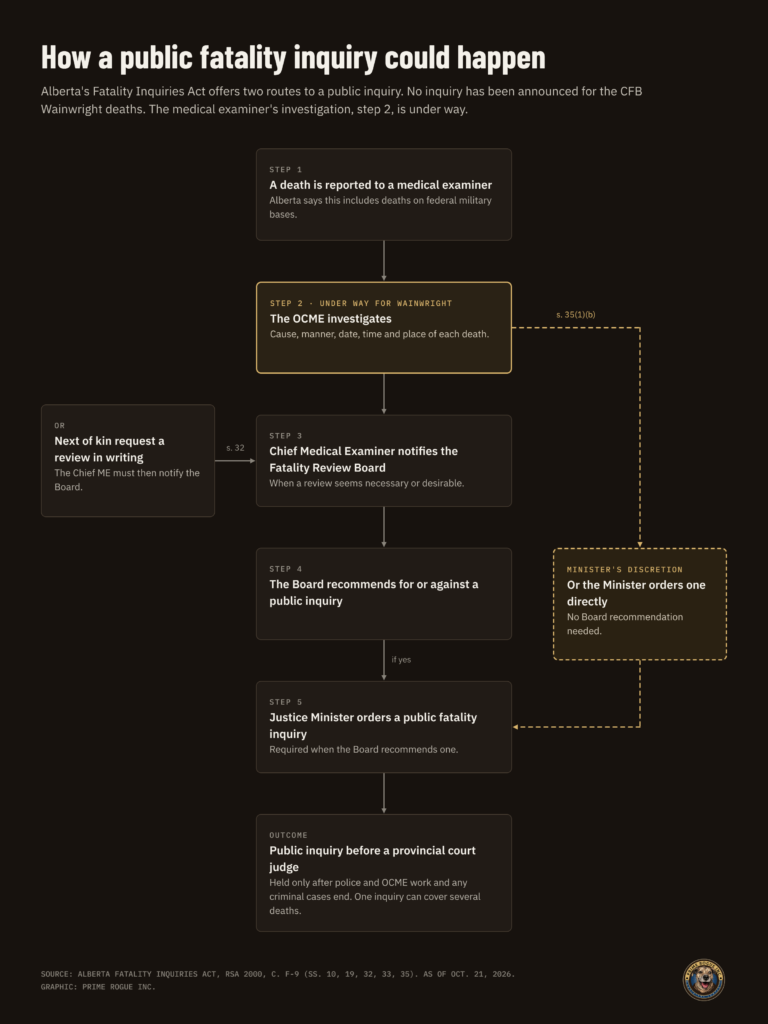
A public fatality inquiry, held before a provincial court judge, can come about two ways:
The provincial official said any inquiry would take place only after other investigations, including those by the military and police, are complete. In practice that can take years. A July 2025 provincial schedule still listed as “to be scheduled” the inquiry into the death of Clayton Crawford, who was shot by RCMP in 2018.
In 2011, Cpl. Shaun Collins of 1st Battalion, Princess Patricia’s Canadian Light Infantry, died in a military police cell at Edmonton Garrison. Alberta held a public fatality inquiry into his death, which The Globe and Mail called the first of its kind in the province.
In her 2016 report, Provincial Court Judge Jody Moher wrote that National Defence and the Canadian Armed Forces took part only in establishing the circumstances of Collins’s death. She wrote that they “refused to fully accede to the jurisdiction of the Inquiry.” She contrasted that with other federal departments, including Correctional Service Canada, which had fully participated in Alberta fatality inquiries.
That history gives weight to Alberta’s position that its law applies on CAF bases. If the province orders an inquiry into the Wainwright deaths, whether National Defence would produce witnesses and documents is an open question.
The military’s main tool for examining the fire is a board of inquiry. Carignan has said she intends to make its findings public. Boards of inquiry are internal administrative reviews, though, and are not designed to assign fault.
Retired colonel and military lawyer Michel Drapeau has called for a coroner’s inquest, arguing National Defence cannot impartially investigate itself. Carney has said he trusts the military to do so. No family of the four soldiers has publicly asked for a provincial inquiry.
Defence Minister David McGuinty said Tuesday that 33 CAF members remained in hospital, down from 39 taken there after the fire.
Prime Rogue has put the following questions to the OCME, the Alberta Justice Minister’s office and National Defence:
This story will be updated as responses arrive.
Checking the explosion claim against seismic data
CFB Wainwright fire: live updates
DND’s account of the fire contradicts government records
DND said the fire “ignited” at 4 p.m. It was known for hours
Satellite data shows fire before the reported explosion
The exercise fire, the gas well and the satellite record
Gas wells were not involved in the fire
 DND said the Wainwright fire “ignited” at 4 p.m. The military now says it was known for hours
 Every Warning Was On The Record: The CFB Wainwright Deaths Were Highly Likely Preventable
 Satellites saw fire on CFB Wainwright range hours before DND says it ignited
 How we found the 82 km/h CFB Wainwright gust: a step-by-step guide to Environment Canada’s wind data


[…] hospitals. Saskatchewan Premier Scott Moe said his province “has deployed resources to Alberta and is ready to provide more if required.” He did not say what was […]
[…] be made public. Alberta’s Office of the Chief Medical Examiner is also examining the deaths, and the province has asserted its own jurisdiction. Typical Boards of Inquiry take nine to twelve months; officials have said this one will take as […]