Address
304 North Cardinal St.
Dorchester Center, MA 02124
Work Hours
Monday to Friday: 7AM - 7PM
Weekend: 10AM - 5PM

Address
304 North Cardinal St.
Dorchester Center, MA 02124
Work Hours
Monday to Friday: 7AM - 7PM
Weekend: 10AM - 5PM
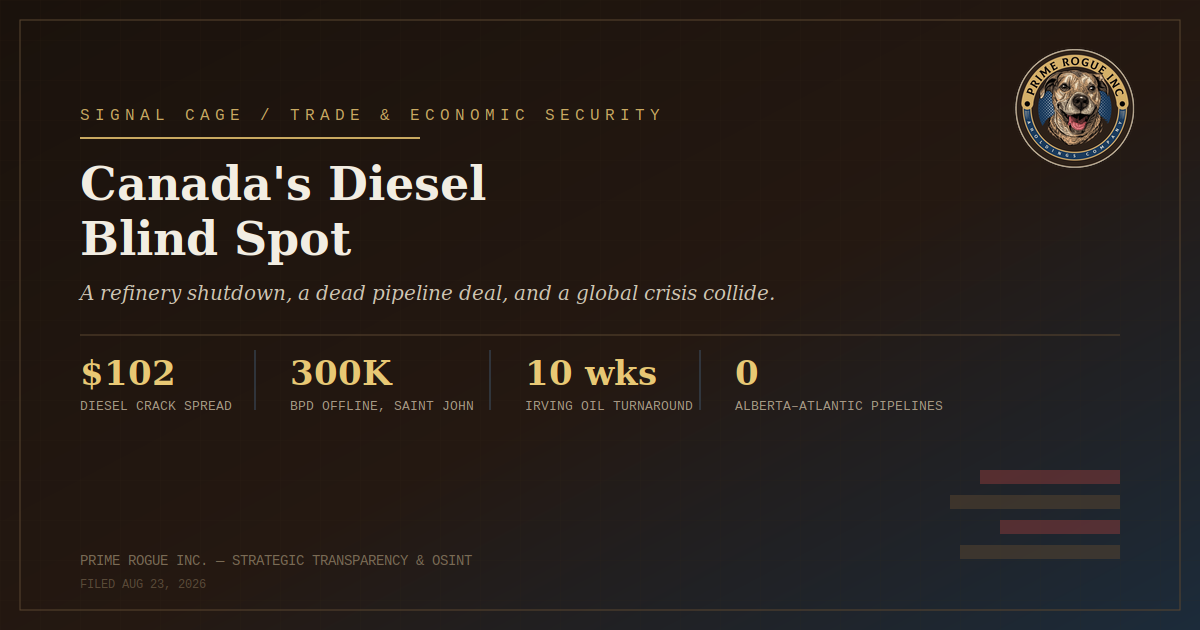
Canada’s largest refinery goes offline for ten weeks starting in September — just as the pipeline deal that could have eased the crisis got caught in the collapse of US-Canada trade talks.
Kevin J.S. Duska Jr. • SIGNAL CAGE / PRIME ROGUE INC. • FILED: AUG 23, 2026 • READ TIME: ~6 MIN
The global diesel market is having its worst crisis in a generation, and almost none of the coverage has connected it to what just happened forty-eight hours ago in Ottawa. Canada has a direct, specific, and almost entirely unreported exposure to this crisis — one that intersects with the US-Canada trade talks collapse in a way nobody else is reporting.
The spread has decoupled from crude prices entirely. Crude oil itself has stayed relatively contained, but diesel is trading at nearly double the price of the crude used to make it — a ratio with no recent precedent. The cause isn’t a crude shortage. It’s a refining shortage: an estimated 7 to 8 million barrels a day of global refining capacity is currently offline, driven by Ukrainian strikes on Russian refineries, a resulting Russian export ban, and lingering disruption from the US-Iran conflict around the Strait of Hormuz. US distillate inventories — the category that includes diesel and heating oil — sat at roughly 107.1 million barrels in early August, the lowest level for that time of year since 1996.
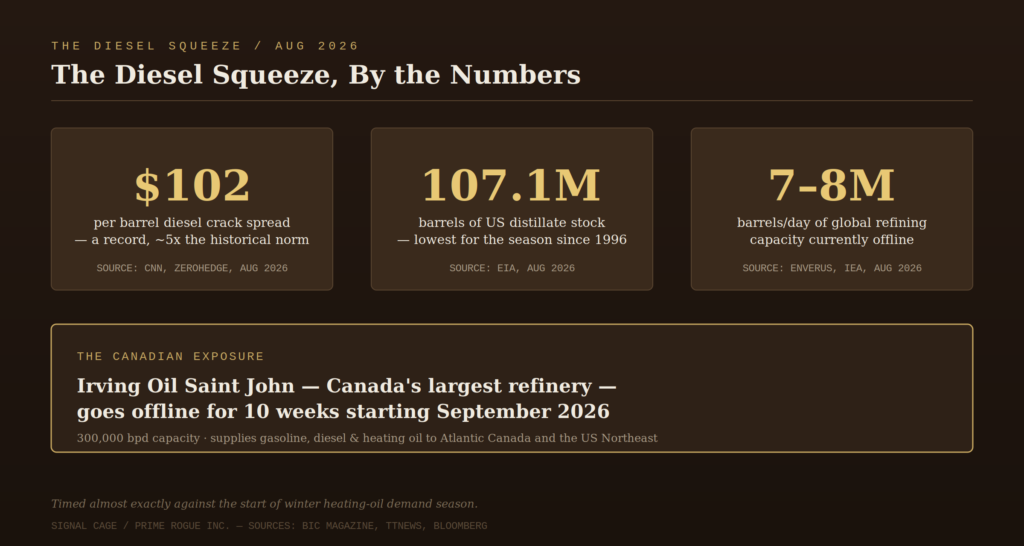
Canada’s Eastern refining capacity has been shrinking for years, leaving Atlantic Canada structurally exposed to exactly the kind of global refining crisis now underway.
The Come By Chance refinery in Newfoundland shut down in 2020 and was converted into a much smaller renewable-diesel operation rather than restored to full conventional output. Earlier closures of Shell’s Montreal and Dartmouth plants, along with capacity at Oakville, further thinned Eastern Canada’s refining base. What’s left is concentrated almost entirely in one facility.
Irving Oil’s Saint John, New Brunswick refinery — Canada’s largest at roughly 300,000 barrels per day — is shutting down for a two-month maintenance turnaround from early September to mid-November 2026, more than double its typical 30-to-35-day maintenance window.
The Saint John refinery is the primary fuel lifeline for both Atlantic Canada and the northeastern United States, supplying gasoline, diesel, and the heating oil that Maine and Massachusetts households depend on through the winter. The extended shutdown lands directly at the start of seasonal heating-oil demand — a timing collision that, during far shorter turnarounds in 2024 and 2025, already produced temporary regional price spikes. This year’s outage is roughly twice as long, against a market already at record tightness before the plant even goes offline.
No direct pipeline connects Alberta’s oil sands to Atlantic Canada, so Eastern Canadian refineries like Irving Oil import virtually all of their crude by tanker rather than by domestic pipeline.
This isn’t an oversight — it’s decades of infrastructure economics. It has historically been cheaper for Saint John to import light crude from the Middle East by tanker than to build or route pipeline capacity across the country from Alberta. The result is a structural irony: Canada is a top-five global oil producer, yet its own Atlantic provinces sit exposed to the same seaborne supply shocks as countries with no oil production at all.
Alberta’s oil sands sit landlocked relative to Eastern Canada. Alberta crude flows south into the US and west toward the Pacific — but not east, across the country, to the one Canadian region now most exposed to a global refined-product shortage.
President Trump floated reviving the Keystone XL pipeline as part of the tentative US-Canada trade agreement on Tuesday, August 18, 2026 — a proposal that stalled when Prime Minister Mark Carney suspended trade negotiations three days later.
The timing is not incidental. US Gulf Coast refiners, Valero, Marathon Petroleum, and Phillips 66 among them, are specifically positioned to capture diesel-refining margin from heavier crude inputs, the kind Keystone-style pipeline capacity would have delivered from Alberta. Market analysts are already discussing the existing Bridger/South Bow line, informally nicknamed “don’t call it Keystone XL,” as one of three live pipeline options Alberta producers are weighing alongside a Pacific-bound route and an East Coast line proposed by Ontario Premier Doug Ford. None of the three moves forward without exactly the kind of stable, multi-year bilateral confidence that a government suspending talks and threatening dollar-for-dollar retaliation does not project.
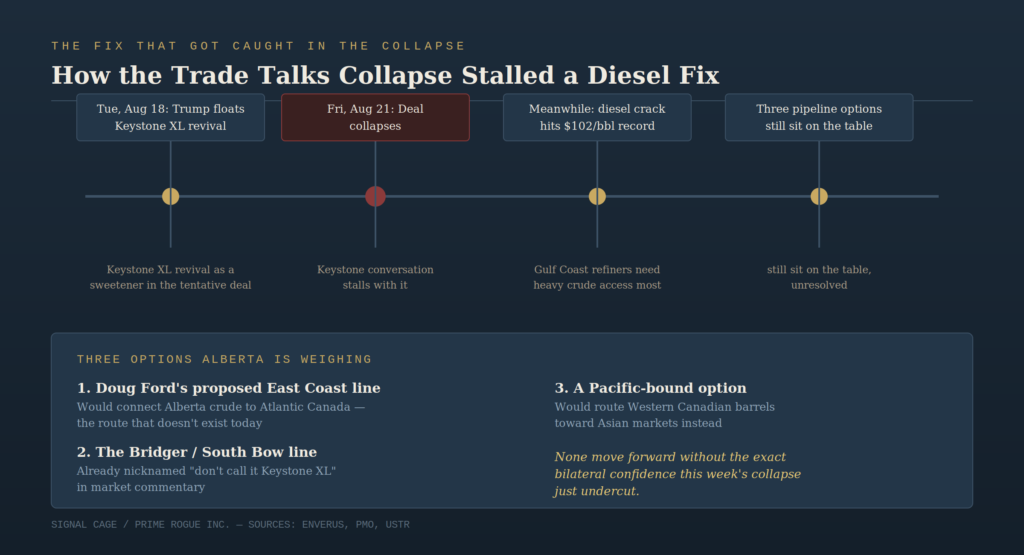
Energy was formally exempted from the new Section 338 tariffs, so crude keeps flowing tariff-free in both directions. But exemption from tariffs isn’t insulation from trade-war uncertainty. Capital doesn’t commit to decade-long pipeline economics against a backdrop of four reversals in four days — which means the collapse has a real, if second-order, energy security cost beyond the headline politics.
Canadian farmers and trucking operators should expect elevated diesel prices through at least Q1 2027, compounding fuel costs that are already stacked on higher fertilizer input costs for the 2026 growing season.
Diesel is more expensive relative to crude because global refining capacity — not crude supply — is the current bottleneck. An estimated 7 to 8 million barrels a day of refining capacity is offline due to strikes on Russian refineries and lingering Middle East conflict effects, and diesel-specific supply has been hit harder than gasoline because Middle Eastern refineries that normally export distillate fuel westward have been disproportionately affected.
No. Irving Oil’s Saint John refinery is undergoing a scheduled maintenance turnaround from early September to mid-November 2026 — a temporary but unusually long shutdown, roughly double the plant’s typical maintenance window.
No. Keystone XL’s revival was floated by President Trump as part of a tentative US-Canada trade agreement on August 18, 2026, but that broader deal collapsed on August 21 when Canada suspended negotiations, leaving the pipeline proposal unresolved.
The diesel crack spread is a global story. Canada’s version of it is a domestic policy story hiding inside a global one — a refining base that’s been quietly shrinking for years, a single point of failure now going offline for ten weeks at the worst possible moment, and a pipeline fix that just became collateral damage in a trade war neither side wanted to escalate this far.
 Why Is Diesel More Expensive Than Gasoline Right Now?
 The Hormuz Cycle, Cycle Six: A Seizure, a Near-Deal, and the Toll Authority Nobody Recognizes
 SITREP 001: India Has 60 Days of Oil Left. Modi Was in Israel 48 Hours Before the Iran War.
 The Hormuz Cycle: Why the Iran War Keeps Whipsawing Oil Markets



[…] Why Refining Capacity, Not Crude, Is the Real Story […]
[…] result of the army’s check of the oil and gas infrastructure, which Rutland described the day after the […]