Address
304 North Cardinal St.
Dorchester Center, MA 02124
Work Hours
Monday to Friday: 7AM - 7PM
Weekend: 10AM - 5PM

Address
304 North Cardinal St.
Dorchester Center, MA 02124
Work Hours
Monday to Friday: 7AM - 7PM
Weekend: 10AM - 5PM
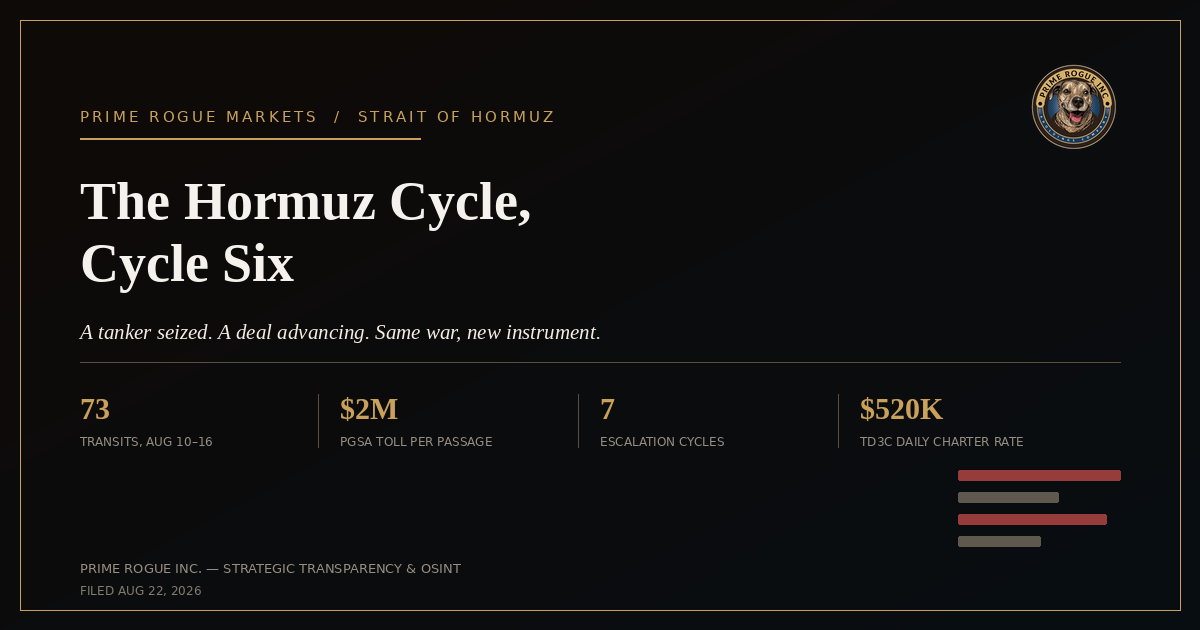
Partially. Weekly transits fell to 73 between August 10–16, 2026, down from 91 the week before, as shippers route around a still-contested waterway. On August 20, Iran seized the Liberia-flagged tanker Amara near Qeshm Island — the first confirmed Iranian seizure since two container ships were taken on June 22. At the same time, Iran and Oman are reportedly closing in on a managed shipping-route deal. Both things are true simultaneously, which is itself the finding.
Because neither side’s core demand has moved since April: Iran wants the U.S. naval blockade lifted, sanctions relief, and war-damage compensation; Washington wants unconditional reopening. Five-plus cycles of escalate-negotiate-collapse later, that stalemate hasn’t broken — it’s just added new instruments, like Iran’s sanctioned toll authority charging shippers up to $2 million per passage.
Our August 10 read of the Hormuz Cycle identified five completed loops of escalation, mediation, and collapse since the war began on February 28, 2026, and flagged a set of falsifiable markers to watch instead of reacting to each headline as a discrete surprise. Twelve days on, here’s what actually moved.
Preliminary data show 73 transits through the strait between August 10 and 16, down from 91 the previous week, with non-Iranian traffic continuing to flow in both directions — at least 22 vessels entered the Gulf and 21 departed over that span, with crude tankers accounting for most movements. Tehran’s targeting of Hormuz users and Washington’s blockade of Iranian ports continue to suppress volumes, and conflicting statements from both capitals are making a near-term breakthrough increasingly unlikely, even as a small core group of operators keeps moving cargo.
A diplomatic track is genuinely advancing. Iran and Oman appear to be edging closer to a deal on how the Strait of Hormuz should be managed, agreeing on routes through the waterway that has proved the major stumbling block in nearly six months of talks between Tehran and Washington. This is the Oman-brokered “managed shipping route” negotiation our prior piece was already tracking as of early August — it hasn’t collapsed yet, which by cycle standards is notable in itself.
And five days ago, the cycle produced its first confirmed seizure since June. A Liberia-flagged tanker, the Amara (IMO 9333280), was held stationary near Qeshm Island for a second consecutive day as of August 20 — a pattern consistent with an ongoing Iranian seizure, the first confirmed since two container ships were taken on June 22. It’s a genuinely new data point, not a repeat of an old one, and it lands in the same week as the Oman progress — escalation and negotiation running on parallel tracks rather than in the strict sequence our original framework described. That’s worth flagging as a structural update to the model, not just a footnote.
The toll authority nobody recognizes is still operating. Iran’s Persian Gulf Strait Authority (PGSA), founded May 5, 2026 as a self-declared regulatory body over Hormuz transit, has continued functioning despite a U.S. Treasury sanctions designation naming it a renewed IRGC revenue-extraction vehicle. Some shipowners have reportedly paid the PGSA’s fee — reported as high as $2 million per passage, payable in Bitcoin or yuan — rather than risk transit without it. The International Maritime Organization has called toll collection through the strait unacceptable under international law; Iran is charging it anyway, and apparently collecting.
Displaced volume is going somewhere, and that somewhere is getting expensive. Cargo is being rerouted through Fujairah, Khor Fakkan, Oman, and the Jeddah land bridge, while DP World accelerates development of Fujairah facilities specifically designed to bypass the strait, and high-risk shadow-fleet operators are capitalizing on a shortage of shipowners willing to transit Hormuz directly. Spot tanker rates continue to surge across both VLCC and suezmax markets, with the strongest gains on trades exposed to Hormuz and disrupted crude flows — Middle East Gulf-to-China earnings are now above $520,000 per day, with Oman-China rates also strengthening as ship-to-ship transfer activity increases off Oman.
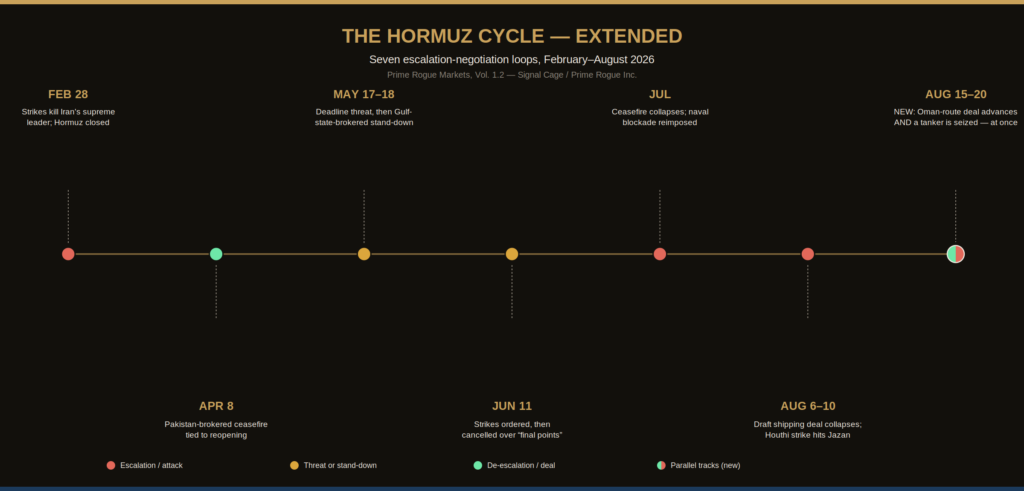
Our confirming/disconfirming signals from August 10 still hold up as a scorecard. Running the last twelve days against them:
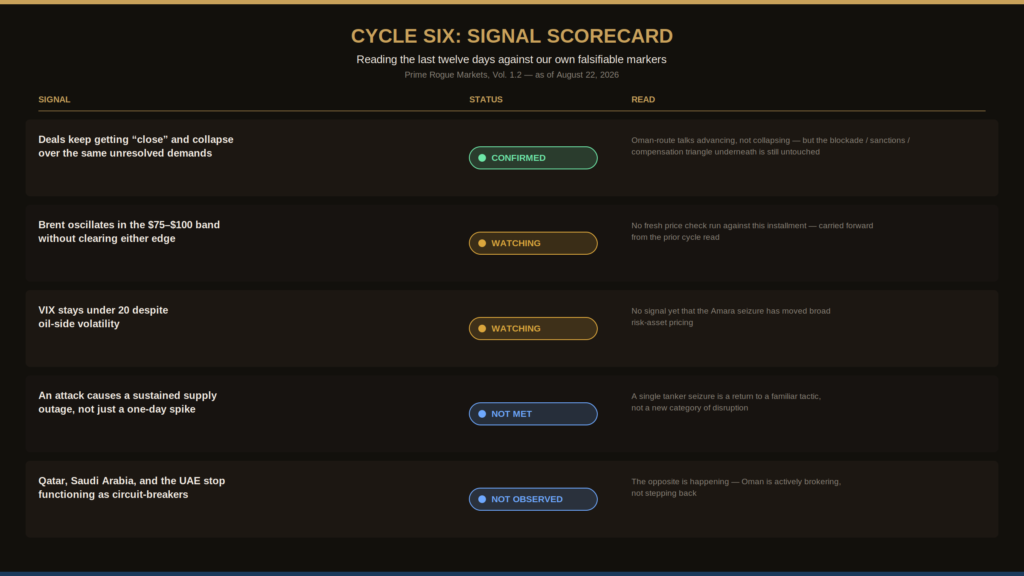
The honest read: cycle six looks like continuation with an added instrument (the PGSA toll regime), not a break in either direction. The falsifiable-marker approach exists precisely so a single seizure doesn’t get overread as a new war and a single round of Oman talks doesn’t get overread as peace.
There’s a structural parallel here worth drawing explicitly, because it says something about how states actually use — or withhold — the leverage they hold.
Iran’s approach to Hormuz has been to institutionalize its leverage in public: stand up a named authority, publish a toll schedule, post updates on X, dare Washington and the IMO to call it illegitimate while collecting fees anyway. It’s a fait accompli strategy — leverage exercised loudly, in the open, specifically so its legitimacy becomes a fact on the ground rather than a negotiating position.
Compare that to what we found when we mapped the Carney-Trump tariff collapse three weeks ago: Canada holds a structurally comparable card — potash, where it controls roughly the same kind of chokepoint position over U.S. agricultural input costs that Iran holds over Gulf energy exports — and has done the opposite of Iran’s play. No public toll, no named authority, no acknowledgment the leverage exists at all, even as Ottawa matched Washington’s tariffs dollar for dollar on everything else. Deterrence-by-silence instead of deterrence-by-fait-accompli.
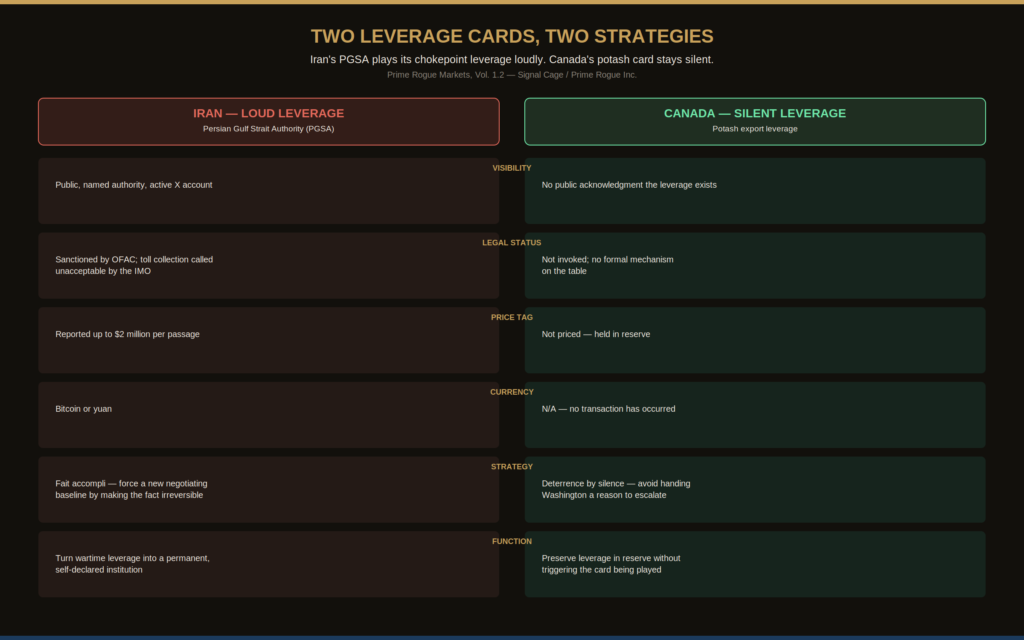
Both are rational strategies for the state deploying them. Iran’s is loud because ambiguity would let Washington and the IMO simply deny the PGSA exists; Canada’s is quiet, on this and CUSMA, because loudness would hand Washington a justification to escalate a lever Ottawa would rather hold in reserve. The lesson for reading either story isn’t “which country is right” — it’s that the presence or absence of public leverage-signaling is itself information, and coverage that only tracks headline announcements will systematically miss the quiet half of that pattern.
It’s worth remembering that Cycle One’s opening move — the February 28 strikes that killed Iran’s supreme leader and triggered the strait’s closure — was a joint U.S.-Israeli operation, and every cycle since has run alongside a parallel information campaign defending it. That’s not a side note to the trade story; state messaging operations are their own infrastructure, funded and staffed the same way a naval blockade is.
We went deep on exactly this apparatus, on the Israeli side specifically, in What Is Hasbara? — including the linguistic tell at the center of it: Hebrew already has an ordinary word for propaganda, ta’amula (תעמולה), and the state’s own communications apparatus is named something else entirely. The piece isn’t an argument that Israel is uniquely propagandistic — it explicitly isn’t, and draws the same comparison to Washington’s USAGM, Moscow’s RT, and Beijing’s CGTN. But it’s directly relevant here: every state actor with skin in the Hormuz Cycle, Tehran, Washington, Jerusalem, is running a public-narrative operation in parallel with the military and economic ones, and reading the trade and shipping data in isolation from the messaging layer means missing half of why each side’s public position moves the way it does.
The PGSA is a self-declared Iranian government body, founded May 5, 2026, that claims regulatory authority over transit through the Strait of Hormuz. The U.S. Treasury’s Office of Foreign Assets Control sanctioned it as an IRGC revenue vehicle. It has reportedly collected transit fees as high as $2 million per vessel, payable in Bitcoin or yuan.
Yes. The Liberia-flagged tanker Amara was held near Qeshm Island in the Strait of Hormuz starting around August 19–20, 2026 — the first confirmed Iranian seizure since two container ships were taken on June 22, 2026.
As of mid-August 2026, Iran and Oman were reported to be nearing agreement on managed shipping routes through the strait — the same negotiating track this series has followed since early August — though the underlying U.S.-Iran demands (blockade, sanctions, compensation) remain unresolved.
Weekly transits fell to 73 between August 10–16, 2026, down from 91 the prior week, according to Lloyd’s List Intelligence. That’s a snapshot within a longer decline that has run since the war began in late February.
Same standard as the last installment: no trade calls, no price targets. This is a tracking exercise, not a forecast — the value is in the falsifiable markers, not in claiming to know which way cycle seven breaks. We’ll keep this cadence tied to material developments rather than forcing a post on a fixed schedule, and the same disclaimer below applies to everything in this series.
This is intelligence analysis, not financial advice. Nothing in this piece is a recommendation to buy, sell, or hold any security, commodity, or currency. Prime Rogue applies open-source intelligence methodology to markets; we are not licensed investment or financial advisors, and this content should be treated as one input into your own research, not a substitute for it.
— Prime Rogue Inc. / Signal Cage
 The Hormuz Cycle, Cycle Seven: Strikes, Blockade Attrition, and the Seven-Day Plan Trump Rejected
 The Hormuz Cycle: Why the Iran War Keeps Whipsawing Oil Markets
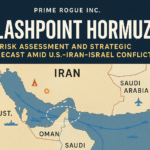 Flashpoint Hormuz: Risk Assessment and Strategic Forecast Amid U.S.-Iran-Israel Conflict
 Canada’s Diesel Blind Spot: How the Irving Oil Shutdown, a Dead Pipeline Deal, and a Global Refining Crisis Collided



[…] Iran has previously seized oil tankers and harassed U.S. naval vessels in the Persian Gulf. […]
[…] attempted Iranian blockade of the Strait of Hormuz, threatening nearly a third of the world’s oil […]
[…] Netanyahu continue to leverage Israel’s national security as a tool for political survival? The toll this strategy is taking on Israel’s international standing, internal unity, and ethical integrity is becoming increasingly clear. If […]
[…] Bajoghli, an Iran scholar at Johns Hopkins, named it directly in her response to the cable: Israel’s decades-long objective has been “the fragmentation of Iran” and “state collapse.” She identified the mechanism clearly. “One of the ways of […]
[…] Iran intervention and Israel support divide conservative factions […]
[…] (A) Israel continues solo strikes: In this case, the conflict might remain somewhat contained. Iran will retaliate against Israel and through proxies, but may hold back from directly attacking U.S. assets to avoid giving […]
[…] “accidentally” fired two Exocet missiles at the USS Stark, an American frigate on patrol in the Persian Gulf. Both hit. One detonated. 37 U.S. sailors were killed. Iraq never admitted to doing it on […]
[…] offline, driven by Ukrainian strikes on Russian refineries, a resulting Russian export ban, and lingering disruption from the US-Iran conflict around the Strait of Hormuz. US distillate inventories — the category that includes diesel and heating oil — sat at roughly […]
[…] — the Strait of Hormuz. Any disruption to the strait’s 21 million barrels per day of oil transit sends crude well past $100 and triggers a global economic shock. Gulf state bypass capacity […]
[…] Cycle Six installment left off on August 22, 2026 with a tanker seizure, an advancing Oman-brokered shipping deal, and […]
[…] ceasefire talks, but it comes with a critical precondition: Ukraine must halt strikes on Russian oil and gas infrastructure in […]
[…] openly objected to “a former Israeli defense ministry employee” managing U.S. policy on Israel and Iran. For critics, the issue was not a smoking gun of espionage, but a pattern: a hard-line pro-Israel […]
[…] feed moves at the speed of the signal, and the signal, right now, is the ultimatum clock and the oil price ticker and the Strait of Hormuz map with the little ship icons frozen in […]