Address
304 North Cardinal St.
Dorchester Center, MA 02124
Work Hours
Monday to Friday: 7AM - 7PM
Weekend: 10AM - 5PM

Address
304 North Cardinal St.
Dorchester Center, MA 02124
Work Hours
Monday to Friday: 7AM - 7PM
Weekend: 10AM - 5PM
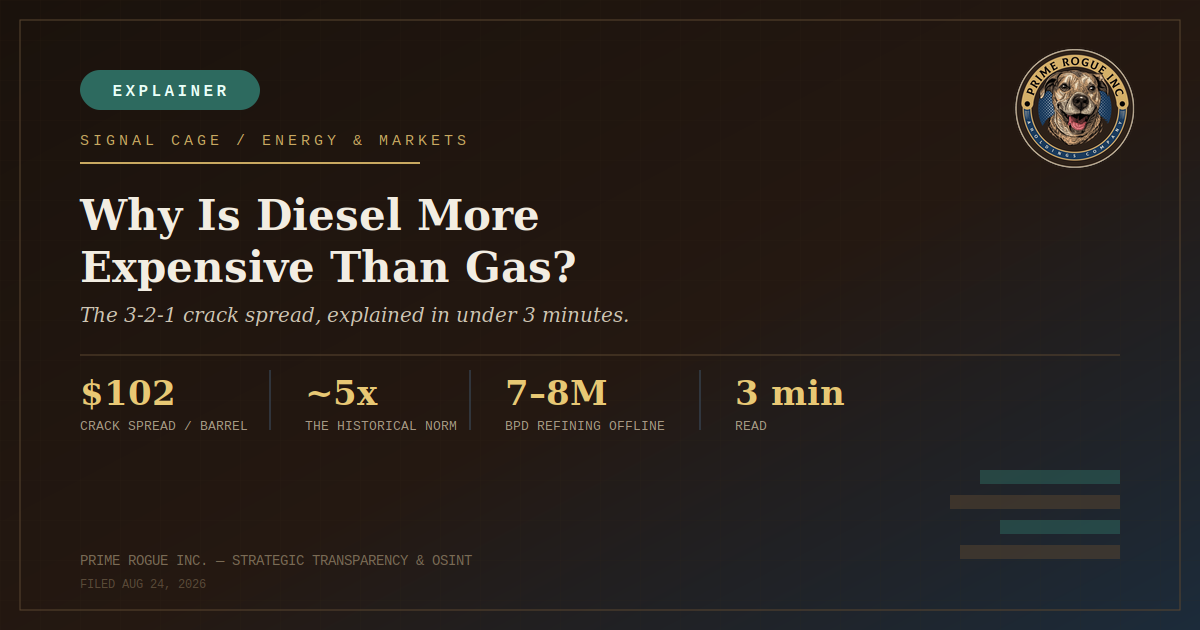
Diesel is more expensive than gasoline right now because global refining capacity — not crude oil supply — is the bottleneck, and refiners are converting crude into diesel at the lowest rate relative to demand in decades.
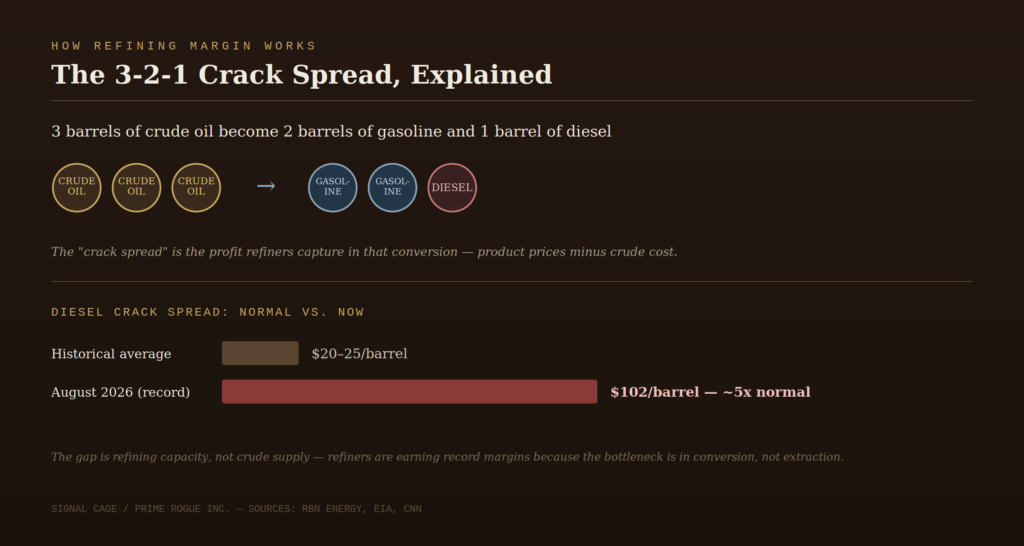
Crude oil prices have stayed relatively contained through 2026. Diesel prices have not. The gap between what refiners pay for crude and what they charge for finished diesel — called the crack spread — hit a record $102 per barrel in August 2026, roughly five times the $20-to-$25 historical average. That gap is the whole story.
The crack spread is the profit margin a refinery earns converting crude oil into finished fuel, calculated as the price of the refined product minus the price of the crude oil used to make it.
Refiners commonly measure this using the “3-2-1 crack spread”: three barrels of crude oil in, converted into roughly two barrels of gasoline and one barrel of diesel out. A wider spread means refiners are earning more per barrel processed — which is exactly what’s happening now, and it’s a warning sign for supply, not a sign of healthy demand.
An estimated 7 to 8 million barrels a day of global refining capacity is currently offline, driven by Ukrainian strikes on Russian refineries, a resulting Russian export ban, and lingering disruption from the US-Iran conflict around the Strait of Hormuz.
Diesel is hit harder than gasoline in this kind of disruption because Middle Eastern refineries normally export large volumes of diesel-equivalent distillate fuel westward to Europe and beyond. When that flow is disrupted, there’s no quick substitute — building new refining capacity takes years, not weeks. US distillate inventories sat at roughly 107.1 million barrels in early August 2026, the lowest level for that time of year since 1996.
That story — including how a since-collapsed Keystone XL pipeline revival ties directly into it — is covered in full in Canada’s Diesel Blind Spot, which also traces the connection back to this month’s US-Canada trade talks collapse.
No. Crude oil supply has remained relatively stable through 2026. The shortage is in refining capacity — the ability to convert crude into finished diesel — not in the crude itself.
Analysts don’t expect a quick normalization. Refining capacity lost to strikes and conflict-related disruption takes years to rebuild, and diesel inventories were already at multi-decade lows before the current disruptions began, leaving little buffer.
Canada faces a compounding, regional version of this crisis: Eastern Canada’s refining capacity has shrunk for years, its largest refinery is about to go offline for an extended maintenance window, and no pipeline exists to move Western Canadian crude east to help. See Canada’s Diesel Blind Spot for the full breakdown.
 Canada’s Diesel Blind Spot: How the Irving Oil Shutdown, a Dead Pipeline Deal, and a Global Refining Crisis Collided
 The Hormuz Cycle: Why the Iran War Keeps Whipsawing Oil Markets
 The Hormuz Cycle, Cycle Six: A Seizure, a Near-Deal, and the Toll Authority Nobody Recognizes
 What Is Arbitrage? Why It’s Profitable — Markets, Crypto, Sports



[…] Why is diesel more expensive than gasoline right now? […]
[…] estimate gasoline and diesel prices could rise by 10-25 cents per gallon in affected […]