Address
304 North Cardinal St.
Dorchester Center, MA 02124
Work Hours
Monday to Friday: 7AM - 7PM
Weekend: 10AM - 5PM

Address
304 North Cardinal St.
Dorchester Center, MA 02124
Work Hours
Monday to Friday: 7AM - 7PM
Weekend: 10AM - 5PM
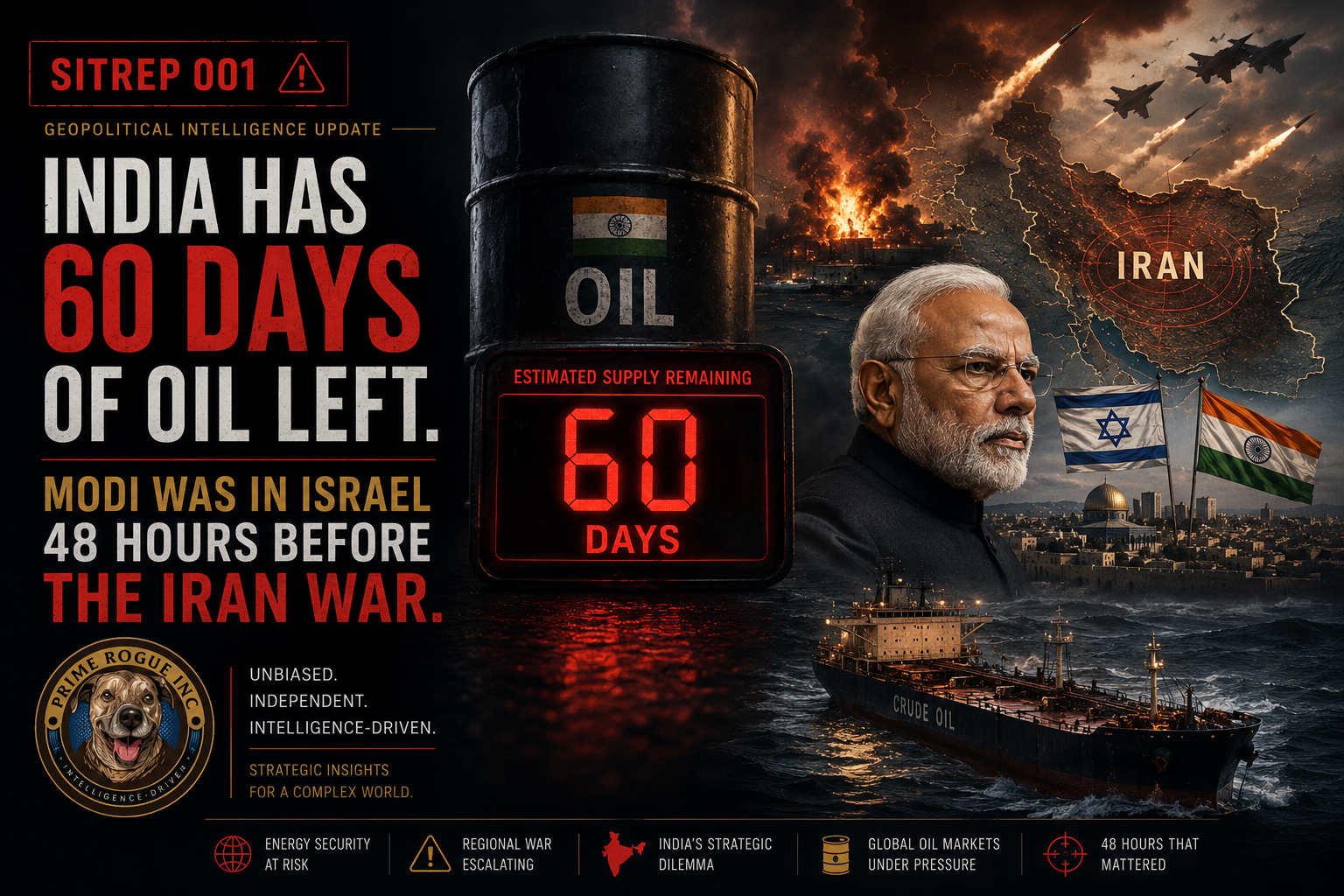
At 12:34 PM Indian Standard Time on May 11, 2026 — 1:04 AM Mountain Standard Time — India’s Defence Minister Rajnath Singh chaired the fifth meeting of the Informal Group of Ministers on West Asia. The IGoM briefing disclosed three numbers that should have led every international news broadcast on the planet.
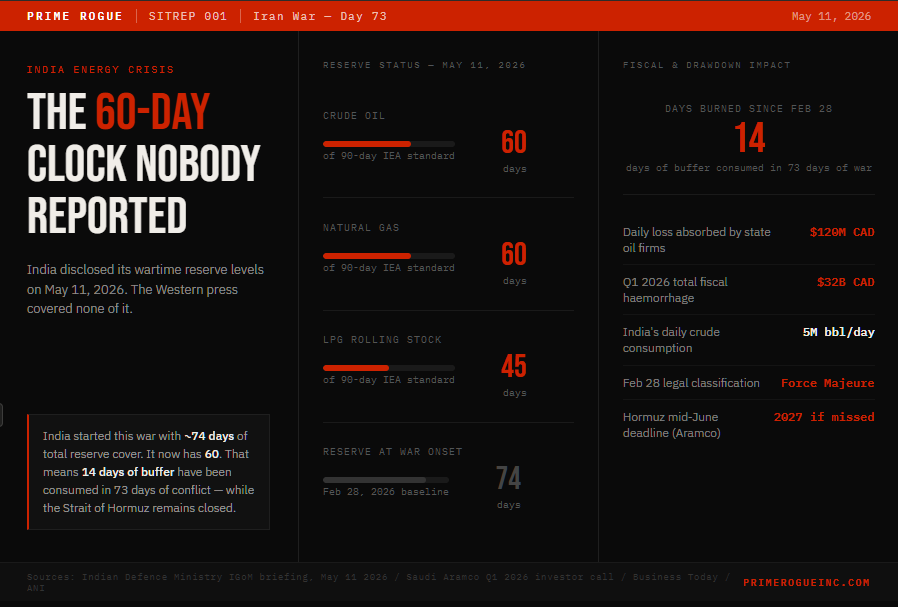
India has 60 days of crude oil reserves remaining. 60 days of natural gas. 45 days of LPG rolling stock.
Indian Defence Minister Rajnath Singh – May 11, 2026
India consumes five million barrels of crude oil per day. It imports approximately 88 percent of its crude requirements, with roughly 50 to 53 percent originating from the Middle East. Of that Middle Eastern supply, Saudi Arabia is the single largest source, followed by Iraq, the UAE, and Kuwait — all countries whose export routes run through the Strait of Hormuz, which has been effectively closed since February 28, 2026, the first day of Operation Epic Fury.
Prime Minister Narendra Modi went on television twice on May 11 to deliver what his own government described as a call for “collective economic participation.” What it actually was: a wartime austerity address. He urged 1.4 billion people to carpool, cancel foreign travel, stop buying gold, and shift to public transit. He urged Indian farmers to cut chemical fertilizer use by 50 percent and adopt solar-powered irrigation pumps. He invoked the COVID-19 pandemic as a comparison — “Just as we overcame COVID, we will come out of this” — and called the Gulf crisis “one of the worst in a decade.”
The force majeure classification is not administrative boilerplate. India’s Ministry of Finance has issued a circular clarifying that the onset of the conflict on February 28 should be treated as war for the purposes of force majeure clauses in public procurement contracts, enabling deadline extensions of two to four months. That is the language governments use when they are telling the rest of the economy: the rules of normal functioning no longer apply.
Indian state oil companies — Hindustan Petroleum, Bharat Petroleum, and Indian Oil — have been absorbing roughly ₹1,000 crore per day in “under-recoveries.” That is the accounting term for the gap between what the fuel actually costs at international prices and what Indians are paying at the pump. The Indian government has made the political decision to shield its 1.4 billion citizens from the full price shock of the war. The cost of that decision, in Q1 2026 alone, is approximately ₹2 lakh crore — roughly 32 billion Canadian dollars — absorbed by state-owned enterprises that cannot sustain these losses indefinitely.
“The energy supply shock that began in the first quarter is the largest the world has ever experienced.”
Amin Nasser, CEO, Saudi Aramco — Investor Call, May 11, 2026
On the same day India disclosed its 60-day countdown, Saudi Aramco CEO Amin Nasser told investors that if the Hormuz disruption is not resolved by mid-June — five weeks from the date of this writing — the global oil market will not normalize until 2027. The market has already lost more than one billion barrels of supply. Aramco’s East-West pipeline, which bypasses Hormuz through the Red Sea, is running at its absolute maximum capacity of seven million barrels per day. There is no additional buffer.
CNN covered none of the Indian disclosure. Neither did the BBC, Reuters, Bloomberg, or the New York Times. The story was covered wall-to-wall in Indian media for the entirety of May 11. In the English-language Western press, it does not exist.
On February 25 and 26, 2026, Indian Prime Minister Narendra Modi made a state visit to Israel — his first in nine years. The visit was described by Israeli Prime Minister Benjamin Netanyahu as “extraordinarily productive.” Twenty-seven bilateral outcomes were announced: sixteen agreements and eleven joint initiatives spanning critical technologies, labour mobility, agriculture, defence, and culture.
India and Israel formally elevated their existing “strategic partnership” to a “Special Strategic Partnership for Peace, Innovation and Prosperity.” Modi addressed the Knesset — the Israeli parliament — and received the “Medal of the Knesset,” a newly created honour. In his address, Modi said: “India stands with Israel. Firmly. With full conviction. In this moment. And beyond.”
The question that Indian opposition parties, foreign policy analysts, and intelligence observers have been asking since March 1 is whether Modi was briefed. The Israeli ambassador to New Delhi said that a decision to strike had not yet been made at the time of the visit. Israel’s foreign minister offered the same line. The External Affairs Ministry in New Delhi offered little explanation for why the visit proceeded at all, given that the massive mobilization of American military hardware in the Arabian Sea made a conflict evident to anyone paying attention.
“The timing of the visit suggests that he may have been briefed by the Israeli prime minister on the proposed Israel-U.S. military action.”
Retired Indian diplomat, quoted in The Diplomat — March 3, 2026
What is not in dispute is the sequence. Modi addressed the Knesset on February 25. He met Netanyahu and oversaw the signing of bilateral agreements on February 26. He departed Israel on the afternoon of February 26. Operation Epic Fury’s opening salvo hit Tehran at 06:35 UTC on February 28.
India’s first post-war phone call was not to Netanyahu. It was to Sheikh Mohamed bin Zayed, President of the United Arab Emirates. Modi told MBZ he “strongly condemned the attacks on the UAE and condoled the loss of lives.” He did not name Iran. That call — the first and only official condemnation by India of any party in the war’s first days — tells you everything about where India’s actual strategic anxiety lay: not in Israel, not in Iran, but in the Gulf states whose energy exports India depends on to keep its lights on.
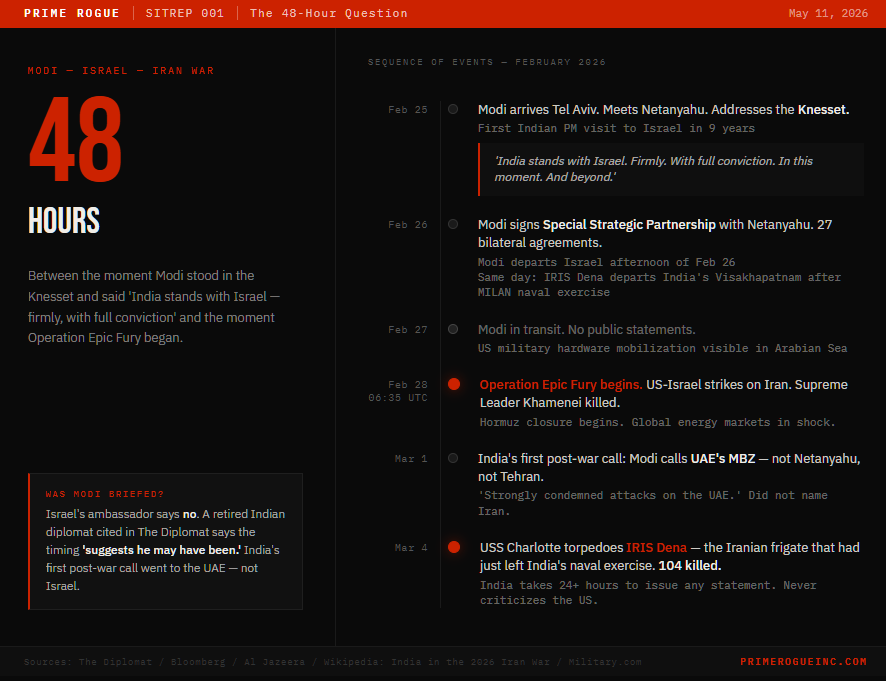
On March 4, 2026, the United States Navy submarine USS Charlotte — a Los Angeles-class attack submarine — fired two Mark 48 torpedoes at the Iranian Navy frigate IRIS Dena in the Indian Ocean, approximately 19 nautical miles off the coast of Galle, Sri Lanka. Of the 136 crew members on board, 104 were killed. Thirty-two survived.
IRIS Dena had been a guest of the Indian Navy. It had participated in India’s flagship biennial multilateral naval exercise MILAN 2026 — hosted by India in Visakhapatnam, designed to foster maritime cooperation among participating nations. IRIS Dena departed India’s eastern coast on February 26, the same day Modi was signing agreements with Netanyahu in Tel Aviv. The war started two days later. The ship was still in transit when it was sunk.
Iranian Foreign Minister Abbas Araghchi publicly framed the sinking as an attack on a vessel that had been “a guest of India’s navy.” US Defense Secretary Pete Hegseth, commenting at the Pentagon, said: “IRIS Dena thought it was safe in international waters. Instead, it was sunk by a torpedo. Quiet death.”
“The conflict has reached our backyard, with an Iranian warship sunk in the Indian Ocean. Yet the Prime Minister has said nothing.”
Rahul Gandhi, Leader of the Opposition — March 2026
India’s government took more than 24 hours to issue any official response. The Indian Navy’s statement said it had received distress signals and deployed resources — but by the time it responded, the Sri Lankan Navy had already led the rescue operation. Neither New Delhi nor the Navy publicly criticized the American decision to sink the vessel. Former Indian Navy Chief Admiral Arun Prakash called the attack “shocking” and described it as “a bit of treachery” — attending a peaceful exercise alongside the Iranian navy and then sinking the ship the moment it left Indian waters.
Strategic affairs analyst Brahma Chellaney stated that the sinking was “more than a battlefield event; it is a strategic embarrassment for New Delhi,” arguing that by attacking a vessel returning from an Indian-hosted exercise, Washington transformed India’s maritime neighbourhood into a war zone and directly challenged India’s authority and reputation as the preferred security partner in the Indian Ocean region.
A second Iranian vessel, IRIS Bushehr, requested entry into Colombo port following the sinking and was interned by the Sri Lanka Navy — the first warship interned in a neutral country since World War II. A third Iranian landing ship, IRIS Lavan, sought refuge at Kochi, India, and was interned there. India, which had recently declared itself the “guardian of the Indian Ocean,” was now hosting interned vessels of a belligerent power while declining to publicly comment on why its guest’s ship had been sunk in its maritime neighbourhood.
While India’s foreign policy calculus was fracturing in real time, its historic rival Pakistan was executing one of the most significant diplomatic reinventions in its modern history. Pakistan — a country sharing a 900-kilometre border with Iran, home to the world’s second-largest Shia population, simultaneously fighting an open war against the Afghan Taliban, and structurally dependent on Gulf state remittances — emerged as the primary mediator between the United States and Iran.
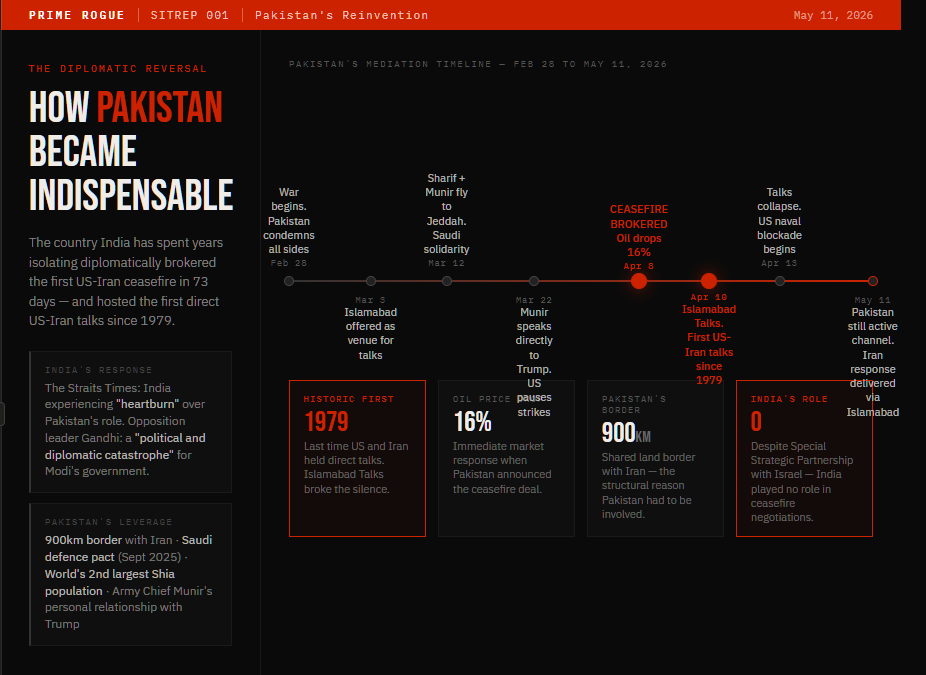
Pakistan’s mediation began almost immediately. When Operation Epic Fury commenced, Foreign Minister Ishaq Dar was in Saudi Arabia attending an OIC meeting. Within hours, Pakistan condemned all strikes — a deliberate positioning that allowed Islamabad to maintain credibility with both sides. By March 3, Dar was in Islamabad’s Senate outlining Pakistan’s offer: “Pakistan is ready to facilitate dialogue between Washington and Tehran in Islamabad.”
The geopolitical irony is acute. India watched as its rival brokered the first US-Iran ceasefire since the war began, hosted the first direct US-Iran diplomatic talks since 1979, and became the primary communications channel between Washington and Tehran. The Straits Times noted that India was experiencing “heartburn” over Pakistan’s visible role. Opposition leader Rahul Gandhi described it as “a stinging strategic setback for New Delhi” and “nothing short of a political and diplomatic catastrophe” for a government that had staked its reputation on isolating Pakistan.
Pakistan’s leverage was structural rather than accidental. It shares a 900-kilometre land border with Iran. It has a Saudi mutual defence pact signed in September 2025. Its Shia population — estimated at 15 to 25 percent — erupted in protests on March 1. And Army Chief General Munir had built a personal relationship with Trump beginning with a private White House lunch in June 2025, an Oval Office meeting in September, and Pakistan’s formal nomination of Trump for the Nobel Peace Prize — an investment that paid dividends when Munir needed direct access to the President in March 2026.
Before the war, India had a strategic workaround for its Gulf dependence. Chabahar — Iran’s southeastern port on the Gulf of Oman, physically outside the Strait of Hormuz — had been developed by India as an alternative gateway into Central Asia that circumvented rival Pakistan’s territory. India had invested years of diplomatic and financial capital into Chabahar.
The war collapsed that workaround almost immediately. The US blockade of Iranian ports, which came into force on April 13, does not distinguish between Iranian territory on the Persian Gulf and Iranian territory on the Gulf of Oman. A US sanctions waiver that had previously given Chabahar special status expired in April and was not renewed. Maritime intelligence analysis from firms including HUAX concluded that “Chabahar is outside the strait geographically, but not outside US blockade logic.”
The Chabahar collapse has cascading agricultural implications. India needs approximately 17 million tonnes of urea by August 2026, and domestic production plus existing stocks leave a shortfall of roughly two million tonnes. Urea is a nitrogen fertilizer essential to Indian agriculture. Its primary precursors are natural gas and ammonia — both sourced significantly from Gulf suppliers whose supply chains run through Hormuz.
The India-Israel-Iran-Pakistan-US nexus of this war is not adequately captured by any single narrative thread. It requires holding all of the following simultaneously.
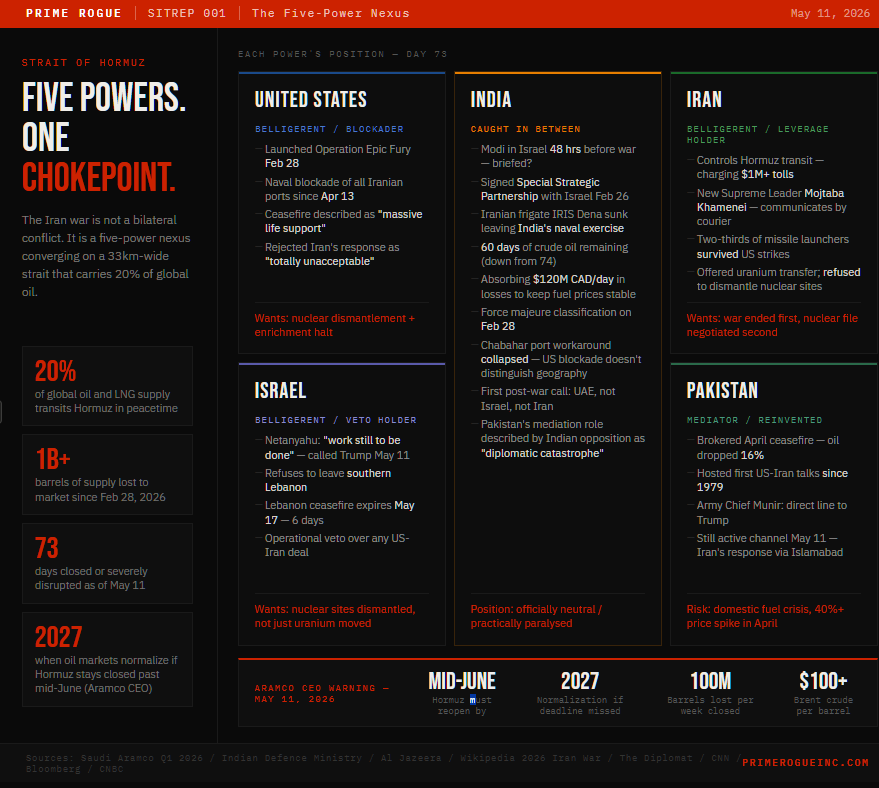
The Special Strategic Partnership signed 48 hours before Operation Epic Fury began has delivered India nothing it could operationalize in the subsequent 73 days. It did not give India advance warning. It did not protect India’s maritime neighbourhood. It did not prevent the US from sinking a ship that had just left an Indian-hosted exercise. What it did was position India as diplomatically aligned with the US-Israel axis at the precise moment that alignment became a liability in every relationship India has with the Gulf states, Iran, the Global South, and its own domestic opposition.
The ceasefire Pakistan brokered in April was genuine. The Islamabad Talks were historically significant. But Pakistan’s domestic energy crisis is severe — petrol prices rose more than 40 percent in a single month in April — and its ability to sustain the mediator role depends on maintaining credibility with both Washington and Tehran simultaneously, which becomes harder with every collapsed negotiating session.
Not because India is about to run out of oil tomorrow — 60 days is a meaningful buffer — but because of what comes after it. If Hormuz remains closed beyond mid-June, Aramco’s CEO has told the market that normalization extends into 2027. India’s state oil companies cannot absorb ₹1,000 crore per day in losses through 2027. At some point, the subsidies end and the price shock reaches 1.4 billion consumers. At that point, the political and social stability calculus changes significantly.
On May 11, 2026, every major English-language Western outlet was covering Trump’s “massive life support” quote, the Aramco earnings call, and Hezbollah’s attacks in southern Lebanon. The Indian government’s disclosure of a 60-day reserve countdown — filed by a Defence Minister in a cabinet-level meeting, covered comprehensively across Indian media — generated zero coverage in CNN, BBC, Reuters, Bloomberg, or the New York Times.
“The emergence of Pakistan, alongside Egypt and Turkey, as a primary back-channel interlocutor between Iran and the United States is a stinging strategic setback for New Delhi — nothing short of a political and diplomatic catastrophe.”
The Wire (India)
This is the structure of what is actually happening. India — which may or may not have known this war was coming, which hosted the warship that was sunk three days later, which signed a partnership with the attacking power 48 hours before the first strike, and which watched its historic rival become the indispensable mediator — is now managing a 60-day energy countdown while absorbing 32 billion Canadian dollars in quarterly losses to keep its people from feeling the full weight of a war it cannot publicly oppose and cannot meaningfully influence.
Sources: Indian Defence Ministry IGoM briefing (May 11, 2026) / Business Today / ANI / The Diplomat / Bloomberg / Al Jazeera / Foreign Policy / Wikipedia conflict timelines / Chatham House / The Wire / Military.com / Saudi Aramco Q1 2026 investor call.
Kevin Duska is the President of Prime Rogue Inc, and holds 14 years of experience in non-military national security and intelligence work in both the public and private sectors. Duska completed a Joint Honours First-Class undergraduate degree in Political Science and Sociology at McGill University in 2007, completed a Master’s in Political Science in 2009 at The Ohio State University, where he studied under Alexander Wendt, Theodore Hopf, Randall Schweller, Alexander Thompson and Jennifer Mitzen. He left Ohio State as an ABD PhD in 2012, where he taught undergraduate level Introduction to International Politics, Critical Security Studies and the Politics of the European Union, to pursue work in the public service. He is a specialist in geopolitics, and an area specialist as it pertains to the Middle-East, Eastern Europe, Russia, Indonesia, and Scandinavia. Duska is an avid proponent of anti-disinformation, narrative control and information warfare-adjacent methodologies, and helps firms manage crises with clarity. In his spare time, he loves practising dog sport with his rescue dog Wilco, and is an advocate for reforming the Canadians Access to Information and Privacy regimes. His first book, “Echo State: The Logs Can’t Lie “Yet,” is slated for publication in late September, 2026.




[…] Assad gone since December 2024, the Iraqi militias firing but increasingly leaderless. The Strait of Hormuz is closed — which is Iran’s last significant remaining leverage, and which is also a knife […]