Address
304 North Cardinal St.
Dorchester Center, MA 02124
Work Hours
Monday to Friday: 7AM - 7PM
Weekend: 10AM - 5PM

Address
304 North Cardinal St.
Dorchester Center, MA 02124
Work Hours
Monday to Friday: 7AM - 7PM
Weekend: 10AM - 5PM
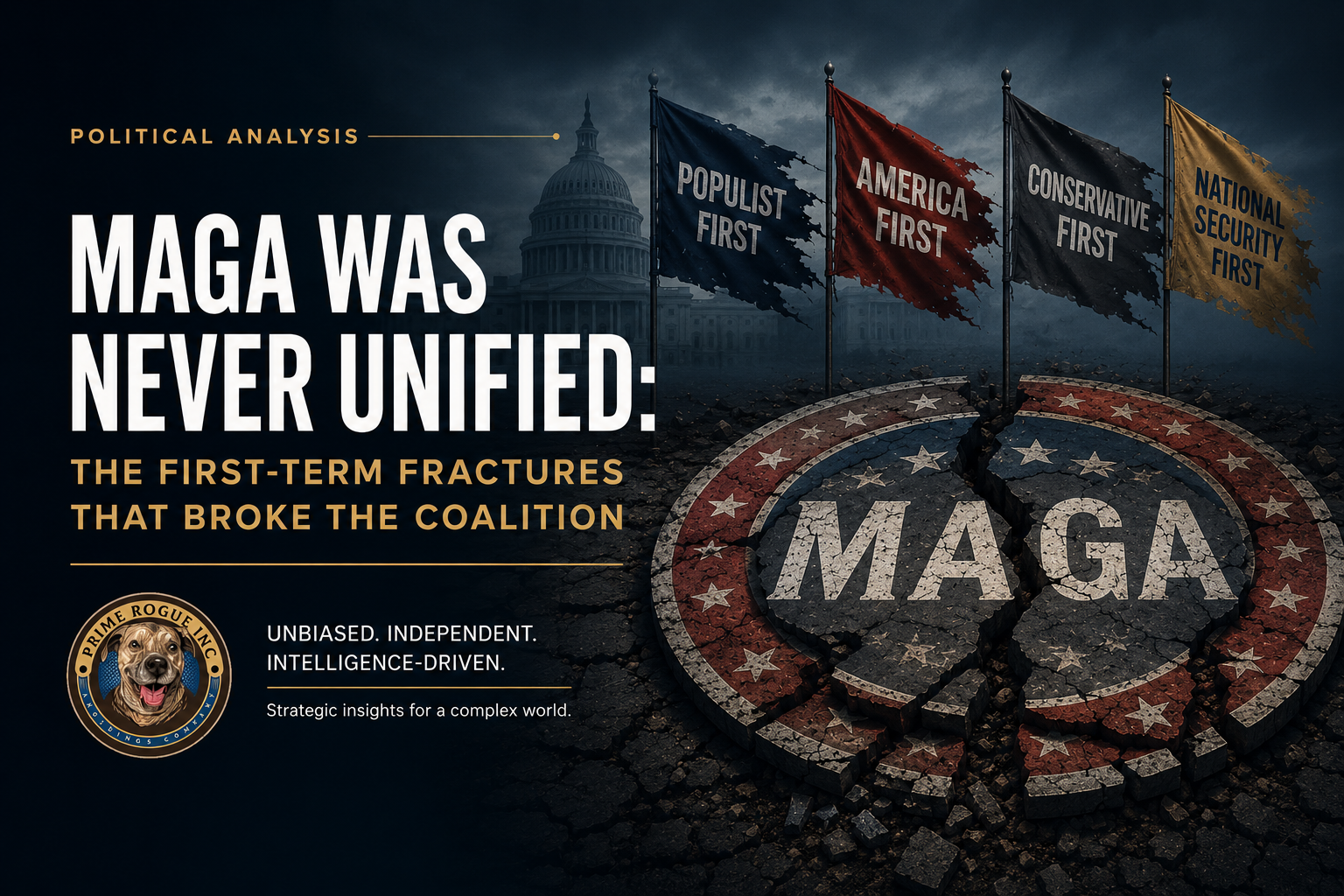
The MAGA coalition carried Donald Trump to two presidential victories. It was also a coalition fracture waiting to happen — held together not by ideology but by a single personality and the crushing electoral incentive to stay loyal. The MAGA civil war of 2025-2026 did not begin with Charlie Kirk’s assassination or the Iran war. It began in the first term, in a White House that contained two mutually hostile political projects and a Republican Party too afraid to say so out loud.
The dominant analytical frame applied to MAGA since 2016 has been unity. A unified base, a unified media ecosystem, a unified electoral coalition that demolished its internal critics and remade the Republican Party in Trump’s image. That frame was always partially wrong. The MAGA coalition fracture now visible as open civil war did not begin in 2025. It began in 2017. And the seeds of the MAGA civil war were never hidden — they were suppressed.
This report — the first in a five-part series tracing the MAGA coalition’s structural fracture — argues that the coalition was never ideologically unified. It was an unstable alliance of competing political projects held together by a single personality and the punishing electoral consequences of public dissent. The Bannon-Kushner White House civil war, the McCain-Flake-Romney establishment break, and the January 6 impeachment split were not aberrations. They were the coalition’s true architecture, briefly suppressed by Trump’s political dominance.
The first term established a critical political norm: dissent would be punished with electoral extinction. Of the ten House Republicans who voted to impeach Trump after January 6, eight were driven from office. The lesson was absorbed by every Republican in national politics. But the disappearance of public dissent did not eliminate the underlying fault lines. It drove them underground, where they accumulated pressure through four years of exile and re-emerged with compound force the moment the second term began governing.
This report documents the specific fracture points of the first term in detail, identifies the structural reasons why the coalition’s unity was always contingent rather than durable, and establishes the baseline from which the subsequent fractures — the Epstein files, the Kirk assassination, the Iran war, the Tucker-Trump break — can be properly understood.
The MAGA coalition, as it arrived in Washington on January 20, 2017, contained at least three distinct and mutually antagonistic political projects housed inside the same White House.
The first was Steve Bannon’s economic nationalist project: aggressive trade protectionism, immigration restriction, deconstruction of the administrative state, and a confrontational posture toward the Republican establishment as much as toward the Democratic Party. Bannon had spent years building the intellectual scaffolding for a populist right that was explicitly hostile to Wall Street, the donor class, and the globalist consensus that had governed both parties since the 1990s. His appointment as Chief Strategist represented the insurgent wing of MAGA in its purest form.
The second was the Jared Kushner-Gary Cohn globalist project: free trade maintenance, immigration flexibility on skilled workers and visa programs, institutional norm preservation, and the kind of transactional pragmatism that prioritized stock market performance over populist symbolism. Cohn, the former president of Goldman Sachs serving as National Economic Council director, was in ideological terms closer to Barack Obama’s economic advisers than to Steve Bannon. His presence in the same White House as Bannon was not a synthesis. It was a cold war.
The third was the institutional Republican establishment project — represented in Congress by figures like John McCain, Mitt Romney, Jeff Flake, Bob Corker, and Susan Collins — which had endorsed Trump as the party’s nominee while maintaining profound private reservations about his fitness, temperament, and policy instincts. These were not closeted Democrats. They were conservatives who had spent decades building the policy infrastructure Trump was now claiming credit for while dismantling its norms. They were inside the coalition by electoral necessity, not ideological alignment.
| These three projects — economic nationalist populism, globalist pragmatism, and institutional conservatism — are not merely different emphases within a shared framework. They are competing visions of what the Republican Party is for, who it serves, and what success looks like. Their coexistence inside the Trump coalition was always contingent on a shared enemy and a dominant personality. Neither condition is permanent. |
The tension between these projects produced real governing consequences from the first months of the administration. It was not background noise. It was the operating environment.
The following events are not a list of Trump controversies. They are a chronology of structural fractures — moments where the coalition’s internal contradictions produced visible breaks that were subsequently suppressed but never resolved.
| DATE | FRACTURE EVENT |
| Aug 18, 2017 | Steve Bannon fired as Chief Strategist. Declares ‘the Trump presidency that we fought for, and won, is over.’ Trump responds: ‘When he was fired, he not only lost his job, he lost his mind.’ |
| Jul 28, 2017 | John McCain casts the decisive thumbs-down vote killing ACA repeal 49-51. Trump tweets at 2:25 AM blaming ‘three Republicans.’ |
| Oct 24, 2017 | Jeff Flake announces retirement rather than face a primary, delivering a 17-minute floor speech: ‘We must stop pretending that the degradation of our politics is normal. It is not normal.’ |
| Oct 24, 2017 | Bob Corker, retiring, calls the White House ‘an adult day care center’ and warns Trump could set the country ‘on the path to World War III. |
| Mar 6, 2018 | Gary Cohn resigns as NEC Director in direct protest of steel and aluminum tariffs — the highest-profile policy-driven departure of the first term. |
| Feb 5, 2020 | Mitt Romney votes guilty on abuse of power at Trump’s first impeachment trial — the first senator in American history to vote to remove a president of his own party. Invokes his Mormon faith publicly. |
| May 2019 | Justin Amash becomes the first Republican congressman to call for impeachment proceedings, citing the Mueller report. Leaves the Republican Party entirely in July 2019. |
| Jan 13, 2021 | Ten House Republicans vote to impeach Trump for incitement of insurrection following January 6. Liz Cheney declares Trump committed ‘the greatest betrayal by a sitting president.’ Kevin McCarthy states Trump ‘bears responsibility.’ |
| Jan 19, 2021 | Mitch McConnell delivers Senate floor speech stating Trump is ‘practically and morally responsible for provoking the events of that day.’ |
| Jan 28, 2021 | Kevin McCarthy visits Mar-a-Lago and is photographed smiling with Trump — 15 days after blaming him for the Capitol attack. |
Steve Bannon’s August 2017 firing was the first major indicator of how the coalition would manage internal contradiction: by expelling the faction that lost rather than brokering a synthesis. Bannon had not become less relevant to the MAGA base — his economic nationalist framework remained the ideological engine of Trump’s appeal to working-class voters. He was expelled because he had become a liability to the Kushner wing and had given unauthorized press interviews that embarrassed the White House.
Bannon’s post-firing trajectory is analytically significant. Rather than becoming a conventional political exile, he built the War Room podcast into one of the most-listened-to political programs in the country, maintaining a direct relationship with the MAGA base that rivalled Trump’s own media apparatus. He was convicted of contempt of Congress in 2023 for defying a January 6 committee subpoena, sentenced to four months in prison, served July to October 2024, and emerged to resume podcasting — pardoned by Trump on January 20, 2025.
The Bannon trajectory established a pattern that would repeat throughout the coalition’s history: expulsion without elimination. Figures driven out of the formal Trump orbit did not disappear. They built parallel platforms, maintained audience relationships, and retained the capacity to re-enter or challenge the coalition’s direction at strategic moments. The coalition lacked the institutional architecture to actually absorb or neutralize its expelled members. It could only exile them. And exiled members with large audiences are a specific kind of political danger — they retain loyalty claims on the base while being freed from the constraints of formal coalition membership.
| The Bannon exile is the template for every subsequent major fracture: Carlson fired by Fox, Kent resigned from the NCTC, Greene driven from Congress. None of them disappeared. All of them became more dangerous to the coalition’s coherence from outside it than they were from within it. The coalition’s enforcement mechanism creates its own opposition. |
The Never Trump movement among Republican elected officials peaked in 2017 and was effectively destroyed as an electoral force by 2022. But its collapse was not a demonstration of MAGA’s ideological triumph. It was a demonstration of the coalition’s capacity for political violence — primary challenges, social media targeting, donor mobilization — against dissenters. The distinction matters analytically because a coalition that maintains unity through threat rather than conviction is not ideologically unified. It is coercively unified. The underlying disagreements remain.
John McCain’s ACA vote was the most consequential single act of Republican dissent in the first term, and its political consequences were limited precisely because McCain was dying of brain cancer and had already announced he would not seek re-election. Jeff Flake retired rather than face a primary he expected to lose. Bob Corker did the same. The pattern was consistent: elected Republicans who publicly broke with Trump did so on their way out the door, not from positions of electoral security. The courage of their convictions was real. Their political calculation was also real.
Mitt Romney’s impeachment vote was categorically different. Romney was not retiring. He was a first-term senator from Utah who had won with 63 percent of the vote. His vote to convict was a deliberate choice to absorb political cost for a principle he believed the historical record required. He stated publicly: ‘Does anyone seriously believe I would consent to these consequences other than from an inescapable conviction that my oath before God demanded it of me?’ Romney was subsequently censured by the Utah Republican Party, faced years of targeted harassment, and chose not to seek re-election in 2024. His exit statement was a sober verdict on what the party had become.
The institutional Republican wing’s defeat was not a surprise. It was structurally predetermined. The coalition’s electoral base had moved to Trump, the donor class had accommodated itself to MAGA, and the primary system ruthlessly punished dissent. What is analytically important is not that the establishment lost — it is that its loss did not resolve the underlying policy disagreements. It merely transferred them to a new set of actors operating under different constraints.
January 6, 2021 produced the clearest demonstration of the coalition’s internal contradiction and its resolution mechanism. The storming of the Capitol was, in real time, condemned by senior Republicans across the ideological spectrum of the coalition. Kevin McCarthy stated Trump bore responsibility. Mitch McConnell called it a violent insurrection. Liz Cheney called it the greatest betrayal by a sitting president. Ten House Republicans voted to impeach. Seven Senate Republicans voted to convict. These were not fringe actors. They were the senior leadership of the Republican Party.
What happened next is the most important political sequence of the first term for understanding the second.
Kevin McCarthy visited Mar-a-Lago on January 28 — fifteen days after blaming Trump for the attack — and was photographed smiling. The RNC formally censured Cheney and Kinzinger in February 2022, describing January 6 as ‘legitimate political discourse.’ Of the ten House Republicans who voted for impeachment, four lost primaries to Trump-backed challengers, four retired under pressure rather than face primaries, and two survived by navigating their districts carefully. The survivors included Dan Newhouse of Washington and David Valadao of California — both of whom represent competitive districts where Trump’s endorsement machine had limited reach.
| The message delivered by this sequence was precise and was received clearly by every Republican in national politics: public dissent from Trump produces electoral extinction. The consequence was not ideological conversion — privately, many Republican elected officials continued to hold the same views they expressed in the hours after January 6. The consequence was the suppression of public dissent, which is a categorically different thing. Suppressed disagreement is not resolved disagreement. |
The coalition that emerged from the first term’s end was, on the surface, more unified than it had ever been. The dissenters had been purged or silenced. Trump held the loyalty of virtually every Republican elected official with national ambitions. The primary system had been demonstrated as a reliable enforcement mechanism. The donor class had accommodated itself.
Beneath that surface, the structural fault lines were intact. The economic nationalist vs. globalist tension that produced the Bannon-Cohn war had not been resolved. The foreign policy tension between America First non-interventionists and hawkish interventionists had not been resolved. The institutional norm questions that animated the Never Trump movement had not been resolved. And a new fault line — over Israel, Iran, and the direction of American foreign policy — was beginning to emerge that would, within four years, become the coalition’s most destructive rupture.
Four conditions created by the first term made second-term fracture not merely possible but structurally predictable.
First, the coalition’s unity was personality-dependent rather than institutionally embedded. Republican elected officials stayed loyal to Trump because Trump was the party’s dominant electoral force, not because they had been converted to his worldview. When the incentive structure changed — when Trump was no longer on the ballot, when governing decisions created real policy costs, when the Iran war made the America First vs. Israel First tension impossible to paper over — the personality-dependent unity had no institutional substitute.
Second, the coalition’s enforcement mechanism created its own opposition. Every figure expelled from the formal Trump orbit — Bannon, eventually Carlson, eventually Greene, eventually Kent — retained audience relationships and public platforms. The coalition could remove people from positions of formal power. It could not remove them from relevance. And people with large audiences who feel they have been unjustly expelled are uniquely motivated and uniquely credible critics, because they can claim insider knowledge and betrayal simultaneously.
Third, the coalition contained a genuine and unresolved ideological contradiction on foreign policy that the first term never had to fully confront. Trump’s America First instincts — skepticism of foreign entanglements, NATO burden-sharing demands, transactional rather than values-based alliances — were in fundamental tension with the hawkish Israel-first interventionism of the Shapiro-Levin-Cruz wing of the coalition. The first term never produced a direct confrontation between these positions because no major war occurred. The second term removed that buffer.
Fourth, and most specifically relevant to what followed: the coalition had no institutionalized mechanism for internal debate and course-correction. In a normal political party, disagreements are processed through committee structures, caucus meetings, leadership negotiations, and formal whipping operations. MAGA processed disagreements through Trump’s social media posts and primary threats. This is an effective suppression mechanism. It is a catastrophically ineffective deliberation mechanism. When real governing decisions with real consequences had to be made — go to war with Iran or don’t; release the Epstein files or don’t; pursue Canadian annexation or don’t — there was no process for working through the coalition’s genuine disagreements. There was only Trump’s decision and the binary choice between public loyalty and public break.
| A coalition that can only maintain unity through suppression cannot survive the pressures of governing. The first term was a suppression operation. The second term was a governing operation. Those are different tasks requiring different political architectures. The MAGA coalition had built one and was asked to perform the other. |
The MAGA coalition’s first-term fractures are best understood not as a series of individual personality clashes but as the predictable output of a structurally unstable political alliance. The Bannon-Kushner war, the McCain-Flake establishment break, and the January 6 impeachment split each expressed the same underlying reality: the coalition contained incompatible political projects that could coexist under electoral pressure but could not coexist under governing pressure.
The coalition’s response to each fracture — expulsion, suppression, primary threats — was effective at maintaining surface unity but counterproductive at maintaining structural stability. It drove disagreements underground rather than resolving them, and it created a growing population of expelled figures with large audiences, insider knowledge, and strong motivation to challenge the coalition’s direction.
The January 6 loyalty enforcement sequence was the coalition’s most consequential self-inflicted wound. By demonstrating that public dissent meant electoral destruction, it created the conditions for the second term’s explosive fractures. Republican elected officials learned not to dissent publicly. They did not learn to agree. The difference — between suppressed disagreement and resolved disagreement — is the difference between a coalition that looks unified and a coalition that is unified. The MAGA coalition, heading into the second term, was the former.
The specific fracture points that followed — the Epstein files, the MTG break, the Kirk assassination, the Iran war, the Tucker-Trump final confrontation — are each explored in subsequent reports in this series. But they cannot be properly understood without this baseline: the coalition was always fragile, the fractures were always present, and the second term’s governing pressures were always going to expose what the first term’s electoral pressures had concealed.
The message was received after January 6. That is what made the second-term fracture, when it came, so much more destructive. The people who broke were not establishment critics who had never truly believed. They were the coalition’s own soldiers — its most loyal media voices, its most unconditional congressional defenders, its institutional infrastructure builders, its counterterrorism chiefs. When they broke, they broke with full knowledge of how the machine worked. And they broke loudly.
The Fracture is a five-part Prime Rogue Inc. analytical series tracing the structural collapse of the MAGA coalition from first-term fault lines through the assassination of Charlie Kirk, the Iran war, and the open civil war of 2025-2026. Parts 2 through 5 cover: the Butler consolidation and second-term breaks; the Epstein files and the MTG rupture; Kirk as the last brake; and why the fracture is more dangerous than the unity was.
Prime Rogue Inc. is a Calgary-based private intelligence and strategic transparency firm. Signal Cage is its investigative geopolitics vertical. Kevin J.S. Duska Jr. is an International Relations, Intelligence, and Narrative Warfare specialist (McGill University; Ohio State University), and a member of the Canadian Association of Journalists.
 We Were Never in Your Court: On the Tactical Refusal of Bureaucratic Norms in Adversarial Systems Work
 Cold War Tech That Never Got the Memo: 8 Systems Still Running Today
 Prime Rogue Inc. Announces Investigation into Epstein’s Ties to Canadian Higher Education
 US-Canada Tariff Whiplash: Inside the Carney-Trump Trade Collapse and the Potash Card No One Plays | Prime Rogue Inc.