Address
304 North Cardinal St.
Dorchester Center, MA 02124
Work Hours
Monday to Friday: 7AM - 7PM
Weekend: 10AM - 5PM

Address
304 North Cardinal St.
Dorchester Center, MA 02124
Work Hours
Monday to Friday: 7AM - 7PM
Weekend: 10AM - 5PM
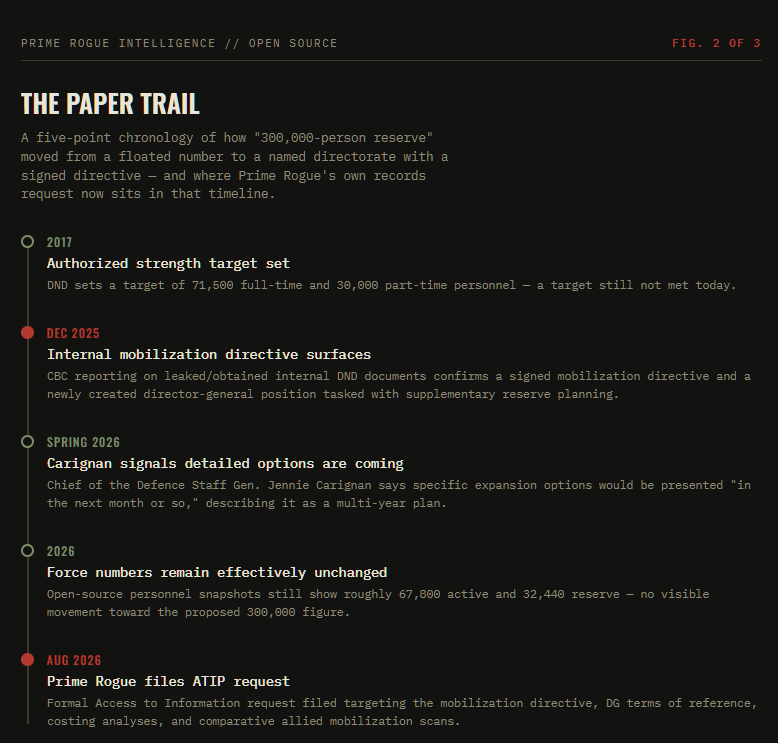
Prime Minister Mark Carney’s pledge to build a 300,000-strong “supplementary reserve” is real, actively staffed, and moving — but it is nowhere near operational. The Canadian Armed Forces can’t yet fill its own existing authorized strength from 2017, let alone a force nearly triple its current reserve. Internal DND planning documents obtained by CBC, and Prime Rogue Inc, confirm a signed mobilization directive and a new director-general position exist. That’s a meaningfully further stage than most government “plans” ever reach. Treat the public mockery about drafting public servants as noise; the underlying mobilization apparatus is the story.
This is a textbook zugzwang for Ottawa: every move available makes the position worse. Say nothing, and the government looks unserious about continental defence at a moment when allies are visibly re-arming, and the United States is an existential threat to Canada. Announce a number as ambitious as 300,000, and you invite exactly the scrutiny now landing — a military that can’t crew its existing structure being asked to more-than-quadruple its reserve pool. Lean on public servants as a stopgap recruitment base, and you hand critics a punchline. There was no move here that avoided cost; Carney’s government chose the one that generates headlines instead of silence, which is its own kind of signal about how seriously the mobilization planning is being taken internally.
Start with the baseline. DND has struggled for nearly a decade to reach an incredibly modest target set back in 2017 — 71,500 full-time and 30,000 part-time personnel. Current numbers, depending on the source and the month, sit closer to 67,800 Regular Force and 32,400 Reserve. That’s the force the government is currently proposing to layer a 300,000-person supplementary tier on top of.
Equipping, clothing, housing, and training even a fraction of that number is a logistics and procurement problem before it’s a recruitment problem. That’s precisely why the costing analyses, Treasury Board submissions, and options papers matter more than the press conference — they’re where the actual scale of ambition versus actual scale of budget gets reconciled, out of public view, unless FOI/ATIP requests pry it loose.
Skepticism about a 300,000-person militia is fair. But internal DND documents reported by CBC, and corroborated by Prime Rogue Inc, confirm two concrete administrative facts: a signed mobilization directive exists, and a new director-general role has been created specifically to manage supplementary reserve planning. Governments don’t usually create standing bureaucratic infrastructure for ideas they intend to quietly drop – well they actually often do – but – there is not but. That being said, and considering ongoing strategic decoupling from the United States, that’s the detail worth weighing more heavily than the public mockery of the “draft the public servants” angle — it suggests planning has moved from political rhetoric into an actual file with an owner, a mandate, and presumably a budget line working its way through Treasury Board.
Prime Rogue has filed a formal Access to Information request targeting the mobilization directive itself, the director-general terms of reference, the costing analyses, and the comparative jurisdictional scans DND is reportedly running against allied mobilization models. We’ll publish what comes back — and if DND tries to claim no responsive records exist on a file this well-documented in the press, that response becomes its own story.
The 300,000-person reserve is not fiction, not vaporware, and not close to happening either. It’s a real, funded planning effort running into a real, unglamorous administrative wall: Canada’s military already can’t recruit and retain the force it’s authorized to have today. Whether Ottawa can solve that before this becomes just another abandoned target, like the one set in 2017, is the question worth tracking, not whether the headline number sounds absurd.
Prime Rogue Inc. is a Calgary-based private intelligence and strategic coommunications firm. This brief is developed from open-source reporting and Prime Rogue’s active ATIP filing program targeting DND mobilization planning records.
 Canada’s Military Playbook for the 2025 Kananaskis G7 Summit – 2025 G7 Security Series #2
 Core Beliefs: How the Darlington BWRX-300 Reactor Was Licensed on Faith, Not Fact
 Metadata as Method: Adversarial OSINT and the Canadian Transparency Regime
 Canada at the Crossroads: NATO Withdrawal or Strategic Realignment with Europe?



[…] University. I a, as of recently, a member of the Canadian Association of Journalists, and I founded Prime Rogue Inc in November 2022. I am also a resident of Calgary’s Killarney neighbourhood, and I walk […]
[…] hundred Canadian military personnel are currently deployed across six Middle Eastern operations. They were there when the […]