Address
304 North Cardinal St.
Dorchester Center, MA 02124
Work Hours
Monday to Friday: 7AM - 7PM
Weekend: 10AM - 5PM

Address
304 North Cardinal St.
Dorchester Center, MA 02124
Work Hours
Monday to Friday: 7AM - 7PM
Weekend: 10AM - 5PM

Short answer: almost certainly not. Longer answer: the path is real, it runs through tonight in Philadelphia, and the story behind it is good enough that the math almost doesn’t matter.
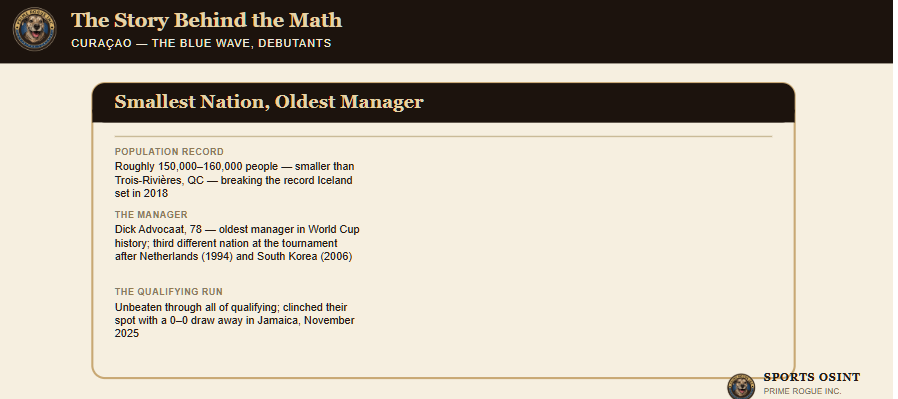
Curaçao is a Dutch Caribbean island of roughly 150,000 to 160,000 people — smaller than Trois-Rivières, Quebec. They are, by a wide margin, the smallest nation by population ever to qualify for a men’s World Cup, breaking the record Iceland set in 2018. They went unbeaten through their entire CONCACAF qualifying campaign, clinching their spot with a 0-0 draw away in Jamaica in November 2025 in front of a hostile crowd that needed a win and didn’t get one.
The man who built that run, Dick Advocaat, is 78 years old and now the oldest head coach in World Cup history. He stepped away from the job in February to care for an ill family member, was replaced by Fred Rutten, watched the team lose warm-up matches and the dressing room grow unsettled, and was reinstated less than six weeks before the tournament started. This is also his third different country at a men’s World Cup, after the Netherlands in 1994 and South Korea in 2006 — a feat no manager has matched. Curaçao’s captain, Leandro Bacuna, spent a decade in England with Aston Villa, Cardiff, Reading, and Watford before becoming the heartbeat of a national side most of the planet had never had cause to look up.
That’s the story. Here’s the math.
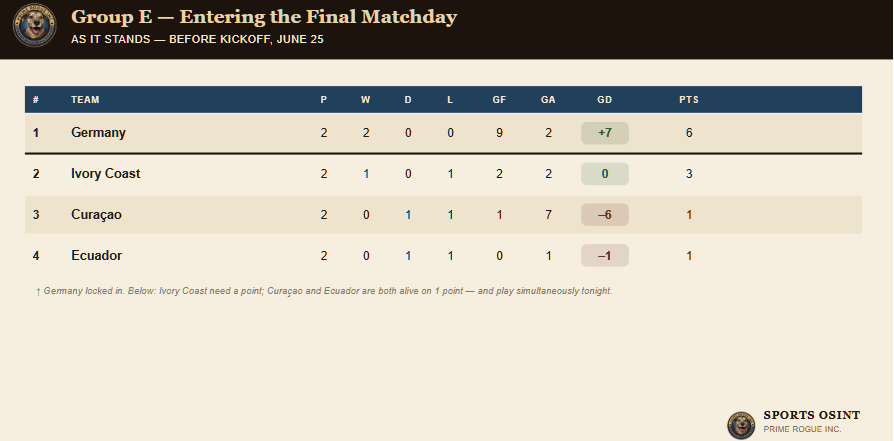
Group E after two matchdays: Germany have already clinched top spot with 6 points. Ivory Coast sit second on 3 points after beating Ecuador and losing to Germany. Curaçao and Ecuador are both on 1 point — Curaçao from a brutal 7-1 opening loss to Germany followed by a 0-0 draw with Ecuador, Ecuador from that same draw plus a 0-1 loss to Ivory Coast.
Tonight, two matches kick off simultaneously at 4pm ET: Curaçao host… well, “host” isn’t the right word in Philadelphia, but Curaçao play Ivory Coast, while Ecuador play Germany 90 miles away in East Rutherford.
For Curaçao, the requirement is more straightforward than the giant goal-difference deficit (-6, after that Germany scoreline) might suggest. They simply need to beat Ivory Coast. A win takes them to 4 points; Ivory Coast would be stuck on 3 with nothing left to play. Points beat goal difference every time under FIFA’s tiebreaker order — so a Curaçao win is enough on its own to leapfrog Ivory Coast, full stop.
The complication is Ecuador, who are playing the exact same math at the exact same time. If Ecuador also win tonight — beating Germany, which would be a genuine upset — they’d also reach 4 points. Curaçao and Ecuador have already played each other once this tournament (that 0-0 draw), so a head-to-head tiebreaker between them is dead even. It would come down to overall goal difference, and Curaçao’s -6 against Germany is the kind of hole that doesn’t dig itself out from a single match. In that specific scenario, Squawka’s own permutations desk is blunt about it: Curaçao would finish third.
So the real, accurate version of “what Curaçao needs tonight” is: beat Ivory Coast, and hope Ecuador doesn’t also pull off the upset of beating Germany. Two improbable things, not one.
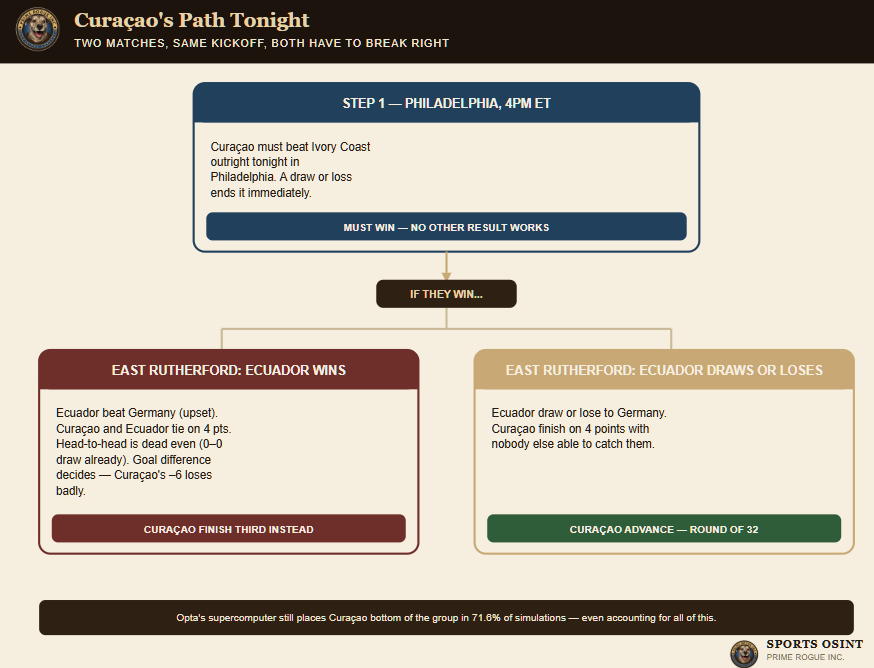
Opta’s supercomputer — which runs thousands of simulations off the underlying data rather than vibes — gives Curaçao odds explicitly: they “need a victory against Côte d’Ivoire to stand any chance at making the last 32, but even then, they need results to swing elsewhere.” The model places them bottom of Group E in 71.6% of simulations. That’s not a door slammed shut, but it’s not cracked open very far either.
For context on what they’re up against tonight: Ivory Coast pushed Germany hard in a 2-1 defeat and beat Ecuador comfortably in their opener. They have the better squad on paper, the better recent form, and need only a draw to be safe. Curaçao’s qualifying campaign was genuinely impressive — unbeaten through two full rounds, a 7-0 demolition of Bermuda along the way — but qualifying against CONCACAF’s middle tier and competing with an Ivorian side that’s pushed the eventual group winners to the wire are different propositions entirely.
If Curaçao wins tonight and Ecuador doesn’t also beat Germany, the smallest nation in World Cup history advances to the Round of 32 as Group E runners-up — and would face the runner-up of Group I (France, Senegal, Iraq, or Norway). Realistically: France or Norway. Realistically: a brutal ask either way, but one that would already have been the single biggest result in the country’s sporting history before a ball is even kicked in the next round.
If they win and finish third instead (the Ecuador-also-wins scenario), there’s still a long-shot path through the eight best third-place teams — but Curaçao’s goal difference makes them one of the least likely third-place teams in the whole tournament to make that cut, regardless of tonight’s result.
The honest read: this almost certainly ends tonight, the way most history-adjacent World Cup debut stories do. But “almost certainly not” has been wrong about Curaçao once already this year — they were a 500/1 outsider to even be at this tournament a year ago, and they’re here. Win tonight in Philadelphia and the maths gets interesting fast. Lose, and a 78-year-old who’s already taken three different nations to the World Cup gets to go home having delivered the smallest country in the tournament’s history its first three games on the biggest stage in the sport. Either outcome is a story worth having watched.





[…] of thorium, concentrated primarily in the Fen Complex near Ulefoss. That’s enough to power the world for centuries if thorium-based nuclear reactors reach commercial viability. Despite this, Norway has done next to nothing to develop its reserves. Unlike […]
[…] citizen, signaling a desire for continuity with Pope Francis’ global outlook and reforms. World leaders immediately recognized the geopolitical significance of this choice. U.S. President Donald Trump, newly returned to office, hailed the […]
[…] stage tournament is categorically safe — no third-placed team with six points has ever failed to advance in any expanded World Cup format. This path guarantees passage and almost certainly second place in […]
[…] Ecuador is the world’s largest banana exporter, producing 30% of the global supply. […]
[…] a world characterized by rapid technological advancements and shifting geopolitical landscapes, the specter of war looms ominously. As global powers vie for dominance and regions face […]
[…] is sports OSINT, not sports punditry, so here’s the honest target-preference ranking, worst-case-for-Canada […]
[…] Read together, over two decades, it’s one of the clearest examples in the contemporary world of a small state systematically converting a narrow resource advantage into durable, multidimensional leverage that […]
[…] humanitarian”. By walking out, he conveyed that Turkey would not tolerate being slighted on the world stage. Likewise, de Gaulle’s “empty chair” policy in 1965 telegraphed France’s refusal to be […]
[…] Through its unique position and diplomatic strategies, the Vatican maintains significant sway in international relations. Its power is derived not from coercion or force, but from its spiritual and moral authority. The Vatican’s ability to navigate the complexities of global politics is a testament to its enduring influence and relevance on the world stage. […]
[…] to Russia-backed separatists, directly countering false narratives and forcing the issue onto the world stage. This demonstrated how even a well-resourced government’s narrative can be upended by civilians […]
[…] to legislation favoring oil and gas interests. In other words, Canada’s climate posture on the world stage was starkly at odds with its domestic […]
[…] Tehran will move swiftly to leverage the strikes to its advantage on the world stage. In the next 1–3 days, Iran will likely announce further reduction of its cooperation with the […]
[…] swiftly summoned Israel’s ambassador and publicly insisted on answers, projecting outrage on the world stage at this rare direct threat to its […]
[…] Serbia’s state identity had taken on a dramaturgical cast: leaders staged themselves and the nation as the tragic hero-victim of Balkan history. Even as Serb forces committed atrocities (such as the […]
[…] a strong USAID enhances America’s role on the world stage. Emphasizing effective aid can lead to increased global cooperation and […]
[…] Panama’s location as a narrow strip of land connecting North and South America has always been of strategic importance. Throughout history, various powers have vied for control over this vital corridor. Its strategic importance has not only shaped its development but also its geopolitical significance on the world stage. […]
[…] directive and a new director-general position exist. That’s a meaningfully further stage than most government “plans” ever reach. Treat the public mockery about drafting public servants as noise; the underlying mobilization […]
[…] City operates like a small state. It handles significant resources that fund a variety of initiatives. These resources support […]
[…] The Holy See’s influence relies heavily on persuasion. Rather than coercion, it fosters dialogue and cooperation. This strategy enhances its moral presence on the world stage. […]
[…] 1970, but he chose June 18, 1970 – which ended up being just four days after England lost in the World Cup quarterfinal to West Germany on June 14. England’s defeat (after leading 2-0) was a gutting national disappointment. Four days […]