Address
304 North Cardinal St.
Dorchester Center, MA 02124
Work Hours
Monday to Friday: 7AM - 7PM
Weekend: 10AM - 5PM

Address
304 North Cardinal St.
Dorchester Center, MA 02124
Work Hours
Monday to Friday: 7AM - 7PM
Weekend: 10AM - 5PM
Tonight’s primetime address on foreign election interference came with a promise of declassified intelligence. Prime Rogue is launching Manifest Declassification — a full forensic series measuring the gap between what the documents say and what the White House claims they say. Document by document, as fast as they drop, from north of a border Washington no longer seems to believe in.
At 9:00 p.m. Eastern on July 16, 2026, President Donald Trump delivered a primetime address to the nation on what the White House billed as newly declassified intelligence concerning foreign interference in American elections — with the 2020 presidential contest at the centre of the frame. Flanked by CIA Director John Ratcliffe, acting Director of National Intelligence Bill Pulte, FBI Director Kash Patel, and Homeland Security Secretary Markwayne Mullin, the President promised the public evidence. Prime Rogue intends to hold him to it.
Starting immediately, Prime Rogue is launching Manifest Declassification: a dedicated forensic series examining every document released under this declassification effort — as quickly as the documents become available, and at whatever length the material demands. Not the talking points. Not the podium characterizations. The documents themselves: their markings, their redactions, their provenance, their internal dissents, and above all the distance between what they actually establish and what is being claimed on their behalf.
The name is not a joke, or not only one. Manifest Destiny was the nineteenth-century doctrine that American expansion was self-evidently righteous — that the claim was its own proof. Manifest Declassification is its information-age descendant: the practice of releasing selectively curated classified material and declaring that the release itself constitutes evidence, the destiny of the narrative made manifest by the mere act of disclosure. A declassification stamp is not a finding. A press conference is not a chain of custody. The doctrine says the documents prove it because we released them; the audit asks what the documents actually say.
And the vantage point matters. This series is written from Calgary, in a country the sitting American president spent the past two years deriding as a future fifty-first state — a country whose prime minister has declared the old relationship with the United States over, which is living under active American tariffs, and which watched Washington threaten the military annexation of Greenland, a NATO ally’s territory, this past January. Canadians no longer have the luxury of treating American institutional claims as presumptively reliable. When the government next door — one that has openly mused about absorbing ours — announces that curated intelligence proves its elections were compromised, due diligence is not a partisan act. It is a sovereignty practice. We read the paperwork of empires. It is safer than trusting their speeches.
This is also, simply, the work Prime Rogue exists to do. Strategic transparency means treating a declassification dump the way an access-to-information practitioner treats a government release package: as primary source material that must be read line by line, not as a press kit to be summarized.
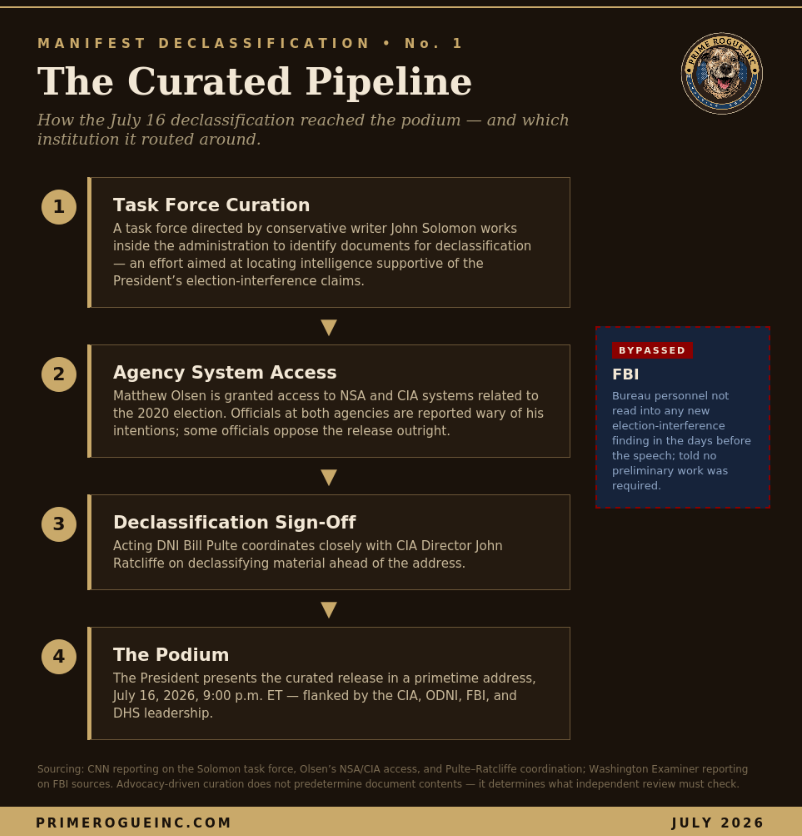
Every declassification is a curation decision, and the reporting that preceded tonight’s speech makes clear this one was curated under unusual conditions. According to CNN, a task force under the direction of conservative writer John Solomon has been working inside the administration to identify documents for declassification and public release — an effort explicitly aimed at locating intelligence that could support the President’s claims of election fraud and interference. CNN also reported that Matthew Olsen was given access to NSA and CIA systems related to the 2020 election, that officials at both agencies have been wary of his intentions, and that not all administration officials supported the release — with some warning that declassifying wide swaths of material could produce a muddled picture of American voting security or jeopardize collection methods.
Meanwhile, sources close to the FBI told the Washington Examiner that bureau personnel had not been read into any new election-interference finding in the days before the speech, and were told no preliminary work was required. A “declassified intelligence” rollout that routes around the FBI while being assembled by a political task force is not a neutral archival exercise. It is an advocacy product built from classified inputs — which makes independent, line-level document review the only honest way to assess it.
None of this predetermines what the documents contain. Curated evidence can still be real evidence. That is precisely why the documents — not the curation, and not the counter-spin — have to be the unit of analysis.
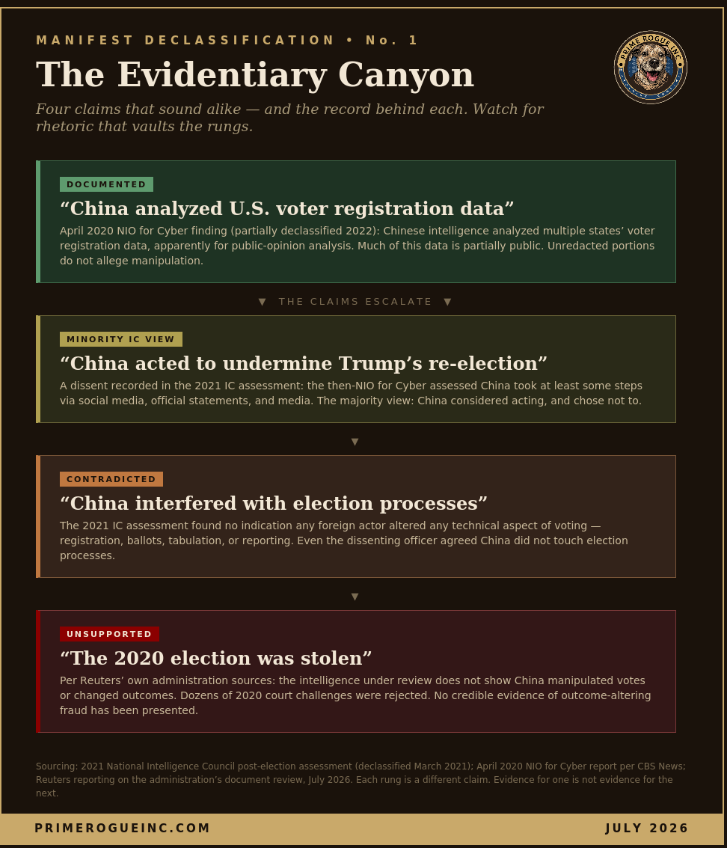
The series starts from the declassified baseline, because the baseline is where the inflation will be measurable. Three anchor points matter.
The National Intelligence Council’s post-2020 assessment — declassified in March 2021 — concluded that China considered attempting to influence the election but ultimately chose not to, and found no indication that any foreign actor altered any technical aspect of the voting process, including registration, ballots, tabulation, or reporting. That report was produced under a framework President Trump himself ordered in 2018.
The same assessment transparently recorded a dissent: the then-National Intelligence Officer for Cyber assessed that China took at least some steps to undermine President Trump’s re-election chances, primarily through social media, official statements, and media. If tonight’s release leans on that dissent, it will be elevating a minority annex — included in the assessment precisely for transparency — into a headline finding. That is a legitimate analytical move only if new corroborating material accompanies it. We will check whether it does.
CBS News reports that an April 2020 finding by the National Intelligence Officer for Cyber — partially declassified in 2022 in heavily redacted form — stated that Chinese intelligence analyzed voter registration data from multiple U.S. states, apparently to conduct public opinion analysis on the 2020 general election. Critically, per CBS, the unredacted portions do not accuse China of manipulating that data or interfering with election processes — and voter registration data in many states is partially public to begin with. “Accessed voter rolls” and “altered an election” are separated by an evidentiary canyon. Watch for rhetoric that vaults it.
Pre-speech reporting from CBS, Reuters, and the Washington Post indicated the release may also include allegations that the CIA withheld China-related findings from the President during his first term, material concerning Venezuela, and claims about voting-machine vulnerabilities. Reuters’ sources were explicit on one point: the intelligence under review does not show China manipulated votes or changed outcomes. That sentence — sourced from inside the administration’s own review — is the yardstick this series will keep returning to.
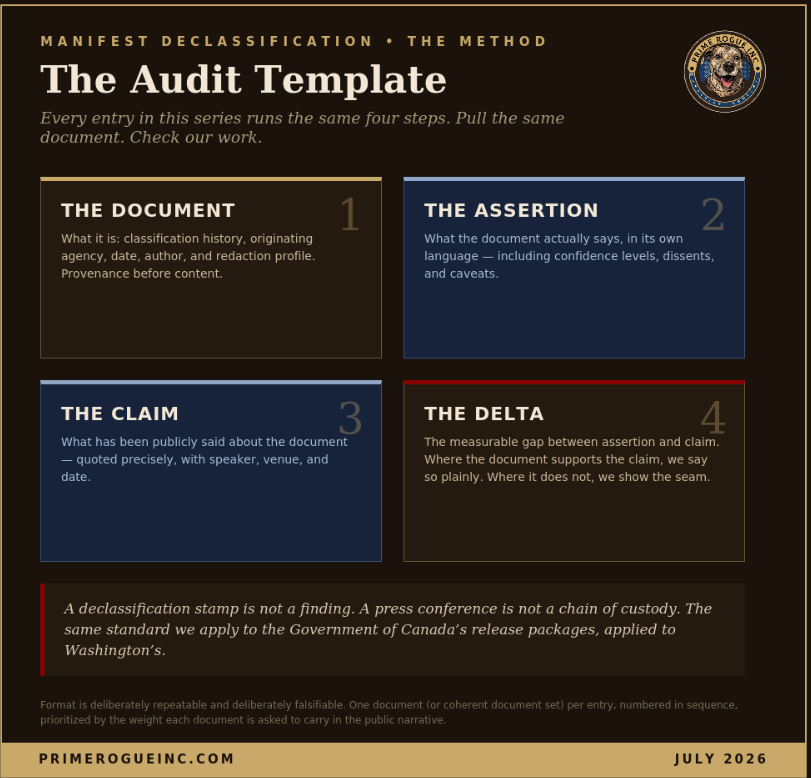
Every entry in Manifest Declassification will follow the same forensic template. One document (or coherent document set) per entry. For each: what the document is — classification history, originating agency, date, and redaction profile; what it actually asserts, in its own language, including confidence levels, dissents, and caveats; what has been publicly claimed about it, quoted precisely; and the delta — the measurable gap between assertion and claim. Where the document supports the claim, we will say so plainly. Where it does not, we will show the seam.
This format is deliberately repeatable and deliberately falsifiable. Readers should be able to pull the same document and check our work. That is the standard we apply to the Government of Canada in our access-to-information practice, and it is the standard we will apply here.
The structural stakes travel with the documents. The address arrives amid an administration push for the SAVE America Act — which would require documentary proof of citizenship to register to vote — and Department of Justice lawsuits seeking detailed voter registration data from numerous states. A foreign-threat narrative about voter data is also, functionally, a justification architecture for federal acquisition of that data. And with the USMCA review underway this very month, Canadians should understand that a Washington narrative of compromised elections is not a domestic American story. It is the epistemic weather in which every file on the continent now gets negotiated. The series will track the policy payload alongside the paper.
Manifest Declassification #2 — a rapid indexing piece cataloguing exactly what was released tonight, in what form, with what redactions — publishes as soon as the release package is in hand. Paired document-versus-claim analyses follow on a rolling basis, numbered in sequence and prioritized by the weight each document is being asked to carry in the public narrative. Companion coverage of the tradecraft and intelligence-community mechanics will run at Signal Cage, with cross-links from each entry.
The White House has framed this release as an exercise in transparency. Prime Rogue agrees that transparency is the correct standard — and transparency has a verification step. The documents are now, or soon will be, public. So is our reading of them. The destiny was declared manifest. The paperwork, as always, gets a vote.
 Manifest Declassification #2: The Interstitial — The Night whitehouse.gov Started Intercepting Its Visitors
 Full Spectrum: Calgary Has Always Been an Intelligence Battleground — Right Now It’s the Most Contested City in Canada
 Tucker Carlson’s Canada Invasion Rhetoric and the MAGA Fracture
 Is the Trump White House Engineering a Recession? A Hard Look at the Data



[…] having withdrawn from the F-3 program and Canada considering alternatives to it due to Donald Trump’s annexation threats and tariff warfare, it is very likely that the NGAD will not be relevant in a […]
[…] viral disinformation campaign. Those mechanisms exist and they matter. But they are not where most foreign interference actually lives. Most of it lives somewhere far less cinematic: inside diaspora communities, working […]
[…] other administration, would have been subject to judicial review, not federal indictment. But under the Trump doctrine of exceptionalism, her real crime was asserting that the judiciary could operate independently of […]
[…] the United States from partner to emergent threat must now be considered a valid line of analysis. Trump’s documented hostility to Canadian institutions, trade sectors (e.g., dairy, lumber, energy), and now […]
[…] primary challenge in assessing the JFK files is distinguishing genuinely new information from previously released material that has been mildly altered or strategically declassified. The […]
[…] the scenes, cardinals are already meeting in informal groups—the Vatican’s version of backroom political deals—deciding who they will back in the upcoming […]
[…] Trump has repeatedly suggested a full U.S. withdrawal from NATO, especially if European countries refuse to meet their spending targets. […]
[…] today, U.S. political figures—from Trump to lower-level Republican lawmakers—periodically float the idea of annexation, whether through economic dominance or outright force. While some see this as bluster, it reflects […]
[…] Trump’s Electoral Victory (January 6, 2025): Vice President Kamala Harris certified Donald Trump’s victory in the 2024 presidential election, marking a significant return to power for Trump under tight national security. The certification […]
[…] 11 — Trump announces strikes are imminent, then cancels them hours later, citing last-minute agreement on […]
[…] Trump claims “diplomatic victory” without full military engagement. […]
[…] president. But where Archibald Cox stood between Nixon and impunity, Powell now stands between Trump and the full political capture of monetary policy. If Trump attempts to remove him — and Powell refuses to […]
[…] Corker, retiring, calls the White House ‘an adult day care center’ and warns Trump could set the country ‘on the path to World War […]
[…] years later, that backbone is snapping. The United States’ renewed withdrawal from UNESCO under the Trump Doctrine in 2025 is not just a procedural divorce from a U.N. agency – it is a symbolic lobotomy of the […]
[…] Trump publicly declaring the agreement “irrelevant” and threatening 100% tariffs unless Canada submits to terms that amount to economic annexation without the courtesy of a formal […]
[…] A Show of Force in Response to Trump’s Annexation Rhetoric (40- […]