Address
304 North Cardinal St.
Dorchester Center, MA 02124
Work Hours
Monday to Friday: 7AM - 7PM
Weekend: 10AM - 5PM

Address
304 North Cardinal St.
Dorchester Center, MA 02124
Work Hours
Monday to Friday: 7AM - 7PM
Weekend: 10AM - 5PM

Before a single document is opened, the delivery infrastructure has already made its argument. Every visitor to the American executive branch’s homepage is now met with a modal window steering them to a contested political narrative — the endpoint of a nine-month escalation that turned the federal government’s front door into a landing page.
Load whitehouse.gov tonight and the site does something no version of itself has done in its thirty-two-year history: it interrupts you. Before the seal, before the news feed, a modal dialog rises over a dimmed White House facade. “Election integrity documents are available for review,” it announces, above two choices engineered with the asymmetry of every subscription pop-up you have ever closed: a bold, filled button reading “View documents,” and beside it, in small underlined text, “Not now.” Not “no.” Not “close.” Not now — the language of postponement, of a decision the site expects you to eventually make correctly.
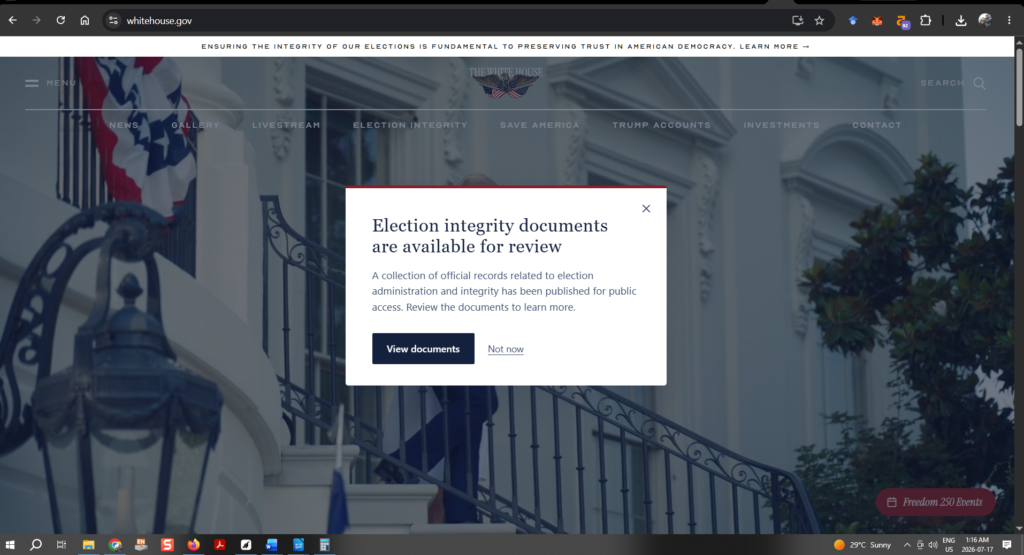
Above the masthead, a site-wide banner runs the thesis in capital letters: ensuring election integrity is fundamental to preserving trust in American democracy, with a “learn more” arrow. The navigation bar now carries ELECTION INTEGRITY as a top-level section alongside SAVE AMERICA — the branding of pending legislation that is also, letter for letter, the name of the President’s political action committee. This entry in Manifest Declassification examines none of the documents. It examines the machine that delivers them — because in a forensic audit, the chain of custody is evidence, and the chain of custody here begins with a pop-up.
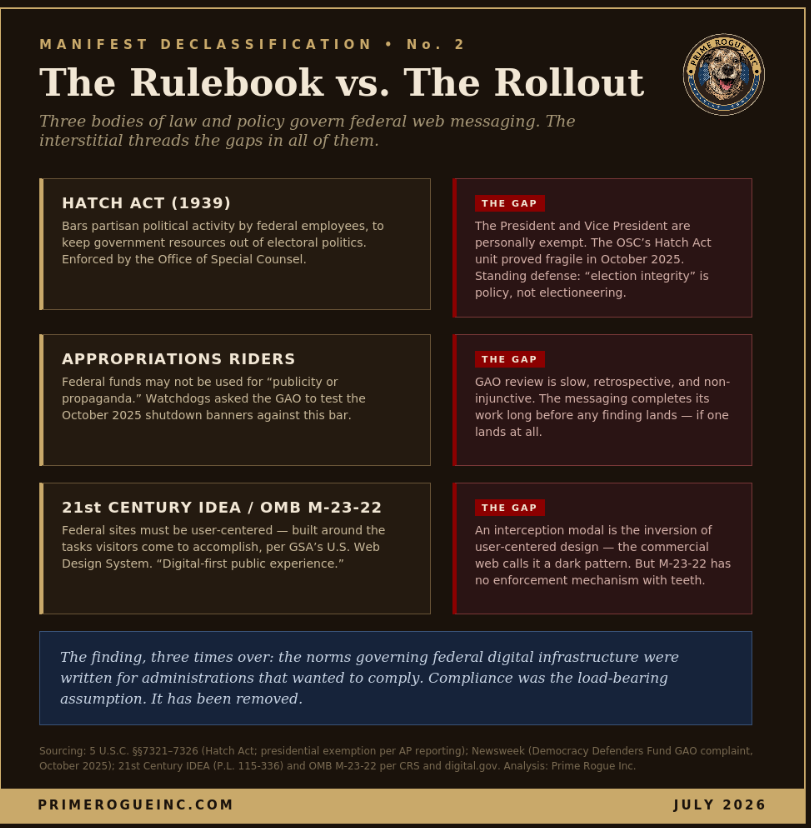
Strip the interstitial to its functions and there are three. First, interception: unlike a page a visitor must seek out, a homepage modal conscripts every visitor, the student looking for a history resource, the tourist checking visiting hours, the citizen looking for a press release, into an audience for the administration’s election narrative. Traffic to the machinery of state is converted into traffic to a political claim. The conversion was working: within minutes of the primetime address, whitehouse.gov buckled under the load, returning “Too Many Requests” errors as the President directed viewers to the site and urged them to call Congress to pass the SAVE America Act.
Second, framing: the modal’s language, “official records,” “published for public access,” “review the documents,” performs neutrality. It borrows the vocabulary of an archive for what PBS described as documents presented without context, comprising selectively released pieces of investigative files, intelligence analysis, and correspondence. The pop-up does not say what the administration claims the documents prove. It does not need to; the President’s address did that. The interstitial’s job is to launder the claim into a records request — to make clicking feel like due diligence rather than persuasion.
Third, capture: the election-integrity page terminates in a mailing-list form promising “new findings, new filings, and next steps” delivered to your inbox, alongside a prompt to text a five-digit shortcode for updates. This is campaign-grade audience infrastructure — acquisition funnel, CRM list, SMS channel — running on the .gov domain of the executive branch. The funnel’s existence is a statement of intent: this is not a document release, it is a subscription product, and tonight’s ZIP files are the first issue.
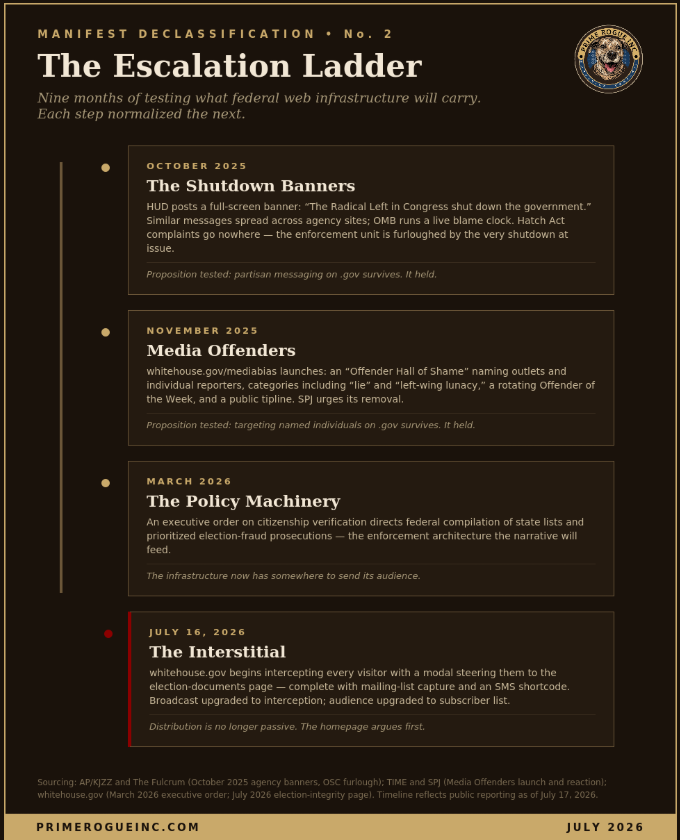
The interstitial did not arrive from nowhere. It is the third rung of a nine-month escalation in the politicization of federal web infrastructure, each step normalizing the next.
In the opening hours of the government shutdown, the Department of Housing and Urban Development posted a full-screen red banner declaring that “The Radical Left in Congress shut down the government,” and similar messaging spread across agency sites; the White House Office of Management and Budget ran a live clock counting the seconds under the message “Democrats Have Shut Down the Government.” Ethics groups filed Hatch Act complaints, which landed in an abyss, because the Office of Special Counsel’s Hatch Act unit was itself furloughed by the shutdown the messaging was about. The banners tested a proposition: that federal websites could carry openly partisan blame-assignment, and nothing enforceable would happen. The proposition held.
The weekend after Thanksgiving, the White House launched whitehouse.gov/mediabias — banner: “Media Offenders”; tagline: “Misleading. Biased. Exposed.” The page names specific outlets and individual reporters in an “Offender Hall of Shame,” classifies coverage under categories including “lie” and “left-wing lunacy,” crowns a rotating Media Offender of the Week, and solicits public reports through a tipline. The Society of Professional Journalists urged its removal, noting the government was punishing journalists for transparently correcting errors — conduct its own ethics code requires. The page tested a second proposition: that the White House site could serve as an instrument targeting named individuals. That proposition held too.
With both propositions established — partisan messaging survives, targeting survives — the third step was distribution: don’t wait for visitors to find the political content, put it in front of every arrival. The pop-up is the shutdown banner’s logic upgraded from broadcast to interception, with a data-capture funnel bolted on. Alongside it, a March 2026 executive order on citizenship verification and the President’s call tonight for the SAVE America Act supply the policy machinery the narrative feeds.
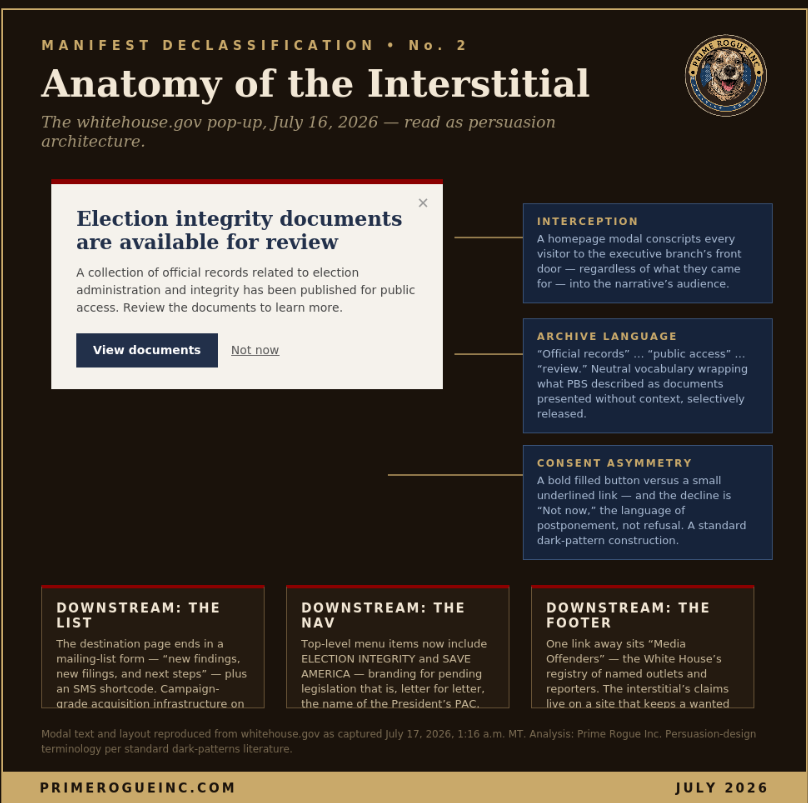
Three bodies of law and policy govern this terrain, and the interstitial threads the gaps in all of them. The Hatch Act of 1939 bars partisan political activity by federal employees, but the President and Vice President are personally exempt, enforcement runs through an Office of Special Counsel whose relevant unit has already demonstrated its fragility, and the administration’s standing defense from the shutdown-banner episode, that criticizing an “ideology” is not electioneering for a party or candidate, previews the argument here: election “integrity” is policy, not politics. Appropriations law bars the use of federal funds for “publicity or propaganda,” and watchdog groups asked the Government Accountability Office to test the shutdown banners against it; those complaints remain the closest live vehicle for challenging this genre of messaging.
Then there is the standard the page fails on its own government’s terms. The 21st Century Integrated Digital Experience Act and OMB’s implementing guidance (M-23-22, “Delivering a Digital-First Public Experience”) require federal websites to be user-centered, designed around the tasks visitors come to accomplish, following the General Services Administration’s U.S. Web Design System. An interception modal that halts every visitor’s task to present unsolicited political content is close to a textbook inversion of user-centered design; the commercial web calls the genre a dark pattern. There is no election-integrity exception in M-23-22. There is also, notably, no enforcement mechanism with teeth, which is the finding, repeated three times now: the norms governing federal digital infrastructure were built for administrations that wanted to comply.
Here is the forensic significance for this series. Documents that carry their own weight do not need an interception layer, an asymmetric consent prompt, and a subscription funnel. The National Intelligence Council’s 2021 election assessment, the baseline document in this record, was released as a PDF through ordinary channels and stood on its contents. Tonight’s release arrives wrapped in persuasion architecture, on a site that maintains a wanted board for journalists one footer link away, under navigation that brands pending legislation with the President’s PAC vocabulary. Axios’s early reality check on the substance points the same direction: multiple documents in the release itself state that large-scale manipulation of U.S. voting systems would be difficult to accomplish without detection — a conclusion the interstitial’s framing exists to outrun.
None of this proves the documents are empty. That determination belongs to the document-by-document audit this series exists to perform, and it begins in the next entry. But the audit’s first recorded observation is this one: before we opened a single file, the state’s own homepage told us how badly it wanted us to reach a conclusion. In an access-to-information practice, when the releasing institution invests more in the presentation layer than the disclosure layer, you read the documents twice.
From this side of the border, the view is unambiguous. Canadians watched American federal agencies blame “the Radical Left” on their homepages in October, watched the White House build a registry of offending journalists in November, and now watch the executive branch’s front door convert into an acquisition funnel for an election-fraud narrative in July, four months before the midterms, with the USMCA review live and Washington’s reliability already a settled question in Ottawa. The infrastructure of the American state is being taught to argue. The documents are next.
Manifest Declassification #3-6 — the full indexing of all four ZIP bundles: every file, format, date, originating agency, classification marking, and redaction profile — is in production now. The paired document-versus-claim audits follow, prioritized by the weight each document is asked to carry. The pop-up promised us the documents are available for review. On that single point, we agree entirely.
 Manifest Declassification #1: Trump’s Declassified Election Documents Get a Full Forensic Audit — From the Country He Wanted to Annex
 Rigged from Washington: How U.S. Disinformation is Engineering Canada’s 2025 Election Takeover
 The “Gulf of America” Gambit – Moronic Genius at Sea
 Tucker Carlson’s Canada Invasion Rhetoric and the MAGA Fracture



[…] These claims are false: Trudeau’s name does not appear in any of Epstein’s records, flight manifests, or the newly unsealed court documents. (He was only included on a dubious “Epstein list” that […]
[…] a feeling of civilizational greatness – the notion that Ethiopia is a “chosen” nation with a manifest destiny, unique for its Orthodox Christian heritage and imperial lineage. This bred a subtle […]
[…] the level of myth.They define who belongs, who doesn’t, who suffered, and who must pay. And they manifest in a unique […]
[…] years, fueled by personal and emotional rhetoric rather than policy debates. This has already manifested in rising hostility toward public officials – from death threats and harassment to physical […]
[…] is aggressive, Pakistan’s counterplay is often to portray its diaspora as under siege. This manifests in university discourse, op-ed campaigns, and sometimes, more worryingly, youth radicalization […]
[…] villagers (often backed by soldiers) have surged, described by one Israeli commander as “a manifest pattern of organized terror.” In 2023, as the Gaza war raged, West Bank violence also spiked – […]
[…] clearance process). CBSA’s Intelligence and Targeting units will have pre-screened passenger manifests for charter flights bringing in delegations, looking for any inadmissible persons or security […]