Address
304 North Cardinal St.
Dorchester Center, MA 02124
Work Hours
Monday to Friday: 7AM - 7PM
Weekend: 10AM - 5PM

Address
304 North Cardinal St.
Dorchester Center, MA 02124
Work Hours
Monday to Friday: 7AM - 7PM
Weekend: 10AM - 5PM
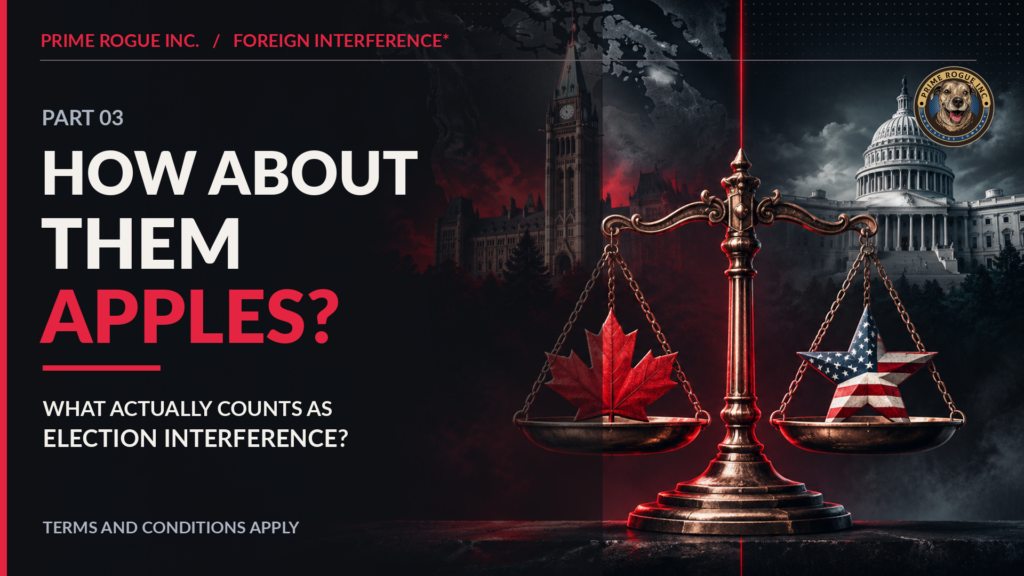
Foreign Interference : Terms and Conditions Apply — Part 03. The scales are editorial imagery, not a legal determination that the cases are equivalent.*
Reader’s note. This article separates documented conduct, official characterization, legal tests and unanswered factual questions. A short In plain English explanation appears in every major section. It credits the original reporters who established the chronology and political relationships, and links to Prime Rogue’s separately published forensic reconstruction. The comparison is general reporting, not a legal opinion or finding that any named person committed an offence.
An American diplomat can lawfully advocate for American interests in Canada. A Canadian minister can publicly exert diplomatic or economic pressure over tariffs. A foreign individual may express views about an election. None of those descriptions, standing alone, identifies a crime. The question is which activity, undertaken by whom, for whose benefit, under what arrangement, with what spending, disclosure and purpose?
That is why the U.S. Embassy’s October 21 fact sheet cannot be treated as a list of proven federal election-law offences simply because it says Canadians have tried to influence U.S. politics. As Alex Boutilier reported for Global News, legal experts distinguished open diplomatic influence from covert or hostile interference. And The Canadian Press’s independently obtained October 20 diplomatic memo showed Ottawa had already imposed special restrictions on its own officials’ contact with American midterm candidates.
There is also no legal shortcut in the opposite direction. The reported U.S. State Department meetings with Alberta separatist representatives, and the Michigan Republican political-technology pitch reported by Carrie Tait, Grant Robertson and Nathan VanderKlippe, establish two distinct channels of American political contact. They do not, by themselves, establish illegal interference under Canadian law. These are separate activities with separate potential legal consequences.
The useful comparison is not ‘Canada did it too’ or ‘America did it too.’ It is: would the relevant law classify this particular conduct differently if the flag were reversed? And if so, is that because of national origin, the type of conduct, or legitimately different statutes?
Figure 1 — Four questions, not one label: political influence, election spending and campaign control, transparency registration, and covert or coercive state-linked interference may be governed by different tests. Source: FEC; Public Safety Canada; FITAA; Elections Alberta.
In plain English: ‘Foreign influence’ describes what a speaker might be trying to accomplish. ‘Illegal election interference’ requires additional facts and a relevant rule. A provocative Embassy statement is not a substitute for identifying that rule.
The American starting point is the Federal Election Campaign Act’s foreign-national rules, administered by the Federal Election Commission. Federal restrictions cover contributions and donations from foreign nationals, campaign-related expenditures and independent expenditures, electioneering-communication disbursements, and involvement by foreign nationals in decisions about election-related activities. The prohibition can reach federal, state and local contests; it is not limited to donations given directly to presidential campaigns.
Yet the same regulator recognizes that a foreign national may generally volunteer unpaid personal services for a campaign, provided the volunteer is not contributing money, making prohibited expenditures or taking part in restricted decision-making. In particular, this is why a photograph of a Canadian politician canvassing for an American candidate does not itself answer every legal question. Whether the person spent funds, received compensation, exercised campaign decision-making authority or otherwise engaged in prohibited conduct would matter.
The FEC’s foreign-nationals legal explanation also distinguishes participation in the democratic process through contributions and expenditures from advocacy about public issues. The litigation in Bluman v. FEC upheld restrictions on specified foreign-national election expenditures; it was not a general ban on a Canadian writing about tariffs or an American election. Particular paid communications, coordination or campaign-directed assistance can change the analysis.
That leaves the October 21 Embassy examples to be evaluated individually. Public pressure by Industry Minister Mélanie Joly for retaliatory tariffs on politically important American regions is overt international trade strategy, even if its architects intend domestic political consequences in the United States. Doug Ford’s advertising likewise requires attention to its content, the entity paying, the context, and its connection, if any, to an American electoral contest. Assertions about individual Canadians improperly voting in past elections belong in an entirely different category: voting eligibility offences, not automatically evidence of an Ottawa-directed strategy.
This is not a declaration that every example is lawful. It is the narrower—and stronger—observation that the Embassy’s publicly reported list contains different kinds of conduct to which different rules may apply. The Embassy has not established in the published material reproduced in this reporting that a specific ministerial remark violated a specified federal campaign-finance provision.
In plain English: Americans can prohibit Canadians from putting money into campaigns or helping run electoral spending decisions without prohibiting every Canadian opinion, government tariff or unpaid campaign volunteer. The line depends on conduct, not the passport alone.
Public Safety Canada calls transparent diplomacy, public communications, lobbying and trade negotiations normal forms of foreign influence. It identifies foreign interference more narrowly as covert, deceptive or coercive activity by foreign governments or those acting on their behalf, directed at Canadian interests. CSIS uses a similar distinction between open lobbying and deliberately covert state-linked activity in its Foreign Interference and You guidance.
That is a national-security description, not a universal legal definition resolving every provincial election-finance or privacy issue. A privately organized foreign-funded advertisement, for example, could raise an electoral-law question even if there were no evidence of a state-directed clandestine operation. Conversely, a foreign official’s publicly acknowledged meeting with a Canadian political group may be political influence without being espionage, coercion or a campaign offence.
The State Department said its reported contacts with Alberta Prosperity Project representatives were routine and that no commitments were made, according to the Financial Times’s reporting. Those explanations matter. So does the absence, in the evidence reviewed, of an instruction tying those diplomatic meetings to the separately reported Michigan technology pitch. Association with political actors does not by itself prove government direction.
In plain English: Not every American attempt to affect Canadian politics is illegal interference. Canada’s own security definition asks whether a foreign state, or someone acting for it, used secrecy, deception, coercion or comparable malign methods. Other electoral and privacy rules can still matter independently.
Alberta’s October 19 referendum had its own legal framework. The Referendum Act framework and Election Finances and Contributions Disclosure Act regulate particular referendum activities. Elections Alberta’s July 8 Interpretation Bulletin No. 9 explains that ‘referendum advertising’ generally means a public advertising message seeking to promote or oppose a specific referendum question. Merely discussing Alberta sovereignty or waving a flag is not necessarily that category of advertising.
A qualifying referendum third-party advertiser generally had to register once it incurred or planned to incur $1,000 or more in referendum advertising expenses, or accepted or planned to accept $1,000 or more in such contributions. Elections Alberta also describes rules concerning eligible contributors, including ordinary Alberta residency for individuals and restrictions for other entities, as well as the treatment of money and in-kind goods or services. Critically, registered political parties, constituency associations and MLAs are subject to different provisions; the third-party rules should not be indiscriminately applied to all political participants.
Therefore, a foreign software business building an Alberta organizing tool is not automatically a registered ‘referendum advertiser.’ The serious questions are who purchased it, whether it was supplied free or at a discount, whether it served to create or disseminate regulated advertising, who reported its costs, and what any relationship to party structures was. Technology supplied for the purpose of promoting a ballot choice may present a different legal situation from ordinary commercial software sold without campaign direction.
Separately, the electoral-list controversy concerns information governance. Rory White at Canada’s National Observer identified approximately 2,000 searchable Alberta records on a 10X Votes subdomain. Jen Gerson at The Line and Jeremy Appel at The Orchard separately reported critical aspects of the much larger Centurion electoral-list controversy. Prime Rogue’s Full Spectrum 02 forensic reconstruction later identified U.S.-hosted Azure application processing. These are not proof that both datasets came from one source or that the database was physically stored in Virginia.
Figure 2 — Canadian and U.S. law regulate different acts: campaign finance and decision-making, Alberta referendum advertising, foreign-influence transparency, and data access. These categories should not be collapsed into one legal conclusion.
In plain English: The first legal question about an Alberta app is often not ‘Was the app American?’ but ‘Who provided it, paid for it, used it, and reported it?’ A separate question asks who had lawful authority to collect, handle and disclose the voter information.
The Foreign Influence Transparency and Accountability Act (FITAA) came into force August 4, 2026. Its central object is transparency about arrangements involving foreign principals and activities directed at Canadian political or governmental processes, explicitly including referendums. The Act is not a blanket ban on foreign citizens speaking to Canadians, nor is an American private company automatically a ‘foreign principal’ just because it is incorporated in Michigan.
The Foreign Influence Commissioner’s guidance on registrable arrangements requires an arrangement under a foreign principal’s direction or in association with that principal, a covered influence activity, and a Canadian political or governmental process. Officials emphasize that a meeting, shared policy position or parallel advocacy does not, on its own, create an arrangement. The Commissioner’s guidance on foreign principals refers to foreign states, foreign powers and qualifying entities under the statutory definitions—not nationality alone.
Timing matters. The Commissioner’s September 22 statement noted that qualifying pre-existing arrangements still active when the regime began were to be registered by October 3, 2026; newly formed qualifying arrangements generally have a 14-day registration period. Alex Boutilier at Global News reported the Commissioner’s outreach concerning the Alberta referendum. That reporting and the official statements do not identify a specific noncompliant American operator.
There is an especially useful question for the next stage of this investigation: Was any qualifying arrangement with a statutorily defined foreign principal active on August 4 or entered afterward? If so, what was its registered purpose, who provided money or facilities, and what was disseminated about the referendum? The answer requires facts about relationships and activities, not a DNS record. Prime Rogue has not established that any named person failed to comply.
Figure 3 — The 2026 transparency timeline. The deadline applies only to qualifying arrangements under the Act; it does not automatically apply to every U.S. citizen, public statement, or commercial transaction.
In plain English: A new Canadian registry can require some foreign-influence arrangements to be publicly declared—even where the advocacy is lawful. But the existence of an American relationship or an American server alone does not settle whether a filing was required.
American law has at least two important and distinct lanes. The FEC’s foreign-national campaign-finance rules address specific election conduct. The U.S. Foreign Agents Registration Act (FARA) generally addresses registration and disclosure by agents engaged in specified activities in the United States at the request, direction or control of foreign principals, subject to statutory definitions and exemptions. It does not mean every Canadian newspaper with U.S. readers is secretly acting as an agent, nor does registration itself mean the registrant has committed espionage.
The Canadian FITAA is another distinct transparency regime, operating under Canadian definitions and timelines. Comparing these regimes can reveal differences in transparency expectations, but legal equivalence cannot be presumed. A requirement applying to a foreign agent lobbying in Washington is not automatically identical to one applying to a registrable influence arrangement in Edmonton. Nor does either automatically make a private reporter working independently for a Canadian publisher a campaign participant.
In plain English: Campaign donations, lobbying disclosures and foreign-influence registration are different legal categories. If someone says ‘foreign interference,’ ask which category they actually mean—and which statute they believe has been engaged.
Prime Rogue sought comment from the U.S. Embassy concerning its October 21 allegations, the distinction between influence and election interference, and the comparison with American activity in Alberta. In a new response expressly authorized for attribution on background, a U.S. Embassy spokesperson stated:
“We have nothing additional to offer outside of what is contained in the fact sheet.”
That statement is attributed to a U.S. Embassy spokesperson, not to the individual press officer by name. It should not be read as an admission, a legal ruling, or a response to articles the Embassy had not yet received. Nor does it assert that the Embassy declined all further contact. It communicates that the Embassy supplied no additional explanation beyond the already published fact sheet in that reply.
That leaves a precise public question: Did the Embassy allege an actual statutory violation by a Canadian government actor, or did it use the broader language of election interference to object to overt Canadian political pressure? The government may legitimately criticize foreign politicians’ conduct. Journalism may legitimately ask it to say what legal or policy standard underlies the criticism.
In plain English: The Embassy did respond. Its publishable position was to refer readers back to its fact sheet. That is not silence—and it is not an answer identifying a particular offence.
The fairest analysis applies identical questions, not an invented single global law. For each Canadian example and American counterpart, identify the actor; the overt or concealed nature of the activity; any money, resources or campaign decisions; any foreign-government instruction or registrable arrangement; the election or referendum affected; and the governing law. Then acknowledge which evidence is missing.
Consider three illustrations. Canadian tariff strategy: public governmental economic pressure may be designed to have domestic American political consequences, but without proof of prohibited U.S. election spending or campaign control its rhetoric should not be treated as proof of a FECA offence. U.S. diplomatic meetings with Alberta separatists: reporting confirms the contacts, but the State Department characterized them as routine and denied commitments; a meeting alone is not a FITAA finding or proof of covert national-security interference. Michigan political software associated with Alberta voter searches: this is a documented technological and political connection worth investigating under relevant finance, electoral-information and transparency rules, but account control, financing, record provenance and U.S.-government direction remain unresolved.
This is precisely where Full Spectrum 1 and Full Spectrum 1.1 supply the diplomatic chronology, while Full Spectrum 02 and its open evidence repository supply the technical record. Original Canadian reporters supplied the first dataset discoveries and interviews; Prime Rogue’s analysis is an additional layer, not a substitute for their work.
Figure 4 — A repeatable six-question evidentiary test. The final box reads ‘Apply the law; do not infer guilt from association.’ It is a newsroom checklist, not a legal adjudication.
In plain English: A politician saying something unpopular, a foreigner owning a server and a government running a covert operation are not interchangeable. Use the same analytical checklist on both sides—and then apply the law that actually governs each event.
The unanswered questions are now narrower and more useful. Did any named Canadian activity in the Embassy’s list involve prohibited U.S. election spending or decision-making? Did any Alberta-related U.S. private-sector technology support amount to regulated referendum advertising, a reportable in-kind contribution or another violation? Did a qualifying FITAA arrangement continue past August 4? Who funded the application, controlled its Azure subscription and supplied the Alberta records? Did any government actor direct the private operation? No published finding reviewed here answers those questions conclusively.
Part 1, Keep Your Nose Out, establishes the immediate controversy. The earlier Full Spectrum 1.1 investigation supplies related documentary context. Part 2, Meanwhile, in Alberta…, separates documented U.S. official contacts from private American political technology involvement. This Part 3 identifies the relevant legal tests. Part 4 — How to Legally “Interfere” in an American Election will use carefully sourced satire to explain the difference between lawful Canadian journalism and electoral conduct U.S. law restricts.
Foreign Interference and Full Spectrum remain separate but complementary series. Full Spectrum 1 continues political accountability reporting; Full Spectrum 2 continues technical network investigation; and Full Spectrum 3 will examine the human networks behind the digital infrastructure. No future article should be represented as already published until its actual URL is live.
We asked how the rules apply in both directions. The answer isn’t a slogan. It’s a set of statutes, factual thresholds, and unanswered questions.
—————————————————————————


[…] argument is not that foreign involvement in an election is harmless. Federal election law does prohibit specific activities by foreign nationals. The Federal Election Commission’s guidance […]