Address
304 North Cardinal St.
Dorchester Center, MA 02124
Work Hours
Monday to Friday: 7AM - 7PM
Weekend: 10AM - 5PM

Address
304 North Cardinal St.
Dorchester Center, MA 02124
Work Hours
Monday to Friday: 7AM - 7PM
Weekend: 10AM - 5PM
This article places a non-technical explanation in each substantive section, gives priority to source-linked original reporting, and distinguishes Prime Rogue’s technical findings from the discoveries of other Canadian journalists. It also asks ‘Is this election interference?’ using a provisional Admiralty-style reliability-and-credibility assessment of individual evidence claims. Those ratings do not decide legality, motive, electoral impact, or anyone’s responsibility; competent authorities and courts make those determinations.
The documented facts support American private-sector participation in Alberta political organizing and identify an Alberta-linked voter-search application hosted in Virginia. Whether any particular act crossed a statutory or national-security threshold for interference is a separate, unanswered question. Canada distinguishes ordinary foreign influence from covert, deceptive or coercive interference.
An Alberta-linked voter-search application ran on Microsoft Azure infrastructure in Virginia and shared identifiable technical characteristics with a Michigan Republican political technology operation promoted during Donald Trump’s 2024 campaign. Separately, a contemporaneous archive records apparent Centurion event-registration activity on the evening of an Alberta court injunction. The evidence establishes a cross-border technical relationship; it does not establish U.S. government direction, the location of the underlying database, or a breach of that injunction.
An application through which names and residential addresses of roughly 2,000 Albertans could be searched was hosted on a Microsoft Azure web application in Virginia, inside the wider 10X Votes technical environment used for American political organizing, a Prime Rogue examination of public infrastructure records has found. The application drew on software developed for Michigan, shared distinctive Azure domain-verification records with applications serving other U.S. jurisdictions, and was associated with a company whose political relationships reach into Donald Trump’s Republican network.
Those relationships are documented, not inferred from an IP address. In an investigation for PressProgress, Luke LeBrun traced 10X Votes’ Michigan Republican connections and reported that Pete Hoekstra, now U.S. ambassador to Canada and previously Michigan Republican Party chair, promoted the application during the 2024 Trump campaign. Hoekstra acknowledged that promotion but denied involvement in its Canadian activities or any financial relationship with the platform. In a separate Globe and Mail investigation, Carrie Tait, Grant Robertson and Nathan VanderKlippe documented a January meeting between Michigan Republican political technology representatives and Alberta separatist organizers. The independently reported relationships establish association, not government direction of the Alberta deployment.
Prime Rogue’s contribution is a narrower but consequential technical finding: the Alberta-linked 10X Votes application was not merely an idea borrowed from Michigan. Public DNS, archived software assets, and certificate-transparency records connect it to a U.S.-hosted application environment. A user interacting with its archived login endpoint would submit credentials to the Azure application in Microsoft’s East US region; related archived search software demonstrates a server-side voter-lookup design. The physical location of the database behind that web application remains unknown. The cross-border application-processing question does not disappear because its database address is not publicly visible.
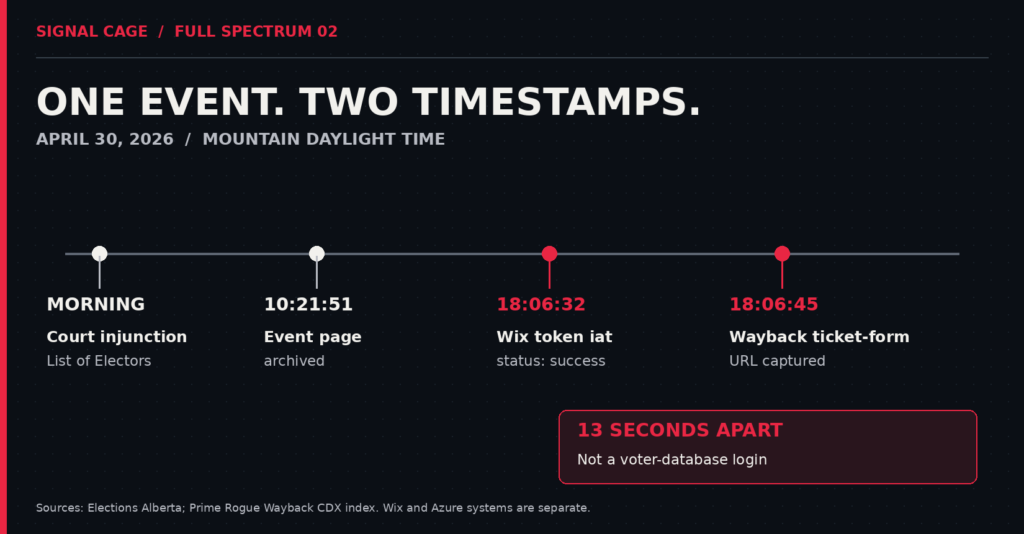
A second, independent finding emerged from the preserved Centurion Project website records. On April 30, 2026, after the Court of King’s Bench granted an emergency injunction against access to and use of Alberta’s provincial List of Electors, a Wix event-registration record associated with Centurion’s scheduled evening organizing session carried a 6:06:32 p.m. Mountain Daylight Time token-issuance timestamp. The Internet Archive captured the corresponding ticket-form URL at 6:06:45 p.m.—13 seconds later. That is evidence of an apparently active event-registration workflow. It is not evidence that the prohibited voter-list application was still being used or that the injunction was violated.
These two stories—an American political software deployment and an Alberta organizing system that left a post-injunction transaction trace—must be investigated together, but not collapsed into one system or one allegation.
Agency responses, October 2026: The RCMP confirmed to Prime Rogue that its investigation continued with no charges as of October 23. Alberta’s privacy commissioner confirmed that its investigation remained open; Elections Alberta cited statutory restrictions on commenting. None publicly established the scope of inquiries into skcn or the Wix reservation. Their responses and the unanswered requests are documented below.
The question is legitimate—and it is not answered simply by observing an American IP address. Luke LeBrun’s original reporting establishes that American political technology figures had relationships with Alberta separatist organizers; Prime Rogue’s DNS reconstruction establishes U.S.-hosted application infrastructure associated with an Alberta voter-search tool. Together, those findings document a cross-border political technology relationship. They do not independently show who supplied the personal information, who commissioned each deployment, or whether the technology changed any vote.
Americans can take part in Canadian political debates and seek to influence opinion without necessarily violating Canadian law. The relevant questions are what they actually did, whether it involved prohibited data use, payments or regulated referendum advertising, and whether there was concealed, deceptive, coercive or foreign-state-directed activity. A digital connection tells us where and how technology operated—not by itself why it operated or whether a law was broken.
The word influence describes an effort or capacity to shape political activity; it is not interchangeable with a finding of interference. Public Safety Canada distinguishes normal foreign influence from covert, deceptive or coercive conduct undertaken by foreign governments or persons acting on their behalf. Alberta’s October 19, 2026 vote was a provincial referendum, not a federal general election. Separate referendum advertising and third-party registration rules may matter, depending on the conduct, funding, timing and legal identity of the participants. Neither regime is automatically triggered by the existence of an American server.
The Admiralty Code is a two-part intelligence-reporting convention: A–F describes the assessed reliability of a source; 1–6 describes the credibility of a specific item of information. These are Prime Rogue’s provisional editorial grades, not official intelligence assessments. B2, for example, means ‘usually reliable source; information assessed as probably true.’ We do not assign an alphanumeric grade to a legal judgment, nor interpret an unproven allegation as disproven.
| Rating | Specific evidence claim | Source / limitation |
| B2 | The skcn application resolved to Azure East US (Virginia) in the October 22 snapshot. | DNS inventory; Azure naming. A documented hosting configuration, not a database-residency finding. |
| B2 | Alberta, Wisconsin, Pennsylvania and hn hosts published the same Azure domain-verification value; Michigan shares code and a scale unit but no matching observed TXT record. | DNS inventory; archive captures; certificate data. Strong common-environment evidence, not ownership identification. |
| B2 | American private political technology figures had documented relationships with Alberta separatist organizing. | Luke LeBrun’s interviews and attributed reporting; other independently reported meetings. Political association, not direction by the U.S. administration. |
| B3 | The archived Centurion Wix records indicate post-injunction activity in a separate event-registration workflow. | Wayback index; injunction chronology. The encoded reservation status and near-synchronous capture support the event-workflow finding; the precise backend transaction and injunction compliance remain unsettled. |
| Not graded | U.S. government direction; unlawful foreign election interference; an actual effect on the October 19 vote. | Insufficient underlying evidence to evaluate these propositions or make legal findings. ‘Not graded’ does not mean ‘false’. |
A grade is not a probability of criminal liability or a score for political wrongdoing. It is a statement about the evidence for the narrower claim in that row. Our source files are public and reproducible; their limitations are documented. The strongest technical findings concern the hosting configuration and shared application indicators. Findings about intent, access, financing and legality require records not presently available.
Our assessment: The published record supports describing this as documented American private-sector involvement in Alberta political organizing, with a verifiable U.S.-hosted application supporting Alberta voter-search functionality. It also supports investigating whether any of that conduct amounted to prohibited electoral activity or foreign interference. Prime Rogue does not conclude that foreign election interference occurred, that any particular American committed an offence, or that the Trump administration directed the activity.
The timing deserves care. The infrastructure records document an application already present in March 2025, while the October 2026 referendum’s separation-process question was formally set later. The available material does not establish that the original application was commissioned specifically to affect the October 19, 2026 ballot, even though the political organizing and the eventual referendum concern overlapping separatist issues. Alex Boutilier reported for *Global News* that Canada’s foreign-influence commissioner was aware of concerns about that referendum; awareness of concerns is not an official determination about 10X Votes or Centurion.
Jen Gerson of The Line independently examined evidence of the larger Centurion voter-file exposure and says she alerted Elections Alberta on March 31. Jeremy Appel of The Orchard attended Centurion’s April 29 launch and reported the Elections Alberta intervention firsthand. Karen Bartko of Global News reported the April 30 injunction and court arguments. Rory White of Canada’s National Observer personally registered with the separate 10X Votes site and discovered approximately 2,000 searchable Alberta records. Luke LeBrun of PressProgress established the political relationships, including Hoekstra’s promotion and denial. Carrie Tait, Grant Robertson and Nathan VanderKlippe of The Globe and Mail investigated meetings between Michigan Republicans and Alberta separatist organizers. None of those discoveries should be credited to Prime Rogue.
A reconstruction of the Alberta-linked application’s DNS route into Azure East US; comparison of Azure domain-verification records, Michigan-related software artifacts and certificate timing in the revised technical analysis; and a separate chronology of Centurion’s Wix event-registration evidence on April 30. These are publicly reproducible infrastructure and archival findings, not a claim that Prime Rogue independently viewed the voter records.
Who supplied the roughly 2,000 records; where the associated database was stored; who legally controlled the Azure subscription; whether the smaller dataset came from the protected electoral list; whether any U.S. official directed the Canadian deployment; and whether Centurion’s separate Wix event-registration activity violated the injunction.
The smaller Alberta dataset was first documented by Rory White for Canada’s National Observer, whose May 20 investigation described roughly 2,000 searchable names and addresses on skcn.10xvotes.com, concentrated around Red Deer and central Alberta. White reported that about 150 records were marked as ‘claimed’ and that the site went offline after the outlet alerted Elections Alberta. This discovery—and not an inference from the DNS records—establishes that the application exposed Alberta-linked personal information.
Rory White first found Albertans’ names and addresses in a 10X Votes search tool. Prime Rogue later identified the American cloud location of the application that presented that tool. A website can process requests in Virginia even if its database is stored somewhere else. These findings do not establish the location of every stored copy.
That smaller collection must not be silently equated with the separate Centurion Project application that exposed information about nearly 2.9 million Albertans. The origin of the `skcn` records has not been established; the National Observer reported differences between that dataset and identifiable fields on the provincial electoral list. It remains an open question whether the records had a common source, overlapping copies, or independent collection histories. The broader Centurion controversy was exposed through original reporting by independent Edmonton journalist Jeremy Appel at The Orchard after he attended the April 29 launch. Separately, The Line co-founder Jen Gerson published her March 31 warning to Elections Alberta; Global News journalist Karen Bartko later reported on that disputed investigative timeline.
Prime Rogue reconstructed the public infrastructure on October 22, 2026, using DNS responses, certificate transparency, and archived application pages. The complete evidence inventory and interpretation are published in the Full Spectrum evidence repository, including the revised Phase 2 analysis and the raw DNS inventory.
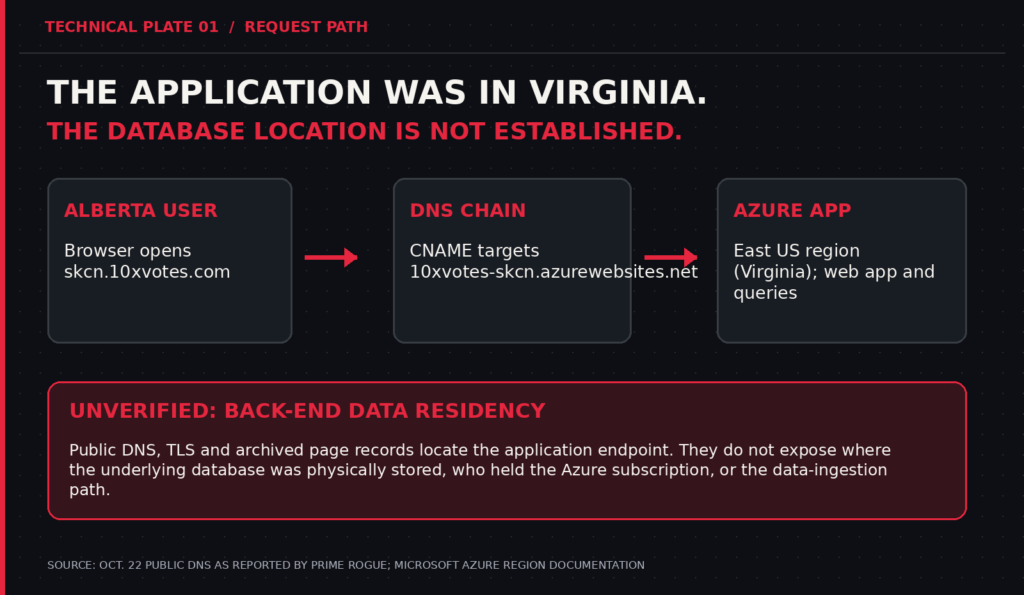
The October 22 DNS response for skcn.10xvotes.com resolves through the following chain:
skcn.10xvotes.com
-> 10xvotes-skcn.azurewebsites.net
-> waws-prod-blu-319.sip.azurewebsites.windows.net
-> waws-prod-blu-319-7e61.eastus.cloudapp.azure.com
-> 20.119.0.3
The azurewebsites.net hostname identifies Microsoft’s Azure App Service. The eastus.cloudapp.azure.com designation identifies Azure’s East US region, which Microsoft locates in Virginia. This is the location of the application endpoint exposed through the DNS record—not, by itself, proof of where a linked SQL database, object store, or backup resided.
The browser-facing application matters. The archived March 7, 2025 login page used ASP.NET Core Identity and posted the login form back to the same application host. Related archived search code from the Pennsylvania deployment sent lookup requests to a /voterinfo endpoint and exposed filters for names, addresses, ages, counties, and townships. Together, the records support U.S.-hosted application processing of Alberta-linked interactions; they do not constitute historical packet captures of each individual query or proof of the database’s storage region.
A cloud IP address can be shared by thousands of customers. It would be a mistake to infer common ownership from a common Azure server alone. The stronger attribution comes from several different, mutually reinforcing records.
Sharing a cloud-server address is like two companies renting space in the same building; it proves little about who manages them. The matching Azure verification code on four domains is more like a shared administrative identifier. Michigan lacks that specific match, but the software and hosting records connect it to the same product family.
First, the Alberta, Wisconsin, Pennsylvania, and unidentified hn subdomains published the same 64-character Azure custom-domain verification value in their asuid TXT records. These are domain-ownership verification tokens used to bind custom hostnames to Azure App Service. The identical value is strong evidence that the four hostnames were configured within a common administrative context; Prime Rogue’s analysis attributes that context to a common Azure subscription. Microsoft’s documentation confirms the purpose of the verification records, although the public DNS record cannot identify the person or legal entity paying the Azure account.
Second, those applications—and Michigan’s mi.10xvotes.com deployment—resolved to the same Azure App Service scale unit, waws-prod-blu-319, at IP 20.119.0.3. This supplies infrastructure context but is not, by itself, ownership evidence. Michigan did not publish the matching asuid record; Prime Rogue cannot verify Michigan’s subscription identity in the same way as the other four hosts.
Third, software artifacts connect the Alberta application to Michigan. The March 2025 `skcn` login page requested a stylesheet named MiFamilyVotingWebsite.styles.css, an ASP.NET Core build artifact tied to the Michigan project’s name. Archived pages from other jurisdictions carry the same stylesheet family and related application assets. This is evidence of a shared or reused software lineage, not proof that one named developer personally deployed every instance.
Fourth, certificate-transparency records show coordinated maintenance. In December 2025, skcn acquired a certificate expiring April 14, 2026; the American jurisdiction apps obtained certificates expiring on the same date. On February 23, 2026, all five jurisdiction hosts received certificates on the same day with the same August 23 expiry. This is consistent with an application fleet managed together. The records cannot identify who clicked the renewal controls, and synchronized expiry dates alone would not prove a single administrator.
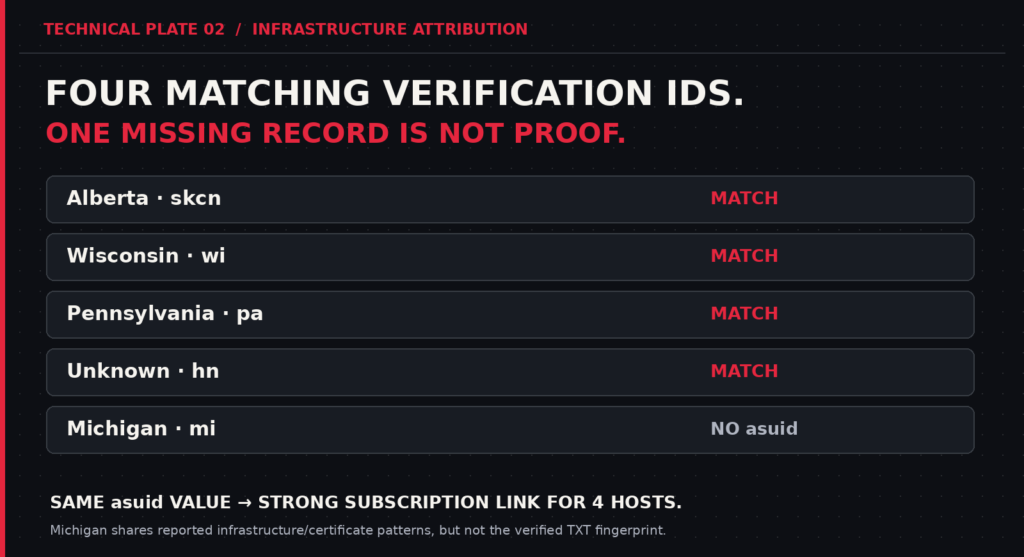
asuid record.The technical attribution, taken together, is substantial: a Virginia-hosted Alberta application, matching Azure verification values with three U.S. jurisdiction apps, Michigan-derived code, and coordinated certificate timing. The evidence supports a common 10X Votes technical operation. It does not establish the Azure subscription’s legal owner, individual administrators, payment arrangements, or access logs.
10X Votes is not an anonymous technical contractor. In his May 18 investigation for Canadian independent outlet PressProgress, Luke LeBrun identified 10X Votes as an operating name of Voteatron LLC, named Michigan organizers Drew Born and Drew Wierda, and quoted Alberta organizer David Parker’s account of sustained contact with the American group. These are attributed statements and reported organizational relationships, not evidence of a U.S. government instruction to deploy the Alberta application.
The people and platform had documented relationships within pro-Trump Republican politics. That does not mean President Trump, his administration, Ambassador Hoekstra or any particular supporter ordered or operated the Alberta application. Political association and operational responsibility are different findings.
During the 2024 U.S. presidential race, then-Michigan Republican Party chair Pete Hoekstra publicly promoted 10X Votes to supporters of Trump and JD Vance. In comments to LeBrun at PressProgress after the Canadian controversy emerged, Hoekstra acknowledged that promotion while saying he was unaware of the collaboration in Alberta, had no financial relationship with 10X Votes, and had no personal involvement in its operation. His denial is as much a part of the evidentiary record as the promotion itself.
Born’s organizational and political associations extend into Michigan Republican politics. PressProgress reported that Born and Hoekstra were both directors of the Mecosta Environmental and Security Alliance. The publication also documented endorsements and promotional exposure from figures in the pro-Trump political-media ecosystem. Wierda has been reported as a relative of Erik Prince and Betsy DeVos, who served in Trump’s first administration. These ties establish relationships or exposure; none of them, by itself, establishes knowledge of or responsibility for the Alberta deployment.
That is the critical line of attribution:
The January 2026 Calgary meeting is independently reported by Carrie Tait, Grant Robertson and Nathan VanderKlippe in The Globe and Mail: Michigan Republican strategists demonstrated 10X Votes technology to Alberta separatist organizers. The same investigation separately reported meetings between Alberta separatist figures and the U.S. State Department. Those are distinct strands of evidence. No public technical record reviewed here connects the State Department meetings to financing, administration or access to skcn, and the U.S. ambassador denied involvement with 10X Votes in Canada.
The Centurion Project operated a public-facing website on Wix. It is not the same host, application or demonstrated database as skcn.10xvotes.com. But its archived event-registration records yield a chronology that deserves scrutiny in its own right.
The archived record indicates Centurion’s event sign-up system generated a successful-reservation marker on the evening of the injunction. It is not a sign-in to the voter database. The event series existed beforehand, and the record does not prove a person attended, used the prohibited list or breached the court order.
Elections Alberta’s April 30 chronology states that the agency sent a cease-and-desist direction on April 28, served notice again at Centurion’s April 29 Edmonton meeting, and obtained a Court of King’s Bench emergency injunction on the morning of April 30 against further access to or use of the provincial List of Electors. The order also required disclosures about recipients and access. Global News reporter Karen Bartko documented the court proceedings and the takedown. Elections Alberta said the portion of Centurion’s site exposing the list was no longer accessible; the full entered court order is necessary to assess any alleged breach.
Prime Rogue examined Internet Archive CDX records preserved in its repository. The site advertised a series called Do You Want to Be a Centurion. Its general event page was already archived on March 19, and a page for the April 16 session by April 14. Thus, the broader recruitment series plainly predates the court order. The April 30 session page itself was archived at 10:21:51 a.m. MDT on April 30; the event’s original creation date is not established.
The more notable record is associated with the April 30 session, scheduled for 7 p.m. MDT. A URL later captured by the Wayback Machine contains a signed-format event-reservation token encoding status: success, an order identifier, and an issuance timestamp of May 1 at 00:06:32 UTC, or April 30 at 6:06:32 p.m. MDT. A corresponding ticket-form URL appears in the CDX index with a capture timestamp of May 1 at 00:06:45 UTC—13 seconds later. The associated success and expired-link URLs were subsequently archived on May 5.
These are two mutually consistent timestamp indicators in the preserved website record. Their close spacing substantially strengthens the inference that an event-registration workflow remained operational that evening. The token’s signature has not been independently cryptographically validated against Wix’s signing key, and the archive does not identify the registrant or prove attendance. It also does not establish that any protected voter-list information was used in the registration.
The finding is therefore specific: a separate Centurion Wix event-registration workflow left an apparent successful reservation record after the injunction was granted. It is not proof of a prohibited voter-list login or a judicial-order violation.
The outstanding questions are straightforward: Which Centurion systems were disabled and when? Did recruitment or outreach after April 30 rely on data from the List of Electors? Was the April 30 session actually held? And what does the entered court order require? Prime Rogue has not reached a legal conclusion on this record.
A separate compliance concern was reported on May 13 by Jack Farrell and Lisa Johnson of The Canadian Press. Elections Alberta spokesperson Michelle Gurney said the agency had information suggesting Centurion’s court-ordered disclosure of people who accessed the voter-list database was incomplete; the reporters also documented an apparent omission involving a Canadian Press journalist. That is evidence of a distinct, officially raised compliance concern, not proof that the April 30 Wix registration breached the injunction.
The relevant privacy issue is not limited to whether a database file was permanently stored in Virginia. A U.S.-hosted application can receive identifiers and credentials, process queries, and return personal information across a border without the public DNS record showing where the persistent data store is physically located. What matters for accountability is who collected or disclosed the personal information, who controlled its processing, which services received it, and whether that handling was authorized.
Sending voter-search requests to an American-hosted application can raise Canadian privacy and accountability questions even when the location of its database is unknown. But using a U.S. cloud provider is not automatically illegal, and different organizations may fall under different laws.
Cross-border processing is not automatically unlawful. Applicable rules depend on which organization controlled the information, its authority to collect and use it, any required disclosure or notice, and the safeguards governing service providers. The Alberta Information and Privacy Commissioner’s May 7 investigation notice identified collection, use, disclosure, security, and notification as issues regarding Centurion under PIPA. It did not announce findings of a breach.
Alberta privacy commissioner Diane McLeod has said that provincial political parties are not covered by Alberta’s Personal Information Protection Act (PIPA), a longstanding gap. Sean Boynton reported the statutory gap and Canadian privacy watchdogs’ calls for reform for Global News. That exemption should not be conflated with the legal position of a separate company, service provider or other organization. Determining which privacy duties applied to 10X Votes, Voteatron LLC, Centurion and the Republican Party requires separate legal analysis; the existence of an American server, by itself, establishes no violation.
This is also why the two datasets cannot be treated as interchangeable. The official List of Electors case concerns approximately 2.9 million Albertans. Rory White’s National Observer `skcn` discovery concerned approximately 2,000 records, and their provenance remains unresolved. A legitimate investigation should test a connection between them, not presume it.
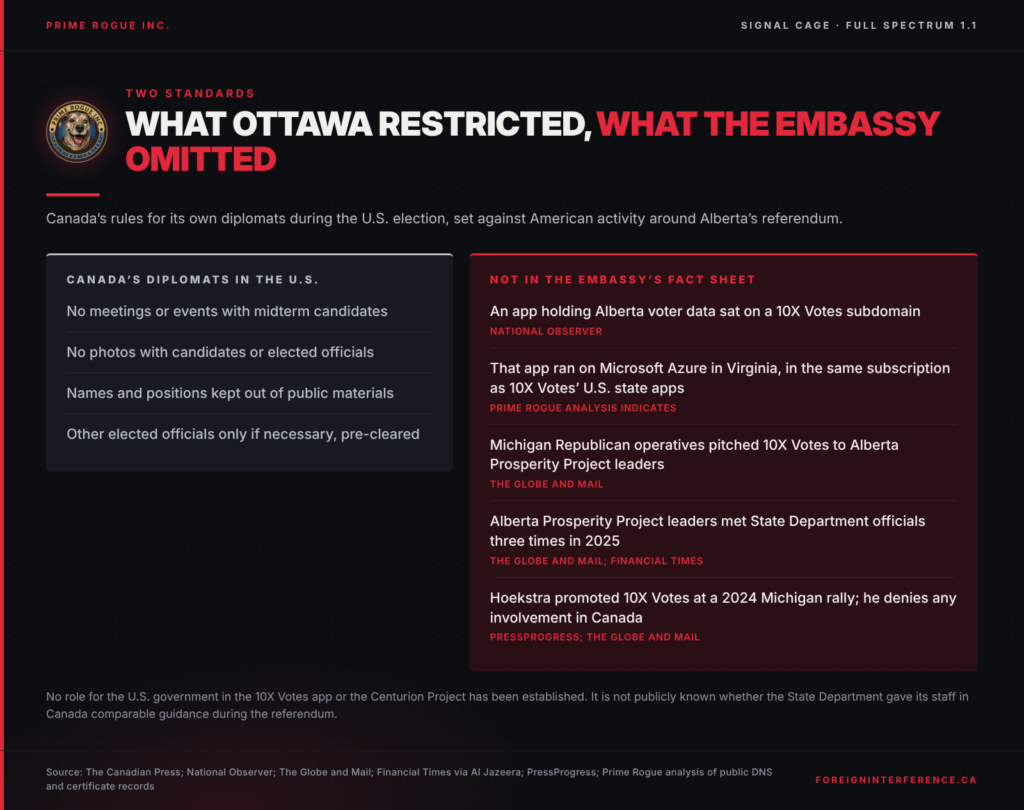
The U.S. Embassy’s October 21 fact sheet characterized public Canadian tariff proposals, political meetings and advertisements as plans to influence U.S. politics ahead of November’s midterms. The dispute’s trade-policy context had been examined independently by Global News investigative reporter Ashleigh Stewart, who reported from U.S. communities affected by Canada’s tariff response. The Embassy document did not address Alberta, 10X Votes, Centurion or the separately reported State Department meetings with Alberta separatists. That omission is observable; it does not establish official knowledge or concealment.
The Embassy publicly objected to certain Canadian political activities but did not discuss the Alberta technology case. That is a documented omission, not proof it knew about the application or secretly supported it. The comparison asks whether officials are applying a consistent definition of influence.
An omission does not establish concealment or knowledge. It does, however, leave a question of analytical consistency. If foreign political influence is considered a matter of public concern when Canadian ministers or premiers exert pressure in the United States, what standard should be applied to documented American private-sector electoral organizing technology deployed in Alberta, and to the acknowledged American government contacts with separatist representatives? Global News’s October 19 referendum coverage by Karen Bartko and Ashleigh Stewart documents the provincial vote’s electoral setting; it does not independently establish anything about the skcn application’s ownership or operation.
The U.S. government’s election-interference allegations and the Canadian voter-data controversy are not legally identical. The appropriate comparison distinguishes public diplomacy, private political organizing, data-processing and privacy compliance, and government direction or covert interference. Conflating them would produce the same conceptual error that the comparison is meant to investigate.
Investigators have confirmed that they are still examining the Alberta electoral-list matter, but they have not publicly answered whether the Virginia-hosted application or the April 30 Wix registration falls within their work. A refusal or inability to discuss an active investigation is not a finding that a person did—or did not—break the law.
In an October 23, 2026 email to Prime Rogue, Fraser Logan, Alberta RCMP media relations manager, confirmed that the investigation into alleged misuse of Alberta’s List of Electors continued and that no charges had been laid as of that date. Logan said the RCMP could not publicly discuss investigative avenues, ‘including geographical locations.’ He supplied the force’s earlier explanation that investigators can draw on local, provincial, national or international resources. That is neither confirmation nor denial that investigators have examined the Virginia-hosted Azure application.
After receiving Logan’s response, Prime Rogue sent a separate follow-up seeking the proper channel to submit two public-record leads: the Azure infrastructure evidence and the apparent April 30 post-injunction Wix reservation record. No further response directing that submission was received as of November 1. The unanswered referral does not show whether investigators already possess either set of records or whether the leads are relevant to any offence.
Prime Rogue asked Elections Alberta whether it knew that the skcn application was U.S.-hosted, whether it had sought records from Microsoft or 10X Votes, whether it had determined the smaller site’s data provenance, and about the injunction and investigation. On October 23, an Elections Alberta media representative replied that the agency is legislatively prohibited from commenting on investigations it may be conducting, may be reviewing, or previously conducted without an adverse finding. The response provided no specific answers to the infrastructure or provenance questions. This should not be mistaken for confirmation or rejection of Prime Rogue’s findings. The agency’s April 30 public announcement remains an on-record source for the injunction itself.
Elaine Schiman, communications manager for Alberta’s Office of the Information and Privacy Commissioner (OIPC), confirmed in an email to Prime Rogue that the investigation announced May 7 was still underway. The office does not provide estimated completion dates. Schiman said the May 7 release listed five initial issues and that the OIPC would not disclose whether additional issues were being examined. Prime Rogue had specifically asked whether cross-border processing or U.S.-hosted infrastructure fell within the scope. The response did not answer that question. No inference about the Commissioner’s motives or the cause of the investigation’s duration can be drawn from this exchange.
In a media request dated October 23, Prime Rogue asked the U.S. Embassy in Ottawa whether Albertans should decide their own referendum without external involvement; why the Embassy’s fact sheet omitted Alberta, 10X Votes and reported State Department contacts; whether the fact sheet had been cleared in Washington; and how its government-proxy source links had been assembled. No attributable response answering those four questions was provided for publication by the October 26 deadline. The public October 21 fact sheet remains the Embassy’s on-record position. Prime Rogue does not characterize that absence of an on-record answer as proof of concealment, knowledge or misconduct.
Prime Rogue also asked the Republican Party of Alberta whether it had established how its copy of the electors list reached Centurion, whether any data was shared with 10X Votes or other U.S. services, and what security measures followed. It asked David Parker where Centurion’s own application was hosted, whether its data reached the American platform, what relation that system had to skcn, whether the April 30 event occurred, and whether copies of protected records were deleted. It asked Microsoft to comment on the Azure hosting evidence, its preservation and legal-request policies, and the significance of the shared asuid domain-verification value. No response to those requests was received by the October 26 deadline or, according to the correspondence available for this update, by November 1. Nonresponse establishes no involvement or wrongdoing.
What these exchanges add: The RCMP and OIPC confirmed that investigations were still active at the time of their replies. The agencies did not publicly validate the application-hosting evidence, establish the origin of the 2,000-record dataset, or resolve the legal status of the Wix reservation. Those remain questions, not findings. The quotations and descriptions above derive from direct emails received by Prime Rogue; unlike the DNS and archive files, the original communications are retained in editorial records rather than published in the open technical-evidence repository.
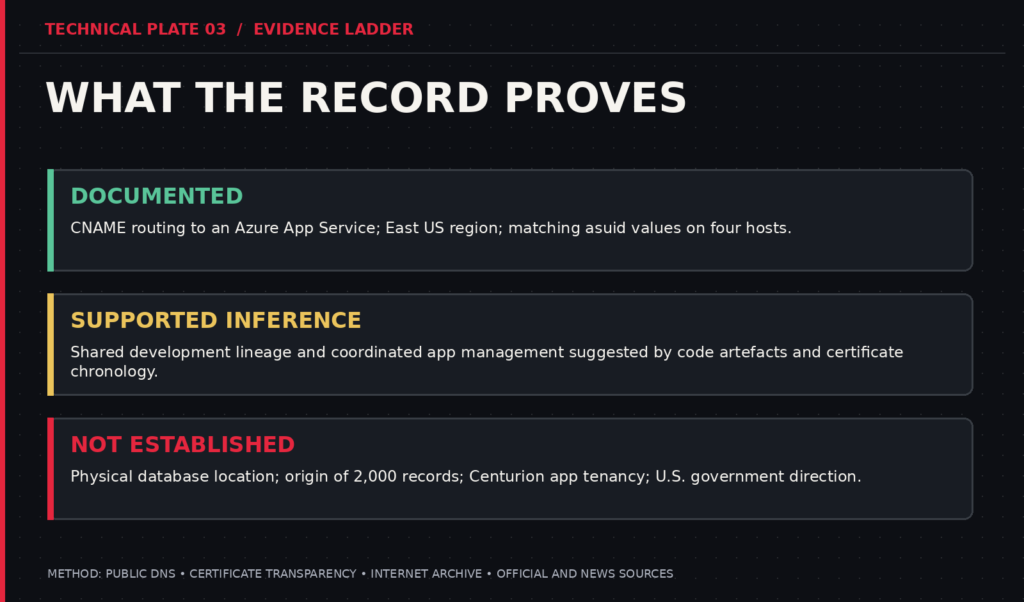
Prime Rogue can document the application hostname, its Azure routing, matching verification records, code artifacts, certificate chronology and the separate Wix reservation trace. Other questions require records held by operators, regulators or service providers.
In plain language: A technical connection tells us how systems relate; it does not automatically tell us who paid for them, uploaded the records, or instructed staff. Each question in the table separates what the records show from what investigators would still need to establish.
| Question | What the current record supports |
| Did the Alberta-linked 10X Votes application run on U.S. infrastructure? | Yes. October 22 DNS records identify Azure App Service East US in Virginia. |
| Does the technology connect to 10X Votes’ U.S. deployments? | Yes, through domain verification values on four hosts, software lineage, and coordinated certificate records. |
| Is Michigan conclusively on the same Azure subscription? | No. It shares a scale unit and software lineage but has no observed matching asuid TXT record. |
| Did Albertans’ searchable personal information pass through a U.S.-hosted application environment? | The reporting and architecture strongly support U.S.-hosted processing; individual historical request logs remain unavailable. |
| Where was the underlying database stored? | Not established. |
| Was skcn the Centurion database of about 2.9 million people? | Not established. |
| Did the Trump administration direct the deployment? | Not established. Documented Republican-network associations are not evidence of government control. |
| Did Centurion’s Wix system record apparent post-injunction activity? | Yes: encoded token issuance at 6:06:32 p.m. MDT and corresponding archive capture at 6:06:45 p.m. |
| Was the injunction breached? | Not established. The preserved event-registration activity is not proof of continued voter-list access. |
Microsoft can identify the Azure subscription’s legal account holder, the resource groups and deployment logs, the database and storage regions, and the people or service identities authorized to manage the application. 10X Votes and Voteatron LLC can explain the Canadian engagement, the identity of the customer, the app-development and data-processing arrangements, and who supplied the smaller Alberta dataset. Centurion can distinguish its proprietary Wix event-registration tools from its prohibited electoral-list application, provide the complete timeline of shutdowns, and identify whether any subsequent organizing used the protected list.
Some questions can only be resolved by the companies’ internal records: Azure account ownership, deployment history, database regions, access logs and customer agreements. Public DNS records provide leads for those requests; they are not substitutes for internal audit records.
Elections Alberta and the Alberta OIPC can say whether investigators have examined the skcn infrastructure, whether they have established a connection between the two datasets, and whether they have obtained the relevant records from American service providers. They may decline specifics while investigations proceed; that should not be misrepresented as evidence of delay for political reasons.
Hoekstra and the State Department can address the limits of their previous denials and, separately, the consistency of the political standards they invoke. The existence of personal, organizational or campaign ties is not sufficient to infer official participation. A direct record of financing, instruction, access, or substantive knowledge would be needed to advance that attribution.
No. Rory White of Canada’s National Observer found and tested the approximately 2,000-record skcn tool. Jen Gerson, Jeremy Appel and other Canadian reporters independently uncovered and investigated the separate larger Centurion voter-list controversy. Prime Rogue’s new work concerns technical infrastructure and the archived Wix chronology.
Yes. The October 22 DNS records identify Virginia-hosted Azure application infrastructure, and archived application design supports American-hosted request handling. The earlier reporting established searchable Alberta records. Historical packet captures of individual sessions and the storage location of the underlying database are not in the public record.
That has not been established. The roughly 2,000-record skcn application, Centurion’s larger disputed voter-list application and Centurion’s separate Wix event-registration site must be reported as distinct systems unless stronger evidence connects them.
No. Luke LeBrun documented Republican political associations, including Pete Hoekstra’s 2024 promotion of 10X Votes and his denial of Canadian involvement. Relationships and campaign endorsements do not establish U.S. government direction, funding or access.
No. The provisional evidence assessment documents American private-sector political relationships and U.S.-hosted Alberta-linked software. Canadian national-security guidance distinguishes influence from interference; Alberta referendum-advertising rules raise specific additional legal questions. No legal finding is made by the Admiralty-style ratings.
The record does not establish a violation. The archived Wix evidence indicates an event-reservation workflow around 6:06 p.m. MDT on April 30. It does not establish post-order use of the protected electors list. The precise order and additional records would govern any legal conclusion.
No. The answer depends on the data source, controlling organization, consent or other lawful authority, applicable statutory duties and safeguards. Sean Boynton’s Global News report also documents the exclusion of provincial political parties from Alberta PIPA; the legal positions of other entities require their own assessment.
The revised analysis links to DNS records, certificate transparency files and archived pages. The records identify what was observable on particular dates; checking them does not prove unobserved historical activity or individual involvement.
This investigation relies on passive, publicly accessible sources: the October 22 Google Public DNS responses; certificate transparency records collected through crt.sh; Internet Archive CDX indexes and preserved application pages; official Elections Alberta and OIPC releases; and cited independent reporting. Prime Rogue’s underlying inventory is preserved in the Full Spectrum GitHub repository, with checksums and OpenTimestamps artifacts. OpenTimestamps can help verify that a specific file existed by an anchored date; it does not establish that every interpretation of that file is correct.
This is a reconstruction from historical public records, not a live intrusion or direct examination of the voter database. We have also corrected previous technical interpretations that went beyond what those records could prove. Independent readers can inspect the linked underlying data.
No live 10X Votes or Centurion voter-search service was contacted as part of the repo’s October 22 collection, no account was created, and no Alberta voter data was downloaded. Historical DNS and archive records are snapshots, not continuous traffic logs. A reconstructed request path should not be mistaken for direct observation of every user session.
An earlier Prime Rogue analysis was corrected because it drew unsupported conclusions from certificate records. This version supersedes those claims. Specifically, it no longer says that skcn traffic necessarily traversed Cloudflare’s web application firewall; current DNS showed a direct Azure application endpoint. It withdraws a mistaken attribution of auth.10xvotes.com to Vercel—the public records identify an Auth0/Okta custom domain. It does not interpret the label skcn as evidence of a Saskatchewan dataset. And it identifies the jurisdiction-host certificates as Azure App Service managed certificates, not an independently purchased DigiCert account.
The remaining unknowns are central, not embarrassing: database residency, original dataset provenance, the precise operator of the Azure subscription, the relationship between the two Albertan datasets, and the identity and knowledge of those who authorized the relevant deployments. None can be responsibly solved by the existence of a U.S. IP address or a political acquaintance.
The proven story is already substantial: a Michigan-derived political technology application provided Alberta-linked voter-search functionality through a Virginia-hosted environment; the political venture behind it has documented ties to prominent Republican actors; and a separate Centurion organizing website left an apparent registration trace on the evening of a court injunction. The next stage is attribution through records, not speculation through association.
Full Spectrum 1 will continue to investigate the political and diplomatic level: public allegations of foreign involvement, the treatment of Canadian advocacy by U.S. officials, and the standards applied to comparable cross-border conduct. That work is analytically distinct from the technical reconstruction published here.
The remaining Full Spectrum 2 investigations will follow the digital and organizational networks: domain and cloud administration, changes over time, data provenance, the identities behind contracts and payment relationships where records permit, and the evidentiary chain between American software and Albertan deployments. Each new finding will be distinguished from previously published Canadian reporting and from unsupported inferences.
Full Spectrum 3, forthcoming, will map the human networks behind the digital ones—the individuals, organizations, financial relationships and documented communications that may explain who authorized, funded, built or used the systems. Family relationships, campaign endorsements and political proximity will remain labeled as association unless direct evidence establishes operational involvement.
Those investigations may refine or refute parts of this assessment. The question remains open: did a documented foreign political relationship also involve conduct that Canadian law would recognize as election interference? We will publish the evidence and its limitations; the legal determination is not ours to make.
Original reporting is credited to the journalists who found or verified it first. Prime Rogue’s own findings are linked to raw evidence or its published analysis. The bibliography documents provenance; it is not intended to transfer credit for another reporter’s work.
Sean Boynton — Global News: Alberta PIPA political-party jurisdiction gap
Public Safety Canada: influence versus interference;
Elections Alberta: October 19 referendum;
Elections Alberta: referendum third-party advertisers;
Admiralty-style source grading: research overview;
Alex Boutilier, Global News: foreign-influence concerns.
Fraser Logan, Alberta RCMP, October 23, 2026; Elections Alberta media office, October 23, 2026; Elaine Schiman, OIPC, reply to October 23 request; Prime Rogue’s October 23 requests for comment to the U.S. Embassy and Alberta authorities; separate requests to the Republican Party of Alberta, David Parker and Microsoft. The Embassy’s public fact sheet, not any private exchange, is the source cited for its position.
 The Pot Calls the Kettle Black: Two Years of American Interference in Canadian Politics
 Ottawa Stood Down. Washington Accused Anyway.
 Alberta Voter Data Crossed Into the US When It Was Uploaded. We Proved It. | Prime Rogue
 Carneyology, Part 0: Before The Count: Mark Carney’s Alberta Referendum Gamble


[…] for Alberta’s best interests, or is she flirting with a political realignment that places Alberta closer to Trump’s America than to Canada […]