Address
304 North Cardinal St.
Dorchester Center, MA 02124
Work Hours
Monday to Friday: 7AM - 7PM
Weekend: 10AM - 5PM

Address
304 North Cardinal St.
Dorchester Center, MA 02124
Work Hours
Monday to Friday: 7AM - 7PM
Weekend: 10AM - 5PM
On the night of November 1, 2026, Tucker Carlson posted that the Trump administration “may be within days of launching a nuclear strike on Iran.” He said Trump was likely to decide by November 7. He posted two days before the US midterms and five days after Israel’s deadlocked election. Most of what surrounds the claim holds up. Netanyahu’s bloc is eight seats short of a majority, supertankers are being hit in Hormuz, and Axios reports Netanyahu pressing Trump to strike right after the vote. The core claim, however, does not hold up. No outlet has corroborated a nuclear option or a November 7 deadline, and on October 16 Trump told Newsmax, not the most reliable of sources, but the only one to which Trump spoke, that he wouldn’t use nuclear weapons. The more important finding is about the post’s structure: it explains the positions of named Americans in both parties as obedience to a foreign leader. Part One of this series said to watch for that line. This post crosses it.
As with Part One, this piece does not rule on whether resuming the Iran war would be wise, or on whether Israeli influence on US policy is overstated. Those questions are real, and they are separate. What follows checks each of Carlson’s claims against the public record as of November 2. It then reads the post as a structure. The aim is to track the pattern, not to keep score on the war.
The post runs about 800 words and is built like a ticking clock. Its argument has seven links:
Most of the claims that can be checked are accurate. That matters, because their accuracy lends credibility to the claims that can’t be checked.
| Claim | Rating | What the record shows |
|---|---|---|
| Netanyahu can’t reach 61 seats | Verified | Final counts: Netanyahu’s bloc 53, Eisenkot’s bloc 48, Arab parties a record 19. Turnout was 77.7%, the highest since 1999. The Washington Post reported that Trump surrogates discussed a Netanyahu–Eisenkot unity government. That reporting is the basis for “broker a deal.” |
| Netanyahu is pushing for a strike | Partly verified | Axios reports an Oct. 31 call in which Netanyahu urged a strike right after Nov. 3 and Trump preferred to let talks run. The strike under discussion is conventional. |
| Pickaxe Mountain is the target | Verified as a target | Trump has named the site repeatedly, including on Oct. 16 and on Oct. 31. |
| ~300 feet of granite | Partly verified | The figures are open-source estimates. CSIS cites 80–100 m. The Institute for Science and International Security says at least 100 m. |
| No conventional bomb can reach it | Broadly supported | The GBU-57 penetrator reaches roughly 60 m at best, and less in hard rock. CSIS calls the site likely beyond any conventional munition. |
| 11 supertankers damaged in October | Mostly verified | A Reuters review of IMO and MarineTraffic data found 11 VLCCs damaged in October, a record month for attacks. “Badly” is Carlson’s word. The global fleet is more than 900 ships, not 850. |
| Secret Netanyahu trip to Abu Dhabi, Sept. 27 | Trip verified | The UAE and Israel’s PMO both confirmed it on Sept. 29. |
| Khamenei killed in February | Partly verified | He was killed Feb. 28, along with several relatives. His son Mojtaba survived and is now Supreme Leader, so “his family” overstates it. |
| Vance and Witkoff favour a deal | Partly verified | Axios confirms that both want talks. It also reports that Trump himself is skeptical Iran will deliver. |
| Eight months of conflict | Verified, with nuance | Strikes began Feb. 28. An April–July ceasefire collapsed, and a blockade and intermittent fighting followed. |
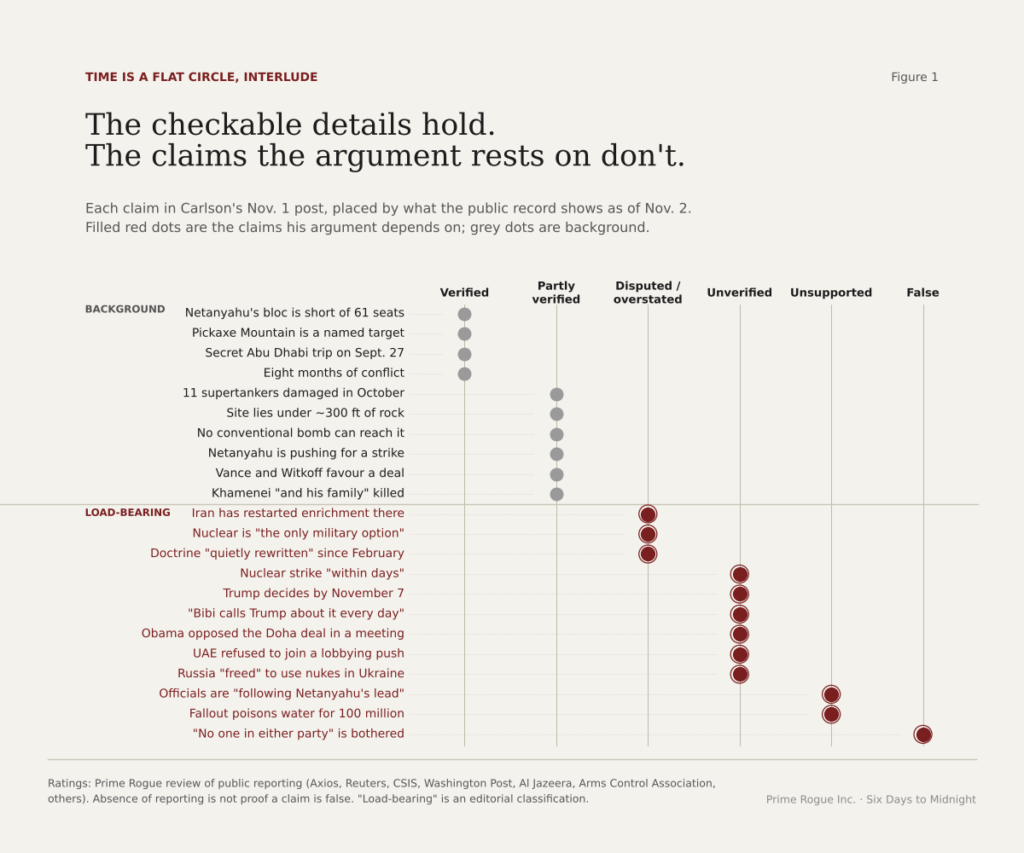
The claims that do the most work in the argument are the ones nobody can check: the warhead, the deadline, the phone calls and the motives.
| Claim | Rating | What the record shows |
|---|---|---|
| A nuclear strike “within days” | Unverified, single source | No outlet has independently reported a nuclear option. Trump told Newsmax on Oct. 16 that he wouldn’t use nuclear weapons and didn’t need to. The Pentagon plans that have been reported involve the conventional MOAB. |
| Decision by November 7 | Unverified | The date appears only in Carlson’s post. Other reporting points to a window after the vote and a White House pledge of no attack before it. |
| “Bibi calls Trump about it every day” | Unverified | Contact between the two is confirmed. How often they talk is not. In mid-October a White House official called reports of pre-midterm strike pressure false. |
| Iran has restarted enrichment at Pickaxe | Disputed | Israel’s claim is that centrifuges were moved there for storage. CSIS imagery from September suggests construction is ongoing and the site is not yet capable of enrichment. IAEA inspectors have never been inside. |
| Nuclear is “the only military option” | Disputed | Analysts describe functional-kill options: repeated strikes on portals, ventilation and power. One analysis drawing on a 2005 National Research Council study puts the yield an earth penetrator would need far above that of tactical warheads. |
| Rubio, Ratcliffe and Democrats are “following Netanyahu’s lead” | Unsupported | Rubio’s skepticism about a deal is on record. No reporting was found on Ratcliffe’s position. Nothing supports the claim that any of them acts at Netanyahu’s direction. |
| Obama opposed the Doha deal in a meeting | Unverified | No report of such a meeting was found. Obama’s public view is doubt about the terms, not opposition to a deal. |
| The UAE refused to join a lobbying push | Unverified | AP and Washington Post reporting gives a different purpose for the trip, tied to a Haaretz story about warnings before October 7. |
| Russia told two governments it would be “freed” to use nukes | Unverified | No reporting was found. Moscow’s public line warns of catastrophe; it does not claim a licence. |
| Water poisoned for 100 million people | Unsupported | Expert concern about Gulf desalination centres on the coastal Bushehr reactor, and Pickaxe is far inland. A University of Utah expert puts desalination dependence at 60 million-plus. The 100 million figure has no source. |
| Nuclear doctrine “quietly rewritten” since February | Overstated | A Pentagon nuclear review is under way, and critics say it lowers the threshold. The Arms Control Association reports declaratory first-use policy unchanged. The W76-2 and SLCM-N programs date from the 2018 posture review. |
| “No one in Washington in either party seems bothered” | False | The Union of Concerned Scientists, the Arms Control Association, the Bulletin of the Atomic Scientists and members of Congress have all objected publicly. |
| A global depression is “imminent” | Forecast | The disruption is real. Kpler data cited by the WSJ show Middle East oil exports in mid-October running above their pre-war level. |
The pattern across these tables matters more than any single row. The precise, checkable details are mostly right: the seat count, the tanker count, the Abu Dhabi date, the depth of the site. That accuracy lends authority to the details nobody can check. The documented facts supply the frame, and the anonymous claims supply the argument.
Carlson’s track record also counts. This is his third escalation of 2026 built on the threat of nuclear war. In April he called a Trump Easter post the first step toward nuclear war, and Trump denied it. On August 28 he aired the Joe Kent episode about Pentagon “conversations” on tactical nuclear weapons. In September he said Trump should have been removed. None of those predictions has come true. He was right in his broader call that Israel-aligned pressure would pull the US into war with Iran, which happened in February, and that is why his audience keeps giving him the benefit of the doubt.
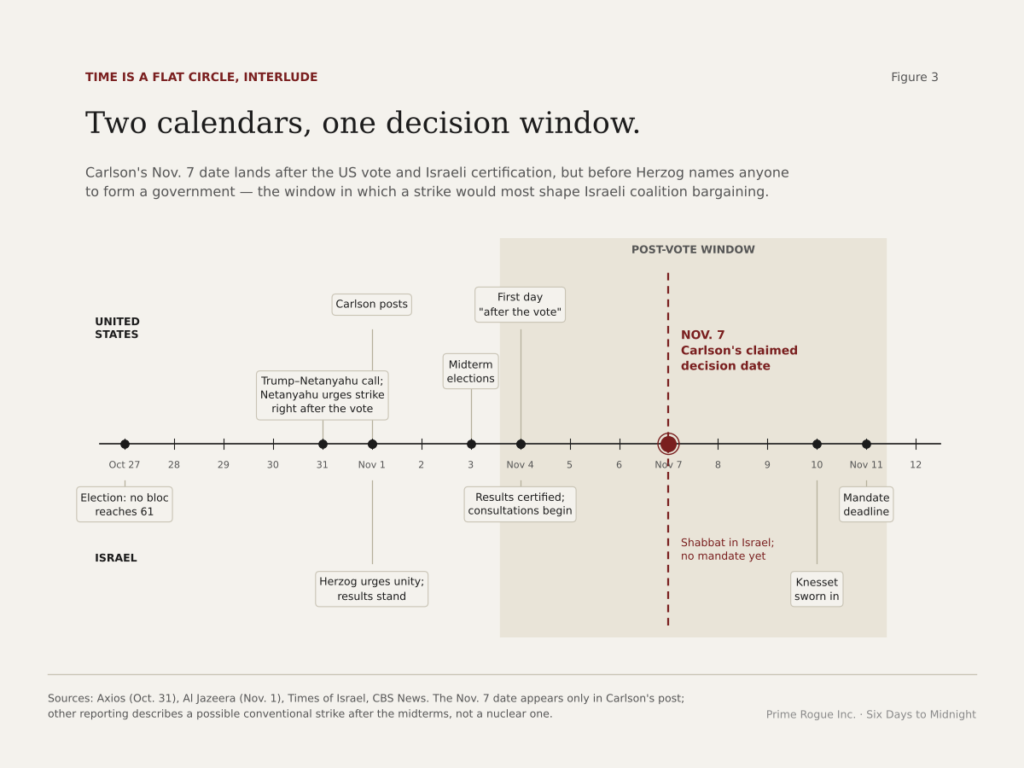
The calendar is the strongest part of Carlson’s case. A US decision on Iran after the midterms would land almost exactly in the middle of Israel’s coalition-formation period.
Voters go to the polls tomorrow with the war as the backdrop. Gas averaged about $4.20 a gallon on October 30, up from $2.98 before the war. Reuters/Ipsos and CNN/SSRS both put Trump’s approval at 32%. Silver Bulletin’s polling average shows 36% support for the war and 57% opposition. Forecasters favour Democrats for the House and, by a narrower margin, the Senate. Cook Political Report lists seven Senate toss-ups, and Fox News still calls Senate control a toss-up. Michigan is the race to watch for this series. In September Carlson said he wouldn’t vote for Mike Rogers “at gunpoint,” which effectively endorsed Abdul El-Sayed. Recent polls show El-Sayed ahead, and both candidates now say the war has to end.
The administration has kept military action off the table until after the vote while it works to hold down fuel prices. Axios describes two tracks running at once: Qatari mediation, and CENTCOM preparations for renewed major combat after the vote. An official told Axios that Trump might lean toward a large operation if Republicans lose badly. That is the electoral logic Carlson is pointing at, but it is about a conventional strike, not a nuclear one.
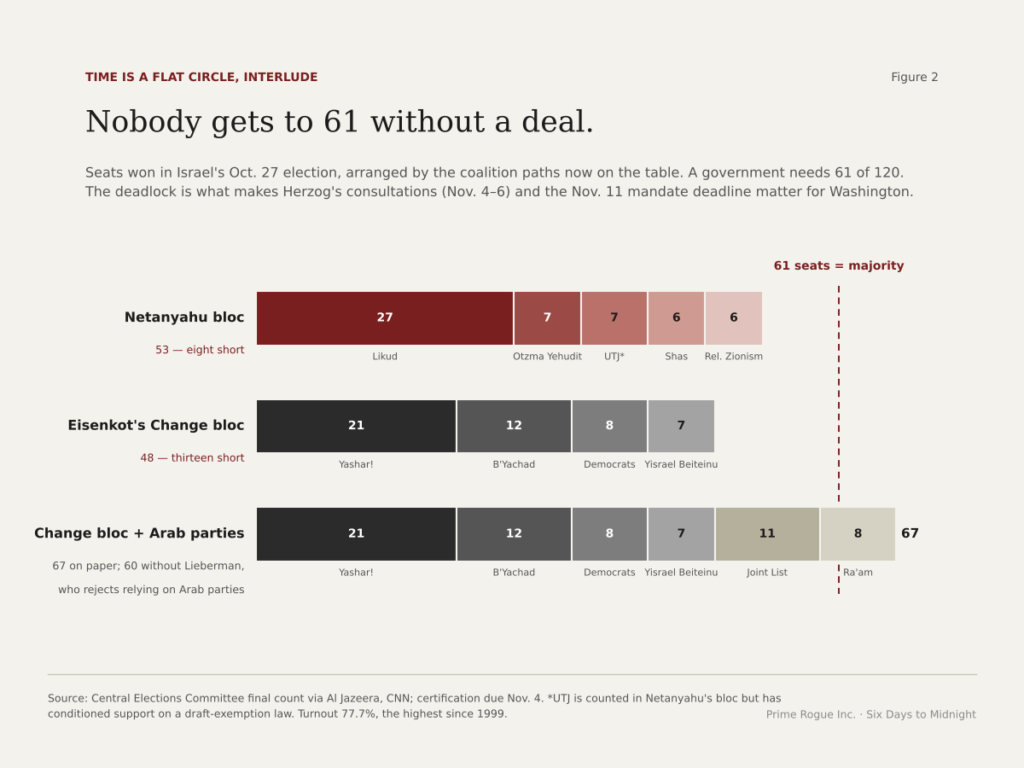
Likud claims the election was “stolen,” echoing a Trumist refrain, and points to a Shin Bet probe into foreign funding and vote-buying. The elections chief, the Shin Bet director and the attorney general have jointly said the results stand. Netanyahu’s trial continues, and his pardon request is unresolved. Haaretz reported that he pushed for a strike on Iran before the election and Trump blocked it. On election night he said the confrontation with Iran is not over. A caretaker government can legally order military action.
| Date | United States | Israel |
|---|---|---|
| Oct. 27 | — | Election held; no bloc reaches 61 |
| Oct. 31 | Trump–Netanyahu call; Netanyahu urges a strike right after the vote | Qatari mediators shuttle between Tehran and Doha |
| Nov. 1 | Carlson posts | Herzog urges leaders toward unity; officials say results stand |
| Nov. 3 | Midterm elections; close races may take days to call | — |
| Nov. 4 | First day that counts as “after the vote” | Certified results go to Herzog; consultations begin |
| Nov. 5–6 | — | Consultations continue; Lieberman and UTJ are the swing recommendations |
| Nov. 7 | Carlson’s decision date | Shabbat; no mandate assigned yet |
| Nov. 10 | — | 26th Knesset sworn in |
| Nov. 11 | — | Legal deadline for Herzog to assign the mandate |
| Mid-Nov. | Lame-duck Congress returns; possible war-powers votes | Designee’s 28-day clock runs, extendable by 14 days |
November 7 makes sense as a date. It falls after the US vote and after Israeli certification, but before Herzog names anyone to form a government. That is the window in which a strike would have the most effect on Israeli coalition bargaining, because it would push Eisenkot toward an emergency unity government. What lacks a source is the warhead.
Part One took its line from Jan-Werner Müller. Attacking elites does not make a speaker an anti-pluralist. The line is crossed when opponents are denied standing as legitimate participants, so that disagreement counts as evidence of loyalty to an enemy rather than as a different judgment. The Kent episode approached that line. This post crosses it.
The decisive phrase is “following Netanyahu’s lead.” Hegseth, Cooper, Rubio, Ratcliffe, Obama and “leaders of the Democratic Party” may each have reached their views on Iran by their own reasoning, sound or not. The post never allows for that. It traces every hawkish position in both parties back to one foreign leader’s personal legal trouble, and reduces the direction of the war to one man’s motive: “He needs this war.” Strategy, nonproliferation doctrine, Trump’s own stated aims and the midterm calendar all drop out of the explanation.
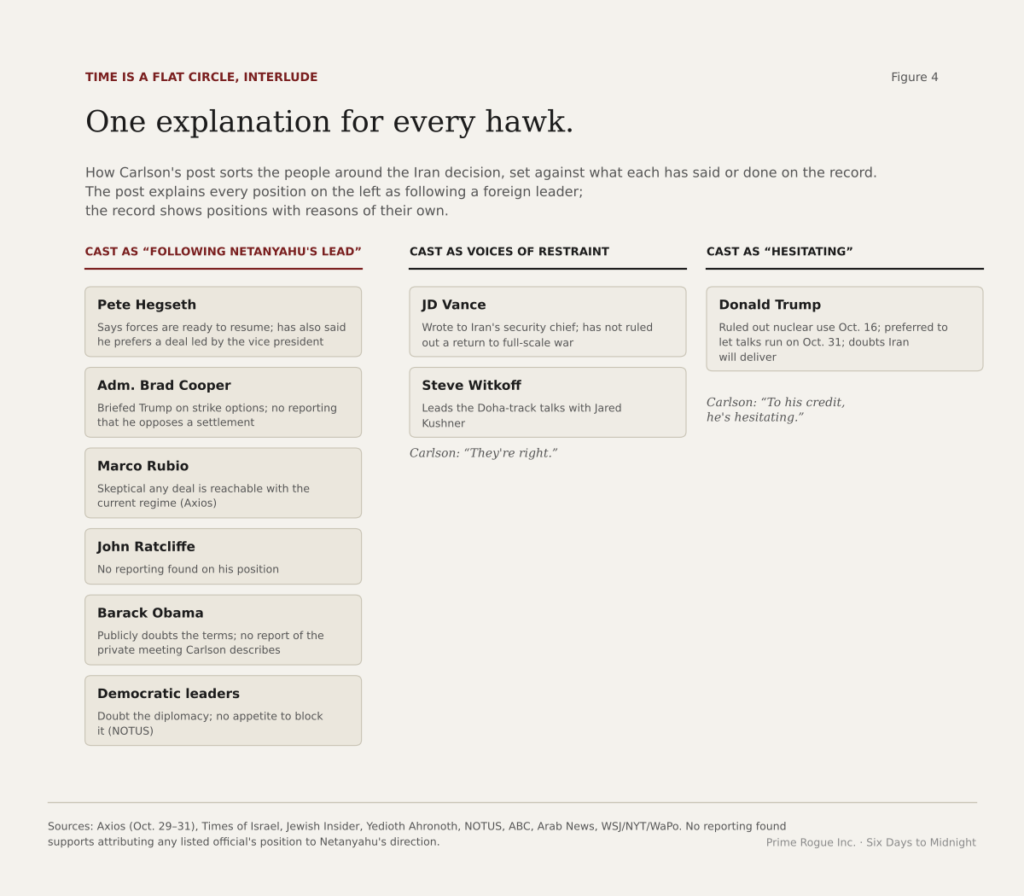
Mudde’s thin ideology is all there. On one side are “the global population” and “hundreds of millions” who have not been consulted. On the other is a Washington where no one “in either party” seems bothered. Obama sits next to Hegseth. The left-right axis disappears, and what replaces it is a single divide between a captured establishment and an excluded people. Kent made the same uniparty move on air in August.
What the post does not do matters too. There is no traitor language, and Carlson claims no exclusive mandate for himself. He appeals to an unorganized global public, not to a “real people” he alone speaks for. The best name for it is soft anti-pluralism: it delegitimizes opponents by attributing their views to a foreign allegiance, though it stops short of claiming exclusive representation.
The series has to make one harder point carefully. Criticizing the Israeli government’s influence on American policy is legitimate journalism, and so is reporting Netanyahu’s incentives to extend the war. Israeli analysts and Eisenkot himself have made that argument. The post moves toward the old trope when it attributes the views of named Americans in both parties to Israeli direction without evidence. Carlson adds a parenthetical noting that many Iranians wrongly believe the United States controls Israel. It reads as an inoculation, a sign that he rejects one control myth. But the body of the post asserts control running the other way, so the disclaimer signals awareness of the problem without solving it.
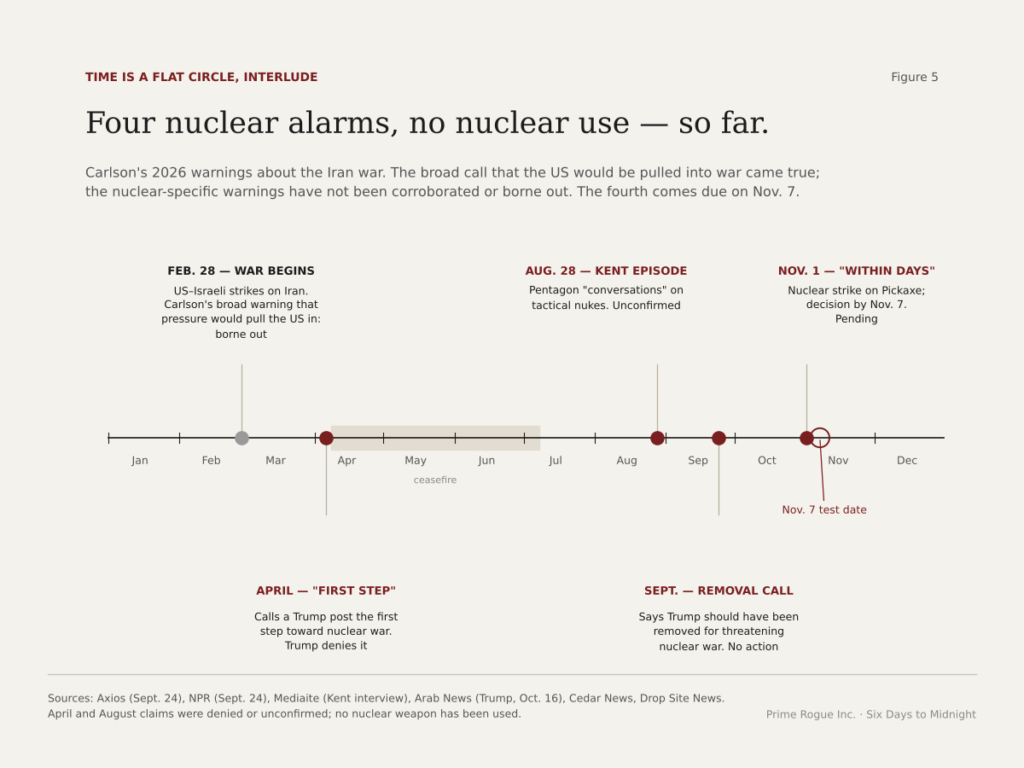
The most revealing line in the post is four words long: “To his credit, he’s hesitating.”
In late September, Carlson told NPR that Trump should have been removed from office immediately for threatening nuclear war. He broke with the Republican Party over the summer, says he isn’t voting in this election, and has said he wants to help build a third party. Yet in this post Trump is not the source of the danger. He is a well-meaning man under foreign pressure who can still be won over by the right advisers.
This is the oldest story in populism: the leader is good, and his court has betrayed him. Moving the blame onto Hegseth, Rubio and a foreign government does three things at once:
Read this way, the post is not an exit from MAGA. It is an intervention inside MAGA’s civil war, timed for the 72 hours when Republicans are most anxious about what the war is costing them.
As of November 2, the only confirmed amplification on the left is Drop Site News, which relayed the post. Haaretz’s live blog also carried it, and Cedar News noted that it had not been independently verified. TYT, Cenk Uygur and Ana Kasparian have not responded yet.
The groundwork was laid long before this post. In June, Uygur told his followers to stop listening to Israel, warning that it would try to drag the US back into war. In a clash with Piers Morgan, he said US officials should stop working for Israel. That is the same move from the left: attributing officials’ positions to loyalty to Israel. On September 3 Kasparian said she would rather back an anti-Zionist conservative than a liberal beholden to pro-Israel donors, a remark covered in Part One. El-Sayed’s allies in Michigan have framed the race as war versus prices. Massie and Khanna have pushed war-powers votes together, and Massie lost his May primary amid heavy pro-Israel PAC spending.
This sharpens the series’ thesis. What Carlson and the TYT camp share is less workers versus bosses than a captured Washington versus the people, with Israel as the captor. Populist form overrides ideological content, and this is where the form has settled. It is also the series’ biggest editorial risk. The line between scrutinizing influence and attributing allegiance has to be drawn each time, case by case, on both sides of the circle.
Carlson has put a date on his warning, which makes it testable. The next ten days will show which parts of it hold.
One caution belongs on the record before the date arrives. A warning like this is hard to falsify. If November 7 passes with no nuclear strike, Carlson can say the warning worked, and his audience may believe him. The series should note that in advance, and grade the post on what it asserted as fact rather than on what failed to happen.
The deeper test from Part One still stands. The question is not whether Carlson is right about Netanyahu, or whether the war should resume. It is whether the people bending the circle can still see an opponent as wrong without seeing that opponent as owned. On November 1, this post failed that test. Time is a flat circle. By Saturday, we will know whether it was a warning or a story.
Kevin J.S. Duska Jr. is President of Prime Rogue Inc. This interlude sits between Parts One and Two of Time Is a Flat Circle.
 On Populism – Time is a Flat Circle – Part One: An Assessment
 The MAGA Purge and the Whistle: How Laura Loomer’s Loyalty Crusade Targets Tucker Carlson’s Epstein Codebreaking
 Trump’s Fentanyl WMD Order: Economic Warfare, Law Enforcement Overreach, and North American Sovereignty at Risk
 What Is Hasbara? Israel’s Public Diplomacy Machine, Explained


[…] On October 21, Carney, flanked by Joly, responded to a question about the accusations by noting that the United States had started the trade actions. “All of our actions are in the interests of Canadian workers, Canadian families and the future of this economy,” he said. Ford said he has “no interest at all” in interfering in American elections. […]
[…] December 12, 2025, American commentator Tucker Carlson delivered a series of explicit, uninterrupted statements during a live interview with Matt Walsh […]
[…] United States (e.g., CPAC, Tucker Carlson, J.D. […]