Address
304 North Cardinal St.
Dorchester Center, MA 02124
Work Hours
Monday to Friday: 7AM - 7PM
Weekend: 10AM - 5PM

Address
304 North Cardinal St.
Dorchester Center, MA 02124
Work Hours
Monday to Friday: 7AM - 7PM
Weekend: 10AM - 5PM
Canada is expected to release its first national security strategy since 2004 today, ending a 22-year gap that has spanned four prime ministers, two missed deadlines and at least one draft the government’s top public servant declared obsolete.
Three government sources speaking to Prime Rogue on background confirmed the release is planned for Thursday, Oct. 29. One has direct knowledge of the plans; two have secondhand knowledge. The Globe and Mail separately reported Wednesday night, citing eight unnamed sources, that the government “is set to unveil a new national-security strategy” on Thursday.
The government itself has not said so. The Privy Council Office’s media advisory announces an 8 a.m. ET technical briefing for Parliamentary Press Gallery members on “forthcoming Government of Canada measures related to Canada’s national security.” It never uses the word “strategy.” The briefing is on background only, attributable to “senior government officials,” with recording for broadcast prohibited. The embargo now lifts at 10 a.m. ET.
Prime Rogue is not a member of the Press Gallery, did not attend the briefing and has not seen its materials. Nothing in this preview comes from the briefing, and none of our sources provided embargoed content.
Very little about the content is on the record. When David Morrison, the prime minister’s senior diplomatic adviser and national security and intelligence adviser, told the Commons public safety committee last week he hoped the strategy would be public “within a week or two,” PCO spokesperson Mélany Gauvin added that it “will have a whole-of-society focus, informed by voices within and outside government, and increase Canada’s focus on economic security.” It “will chart how Canada will enhance its own strategic autonomy to advance its national interests.”
Morrison’s own summary was blunter: “In an increasingly tumultuous world, all risks have gone up.”
February 2026 briefing notes for Public Safety Minister Gary Anandasangaree, reported by The Canadian Press, said the strategy would “for the first time, recognize the centrality of economic security to national security.” The Globe’s sources expect terrorism, foreign interference and sovereignty to be significant themes.
Everything else is unknown: which countries it names, how it describes the United States, whether it carries money, legislation or deadlines, and who is accountable for delivering it. Those are the questions that will decide whether it matters.
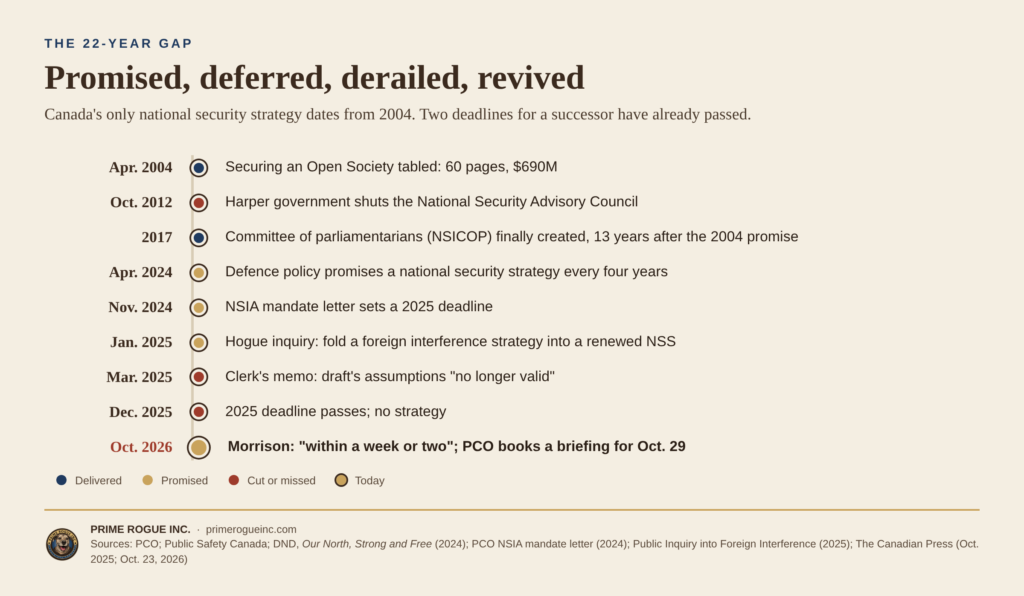
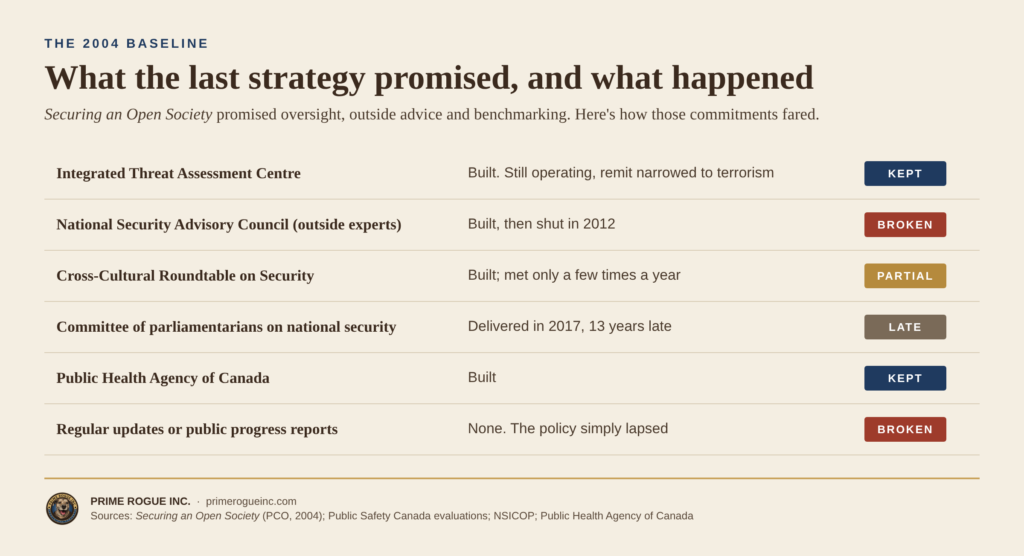
The last strategy, Securing an Open Society, was tabled by Paul Martin’s government in April 2004: 60 pages, backed by $690 million in new initiatives. Some of what it built lasted. Some was quietly dismantled: the Harper government shut its outside-expert National Security Advisory Council in 2012. The committee of parliamentarians it promised didn’t exist until 2017. It was never formally updated or reported on. It simply lapsed.
The successor has been promised repeatedly. The 2024 defence policy, Our North, Strong and Free, committed to publishing a strategy every four years. The mandate letter for the national security adviser set a 2025 deadline. Then, in March 2025, then-Clerk of the Privy Council John Hannaford told the new prime minister that changes in Canada’s strategic environment had left many of the draft’s assumptions “no longer valid.” The memo surfaced only through an access-to-information request, and it was released heavily redacted.
Nobody has said publicly what those assumptions were. Readers can guess which neighbour stopped behaving the way the 2024 draft expected.
Every national security strategy has to say who the threats are. This one has to say what the United States is, and every available answer costs Ottawa something.
Washington’s own strategy, released last December, pledges a “Trump Corollary” to the Monroe Doctrine to restore American preeminence in the Western Hemisphere, which includes Canada. Wesley Wark, among Canada’s most closely read intelligence historians, calls it “distinctly unfriendly.” Name the U.S. as a source of strategic risk, and Ottawa invites retaliation from a partner it depends on for intelligence, defence and trade. Call it “a committed ally” without qualification, and the document contradicts the prime minister’s own Davos speech about a “rupture” in the international order. Say nothing, and a strategy built on “strategic autonomy” never names what Canada needs autonomy from.
How it handles that paragraph will tell you more than anything else in the document.
It also matters how the strategy arrives. Prime Minister Mark Carney is in Montréal for the Canada-EU Summit Thursday and Friday. The strategy is being briefed by unnamed officials, on background, to accredited Gallery reporters only, with no announced ministerial event. Major policy launches usually come with a minister or the prime minister at a podium and attributable answers. This one, so far, doesn’t.
That may be logistics. But a strategy is supposed to be the government’s public statement of what it’s afraid of and what it will do about it. Who stands behind it on the record is part of the test.
The timing also lands mid-scandal. The Commons public safety committee is still probing how Biwei (Claire) Zhang, a former federal employee arrested in Belgium in July in an espionage investigation while interning at NATO’s military headquarters, obtained a Global Affairs security clearance. Morrison has floated a government-wide clearance registry. Watch whether screening reform appears in today’s package.
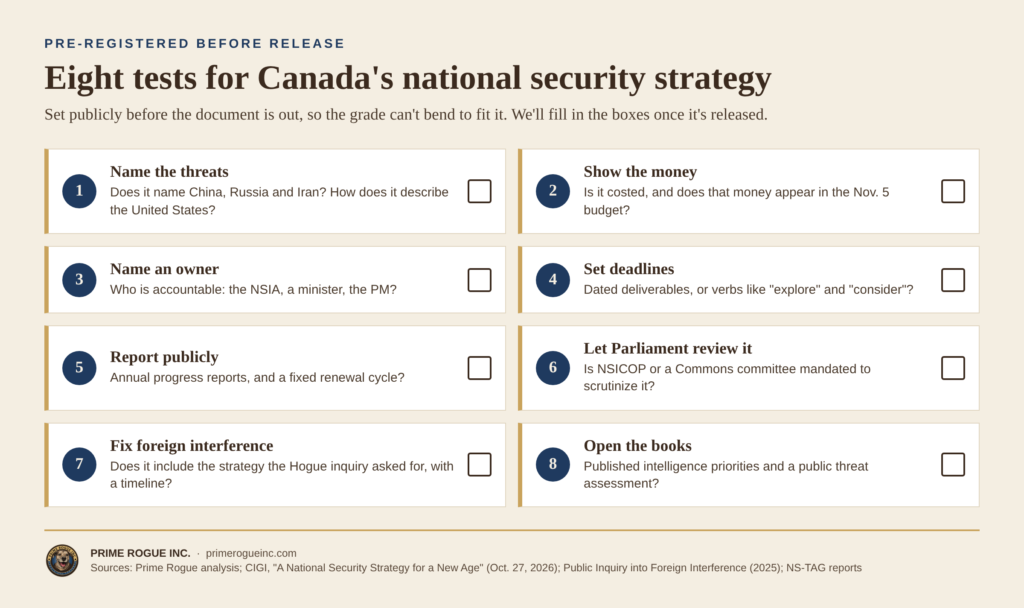
Prime Rogue is publishing its grading criteria before the strategy is out, so the grade can’t be bent to fit the document. They draw on the Hogue inquiry’s recommendations, the federal government’s own transparency advisory group, and an Oct. 27 checklist from Stephanie Carvin, Thomas Juneau, Trevor Neiman and Wesley Wark at CIGI, who warn that “a national security strategy is not cost-free” and that “budget allocations will be required.”
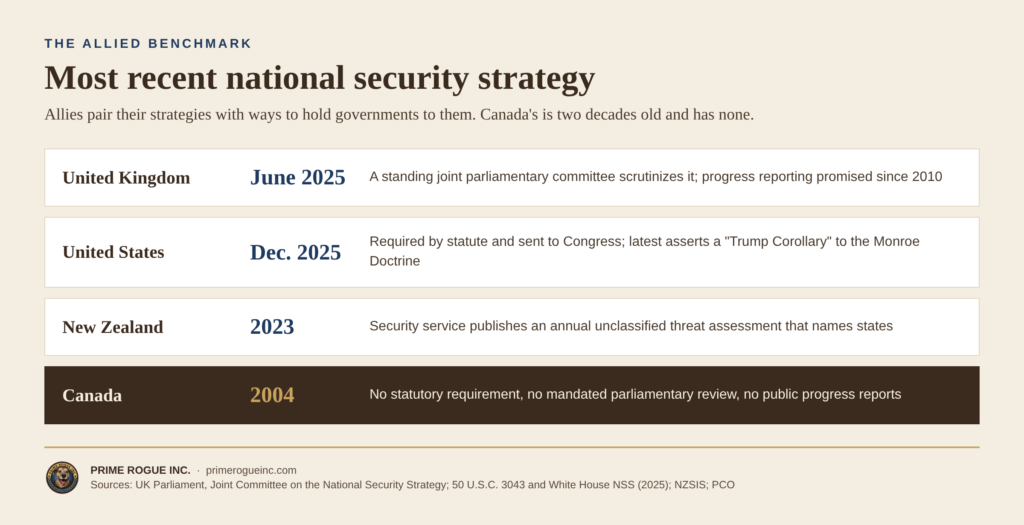
Canada’s closest allies don’t just publish strategies; they build ways to hold governments to them. The U.K.’s is scrutinized by a standing joint parliamentary committee. The U.S. strategy is required by statute and sent to Congress. New Zealand’s security service publishes an annual unclassified threat assessment that names hostile states. Canada currently has none of those mechanisms for a national security strategy.
If the strategy is what the government releases this morning, Prime Rogue will grade it against the eight tests above. If the “measures” turn out to be something narrower, or the document is briefed today and published later, we’ll report that too.
Twenty-two years is long enough to wait. The question now is whether what arrives is a strategy or just a document.
Sourcing: Three Government of Canada sources, on background (one with direct knowledge, two with secondhand knowledge of the release plans); The Globe and Mail; The Canadian Press; Privy Council Office; Department of National Defence; Public Safety Canada; Council of the EU; CIGI; Wesley Wark’s National Security and Intelligence Newsletter.
Kevin J.S. Duska Jr. is the President and Chief Analyst of Prime Rogue Inc. and an intelligence analyst with 14 years of experience in the field. His first book on Canada’s access-to-information system, Echo State, is out in December. Duska’s professionals areas of interest include long-form investigative journalism, national security, information warfare, populism, the threat America poses to Canada, and access to information reform. His personal interests include rescue dogs, dog training, scale-modelling, genealogy, Rusyn history, and humour as anti-comedy. A graduate of McGill University and the Ohio state University, he is currently based in Calgary.
 Canada’s Defense Pivot: Over-the-Horizon Radar, F-35 Reassessment, and the Future of Military Sovereignty
 A Hypothetical U.S. Military Invasion of Greenland – Grand Strategy, Strategy, Operations, and Tactics: A National Security Briefing
 A Hypothetical American Invasion of Panama – Grand Strategy, Strategy, Operations, and Tactics: A National Security Briefing
 The Pot Calls the Kettle Black: Two Years of American Interference in Canadian Politics


