Address
304 North Cardinal St.
Dorchester Center, MA 02124
Work Hours
Monday to Friday: 7AM - 7PM
Weekend: 10AM - 5PM

Address
304 North Cardinal St.
Dorchester Center, MA 02124
Work Hours
Monday to Friday: 7AM - 7PM
Weekend: 10AM - 5PM
On October 21, 2026, the U.S. Embassy in Ottawa published a fact sheet, issued under the U.S. Mission’s name with no individual author, accusing Canadian politicians of trying to influence the November 3 midterms. Its closing line is a principle: “Americans decide America’s elections.”
Seven days earlier, on a rally stage in Bullhead City, Arizona, the President of the United States told the crowd Canada will “end up being the 51st state.” Albertans were five days from voting on whether to leave the country.
That is the pot calling the kettle black. This series documents the American side of the ledger: the annexation campaign, the election-day post, the State Department meetings with separatists, and the Michigan voter app that turned up in Alberta. Part 1 lays out the record.
The fact sheet lists nine items. Four are Industry Minister Mélanie Joly’s public remarks about aiming counter-tariffs at Republican states. Two are Ontario Premier Doug Ford: his August letter urging tariffs on “politically significant states” and Ontario’s 2025 Reagan ad. The rest are Liberal MP Anthony Housefather door-knocking in Florida, Boston Consul General Bernadette Jordan appearing with Vermont Democrats, and a 2025 federal billboard campaign.
It then names 11 Canadians charged or sentenced for illegal voting in U.S. elections, and claims Canada ranks “second highest” for such prosecutions. It attributes that ranking to the U.S. Department of Justice but publishes no dataset and, as Al Jazeera noted, no evidence tying any of those voters to the Canadian government.
The list is not even complete on its own terms. CBC News has since identified at least 15 Canadians caught up in the Justice Department’s noncitizen-voting crackdown, including cases the DOJ announced that the embassy did not mention.
Every item on the list was public, and nearly all of it was aimed at changing a U.S. trade policy. University of Toronto political scientist Randy Besco told the National Post the claims were “not credible at all.” He called Housefather’s Florida canvassing the only possible exception: legal, he said, but probably ill-advised. The federal ban on foreign election spending and its FEC rules target money and decision-making in campaigns, not lobbying or trade policy, and they exempt uncompensated volunteer work.
The embassy’s standard is broad, then: a minister’s public comments and an MP’s volunteer weekend can count as interference. Apply that standard to Washington’s own conduct toward Canada.
The annexation campaign began before Trump took office, and it was never a single throwaway line.
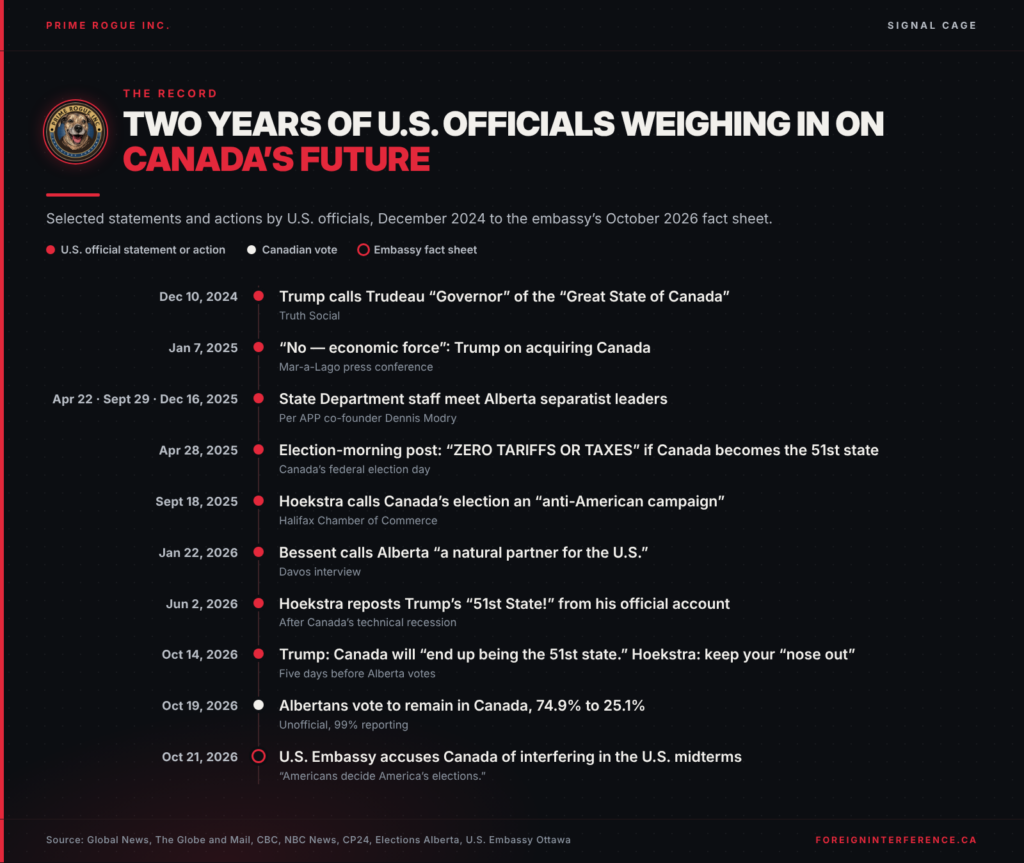
Note the instrument he named. Economic force is the thread that runs through everything that follows: tariffs offered, withheld or raised depending on whether Canada stays Canada.
Canada went to the polls on April 28, 2025, with annexation as a live campaign issue, and the White House kept it there.
A foreign head of state told Canadians how to vote while polls were open, and attached a tariff offer to an outcome that ended the country. Conservative Leader Pierre Poilievre answered the same day: “President Trump, stay out of our election.”
Canada’s election security task force later described foreign interference in that election as small-scale, focusing on China and Russia. Its framework targets covert and deceptive activity. In the public reporting, it did not address a president intervening openly, under his own name.
Pete Hoekstra arrived in Ottawa as the former chair of the Michigan Republican Party. As ambassador, he has repeatedly treated Canadian domestic politics as his business.
That last point cuts against the fact sheet. If the ambassador’s job is to carry the president’s views into Canada, then the president’s views on absorbing Canada are official U.S. messaging to Canadians, delivered by the embassy that now warns Canadians off American politics.
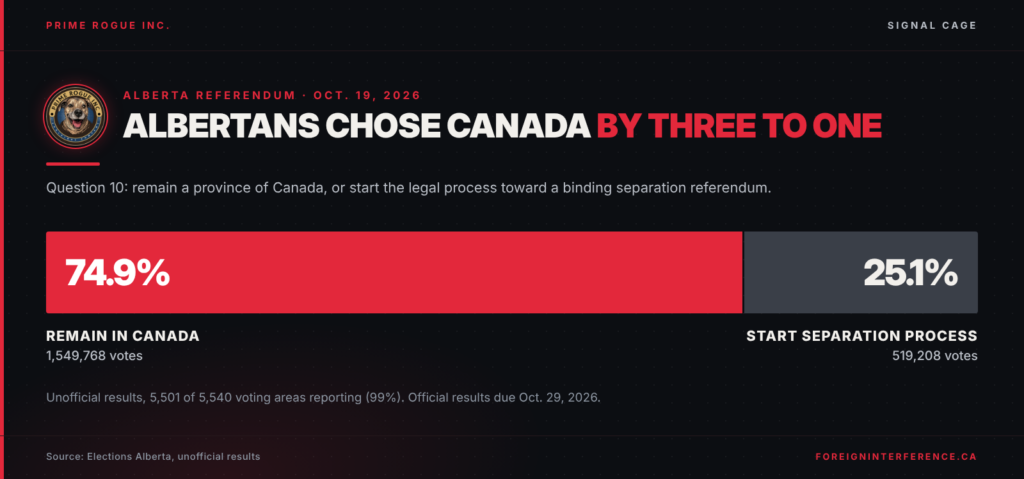
Alberta is the strongest documented case of Americans inside a Canadian domestic campaign. Albertans voted to remain in Canada on October 19, 2026, by 74.9 to 25.1 per cent, 1,549,768 votes to 519,208, with 99 per cent of voting areas reporting. Official results are due October 29. Here is what preceded that vote.
The State Department meetings. Leaders of the separatist Alberta Prosperity Project met State Department officials in Washington three times in 2025, on April 22, September 29 and December 16, according to APP co-founder Dennis Modry. APP lawyer Jeffrey Rath told the Financial Times in January 2026 that officials they met left to go “directly to the Oval Office,” a claim that has not been substantiated. A senior State official told NBC News the meetings were staff-level only, no principals were involved and no commitments were made.
The Treasury Secretary. On January 22, 2026, at Davos, in an interview with Real America’s Voice host Jack Posobiec, Scott Bessent said that the U.S. should “let them come down,” calling Alberta “a natural partner for the U.S.” The Canadian Press called him the highest-ranking Trump administration official to weigh in at that point. A person familiar with his views told NBC he neither supports nor opposes separation. B.C. Premier David Eby called the separatists’ Washington meetings treason.
The app. On April 29, 2026, Centurion Project founder David Parker launched a voter-contact app in Edmonton. Elections Alberta alleges it drew on the protected provincial voter list, covering close to three million Albertans. The agency had emailed a cease-and-desist the day before and served it in person at the launch; a court injunction followed on April 30. Parker’s lawyer has accused Elections Alberta of circulating a fictional narrative. Parker called it “the 10x slash the Centurion Project app,” after the Michigan platform 10X Votes. Hoekstra had promoted 10X Votes at a November 2024 Michigan rally. He says he has “zero involvement” with 10X Votes in Canada. National Observer later found Alberta voter data on the website of the U.S. company linked to Centurion. The RCMP, Elections Alberta and Alberta’s privacy commissioner opened investigations; none has produced public findings or charges as of publication. Separately, Elections Alberta is seeking an injunction to compel the Alberta Prosperity Project to disclose its finances and donors.
The operatives. An October 3, 2026 Globe and Mail investigation found Republican operatives from Michigan, including 10X Votes founders Drew Born and Drew Wierda, on the ground in Alberta helping the separatist campaign. It also reported, citing APP co-founder Dennis Modry, that APP leaders offered the State Department access to fresh water and oil royalties in exchange for help with independence. Rath called that account a lie, the White House said no support or commitments were offered, and no deal was reached.
The information space. Researchers with the Cipher AI project at the universities of Regina and Alberta, led by Brian McQuinn, found the U.S. share of suspected foreign influence content around the referendum rose to 24 per cent from late September, with Russia at 76 per cent. An Angus Reid poll conducted October 13 to 15 found 65 per cent of Albertans believed foreign interference affected the campaign.
The capstone. On October 14, five days before the vote, Trump said Canada will end up the 51st state. In a podcast episode released the same day, Hoekstra said Canadians should keep their “nose out” of American politics.
Alberta was not the only front, though the evidence elsewhere is thinner.
Navarro’s line is the template for the fact sheet: an American official commenting on Canadian leaders’ domestic popularity while accusing them of meddling in his country’s.
The embassy set the standard. Here is how each side measures against it.
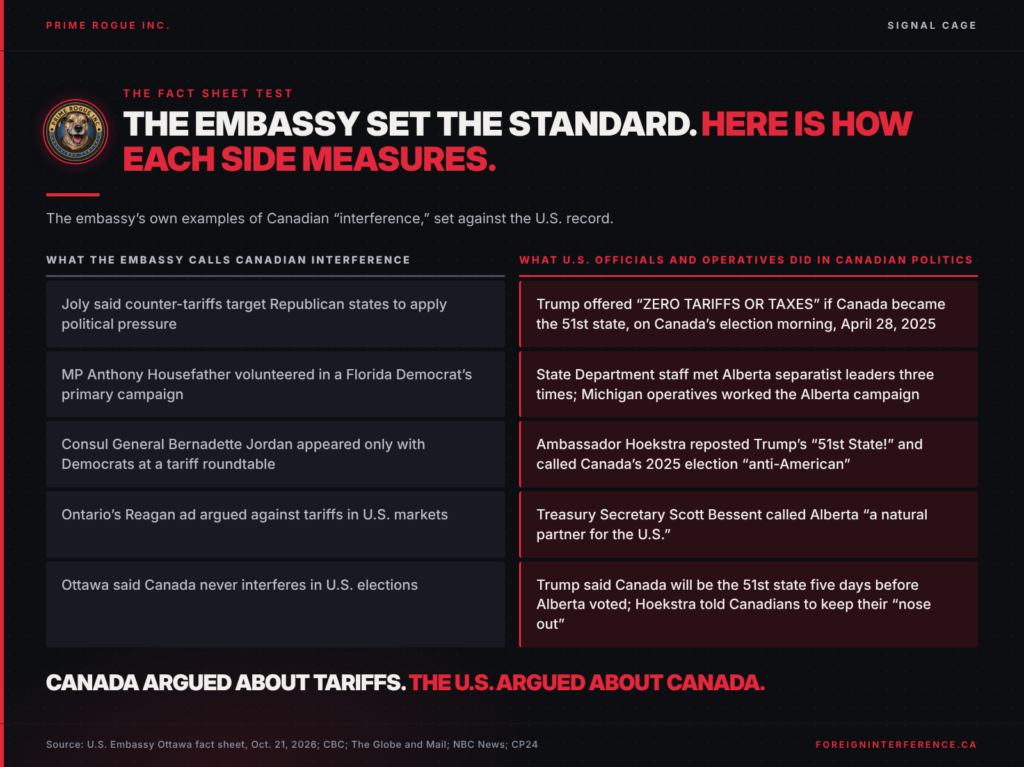
| What the embassy calls Canadian interference | What U.S. officials and operatives did in Canadian politics |
|---|---|
| Joly said counter-tariffs target Republican states to apply political pressure | Trump offered “ZERO TARIFFS OR TAXES” if Canada became the 51st state, on election morning, April 28, 2025 |
| MP Anthony Housefather volunteered for a Florida Democrat’s primary campaign | State Department staff met Alberta separatist leaders three times; Michigan operatives worked the Alberta campaign |
| Consul General Bernadette Jordan appeared only with Democrats at a tariff roundtable | Ambassador Hoekstra reposted Trump’s “51st State!” and called the 2025 Canadian election “anti-American” |
| Ford’s Reagan ad argued against tariffs in U.S. markets | Treasury Secretary Bessent called Alberta “a natural partner for the U.S.” |
| Ottawa said Canada never interferes in U.S. elections | Trump said Canada will be the 51st state, five days before Alberta voted; in a podcast released that day, Hoekstra told Canadians to keep their “nose out” |
The left column is a country fighting a trade war in public. The right column is the government of a neighbouring state commenting on, and in places engaging with, the question of whether that country should continue to exist.
Canada argued about tariffs. The United States argued about Canada.
A fair ledger names its own gaps. These matter, and this series will keep testing them.
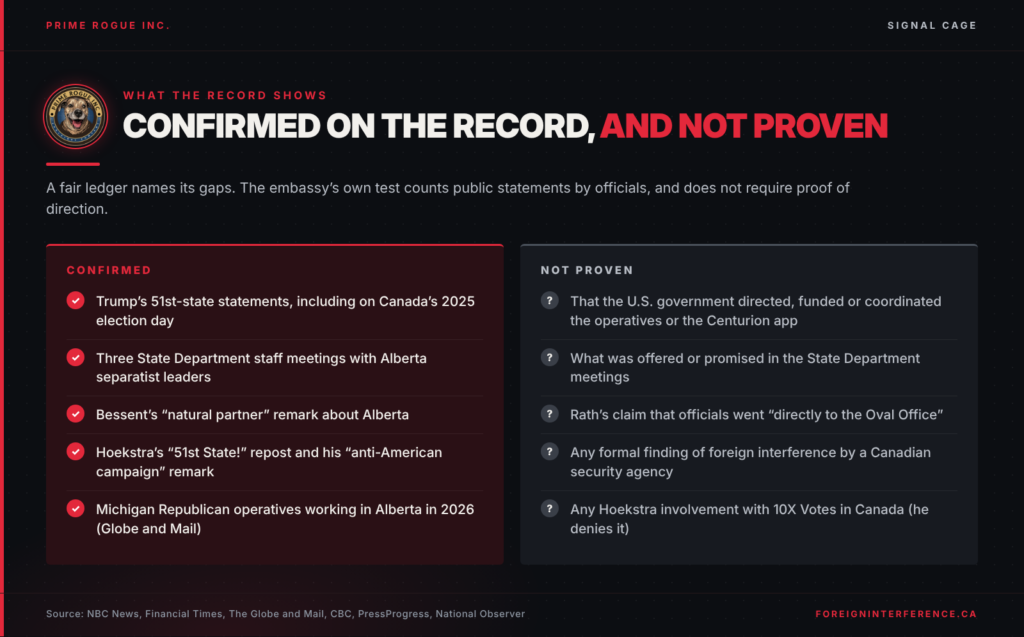
None of those caveats rescues the fact sheet. The embassy’s own test does not require covert action or proof of direction. It counts public statements by officials. On that test, the American record is the heavier one by a wide margin.
Ottawa’s public answer to the fact sheet was restraint. Its quieter answer was to flinch.
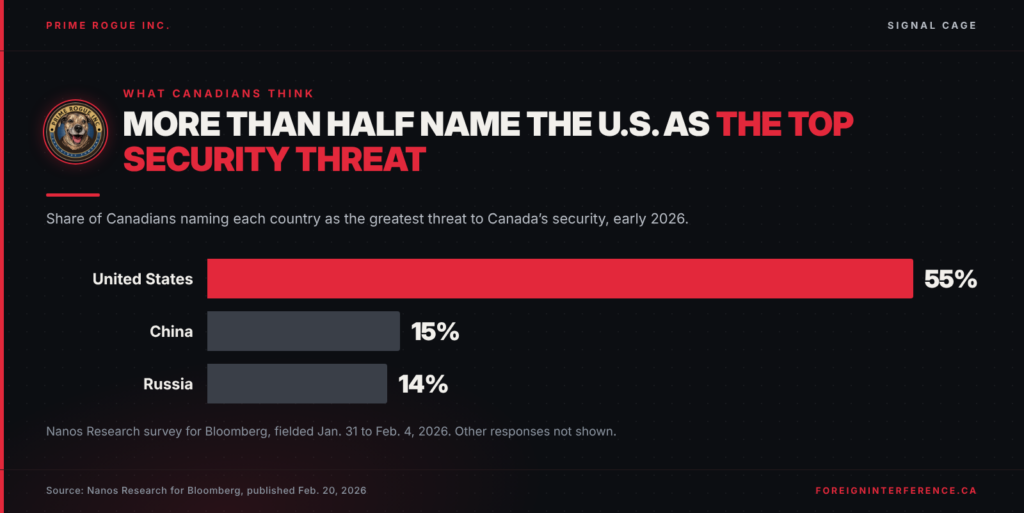
Canadians, meanwhile, made up their minds long ago. In a Nanos survey for Bloomberg in early 2026, 55 per cent named the U.S. as the greatest threat to Canada’s security, against 15 per cent for China and 14 per cent for Russia. A Nanos poll for The Globe and Mail, published July 1, found “influence from the United States” ranked as the top threat to national unity, ahead of the Alberta referendum itself.
A House of Commons petition, e-7531, asks the government to declare Hoekstra persona non grata. Its grounds include his “anti-American” description of Canada’s election, his link to 10X Votes, the State Department meetings with Alberta separatists, and his accusing Canada of interfering in U.S. politics. As of October 23 it had 279,683 validated signatures, and it closes November 18.
On October 21, 2026, the U.S. Embassy in Ottawa published a fact sheet accusing Canadian officials, including Industry Minister Mélanie Joly and Ontario Premier Doug Ford, of trying to influence the 2026 U.S. midterm elections. It cited tariff targeting of Republican states, Ontario’s Reagan ad, meetings with Democrats, and 11 Canadians charged with illegal voting.
U.S. officials have repeatedly intervened publicly in Canadian politics since late 2024. President Trump called for Canada to become the 51st state, including on election day in April 2025. State Department staff met Alberta separatist leaders, and Treasury Secretary Scott Bessent called Alberta “a natural partner.” No federal security agency has publicly attributed foreign interference to the U.S. government, and U.S. government direction of separatist activity has not been proven.
On the morning of April 28, 2025, Trump posted on Truth Social urging Canadians to elect a leader who would cut taxes, and offered “ZERO TARIFFS OR TAXES” if Canada became “the cherished 51st State of the United States of America.”
Yes. A Globe and Mail investigation found Michigan Republican operatives working with the Alberta separatist campaign, and an app modelled on the Michigan platform 10X Votes was used by the Centurion Project. Albertans voted to remain in Canada on October 19, 2026, by 74.9 per cent to 25.1 per cent, with 99 per cent of voting areas reporting; official results are due October 29.
Not on its face. U.S. federal law bars foreign nationals from spending money in U.S. elections or directing campaigns. It does not bar foreign governments from lobbying, running issue ads or targeting retaliatory tariffs.
Pete Hoekstra is the U.S. ambassador to Canada, a former Michigan congressman and former chair of the Michigan Republican Party. A House of Commons petition, e-7531, asks Ottawa to declare him persona non grata.
I first heard it at 17, in 2002, at L’X in Montreal, nursing a forty of Labatt 50 the way my grandpa Steve, the Rusyan peasant who raised me, would have endorsed once I was of age – but he didn’t care even then. I traded a du Maurier for a Lucky Strike with Paddy, who then played most of the set fully naked. I regretted smoking a filterless cigarette for the rest of the night. Thank goodness his ballsack was not yet hanging below his bass.
It’s four Minneapolis punks taking apart the story their own country tells itself, decades before a U.S. embassy told Canadians to keep their noses out. It hits harder now than it did then.
Two lines have stuck with me for more than two decades.
A man finds nothing left to eat, another sells his body for a place to sleep
As Klansmen flood a conference hall downtown
When I first heard that line it sounded like a warning. Twenty years later it read like a forecast. In August 2017, white nationalists didn’t even bother booking the hall. They marched through Charlottesville, Virginia, by torchlight for the Unite the Right rally, and the next day one of them drove his car into a crowd of counter-protesters and killed Heather Heyer, a 32-year-old paralegal. Days later, the President of the United States said there were “very fine people on both sides.” The song’s point was never that hatred hides. It’s that it walks in the front door, and too many people at the top find a way to shrug.
I think of a story my father told me
About a fella he know in the Army
The Pentagon traded him checks for both his legs
“Fuck the States” was the last thing father heard he had said
The song saves its bitterest verdict for an American who paid for the country’s wars with his own body. That’s why it lands for this series. The sharpest critique of American self-mythology doesn’t come from Ottawa, or Alberta, or me. It comes from inside: from a vet, from a kid repeating his father’s story, from four punks in Minnesota who’d seen enough by 1997 to stop playing along.
Lyrics quoted for commentary. Dillinger Four (1998) “The Great American Going Out of Business Sale,” from Midwestern Songs of the Americas, Hopeless Records.
Every part of Full Spectrum gets a track. Turn it up, and support the bands by buying some vinyl.
 Alberta Voter Data Crossed Into the US When It Was Uploaded. We Proved It. | Prime Rogue
 The American Perimeter: U.S. Protective Operations and Intelligence Footprint at G7 Kananaskis 2025 – 2025 G7 Security Series #4
 America’s Collapse Is Not a Canadian Tragedy—It’s a Canadian Reckoning
 Trump Revokes Secret Service Protection for Hunter & Ashley Biden: A Dangerous New Precedent in U.S. Politics


