Address
304 North Cardinal St.
Dorchester Center, MA 02124
Work Hours
Monday to Friday: 7AM - 7PM
Weekend: 10AM - 5PM

Address
304 North Cardinal St.
Dorchester Center, MA 02124
Work Hours
Monday to Friday: 7AM - 7PM
Weekend: 10AM - 5PM
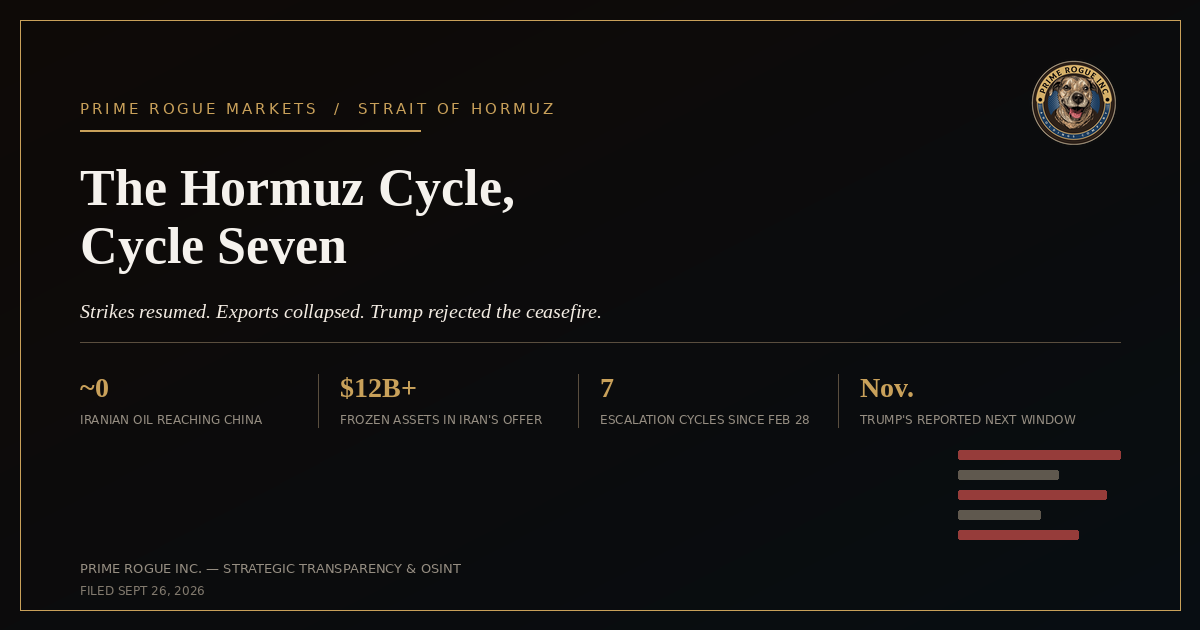
Yes. On September 26, 2026, President Trump told reporters “I reject their proposal,” dismissing a seven-day roadmap Iran had submitted through Qatari mediators at the UN General Assembly a day earlier. The plan would have lifted the US naval blockade, waived oil sanctions, and released over $12 billion in frozen Iranian assets in exchange for reopening the strait by day six. The Wall Street Journal reports Trump privately expects to resume bombing Iran after the November midterms.
Partially, and the two sides can’t agree on how partially. US officials claim 10 to 17 million barrels a day are transiting; independent analysts at the International Crisis Group put the real figure closer to 5 to 7 million. What isn’t disputed: Iran’s own oil exports have collapsed to a trickle under the US naval blockade, with floating stockpiles reportedly set to run out by mid-October.
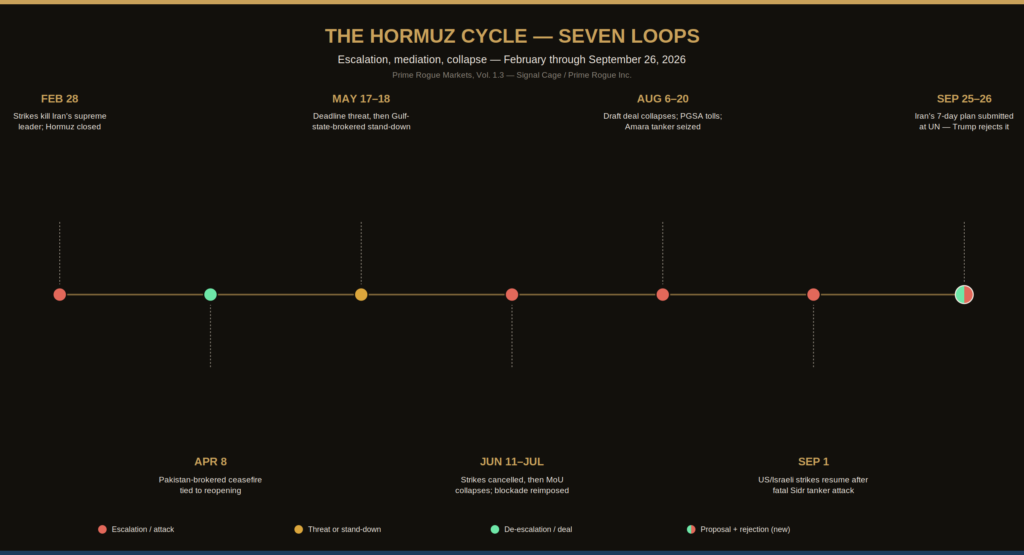
Our Cycle Six installment left off on August 22, 2026 with a tanker seizure, an advancing Oman-brokered shipping deal, and Iran’s sanctioned toll authority still collecting fees. In the five weeks since, the cycle ran through its fastest and most compressed loop yet — and for the first time since the war began, escalation and diplomacy never converged into even a partial agreement before collapsing.
Iran struck at least 13 commercial vessels through August, including a late-night attack on the Saudi-flagged VLCC Sidr on August 31 that killed two Filipino crew members. CENTCOM responded on September 1 with strikes on “air defense sites, radar systems, maritime assets and facilities, mine laying capabilities, and communications sites,” in the heaviest exchange since the war’s opening weeks. Trump called it retaliation for “the Iranians’ failed attempt at adding sea mines to the Strait.” Iran claimed retaliatory strikes on US-linked targets in Bahrain, Jordan, Iraq, and Kuwait.
At least ten more vessels were struck or disabled through late September, including the Antigua-flagged Cape Dao on September 23 near Musandam, which killed an Indian seafarer. By Windward’s count, at least 23 seafarers have been killed since the war began. CENTCOM says it has “permanently disabled” several Iranian-flagged vessels and redirected over 100 ships from the blockade line in a 60-day span
At the UN General Assembly, Iran’s Foreign Minister Abbas Araghchi met Trump envoy Steve Witkoff and formally submitted a seven-day roadmap through Qatar: the US lifts the naval blockade, waives oil sanctions, and releases frozen Iranian assets — reported by the New York Times at “at least $12 billion” — in exchange for the strait reopening on day six and final talks beginning on day seven. Araghchi said the terms were “nothing more” than the failed June 17 Islamabad memorandum of understanding, compressed onto a faster clock. Trump rejected it the next morning: “They want to make a deal where they open the Strait immediately because they’re losing so badly… We’re winning tremendously.” Hours earlier, he had posted a map to Truth Social relabeling the waterway “Trump Strait.”
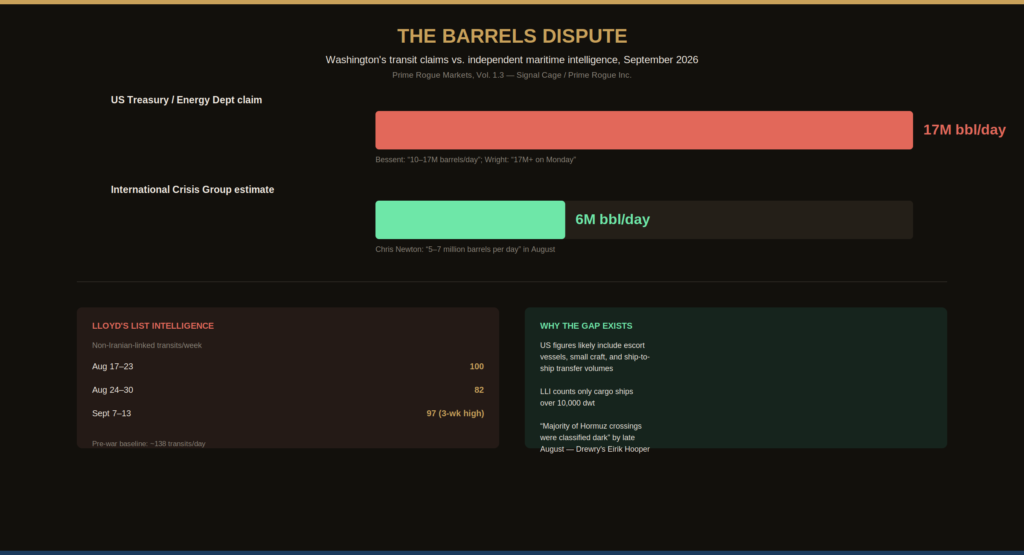
Treasury Secretary Scott Bessent has claimed “at least 10 million barrels” a day are transiting the strait, with Energy Secretary Chris Wright citing over 17 million on a single Monday. Independent trackers tell a different story. Chris Newton, senior early warning analyst at the International Crisis Group, told USNI News that roughly 5 to 7 million barrels a day made it through in August — “likely much less than the volume claimed by Washington.” Lloyd’s List Intelligence’s weekly transit counts (which count only non-Iranian-linked cargo ships over 10,000 deadweight tons) show 82 to 100 transits a week through September — against a prewar baseline of roughly 138 transits a day. Drewry’s Eirik Hooper noted that “the majority of Hormuz crossings were classified dark” by late August, meaning vessels with transponders switched off. The honest read: US single-day figures likely fold in escort vessels and ship-to-ship transfer volumes that inflate the headline number well past what’s actually moving as ordinary commercial cargo.
Whatever the transit-count dispute, one thread of this cycle isn’t contested: Iran’s own oil exports have been strangled. Since the naval blockade was reinstated on July 14, no Iranian crude cargoes have successfully cleared the strait bound for China, according to Kpler, Vortexa, and TankerTrackers data cited by Reuters. Loadings fell to 220,000–255,000 barrels a day in August, down from a prewar baseline near 2 million. The Wall Street Journal reported on September 7 that Iranian crude stored afloat outside the blockade fell from roughly 90 million barrels in mid-July to about 29 million by early September — and, citing Kpler’s Homayoun Falakshahi, that those stocks “could be exhausted by mid-October,” with payment flows for delivered cargoes drying up by mid-December.
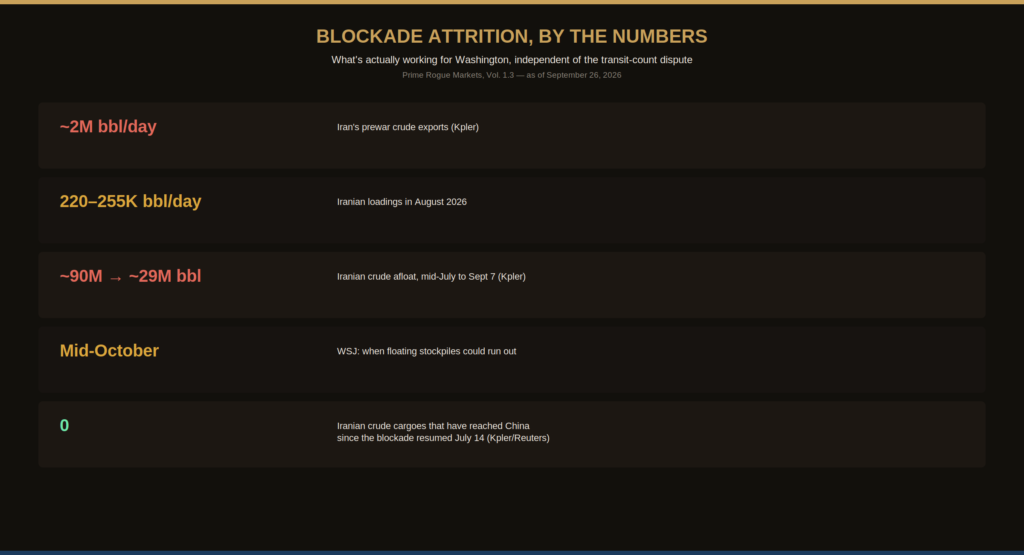
That timeline matters more than any single headline this week. If the mid-October estimate holds, Iran is negotiating against its own clock — which helps explain why Araghchi is the one publicly pushing a seven-day plan while Washington, per its own officials, says it “is not in a rush.”
Strip away the rhetoric and the seven-day plan was a straightforward sequencing proposal: accept, then de-escalate, then reopen, then formalize.
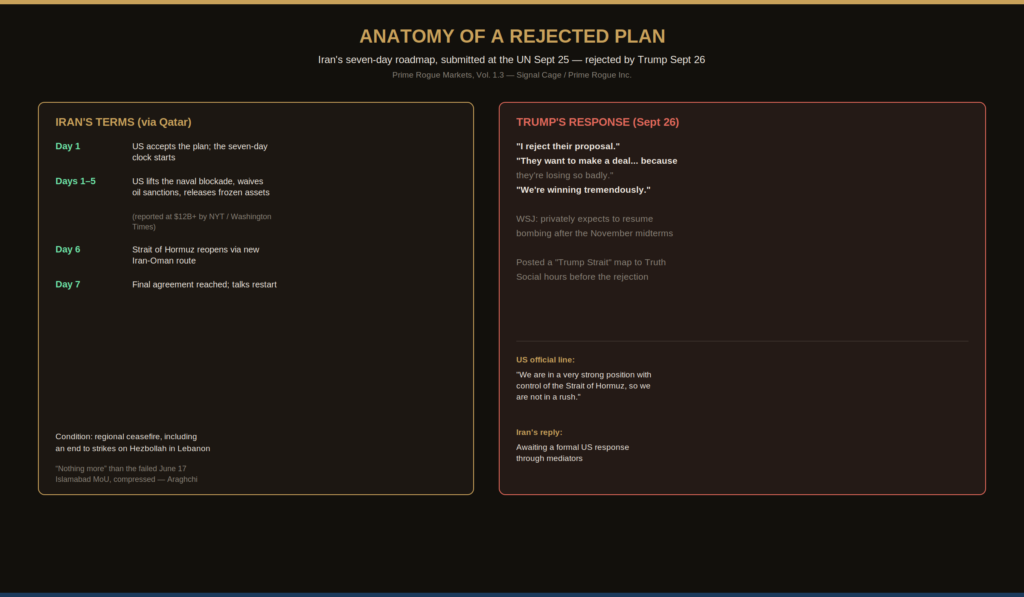
What stands out isn’t the rejection itself — Washington has rejected offers before, in June and again in July. It’s the reasoning behind this one. A US official told reporters Washington is “in a very strong position with control of the Strait of Hormuz, so we are not in a rush.” The Wall Street Journal, citing unnamed officials, reported that Trump privately “sees a renewed bombing campaign as likely” after the November midterms — meaning the administration’s own stated timeline for the next move is now tied explicitly to a domestic election calendar rather than to conditions in the Gulf. Iran, meanwhile, is negotiating against its own exhaustion clock. Both sides are now running this war on a schedule that has nothing to do with the strait itself.
Brent crude eased to $104.32 on September 25 as hopes built around the Qatar-mediated talks — down from a September 15 high of $108.75 that had been driven by the September 1 strikes and a September 10 attack on Saudi Arabia’s East-West Petroline that cut Red Sea-bound crude flows by roughly 84%. The VIX stayed contained throughout the period, in the mid-to-high teens, showing the usual pattern from this series: oil reprices hard on every escalation, equities barely move. Freight markets tell a sharper story — the Baltic Exchange’s Oman–China VLCC rate hit $870,947 a day in mid-September, well above the $520,000 benchmark we flagged in Cycle Six, as ship-to-ship transfer waiting times and Cape-route rerouting squeeze available tonnage.
Trump’s rejection came on a Saturday, after Friday’s close. Monday, September 28 is the first real test of whether markets price in a stalemate or a resumed bombing campaign — the September 25 discount built on deal hopes is the part most likely to reverse first.
Our read on the Carney-Trump tariff collapse and Canada’s potash leverage flagged a structural pattern worth revisiting here: states deploy leverage either loudly, as fait accompli, or silently, in reserve. Iran’s Persian Gulf Strait Authority remains the loud model — a named, sanctioned, still-operating toll authority daring Washington and the IMO to call it illegitimate. The seven-day plan is Iran trying to convert that same loud leverage into a negotiated exit before its own exhaustion clock runs out. Washington’s posture, “not in a rush,” next move penciled in for after the midterms, is the mirror image: leverage held in reserve, deployed on its own schedule rather than the other side’s.
Every belligerent in this conflict is running a public-narrative operation alongside the military and economic ones — a pattern we mapped in detail, on the Israeli side specifically, in What Is Hasbara?. Trump’s “Trump Strait” map and his “we’re winning tremendously” framing are the same genre of state messaging: not a factual claim to be checked against shipping data, but a public position designed to shape how the rejection gets read. Reading the barrels dispute above in isolation from this messaging layer means missing why the US and Iranian numbers diverge as much as they do — both sides have a narrative incentive to publish a number, and neither number is a neutral measurement.
Submitted through Qatar at the UN General Assembly on September 25, 2026, the plan called for the US to lift its naval blockade of Iran, waive oil sanctions, and release over $12 billion in frozen Iranian assets, alongside a regional ceasefire including Lebanon. In exchange, the Strait of Hormuz would reopen via a new Iran-Oman route on day six, with a final agreement reached on day seven.
Trump told reporters on September 26 that Iran wants a deal because “they’re losing so badly” and that the US has “total control” of the strait. The Wall Street Journal reported he is privately skeptical Iran would meet US demands and expects to resume bombing after the November midterm elections.
It depends who you ask. US officials claim 10 to 17 million barrels a day. The International Crisis Group’s independent estimate is roughly 5 to 7 million barrels a day for August 2026 — a gap likely explained by US figures including escort vessels and ship-to-ship transfers that independent trackers exclude.
On Iran’s oil exports, yes, unambiguously: no Iranian crude has reached China since the blockade resumed July 14, 2026, and Iran’s floating oil stockpiles are reportedly on track to run out by mid-October. On fully reopening the strait to normal traffic, no — shipping volumes remain far below prewar levels regardless of whose transit count you use.
This analysis applies the same standard as the prior two installments: no trade calls, no price targets. This is a tracking exercise built on primary and named sourcing, notablyCENTCOM releases, Treasury/OFAC actions, named analysts at Lloyd’s List and the International Crisis Group, over aggregation. Several figures in this piece originate with Iranian state-aligned outlets or unverified OSINT accounts; where that’s the case, it’s flagged in the text rather than presented as confirmed fact.
This is intelligence analysis, not financial advice. Nothing in this piece is a recommendation to buy, sell, or hold any security, commodity, or currency. Prime Rogue applies open-source intelligence methodology to markets; we are not licensed investment or financial advisors, and this content should be treated as one input into your own research, not a substitute for it.
— Prime Rogue Inc. / Signal Cage
 The Hormuz Cycle, Cycle Six: A Seizure, a Near-Deal, and the Toll Authority Nobody Recognizes
 The Hormuz Cycle: Why the Iran War Keeps Whipsawing Oil Markets
 SITREP 001: India Has 60 Days of Oil Left. Modi Was in Israel 48 Hours Before the Iran War.
 Operation Lion’s Roar: Joint US-Israeli Strikes on Iran, February 28, 2026 – 0826 UTC – Situation Report 1