Address
304 North Cardinal St.
Dorchester Center, MA 02124
Work Hours
Monday to Friday: 7AM - 7PM
Weekend: 10AM - 5PM

Address
304 North Cardinal St.
Dorchester Center, MA 02124
Work Hours
Monday to Friday: 7AM - 7PM
Weekend: 10AM - 5PM
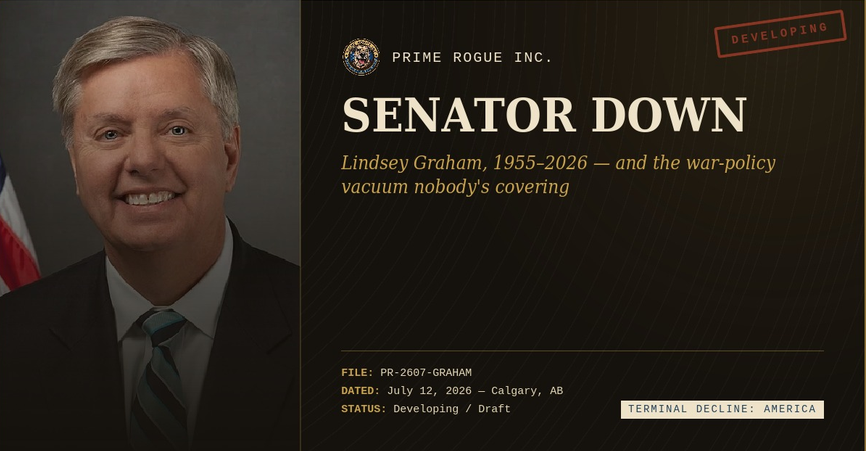
Sen. Lindsey Graham (R-South Carolina) died Saturday night, July 11, at his Capitol Hill home. He was 71. His office says the cause was a “brief and sudden illness.” Police scanner audio obtained by NBC News tells a more specific story: the emergency call was for cardiac arrest. Paramedics carried him out on a stretcher. No hospital has been named. No pronouncement location has been confirmed. No autopsy has been announced.
None of that is unusual for eight hours out. What’s unusual is the timing, and what nobody in the wall-to-wall coverage is asking out loud: who is actually running two active American war files this morning?

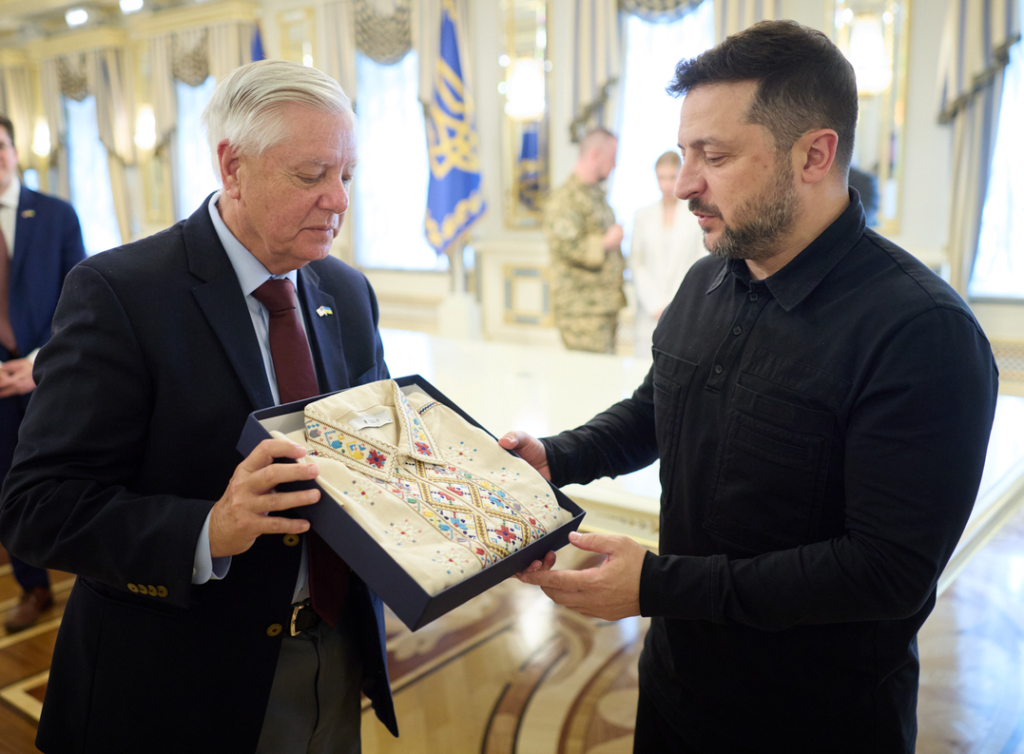
Graham was in Kyiv on Friday, July 10 — less than 48 hours before his death — meeting with Volodymyr Zelensky. The visit produced a breakthrough: the White House agreed to advance a new Russia sanctions bill, a deal Graham himself announced. He was booked for an exclusive Sunday appearance on Meet the Press. He was, by every visible measure, at the center of the Senate’s Ukraine policy machinery the moment he died.
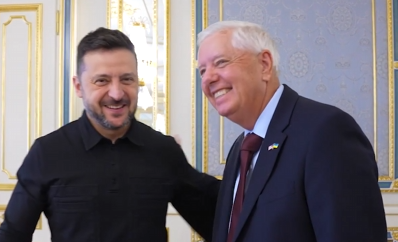
Graham wasn’t a peripheral figure on this file. He was chairman of the Senate Budget Committee, sat on Judiciary and Appropriations, and had spent two decades building a reputation as the chamber’s most reliable hawk on both Russia and Iran. He was also a chief architect of the war-hawk consensus that has kept Ukraine funding and Iran action moving through a fractured Republican caucus increasingly pulled toward an “America First” posture that opposed exactly the kind of intervention Graham championed.
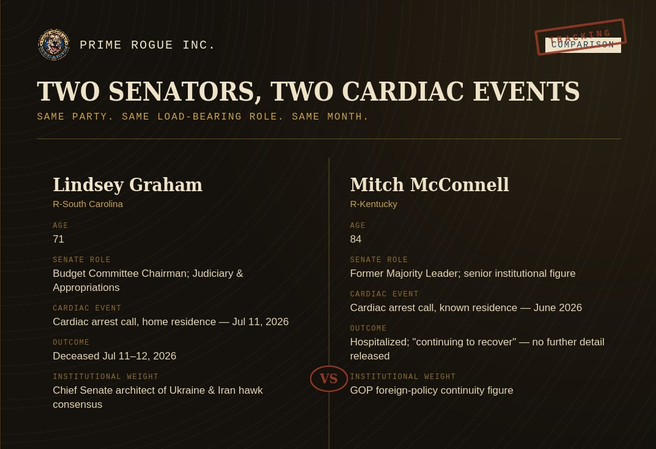
Graham’s death is not an isolated data point. Senate Minority figure Mitch McConnell — older, similarly institutional, similarly load-bearing for GOP foreign policy continuity — remains hospitalized after his own cardiac arrest call at his residence last month. His office has offered no details beyond confirming he is “continuing to recover.”
Two of the Senate’s most consequential Republican figures, both central to how the party navigates war policy, both felled by cardiac events at home within weeks of each other. That is not evidence of anything beyond what it appears to be: a Senate leadership class that is old, that works itself hard, and that is now visibly breaking down in real time. This is the Terminal Decline: America thesis playing out in the most literal way possible — not metaphorical institutional rot, but the actual bodies of the people running the institution.
No autopsy result exists yet for Graham. No new details have emerged on McConnell’s condition. Drawing a causal line between the two events would be irresponsible. Noting that American war policy on two fronts currently runs through a bench this thin, this old, and now this depleted — that’s just reporting.
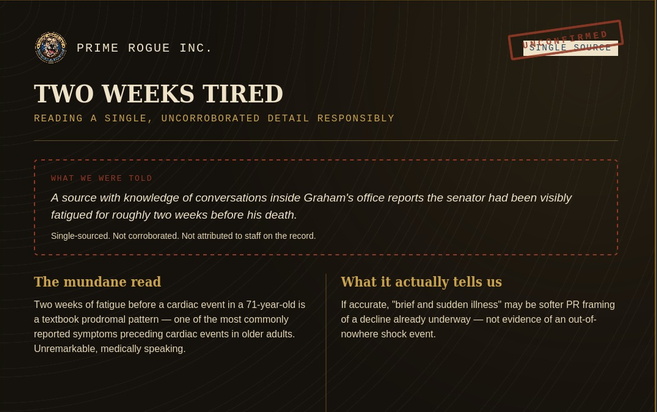
Prime Rogue has a single, unconfirmed source with knowledge of conversations inside Graham’s office reporting that the senator had been visibly fatigued for roughly two weeks prior to his death. This has not been independently corroborated and is not attributed to Graham’s staff on the record; readers should weigh it accordingly. If accurate, it is not evidence of anything exotic — two weeks of fatigue preceding a cardiac event in a 71-year-old is a common prodromal pattern, not an outlier. If anything, it suggests “brief and sudden illness” may be doing some PR softening of a decline that was already underway, rather than describing an out-of-nowhere shock event. We’re noting it for the record, not building on it.
Graham’s Budget Committee chairmanship, his Judiciary seat, and his informal role as the Senate’s Ukraine-Russia point man don’t have a clean succession plan playing out in public yet. South Carolina’s governor will need to appoint a replacement senator, and whoever it is inherits none of Graham’s two decades of relationship capital with Zelensky, with the Israeli government, or with the White House on the Iran file.
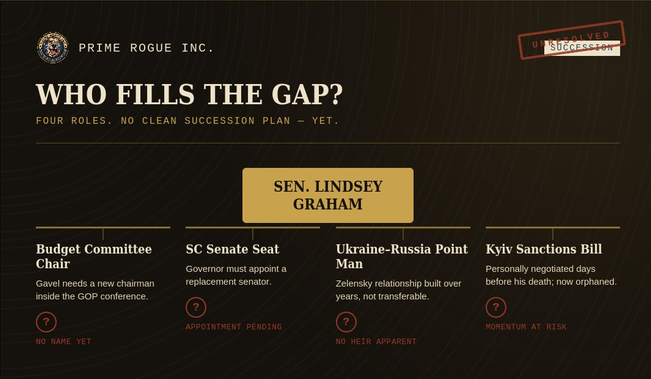
The sanctions bill Graham just personally negotiated in Kyiv is now, functionally, an orphaned piece of legislation at the exact moment it needed a champion to shepherd it through. Whether the White House and Senate Republicans treat that bill as unfinished business or let it stall without Graham pushing it is the concrete, answerable question here — not what killed him.
Graham was the single most personally invested US senator in Ukraine’s war effort — not just a reliable vote, but a repeat visitor to Kyiv who built a direct working relationship with Zelensky over years, not photo ops. The sanctions bill he negotiated days before his death still exists on paper, but bills don’t move themselves through a fractured caucus; they move because someone with standing spends political capital pushing them. Graham was that person on this file. His absence doesn’t kill the bill outright, but it removes the single Republican most willing to fight his own party’s America First wing to pass it. Watch whether any other GOP senator steps into that specific role, or whether the bill quietly loses momentum without a visible villain to blame.
Graham was one of Israel’s most consistent Senate defenders across administrations, tightly aligned with hawkish positioning on Iran and a reliable vote and voice for Israel–US defense cooperation. His death removes a senior Republican who could reliably rally caucus support for Israel-aligned measures without needing to be whipped into line. In the middle of Operation Epic Fury, that matters: Graham was a builder of the Iran-hawk consensus inside the GOP, not just a member of it. Whether that consensus holds without its most senior institutional voice — particularly as the America First wing grows more openly skeptical of continued Middle East entanglement — is now an open question rather than a settled one.
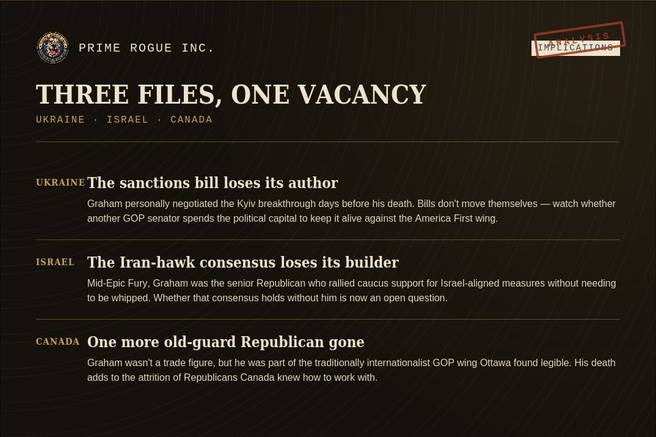
Graham’s death has no direct bearing on Canada-US file mechanics, but it lands at a moment when Ottawa is already recalibrating around a relationship Prime Minister Carney has called “fundamentally changed,” with a pivot toward Europe underway and USMCA review looming this month. Graham was not a figure Canadian officials dealt with directly on trade, but he was part of the older, more traditionally internationalist wing of the Republican Party that Canadian diplomats found more legible and more predictable than the America First bloc now ascendant. His death is one more data point in a broader pattern this outlet has tracked all year: the steady attrition of the Republican old guard that Ottawa has known how to work with, replaced by a caucus increasingly organized around instincts Canada has less practice reading.
Prime Rogue will track three things over the coming days: whether an official cause of death and pronouncement location are released, who South Carolina’s governor names as Graham’s replacement, and whether the Kyiv sanctions bill retains momentum without its author in the room. All three are checkable. All three matter more than speculation about a 71-year-old man’s cardiac arrest.
 The MAGA Purge and the Whistle: How Laura Loomer’s Loyalty Crusade Targets Tucker Carlson’s Epstein Codebreaking
 The Arctic Flight That Reveals NATO’s Greenland Strategy
 Populism as Social Technology: Why It’s Such a Danger in 2026
 April 25, 2025: The Death of American Democracy Began With a Judge in Handcuffs