Address
304 North Cardinal St.
Dorchester Center, MA 02124
Work Hours
Monday to Friday: 7AM - 7PM
Weekend: 10AM - 5PM

Address
304 North Cardinal St.
Dorchester Center, MA 02124
Work Hours
Monday to Friday: 7AM - 7PM
Weekend: 10AM - 5PM

A claim circulating since the morning of 21 June states that Belarus has begun jamming Russian military relay equipment used to guide drone strikes into northern Ukraine, allegedly in response to a public ultimatum from Volodymyr Zelensky earlier in the week. The claim has picked up real volume — hundreds of thousands of views, four-figure repost counts — but the sourcing underneath it is thin: it traces to unnamed Russian military bloggers, repeated without independent corroboration from Ukrainian officials, Belarusian state media, or any Western government or open-source monitoring outfit with a track record on this specific theatre.
Here’s what’s actually solid, and where the gap sits.

On 19 June, Zelensky gave Belarus a one-week deadline to dismantle or switch off relay stations he says are located in two Belarusian regions along the Ukrainian border, equipment Kyiv alleges helps Russian (and Iranian-supplied) drones and missiles navigate more accurately during strikes on Ukrainian territory. The framing was deliberately narrow and almost legalistic: not a broad complaint about Belarus’s alignment with Moscow, but a specific technical demand with a specific technical fix. “There are relay stations on the towers,” Zelensky said. “Can he take them down? Just take down that equipment; just shut it down.” He paired the demand with a second one — that Belarus stop supplying refined fuel products to the Russian military, citing a reported thirteenfold increase in gasoline shipments to Russia between January and May compared to the same period last year.
Kyiv says this wasn’t a first contact. Zelensky has stated that private warnings went to Minsk through intelligence and security-service channels well before the public ultimatum, and that the public version was specifically the escalation step taken after those private channels produced nothing. Ukraine’s Unmanned Systems Forces commander separately said Ukrainian forces have already identified roughly 500 targets inside Belarus in the event of further escalation — a real, on-record threat that gives the relay-station deadline teeth beyond rhetoric which makes sense after further sanctions against Russia were announced at the 2026 G7 Summit.

This is where the viral claim runs into trouble. In an interview published within the last day — after the jamming claim had already started circulating — Zelensky was asked directly whether there had been any response from Minsk to the ultimatum. His answer: no confirmed reaction. He explicitly waved off “unofficial words” coming out of Belarus as being of little interest to him, and reiterated that the test is a concrete, verifiable action — switch the equipment off, dismantle it, and show Ukraine that it’s been removed — not a claim relayed secondhand through bloggers on either side of the border.
That’s about as close to an official non-confirmation as exists right now, and it sits in direct tension with the jamming claim. Either Zelensky’s team hadn’t yet picked up on the milblogger chatter when he gave that answer, or the claim is exactly the kind of pre-emptive, face-saving signal a regime under pressure has every incentive to put into circulation: a way of suggesting compliance is already underway without anyone having to verify it, timed conveniently inside the same week as the deadline itself.
“According to Russian mini bloggers” is not a slur on the format — milblogger channels have produced real, occasionally first-to-report intelligence over the course of this war. But they’re also a known vector for exactly this kind of claim: face-saving narratives that let a pressured actor (in this case, Minsk, caught between a Ukrainian deadline and its dependency on Moscow) appear to be threading the needle without any of the parties who’d actually know — Ukrainian signals intelligence, Western monitoring services, Belarusian state media itself — going on record. Belarusian state outlets have not, as of this writing, confirmed any jamming action against Russian infrastructure. Russian state channels haven’t either. The claim exists, for now, almost entirely inside the secondary-amplification layer of the war’s information environment: a war-aggregator account citing unnamed bloggers, reposted at scale, with no primary source anyone can independently check at a time when the Suwalki Gap is such a massive flashpoint between Russia and NATO.
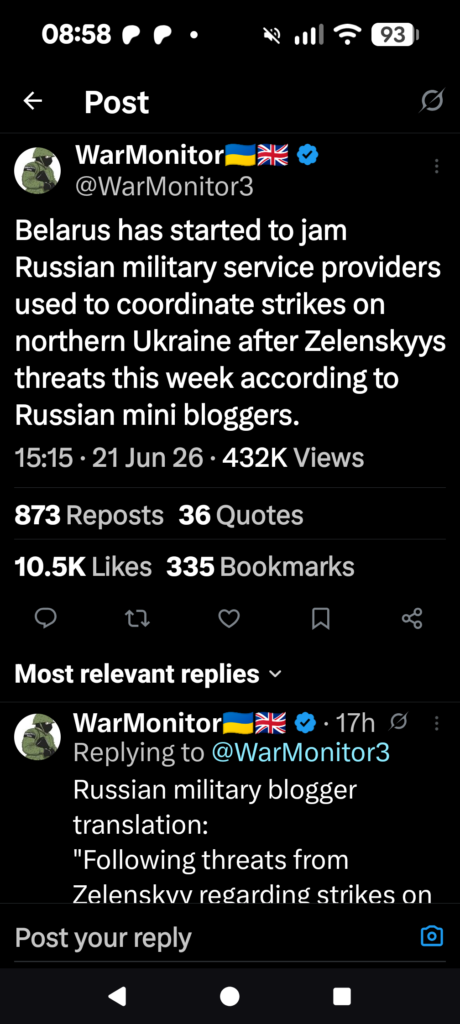
The underlying dispute is real and well-documented: Zelensky’s ultimatum, the 500-target threat, the fuel-supply pressure, the one-week clock. Whether Belarus has actually taken any technical action in response — jamming, dismantling, or otherwise — is not yet established by anything beyond an anonymous claim that the Ukrainian president’s own most recent public comments seem to contradict. This is worth watching, not reporting as fact. If Belarusian state media, Ukrainian officials, or a credible independent monitor confirms movement on the relay stations in the next few days, that’s the next flash. Until then, the honest status is: disputed, single-sourced, and currently undercut by the one government with the clearest incentive to confirm it if it were true.
 Infrastructure Warfare: Vulnerabilities and Protection
 Russian Missile Attack on Dnipro: Intelligence Brief
 The Next NATO-Russia Flashpoints: Why Conflict Could Erupt in the Suwalki Gap After a Ukraine Peace Agreement
 Analysis: France Pushes to Seize $400 Billion in Russian Assets as U.S. Retrenchment Threatens NATO and Canada