Address
304 North Cardinal St.
Dorchester Center, MA 02124
Work Hours
Monday to Friday: 7AM - 7PM
Weekend: 10AM - 5PM

Address
304 North Cardinal St.
Dorchester Center, MA 02124
Work Hours
Monday to Friday: 7AM - 7PM
Weekend: 10AM - 5PM
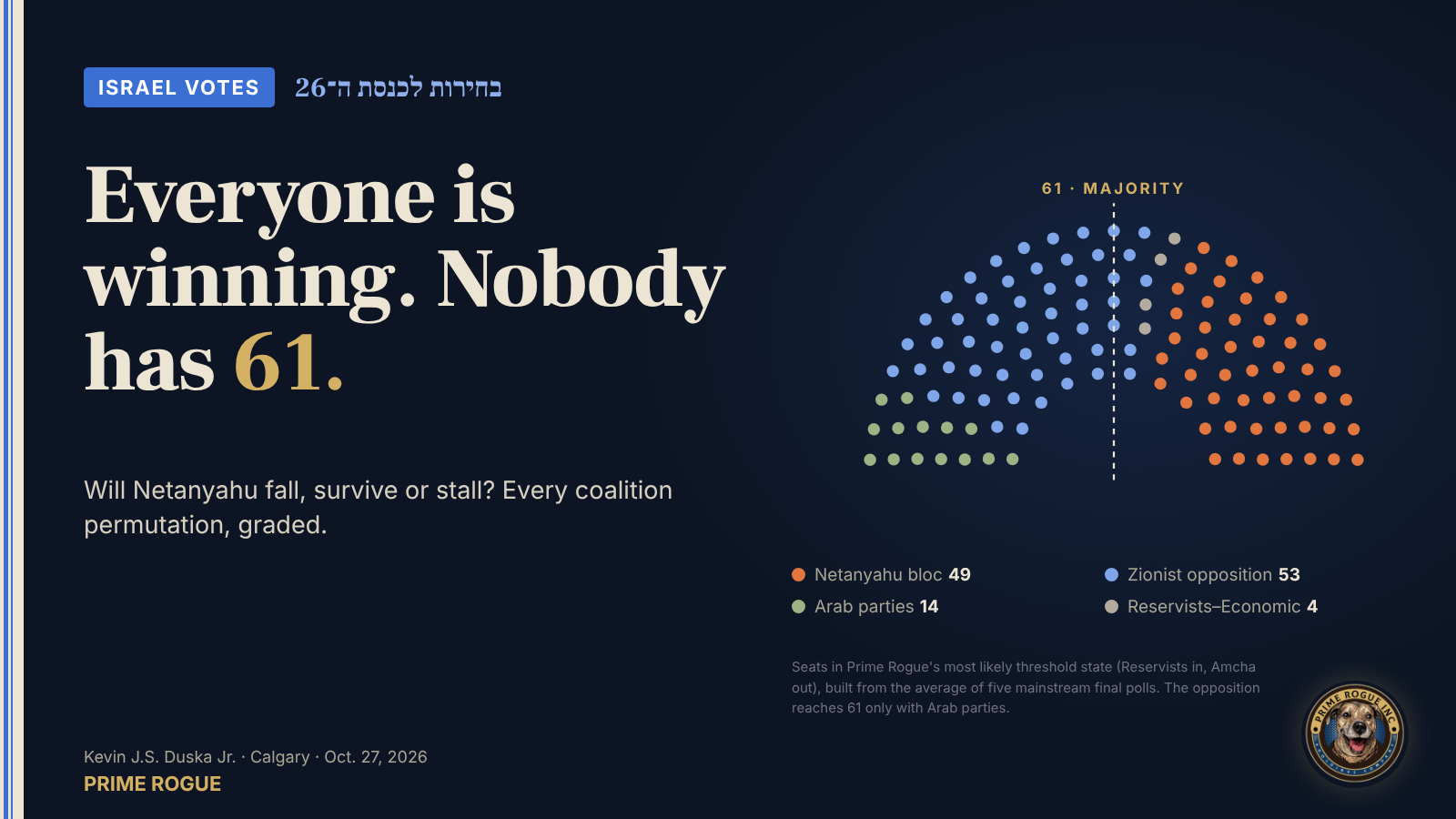
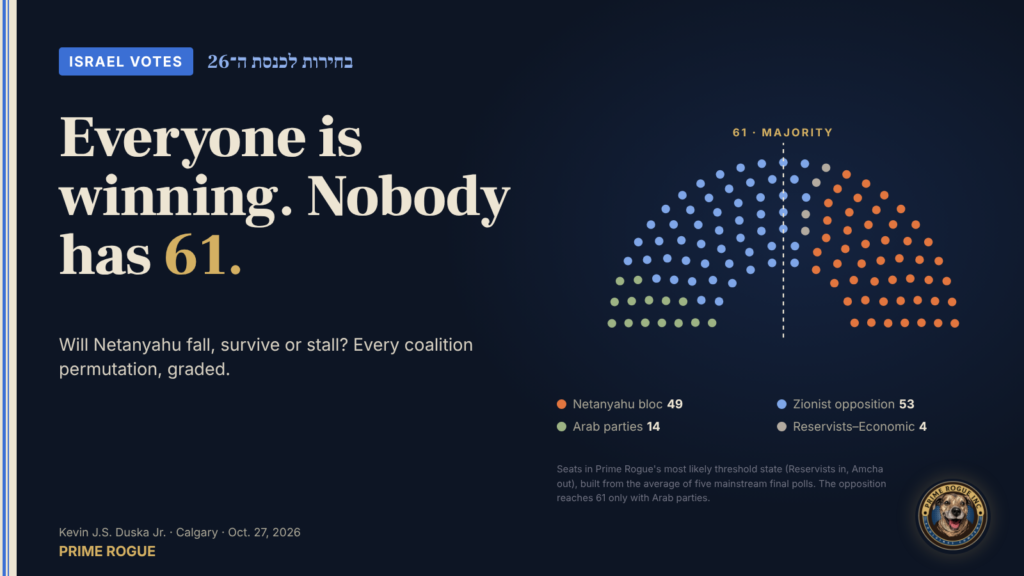
KJ1. No bloc reaches 61 seats on any credible measure. It is HIGHLY LIKELY (80–90%) that exit polls show a hung Knesset. Mainstream final polls average the Netanyahu bloc at 49.6 and the Zionist opposition at 53.6, with 14–16 Arab seats holding the balance. [B2]
KJ2. It is ALMOST CERTAIN (≥95%) that Netanyahu remains in office as prime minister or caretaker for at least the next 30 days. Formation takes up to 42 days for the first nominee alone after the 4 Nov results. The outgoing government keeps its legal powers in the meantime, though Israeli case law and Attorney General guidance bind a transitional government to a duty of restraint. [A1 on process; analytic judgement on timing]
KJ3. Of 11 coalition permutations examined, three have a realistic path: an opposition government relying on Arab-party votes or abstention (P5/P6, ~31%), deadlock leading to a seventh election (P10, ~24%), and a Netanyahu right-religious government (P1, ~10%). No single permutation is LIKELY (>55%). A Likud–Yashar unity deal under Netanyahu (P3) falls to ~10% after Eisenkot’s Oct. 21 pledge that he will not serve under Netanyahu even in a rotation, resigning “an hour later” if it happened. [B1] He has not ruled out governing with a Likud led by someone else (P9, ~8%).
KJ4. The two threshold parties are the decisive swing variable, not the Eisenkot–Netanyahu head-to-head. Amcha Yisrael crossing adds 4 seats to the right; Reservists–Economic crossing adds 4 non-aligned seats. Each outcome reshuffles which permutations are viable (Section 5). [B2/B3]
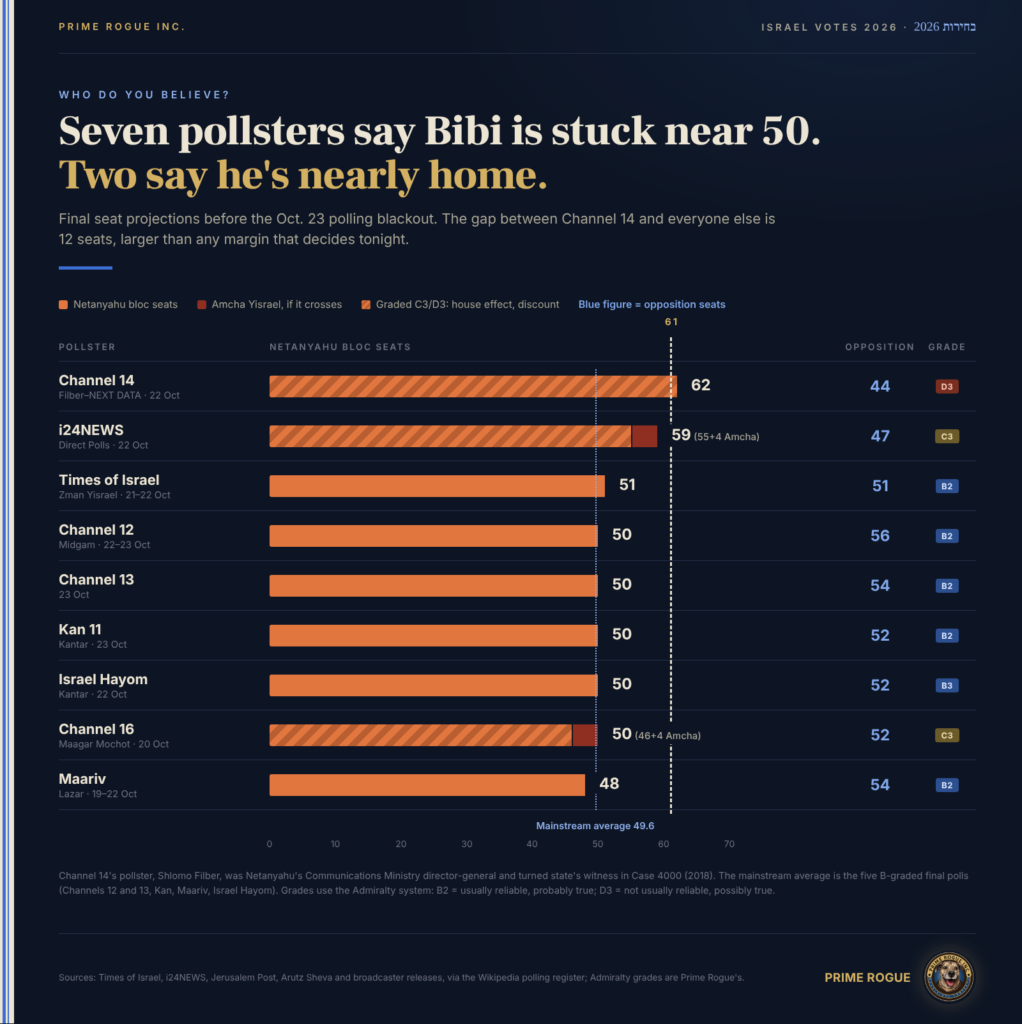
KJ5. Channel 14 is the outlier and is graded D3. Its pollster, Shlomo Filber, was Netanyahu’s Communications Ministry director-general and turned state’s witness in Case 4000 (2018); the channel runs +10 to +12 seats high for the bloc. A Channel 14 exit poll near 60+ should not be read as a Netanyahu majority until the count confirms it.
Overall analytic confidence: MODERATE. Polling is plentiful and convergent outside two outlets, but exit-poll error, threshold effects and Arab turnout carry seat-level uncertainty larger than the margins that decide formation.
Every sourced claim carries a two-character Admiralty (NATO STANAG 2511) code: source reliability, then information credibility. Probabilities use the UK PHIA yardstick. Scenario probabilities and the threshold vote estimate are Prime Rogue analytic judgements, marked [PR]; they are not sourced figures.
| Reliability | Meaning | Credibility | Meaning |
| A | Completely reliable | 1 | Confirmed by independent sources |
| B | Usually reliable | 2 | Probably true |
| C | Fairly reliable | 3 | Possibly true |
| D | Not usually reliable | 4 | Doubtful |
| E | Unreliable | 5 | Improbable |
| F | Cannot be judged | 6 | Cannot be judged |
| Yardstick term | Probability |
| Remote | ≤5% |
| Highly unlikely | 10–20% |
| Unlikely | 25–35% |
| Realistic possibility | 40–50% (used down to ~30% for the modal outcome in a fragmented field) |
| Likely | 55–75% |
| Highly likely | 80–90% |
| Almost certain | ≥95% |
Mainstream broadcast pollsters grade B2; the two Netanyahu-aligned pollsters and the prediction markets are downgraded for bias or manipulability.
| Source | Grade | Rationale |
| Central Elections Committee (eligibility, procedure, timeline) | A1 | Statutory authority; figures corroborated across Reuters, Al Jazeera, JPost |
| Channel 12 / Midgam (final 22–23 Oct, n=1,018) | B2 | Long track record; converges with peers; normal exit-poll error history |
| Channel 13 / Midgam Project et al. (23 Oct, n=1,875) | B2 | Converges with Ch. 12 and Kan |
| Kan 11 / Kantar (23 Oct, n=1,106) | B2 | Public broadcaster; bloc totals confirmed, coalition-party breakdown incomplete |
| Maariv / Lazar (19–22 Oct) | B2 | Consistent with mainstream cluster |
| Israel Hayom / Kantar (22 Oct) | B3 | Outlet historically pro-Netanyahu, but Kantar figures sit inside the mainstream band |
| Channel 16 / Maagar Mochot (20 Oct) | C3 | Runs low on Likud (18); final poll also had Reservists 4 and Amcha 4 |
| i24 / Direct Polls (fieldwork 22 Oct, n=5,124) | C3 | Bloc 59 incl. Amcha 4, opposition 47, Arab 14; runs +5 to +9 for the bloc |
| Channel 14 / Filber–NEXT DATA (22 Oct, n=7,937) | D3 | Pollster Shlomo Filber, ex-Netanyahu ministry director-general and state’s witness in Case 4000 (2018); +10 to +12 house effect; large n does not cure bias |
| Poll-of-polls (MEF, The Petek) | C2 | Transparent but include Ch. 14, pulling the average toward a 53–53 tie |
| Polymarket / Kalshi (Eisenkot 58% / 52%, 26 Oct) | E4 | Moves within hours (Polymarket ~55% on 27 Oct). Ofir–Mitts–Zimmermann study of 1.24M transactions found 18% of pro-Netanyahu money in one account |
| Eisenkot on Radio 103FM, 21 Oct (via Times of Israel) | B1 | On-record, unequivocal statement by the principal; rules out serving under Netanyahu in any rotation |
| Trump endorsement, Truth Social, 18 Oct (Axios) | A1 | Primary text: “Complete and Total Endorsement of Bibi Netanyahu” |
| TIME, Netanyahu’s unity preference (two anonymous sources) | C4 | Undetermined |
| CNN, Netanyahu sought a pre-election joint strike on Iran (26 Oct) | C3 | Two U.S. officials and an Israeli security source; PMO calls it “fake news” |
| Golden Owl OSINT via Ynet, Iran-linked influence network | C3 | Private firm; method published; no independent authority confirmation |
| Netanyahu, claims of Iranian interference (i24) | E4 | Interested party; no evidence released; Tehran denies |
| Times of Israel / JPost on observers and policing | B2 | Corroborated across outlets of differing editorial lines |
| Prime Rogue scenario probabilities | [PR] | Analytic judgement derived from the above |
The working baseline is the mean of the five B-graded final polls: Netanyahu bloc 49.5, Zionist opposition 53.6, Arab parties 14.5, with Reservists–Economic in 3 of 5 polls at 4 seats. [B2] The Times of Israel’s own final poll (Zman Yisrael, 21–22 Oct) was tighter, at 51–51 with Arab parties 14 and Reservists 4, down from 54–49 in its 15 Oct poll. [B2] All final TV-poll figures below match the published releases.
| Party (leader) | Bloc | Mean | Range | Ch. 14 (D3) |
| Yashar (Eisenkot) | Opposition | 22.2 | 21–23 | 20 |
| Likud (Netanyahu) | Netanyahu | 20.0 | 19–21 | 30 |
| Together (Bennett–Lapid) | Opposition | 14.4 | 14–15 | 11 |
| The Democrats (Golan) | Opposition | 9.2 | 8–10 | 8 |
| Joint List (Jabareen) | Arab | 9.0 | 9 | 8 |
| Yisrael Beiteinu (Lieberman) | Opposition | 7.75 | 7–8 | 5 |
| Shas (Deri) | Netanyahu | 7.75 | 7–8 | 9 |
| Otzma Yehudit (Ben-Gvir) | Netanyahu | 7.75 | 7–8 | 8 |
| United Torah Judaism (Yaakov Asher) | Netanyahu | 7.25 | 7–8 | 8 |
| Religious Zionism–Zehut (Smotrich) | Netanyahu | 6.75 | 6–8 | 7 |
| Ra’am (Abbas) | Arab | 5.5 | 5–7 | 6 |
| Reservists–Economic (Hendel–Zelekha) | Non-aligned | 0 or 4 | out–4 | out (1.9%) |
| Amcha Yisrael (Winter) | Right, non-bloc | 0 | out (2.5–3.1%) | out (1.5%) |
| Netanyahu bloc | 49.5 | 48–50 | 62 | |
| Zionist opposition | 53.6 | 52–56 | 44 | |
| Arab parties | 14.5 | 14–16 | 14 |
House-effect adjustment. Including Ch. 14 and i24 moves the average to roughly 53–53 (MEF, The Petek). [C2] Prime Rogue weights the B-graded cluster only. The ~4-seat-per-bloc gap between the two baselines is the single largest source of uncertainty in this assessment.
Exit-poll error. Historic error is ±2–3 seats per party and larger at the bloc level; in 2015 exit polls showed a tie and Likud won 30–24. [B1]
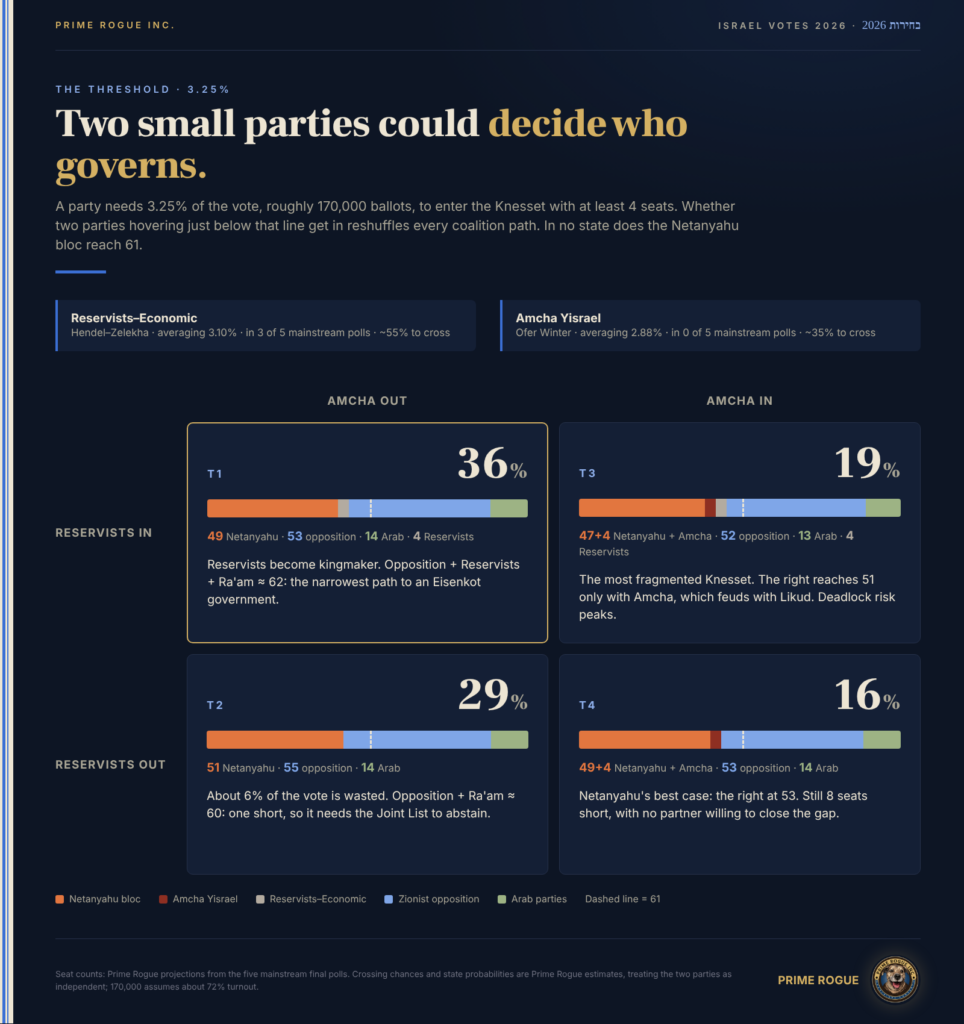
The most likely threshold state is Reservists in and Amcha out (~36% [PR]), which is also the state most favourable to an opposition majority. The threshold is 3.25%, roughly 170,000 votes at 72% turnout [PR]. A party that crosses takes 4 seats from everyone else; a party that misses wastes its ~3% and inflates everyone else.
Inputs: Reservists–Economic averages 3.10% (in 3 of 5 B-graded polls), giving ~55% to cross. Amcha Yisrael averages 2.88% (in 0 of 5 B-graded polls), giving ~35%. [B2 inputs; PR probabilities, treated as independent]
| State | Res. | Amcha | P [PR] | Bibi bloc | Amcha | Opp. | Res. | Arab | Effect on formation |
| T1 | In | Out | ~36% | 49 | – | 53 | 4 | 14 | Reservists become kingmaker. Opposition + Reservists + Ra’am ≈ 62 |
| T2 | Out | Out | ~29% | 51 | – | 55 | – | 14 | ~6% wasted vote inflates all lists. Opposition + Ra’am ≈ 60; needs Joint List abstention |
| T3 | In | In | ~19% | 47 | 4 | 52 | 4 | 13 | Most fragmented state. Right reaches 51 only with Amcha. Deadlock risk peaks |
| T4 | Out | In | ~16% | 49 | 4 | 53 | – | 14 | Best state for Netanyahu: right at 53, still 8 short |
Judgement. In no threshold state does the Netanyahu bloc reach 61 on B-graded numbers; it needs a further overperformance of 8–12 seats, which is what Ch. 14 claims. Reservists crossing helps the opposition more than Amcha crossing helps Netanyahu, because Hendel and Zelekha sit closer to the change bloc while Winter is openly hostile to Likud’s leadership. [B2/PR]
Surplus-vote agreements (Together–YB, Yashar–Dems, Joint List–Ra’am, Likud–RZP, Shas–UTJ) can move one seat between blocs. Otzma, Amcha and Reservists have none, so they are likeliest to lose a fractional seat. [B2]
Read the exit poll by where the Netanyahu bloc (including Amcha if it crosses) lands. Bands and probabilities are [PR], from the Section 4 baseline with ±3 seats of bloc-level error and the Section 5 threshold states.
| Band | Bloc seats | P [PR] | What it means | Live permutations |
| N1 | 61+ | ~10% | Ch. 14 was right. Netanyahu forms the most right-wing government in Israel’s history; Ben-Gvir bids for Defense | P1 |
| N2 | 58–60 | ~12% | Netanyahu 1–3 short. Hunts for defectors, Reservists or a reluctant Lieberman; opposition cannot form either | P1, P2, P3, P10 |
| N3 | 53–57 | ~30% | Classic stalemate. No path without a cross-bloc deal; unity pressure peaks (60% prefer unity to another election in Maariv; Kan, worded differently, split 27% unity / 27% repeat election / 26% minority government) [B2], but Eisenkot refuses to serve under Netanyahu | P10, P9, P3, P4, P11 |
| N4 | 48–52 | ~40% | The B-graded baseline. Opposition leads but needs Ra’am inside or Joint List abstention | P5, P6, P8, P3, P10 |
| N5 | ≤47 | ~8% | Opposition plus Reservists or Ra’am clears 61; Likud succession fight (P9) becomes realistic | P5, P8, P9 |
Judgement. The bloc is HIGHLY LIKELY (~78%) to land between 48 and 60, the zone where no government forms on election night. [PR]
Eleven permutations are arithmetically conceivable. The opposition paths (P5+P6+P8) total ~36%, deadlock (P10) ~24%, unity variants with Netanyahu (P3+P4) ~13%, a Netanyahu right-wing government (P1+P2) ~13%, and a post-Netanyahu Likud deal (P9) ~8%. [PR] Seat math uses rounded B-graded means (±1): Likud 20, Shas 8, UTJ 7, Otzma 8, RZP 7, Yashar 22, Together 14, Dems 9, YB 8, Joint List 9, Ra’am 5, Reservists 0/4, Amcha 0/4.
| # | Permutation | Members | Seats | Blockers | Needs | P |
| P1 | Right-religious | Likud, Shas, UTJ, Otzma, RZP (+Amcha) | 50 (54) | Amcha–Likud feud | N1: 8–11 seat overperformance | ~10% |
| P2 | Right-religious + crossover | P1 + YB and/or Reservists or defectors | 58–62 | Lieberman’s anti-Haredi stance; Reservists’ centrist base | N2 and a defection | ~3% |
| P3 | Likud–Yashar unity under Netanyahu | Likud, Yashar + Shas/UTJ or + Together/YB | 57–64 | Eisenkot’s 21 Oct pledge not to serve under Netanyahu; Haredi draft | N3; Eisenkot reverses his pledge or Yashar splits | ~10% |
| P4 | Likud–Together rotation | Likud, Together, Shas, UTJ, RZP (+Res.) | 56–60 | Lapid inside Together; Bennett’s 2021 history | N2/N3 and a Together split | ~3% |
| P5 | Opposition + Ra’am | Yashar, Together, Dems, YB, Ra’am (+Res.) | 58 (62) | Arab partners ruled out by most; “Right or Palestine” | N4 + state T1 | ~20% |
| P6 | Opposition minority, JL abstains | Yashar, Together, Dems, YB (+Res.) | 53–57 vs ~50 | Joint List conditions; budget vulnerability | N4; JL abstains on investiture | ~11% |
| P7 | Opposition + Haredim | Yashar, Together, Dems, Shas, UTJ | 60 (64) | Draft law; Lieberman exits | Haredi break with Netanyahu | ~3% |
| P8 | Zionist-only majority | Yashar, Together, Dems, YB, Res., Amcha | 61–62 | Winter’s right-wing base; fragile | T3, or band N5 | ~5% |
| P9 | Post-Netanyahu Likud | New Likud leader + Yashar/Together | 56–64 | Requires Likud revolt; none signalled. Eisenkot has not ruled out Likud without Netanyahu | N3/N5 or failed Netanyahu mandate | ~8% |
| P10 | Deadlock → 7th election | Caretaker Netanyahu; vote ~spring 2027 | n/a | n/a | All mandates fail (~42+ days) | ~24% |
| P11 | Interim gov. to dissolve | Ad hoc | n/a | Short-lived by design | Mutual exhaustion | ~3% |
Judgement. The modal outcome is an opposition-led government that depends on Arab parties (P5/P6, ~31%), with deadlock (P10, ~24%) close behind; neither is likely on its own. [PR] Eisenkot’s rotation pledge removes the main escape hatch from a stalemate, which is why deadlock gained the most from P3’s downgrade. P5 and P6 are the permutations Likud’s campaign was built to delegitimise, so even a successful formation carries elevated legitimacy-challenge risk (Section 9).
Investiture mechanics. A new government needs only more votes for than against, not 61. [A1] That makes P6 viable: 53–57 opposition votes beat ~50 with the Joint List abstaining. It also leaves such a government vulnerable on the budget, which must pass or the Knesset dissolves.
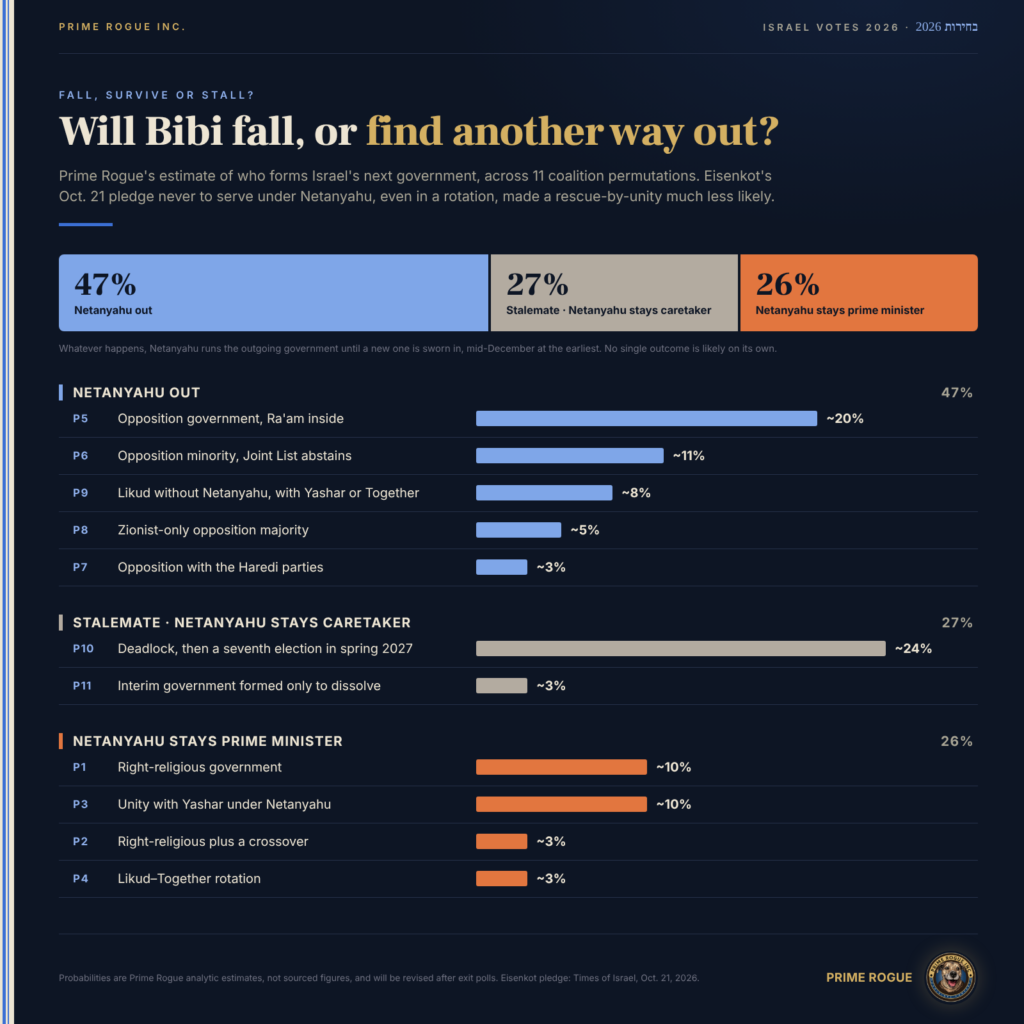
This is the first Knesset to reach its scheduled election date since 1988, and the sixth election since 2019. The earliest realistic swearing-in is mid-December; the latest point before a seventh election is triggered falls in January 2027. Process steps are A1 (Basic Law: The Government; CEC timeline); dates beyond 4 Nov are [PR] estimates.
Throughout, Netanyahu leads the outgoing government. It keeps its legal powers, but Israeli case law and Attorney General guidance require a transitional government to act with restraint; how much that binds security decisions is contested. [A1/PR] That window overlaps the 3 Nov U.S. midterms and the November period Prime Rogue’s Hormuz Cycle (Cycle Seven, 27 Sept) flagged as Trump’s reported window for renewed strikes on Iran, in the war that began with the joint strikes covered in Situation Report 1.
The caretaker question is already live. CNN reported on 26 Oct, citing two U.S. officials and an Israeli security source, that Netanyahu tried to persuade Trump to launch a joint strike on Iran before the vote and Trump did not give a green light; the PMO called it “fake news.” [C3] Channel 12 reported on 25 Oct that IDF chief Zamir sought signed legal authorization from Netanyahu for Iran-related action, which Netanyahu called “nonsense,” and Defense Minister Katz said there was no intention to strike Iran before the election. [C3] It is the latest round in the security-establishment rift Prime Rogue traced in Netanyahu’s Gamble.
The highest combined risk is a post-result legitimacy challenge to an Arab-dependent opposition government; the lowest-likelihood, highest-impact risk is a kinetic event during the caretaker period.
| Risk | Likelihood [PR] | Impact | Evidence | Grade | Exposed |
| Exit polls mislead by ≥2 seats on a decisive party | Likely | High | 2015 precedent; threshold calls flip late | B1 | All, esp. T1–T4 edges |
| Legitimacy challenge / refusal to accept results | Realistic possibility | High | Defence-establishment “Operation Capitol” scenario; ~20,000 officers officially, 22,000 per a senior police source | B2 | P5, P6 |
| Arab-sector intimidation or suppression | Realistic possibility | High | ~2,000 Likud/RZP observers in Arab towns; licensed guns allowed; High Court rejected the Adalah/Joint List petition on 25 Oct | B2 | P5, P6 |
| Disinformation and foreign influence | Almost certain (occurring) | Medium | Golden Owl: 32 fake Israeli personas drew ~947,000 views in 30 days; 357 fraud allegations flagged | C3 | All |
| Iranian interference claims used politically | Likely | Medium | Netanyahu claims, no evidence; Tehran denies | E4 | P1, P10 |
| Cyber disruption | Unlikely to alter outcome | Medium | No cyberattack or outage reported by mid-morning 27 Oct; Iran-war hacktivist activity elevated | C3 | Threshold parties |
| Kinetic or security event on election day | Highly unlikely | Very high | IDF general closure of the West Bank; minor incidents only by mid-morning (Beit Shemesh station vandalised, Yashar billboard burned in Dimona) | B2 | P5/P6 (turnout) |
| Renewed Iran strikes in caretaker period | Realistic possibility | Very high | CNN: Netanyahu sought a pre-election joint strike, Trump declined (PMO denies); Zamir legal-authorization report; November window | C3 | P10, P3 |
| U.S. pressure distorts formation | Likely | Medium–high | Trump’s 18 Oct “Complete and Total Endorsement”; same pattern Prime Rogue documented in Canada | A1 | P1, P3 |
| Weather suppresses turnout | Realistic possibility | Low–medium | Thunderstorms, hail and flooding forecast from midday in the centre and south | B2 | Turnout-sensitive lists |
| Seventh election | ~20% | High | Five elections 2019–22 precedent | PR | P10 |
Turnout as a risk multiplier. Arab turnout was 53.2% in 2022. Recent polling suggests about 60%, campaigners are aiming for 70%, and Israel Policy Forum puts it above 65%. [C2] Every ~5 points of Arab turnout is worth roughly one seat to the Arab lists and raises the effective bar for Jewish threshold parties. [PR] Returning expatriates add variance: estimates run from 50,000 (IPF) to about 67,000 (i24) and up to 80,000 (CNBC). [C3] First-time voters could decide up to 12 seats, per the Times of Israel; headcount estimates conflict and were not confirmed.
On Iran and Palestinian statehood, every permutation produces broad continuity; the divergence is on Oct. 7 accountability, Gaza administration, the judiciary and Canada’s ICC posture. Both front-runners oppose a Palestinian state and neither is dovish on Iran. [B2] Entries are [PR].
| Permutation | Iran | Gaza | United States | Canada |
| P1/P2 Right-religious | Strike resumption most likely; Otzma and RZP push maximalism (the coalition profile Prime Rogue described in Israel’s Threat to Global Stability) | Annexation and emigration agenda; stabilisation force stalls | Trump vindicated; U.S. leverage minimal | ICC warrant standoff entrenched |
| P3/P4 Unity | Continuity, more process-bound; Eisenkot as cabinet brake | Trump plan revived; international force unfrozen | Pliable, centrist-fronted partner | Warrant problem persists while Netanyahu is PM or rotation partner |
| P5/P6/P8 Opposition-led | Hawkish but institutional | Commission of inquiry; arrangements proceed; no statehood | Rebuke to Trump’s endorsement; U.S. leverage rises | Warrant out of leader channel; tests whether Ottawa targets Netanyahu or policy |
| P7 Opposition + Haredim | As P5 | As P5 | As P5 | As P5 |
| P9 Post-Netanyahu Likud | Continuity | Moderate re-engagement | Reset, less personal Trump stake | Warrant issue dissolves |
| P10 Deadlock | Highest risk: caretaker with war powers in the November window | Frozen into 2027 | Maximum U.S. influence over a caretaker | Standoff frozen; Hormuz exposure persists |
Washington’s open backing of Netanyahu mirrors the interference pattern Prime Rogue has tracked at home in the Full Spectrum series. An Eisenkot win would be read in Washington as a rebuke; a Netanyahu return keeps Ottawa’s stated position on the ICC warrant on a collision course with the White House. [PR]
Any Iran escalation in P1 or P10 transmits to Alberta through oil prices and the Hormuz risk premium Prime Rogue mapped in Flashpoint Hormuz and Canada’s Diesel Blind Spot. Higher prices help Alberta’s treasury while hurting Canadian diesel consumers. [PR]
The single most diagnostic reading tonight is whether Reservists–Economic and Amcha Yisrael clear 3.25% in the actual count; the exit poll alone will not settle it. Times are MDT (Israel UTC+2, Alberta UTC−6 until 1 Nov).
| Time (MDT) | Indicator | If observed | Confirms | Weakens |
| 2, 4, 6, 8, 10 a.m.; 12 p.m. | CEC turnout updates | Above 2022 pace (70.6% final) | Higher variance; P5/P6 if Arab towns surge | P1 |
| All day | Arab-town turnout; Adalah hotline | >63% / armed-observer incidents | P5/P6 / legitimacy risk | P1 |
| All day | Rocket alerts, security incidents | Major event | Turnout suppression; caretaker narrative | P5/P6 |
| From ~4 a.m. | Storms in the centre and south | Turnout dips in afternoon updates | Higher variance on threshold parties | – |
| 2:00 p.m. | Exit polls (Ch. 12, 13, Kan; Ch. 14) | Bloc ≥58 on B-graded channels | N1/N2: P1, P2 | P5, P6 |
| 2:00 p.m. | Exit polls | Bloc ≤52, Arab ≥15 | N4: P5, P6 | P1, P3 |
| 2:00 p.m. | Exit polls | Ch. 14 at 60+, others ≤52 | House effect persisting | Nothing yet |
| 2:00 p.m. | Yashar vs Likud gap | Yashar ahead by >2 | Eisenkot first mandate if Arab parties recommend | P1 |
| 3–7 p.m. | Threshold counts | Reservists in, Amcha out (T1) | P5 with a 61+ path | P1, P10 |
| 3–7 p.m. | Threshold counts | Amcha in (T3/T4) | Right at 51–53; deadlock risk up | P5 |
| Election night | Leaders’ speeches | Netanyahu calls for “national unity” | P3 | P1 |
| Election night | Leaders’ speeches | Eisenkot rules out Arab parties again | P3, P10 | P5, P6 |
| Election night | Leaders’ speeches | Fraud claims from either camp | Legitimacy-challenge risk | Clean transition |
| Wed–Thu | Double-envelope count | A seat flips across a bloc line | Recalculate Section 7 | – |
| Early–mid Nov | Herzog recommendations | Ra’am or JL recommends Eisenkot | P5/P6 | P1, P10 |
| 3 Nov onward | Iran rhetoric after U.S. midterms | Strike signalling while caretaker | Caretaker-war risk | – |
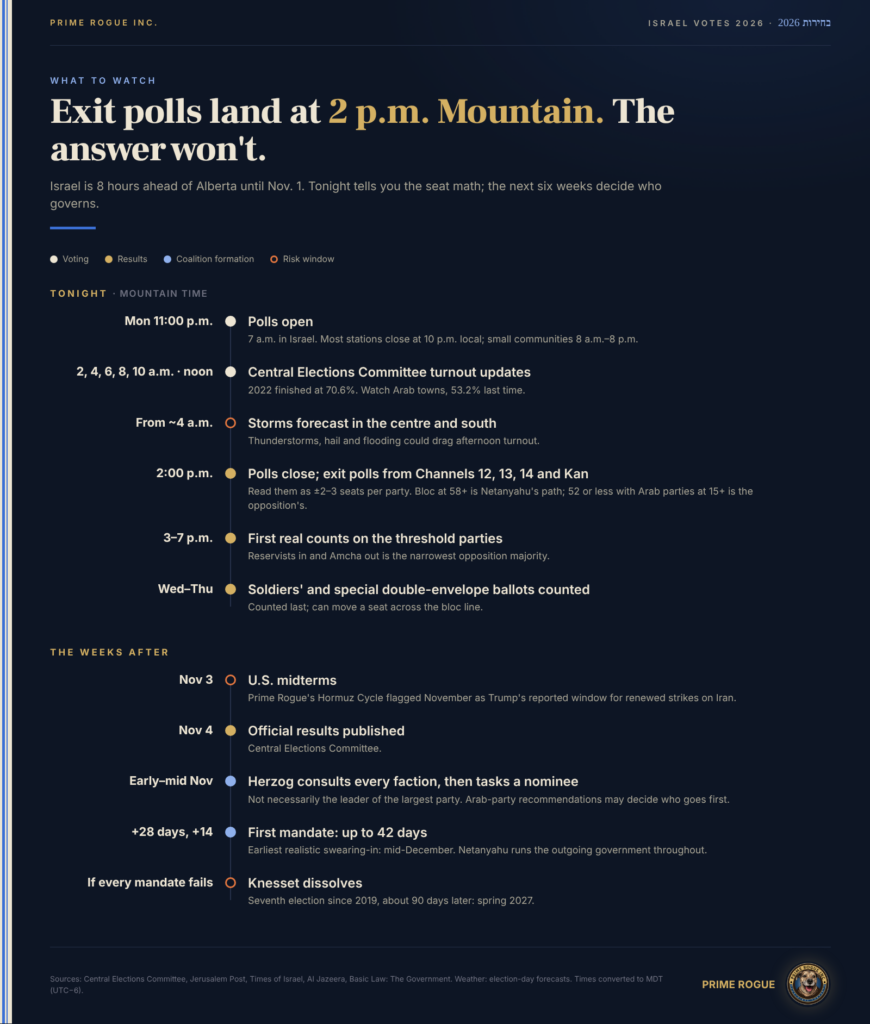
Analytic confidence is MODERATE on the hung-Knesset judgement and LOW on which permutation forms. Each gap below could move a permutation by 5+ points.
What would change the bottom line: a B-graded exit poll showing the bloc at 58+, or a threshold count with Reservists in, Amcha out and the Arab vote at 15+ seats.
| Question | Answer |
| When do Israel’s election polls close in Mountain Time? | Polls close at 10:00 p.m. Israel time on Oct. 27, 2026, which is 2:00 p.m. MDT. Exit polls from Channel 12, Channel 13 and Kan are released at that moment. |
| Who is leading the Israel election 2026 polls? | Gadi Eisenkot’s Yashar led every mainstream final poll at 21 to 23 seats, ahead of Likud at 19 to 21. No bloc reached the 61 seats needed for a majority. |
| Can Netanyahu still win? | Yes. A right-religious majority needs the bloc to outperform mainstream polls by 8 to 12 seats. Prime Rogue puts that at about 10%, and Netanyahu stays caretaker PM until any new government is sworn in. |
| What happens if no one forms a government? | After certification on Nov. 4, the nominee has up to 42 days. If every mandate fails, the Knesset dissolves and Israel holds its seventh election since 2019, likely in spring 2027. |
| What is the electoral threshold in Israel? | Parties need 3.25% of valid votes, roughly 170,000 votes at 72% turnout, to enter the Knesset. A party that crosses wins at least 4 seats. |
Fact-checked 27 Oct.
 Flashpoint Hormuz: Risk Assessment and Strategic Forecast Amid U.S.-Iran-Israel Conflict
 Post-Election Political Violence Risk Assessment: Canada 2025 After the Liberal Victory
 Netanyahu’s Gamble: Trust Breakdown in Shin Bet and Military Escalation
 Make Great Replacement Great Again: Carlson vs. Shapiro


[…] the regime is not cracking. Israel’s own intelligence assessment — delivered privately, meaning without audience management — concludes that the Islamic […]
[…] Rogue assesses that Israel is the single most likely trigger for full-scale escalation. Key risk vectors […]