Address
304 North Cardinal St.
Dorchester Center, MA 02124
Work Hours
Monday to Friday: 7AM - 7PM
Weekend: 10AM - 5PM

Address
304 North Cardinal St.
Dorchester Center, MA 02124
Work Hours
Monday to Friday: 7AM - 7PM
Weekend: 10AM - 5PM
Zero Convictions, One Bullet: Quebec Stonewalls Mizrahi Death in Montreal ShootingSPVM declined comment. RCMP declined comment. The office of Public Security Minister Ian Lafrenière declined comment. The Bureau des enquêtes indépendantes (BEI) — Quebec’s body for investigating police, by police — answered only after business hours, in a single line. Prime Rogue Inc. examines a watchdog with zero convictions in nearly 500 investigations, and asks why “too premature” should be accepted as an answer.
One week ago, three people died in Côte-des-Neiges. A police officer. A civilian. A suspect. On that much, every institution involved agrees.
On everything else, they have gone silent — and the silence has a shape to it. It is not the shape of an unsolved mystery. It is the shape of an answer everyone already has and nobody wants to say out loud.
Here is the question: did a bullet fired by a Montreal police officer kill the civilian, Michel Mizrahi, a 68-year-old tailor known in his community for giving away suits to people who couldn’t afford them?
This is not a complicated forensic puzzle. Investigators recovered the fatal round. They have, on scene, exactly two weapons it could have come from: the SPVM-issued service pistol, and the suspect’s long gun. Different calibers. Different rifling. A trained ballistics technician can resolve that comparison in an afternoon — sometimes less. The difference should, unless exceptional circumstances are in place, which they do not appear to be, visible to the naked eye of a lay observer familiar with firearms.
It has now been seven days. Radio silence from Québec and Montréal.
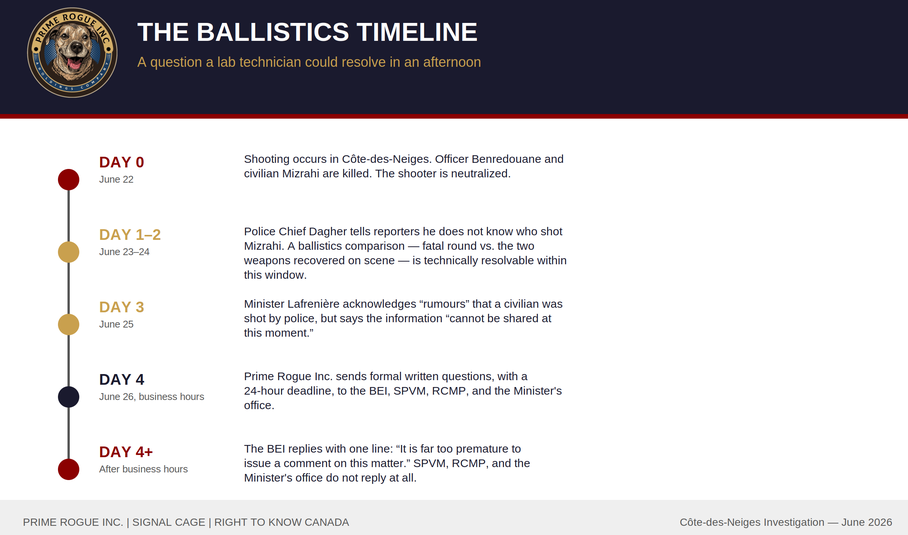
A ballistics comparison between two recovered weapons is normally an afternoon's work for a lab technician. Four days after the Côte-des-Neiges shooting, it still hadn't been confirmed publicly. Here's how the silence unfolded, day by day.Prime Rogue Inc., on behalf of its Signal Cage vertical, and in partnership with Right to Know Canada, sent formal written questions to four institutions: the BEI, the SPVM, the RCMP, and the office of Minister Ian Lafrenière. We asked, directly: has ballistics already determined whose weapon fired the fatal round? If so, when? If the file has been referred to the Director of Criminal and Penal Prosecutions, when did that happen? What is the BEI’s actual disclosure timeline?
We set a 24-hour deadline for response.
The SPVM declined to comment. The RCMP declined to comment. The office of Minister Lafrenière did not respond.
The BEI responded — after business hours, when no follow-up could land before the news cycle moved on — with exactly one line:
“It is far too premature to issue a comment on this matter.”
Let’s do the math the BEI apparently needs help with. “Premature” means too early. Four days into a ballistics determination that takes a lab technician an afternoon is not early. It is late. It has been late since day two.
Minister Lafrenière, for his part, has already told cameras there are “rumours” that a civilian was shot by a police officer — while insisting “this is not the kind of information we can share at this moment.” Read that sentence for what it actually is. That is not “we don’t know.” That is “we know, and we’ve decided you don’t get to.” Historically, and per the author’s experience as a near-lifelong Montréaler, highly knowledgeable in information operations, “rumour” is generally a Québécois political colloquialism for unconfirmed information that is inconvenient to governmental institutions.
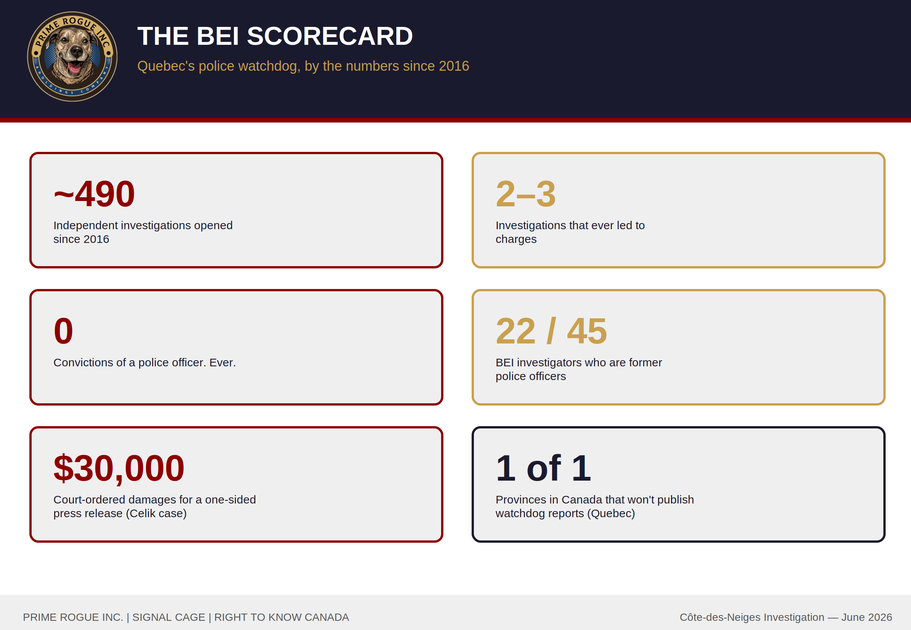
Nearly 500 investigations. Zero convictions. A court-ordered damages payout for biased reporting. This is the institution that told us a basic ballistics question was "too premature" to answer.None of this should surprise anyone who has watched the BEI operate since its creation. The agency was built in 2016 specifically to end the practice of police investigating police in Quebec. Here is what it has actually produced since:
— Nearly 500 independent investigations opened since 2016. Only two or three have ever led to charges from the Director of Criminal and Penal Prosecutions.
— Zero. Convictions. Of a police officer. Ever.
— In 2017, university student Koray Kevin Celik died after an SPVM intervention. The BEI issued a press release reflecting only the officers’ account — not the family’s, despite the family being present. Quebec’s Court of Appeal ordered the BEI to pay $30,000 in damages over it.
— As of last year, 22 of the BEI’s 45 investigators were former police officers — inside the very agency built to remove police from policing themselves.
— Months after its 2016 launch, the BEI had to call in the SPVM — the kind of force it exists to watch — for staffing reinforcement.
— Quebec remains the only province in Canada whose police watchdog does not publish its final investigation reports. British Columbia does. Ontario does. Manitoba does. Nova Scotia does. Quebec does not.
— Pierre Coriolan’s family waited eight months without even an autopsy report. Riley Fairholm’s mother is still asking questions, years later. Nooran Rezayi was fifteen years old.
This is the institution that just told Prime Rogue Inc. it is “too premature” to comment on a ballistics question. We are not required to extend the benefit of the doubt to an agency with this resume, and we do not.
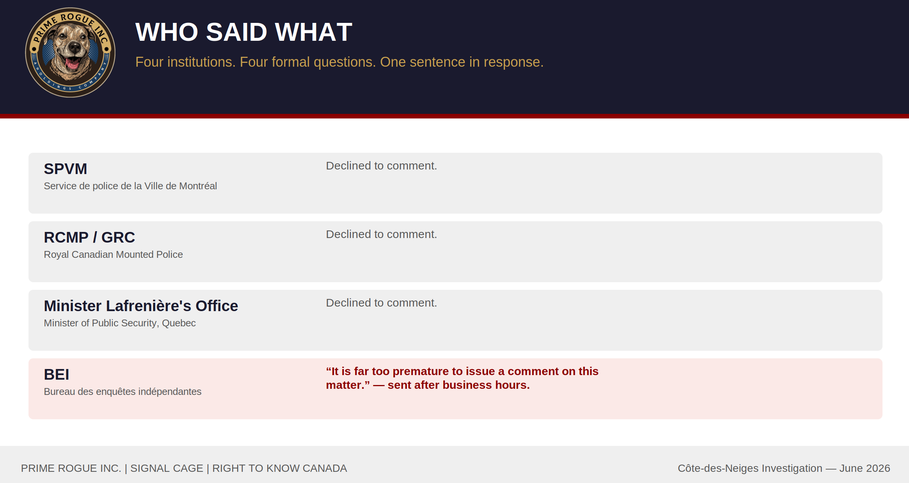
Four institutions. Four formal, written questions. Three declined outright. The fourth waited until after hours to send one sentence.There is a second front in this story: the footage itself.
Minister Lafrenière has publicly asked the public not to circulate video from the shooting. Let’s be precise about what that request actually is, because precision is the entire point of accountability journalism. It is not a court order. It is not a publication ban. It is not a sealing order issued by a judge. No legal mechanism has been cited by anyone, anywhere, because there isn’t one. It is a minister, asking nicely.
Compare that to a different, and entirely legitimate, request: the sister of the SPVM officer killed that day, Mohamed Lamine Benredouane, asked the public not to circulate images of her brother’s body. That is a grieving family member asking for basic human dignity for someone she loved. Prime Rogue Inc. respects that request completely, without hesitation, without exception.
A minister asking the public to look away from evidence of a shooting whose central facts he won’t confirm or deny is a different animal entirely. One request is grief. The other is image and narrative management wearing grief’s clothing. When the institutions with the most to lose from public scrutiny are also the institutions asking the public to look away, that is not a coincidence — it is a pattern. The cover-up rarely arrives after the crime. It arrives before it: in the framing, in the polite request, in the appeal to your decency instead of an appeal to the law. Such appeals to pathos, when undertaken by government, must be rejected outright.
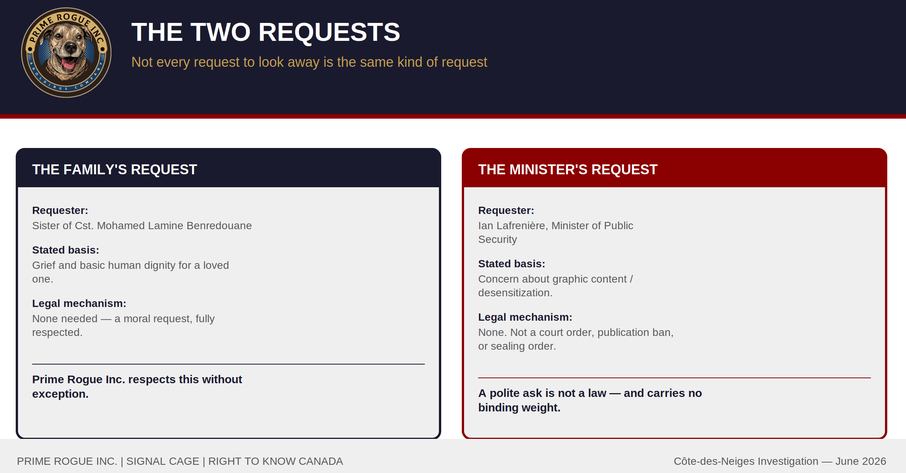
Not every request to look away deserves the same response. One is grief asking for dignity. The other is a minister asking the public not to look at evidence he won't confirm or deny.Here is exactly what Prime Rogue Inc. has done, stated plainly so the public can hold us to it.
We have preserved the event footage and the suspect’s manifesto. Both have been hashed, archived on IPFS, and anchored across six separate blockchains. As is our editorial policy regarding blockchain records preservation, we have destroyed the keys to the wallets used to post these artifacts. No institution, not the SPVM, not the BEI, not a government takedown request, not a platform’s content moderation team, can quietly make these records disappear. They are permanent – and immutable. This is the pattern that follows every event of this kind: a document exists, and the public conversation about it ends up shaped less by what it actually says than by who succeeds in getting it removed from the internet fastest. We refuse to let that decision be made for the public by whoever moves quickest with a legal letter.
But preservation is not the same act as broadcast, and we have drawn our own line accordingly, in public, so it can be tested.
The event footage and the manifesto: if you contact us in good faith, we will very likely provide access. Not because we are pushing it onto every feed for engagement. Because once a document carries genuine academic, forensic, or public-interest analytical value — and a mass shooter’s manifesto unquestionably does, however completely we reject every page of its content — burying it does not make the underlying ideology disappear. It simply means no one studies it except whoever the state permits to see it.
Cadaver imagery, of anyone, including the suspect, is not available for distribution. Not on request. Not at this juncture. The line is not about who deserves dignity based on what they did; it is about what genuinely serves the public record versus what merely feeds the worst impulses of the internet. The public does not require a visible body to understand what happened on that street. Regardless, for the morbidly curious, a basic search of X will allow them to find such gore.
That is the difference between paternalism and judgment. Paternalism says: trust us, you see none of it. Judgment says: here is what serves understanding, here is what doesn’t, and here is exactly where the line sits — stated out loud, so we can be held to it. The institutions in this story have not drawn a line. They have drawn a fog.
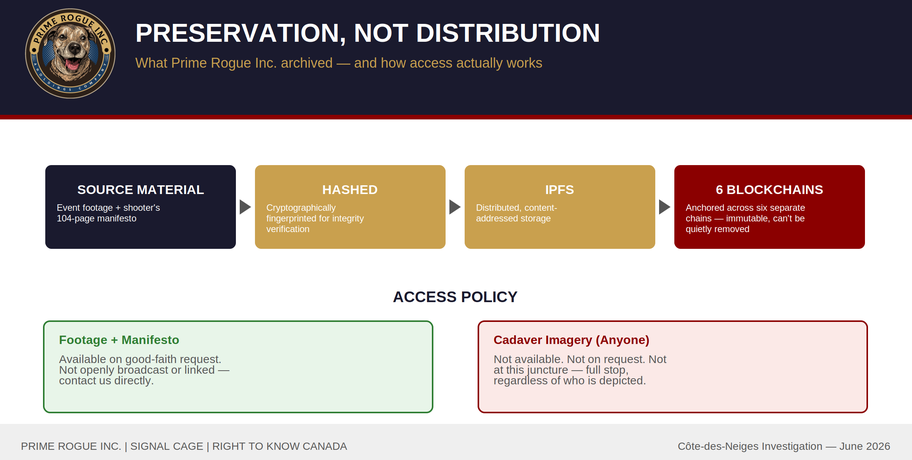
We preserved the record so no institution can quietly make it disappear. We did not put it on a billboard. Here's exactly what we archived, and our actual access policy.• SPVM (Service de police de la Ville de Montréal): Declined to comment.
• RCMP / GRC: Declined to comment.
• Office of Minister Ian Lafrenière, Minister of Public Security: Did Not Respond
• BEI (Bureau des enquêtes indépendantes): “It is far too premature to issue a comment on this matter.” — received after business hours, in full, with no further elaboration.
Four institutions. Four declinations or non-answers. Zero confirmations. This is not what transparency looks like. It is what stalling looks like when it has learned to wear a press release.
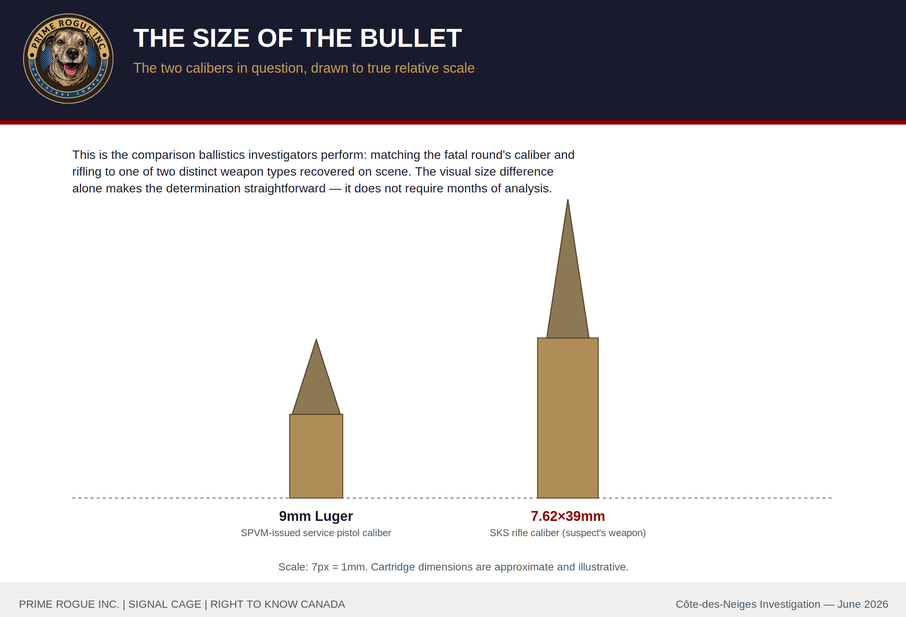
This is the comparison ballistics investigators perform: matching the fatal round to one of two distinct weapon types recovered on scene. The size difference alone tells most of the story.Prime Rogue Inc., Signal Cage, and Right to Know Canada are not closing this file because an institution found the question inconvenient. We have filed or are filing formal access-to-information requests with the Sûreté du Québec and the BEI for the ballistics report and the underlying disclosure protocol. We have asked the Coroner’s office whether an inquest is planned. We are preparing to brief an opposition critic’s office on the timeline. We are maintaining a running public record of every request, every deadline, and every non-answer — because four days of silence on a question this simple does not happen by accident, and a family does not deserve to learn the truth about a father’s death on the institutional timeline most convenient to the institutions involved.
We are also spinning up the Wilco Works 3D printers to print replica bullets so that our audience can judge, for itself, whether a 9mm slug can be distinguished from 7.62mm slug with the naked eye. Lest we be misunderstood, we are printing fake plastic bullets – albeit to exact size and specifications.
We have a right to know. We intend to keep asking until someone with the authority to answer decides that “too premature” no longer holds.
Kevin J.S. Duska Jr. is President of Prime Rogue Inc. Prime Rogue Inc. operates the Signal Cage international affairs vertical. Right to Know Canada is an independent transparency and access-to-information watchdog project for which Duska serves as a director.
 Montreal Shooting Analysis: Who Shot Michael Mizrahi?
 The Empire That Forgot It Was One: JD Vance, Greenland, and the Death of the Rules-Based Order
 April 28, 2025: The Death of American Democracy Continues With Executive Militarization
 The Last Stand for Canadian Sovereignty: Why We Must Build a Civil Defense Corps NOW



[…] the absence of patrol rifles for first-responding officers facing a rifle-armed ambusher, and Quebec’s status as the only Canadian province that does not publicly release BEI investigation […]
[…] protester hit by a rubber bullet at close range), Foothills would handle operative care – much as Quebec City’s hospitals did in 2001 when a protester struck in the throat by a plastic bullet required an emergency […]