Address
304 North Cardinal St.
Dorchester Center, MA 02124
Work Hours
Monday to Friday: 7AM - 7PM
Weekend: 10AM - 5PM

Address
304 North Cardinal St.
Dorchester Center, MA 02124
Work Hours
Monday to Friday: 7AM - 7PM
Weekend: 10AM - 5PM
On the afternoon of June 22, 2026, a lone gunman in military-style camouflage, armed with a Simonov SKS semi-automatic rifle, ambushed Service de police de la Ville de Montréal (SPVM) patrol officers outside the Hilton Garden Inn Montreal Midtown in the Côte-des-Neiges district. In the span of roughly sixty seconds and at least twenty-nine rounds, the gunman killed Constable Mohamed Lamine Benredouane, 34, and was himself fatally shot by a surviving female officer. In the same chaotic interval, an unarmed civilian — Michael Moshe Mizrahi, a member of the local Chabad community — was shot at close range, by most accounts struck twice, and later died. SPVM has confirmed that an officer’s gunfire may be responsible for Mizrahi’s death but has declined to confirm this pending review by Quebec’s police oversight body, the Bureau des enquêtes indépendantes (BEI).
Prime Rogue Inc. holds two conclusions simultaneously, because the evidence supports both. The surviving officer engaged and neutralized an active killer who had just murdered her partner; that part of her conduct, on the facts available, appears to meet the legal standard for justified force and deserves to be named as such. In the same encounter, she fired on an unarmed civilian who presented no objective threat. That shot does not meet the standard. A person can be a hero and respond to one threat correctly, and separately and simultaneously fail catastrophically when she turns her weapon on someone else. Canadian law does not require an all-or-nothing verdict across an incident — it asks, shot by shot, whether force was justified at the moment it was used (R. v. Forcillo, 2018).
This report does two things the official record has not yet done. First, it sets out, plainly and without euphemism, why the available video evidence does not support any reasonable claim that Mizrahi posed a threat to the officer who shot him. Second, it applies the peer-reviewed and professional use-of-force literature — on contagious fire, perceptual narrowing under stress, threat misidentification, and reaction-time science — to test whether any recognized excuse in that literature extends far enough to cover what the footage shows. It does not. This report also identifies the institutional questions SPVM and the Quebec government owe the public an answer on: training in target discrimination under stress, the absence of patrol rifles for first-responding officers facing a rifle-armed ambusher, and Quebec’s status as the only Canadian province that does not publicly release BEI investigation outcomes.
Multiple videos of the shooting are circulating online. SPVM has not disputed their authenticity but has declined to comment on their contents, citing the active BEI investigation (NBC News, 2026). Quebec’s Minister of Public Security, Ian Lafrenière, separately acknowledged that footage appearing to show “a civilian shot by a police officer” exists, while declining to confirm it (CBC News, 2026).
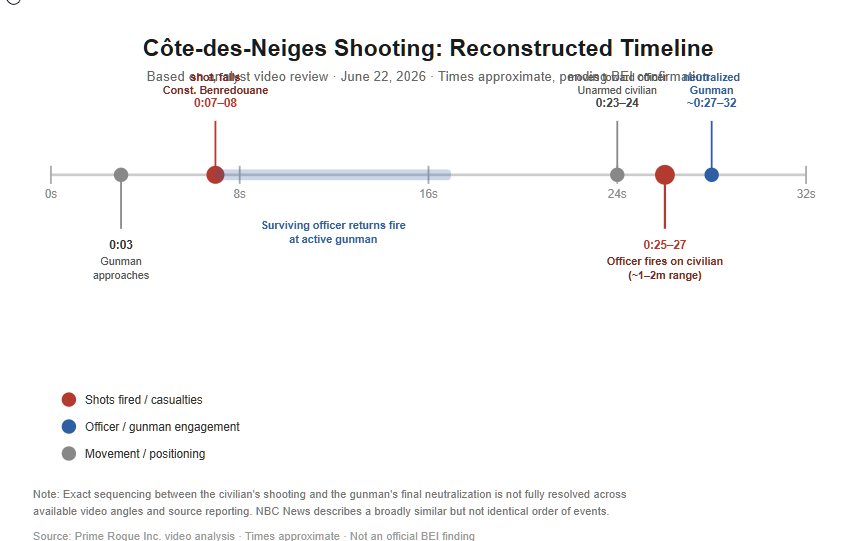
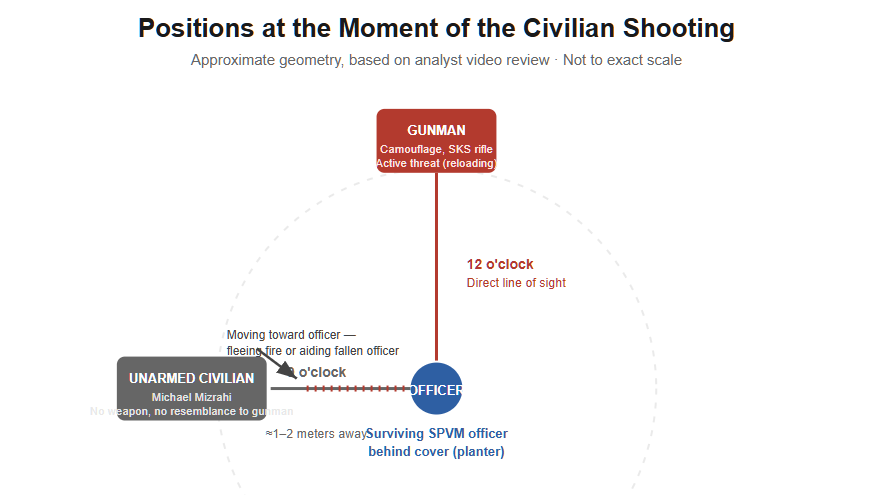
Reviewing the available footage in detail, the encounter unfolds as follows. The gunman, in camouflage clothing, approaches a position near a grey sedan and takes cover behind a row of columns. He opens fire, fatally wounding Constable Benredouane within the first two shots prior to rushing the surviving officer. The surviving officer takes cover and returns fire toward the gunman’s position, who remains an active, weapon-handling threat, at one point seen attempting to reload, for an extended portion of the sequence. At some point in this same window, an unarmed civilian in dark clothing, bearing no resemblance to the camouflaged, rifle-armed gunman, moves toward the officer’s position, appearing either to flee the line of fire or to attempt to render aid to the fallen officer. The civilian is positioned roughly at the officer’s nine o’clock; the gunman remains at her twelve o’clock, in front of her, still active. The officer turns and fires what is most likely two rounds into the civilian, at a distance Prime Rogue assesses at approximately one to two meters, before redirecting a further round toward the gunman as he appears to be reloading — an audible rhythm of “boom-boom … [pause] … boom.” The gunman is neutralized nearly simultaneously to Mr. Mizrahi.
The precise sequencing, whether the civilian was shot before, during, or immediately after the gunman’s final neutralization, is not fully resolved across the available footage and source reporting. NBC News (2026), citing a separate elevated-angle video, describes an unarmed person approaching the officer, a gunshot, and the person collapsing, “though it’s unclear from the video whether the officer shot the person or the person was caught in crossfire from the gunman,” with the gunman engaging again and going down only “seconds later.” This sequencing, if accurate, would mean the civilian was shot while the actual gunman remained an active, visible threat elsewhere in the same frame — a materially different and, if anything, more difficult fact pattern to excuse than a shooting that occurred after the threat had fully ended.
What is not in dispute: the civilian was unarmed; he did not resemble the suspect in any respect — no camouflage, no rifle, no weapon of any kind visible; and he was shot at very close range. No version of the available footage shows him making a sudden aggressive movement, brandishing an object, or doing anything consistent with a reasonable threat indicator.
Canadian police use of force is governed by section 25 of the Criminal Code, which permits an officer to use force “as is necessary” to carry out a lawful duty, but restricts force “intended or likely to cause death or grievous bodily harm” to situations where the officer “believes on reasonable grounds that it is necessary for the self-preservation of the person or the preservation of any one under that person’s protection from death or grievous bodily harm” (Criminal Code, R.S.C. 1985, c. C-46, s. 25(3)).
The Supreme Court of Canada, in R. v. Nasogaluak (2010), held that the degree of force used by police “remains constrained by the principles of proportionality, necessity and reasonableness” and is judged on a subjective-objective basis: the officer’s belief in the necessity of force must be honestly held and objectively reasonable in the circumstances (R. v. Nasogaluak, 2010 SCC 6).
The controlling Canadian authority on whether justification can lapse within a single, continuous use-of-force incident is R. v. Forcillo (2018 ONCA 402). Toronto Constable James Forcillo fired two volleys of shots at Sammy Yatim, an agitated young man on an empty streetcar: three shots, which a jury found to be justified, followed 5.5 seconds later by six further shots fired while Yatim lay on the floor, which the jury found not to be justified, resulting in an attempted murder conviction. The Ontario Court of Appeal upheld the conviction, holding that the jury could properly find that by the second volley, Forcillo “would have little difficulty concluding that Mr. Yatim posed no imminent threat to [him] and the appellant knew it,” such that “the appellant’s justification defences could not succeed” for the second volley even though the first had been lawful (R. v. Forcillo, 2018 ONCA 402, para. 46).
Forcillo establishes the precise analytical structure this report applies: an officer’s conduct across a single incident is not assessed as a monolithic whole. Each discharge of a firearm is its own act, justified or not justified according to the threat reasonably perceived at that specific moment. An officer who is unquestionably justified in firing at an armed assailant in one instant can, moments later, fire an unjustified shot at someone else — and the law holds her responsible for that second act regardless of how the first is characterized.
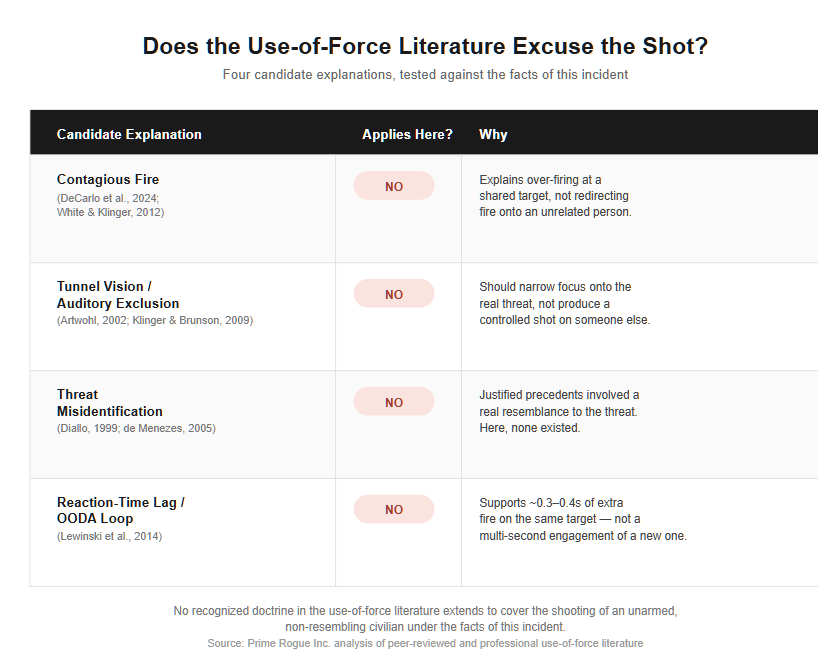
Three bodies of literature could, in principle, excuse or mitigate the shooting of an unarmed, non-threatening civilian during an active engagement: contagious fire, perceptual distortion under stress, and threat misidentification. Each is examined below, on its own terms, against the facts of this incident.
“Contagious fire” describes officers discharging their weapons in response to the stimulus of nearby gunfire rather than independent threat assessment (Stoughton et al., 2021). The first experimental, causal evidence for the phenomenon comes from DeCarlo, Dlugolenski, and Myers (2024), who randomly assigned 169 officers across eleven agencies to a simulated scenario and found that the presence of confederate peer gunfire increased the odds of an officer firing by a factor of 11.57 — 92% of officers fired when peers fired, compared to 49% in a no-peer-fire control condition — and increased rounds discharged by approximately 72% (DeCarlo et al., 2024, Journal of Criminal Justice, 93, 102215). The earlier foundational study by White and Klinger (2012), analyzing 808 Philadelphia Police Department shootings, characterized contagious fire as “a panicked or unconscious response” and found that its necessary preconditions “rarely occur” in real-world incidents (White & Klinger, 2012, Crime & Delinquency, 58(1)).
This literature explains why an officer might fire additional, unnecessary rounds at a target she is already engaging in response to surrounding gunfire. It does not explain, and was never intended to explain, an officer redirecting fire onto a different person who is not the source of the stimulus gunfire. The gunman, not the civilian, was the source of the shooting in this incident. Contagious fire, properly applied, would only bear on whether the officer fired more rounds at the gunman than were strictly necessary — not on her decision to fire at someone at her nine o’clock while the actual shooter remained active at her twelve.
Officer-involved shootings are reliably associated with documented perceptual distortions. Artwohl (2002), surveying 157 officers who had been involved in shootings, found that 79% experienced tunnel vision and 84% experienced diminished auditory perception (Artwohl, 2002, FBI Law Enforcement Bulletin, 71(10)). Klinger and Brunson (2009), in a study of 80 officers across 113 shooting incidents, similarly found diminished sound perception in 82% of cases (Klinger & Brunson, 2009, Justice Quarterly, 26(1)). A controlled study using realistic deadly-force scenarios with RCMP-affiliated participants found heart rates approaching 150 beats per minute and associated tunnel-vision-type effects, with 27% of participants making at least one lethal-force error under stress (Andersen et al., 2021, Frontiers in Psychology, 12).
This literature is genuine and important, but its direction cuts against, not for, an excuse in this case. Tunnel vision describes narrowing of attention onto the perceived primary threat — it should have kept the officer’s focus locked on the gunman in front of her, not produced a deliberate redirection of aim onto an unrelated figure to her side. Tunnel vision is also typically invoked to explain failures of awareness or missed information, not the affirmative, fine-motor act of aiming and discharging a firearm twice at a specific target. Notably, the same footage shows the officer subsequently delivering an apparently accurate, controlled shot at the gunman as he attempted to reload — a level of weapons-handling composure that is difficult to reconcile with a simultaneous claim of total perceptual breakdown or loss of motor control with respect to the civilian.
The most factually relevant body of literature concerns cases where officers shoot a bystander mistaken for an actual threat. In the 1999 shooting of Amadou Diallo in New York, four officers fired 41 rounds at an unarmed man reaching for his wallet, believing him to match the description of a rape suspect; an internal review found the officers had acted within departmental policy and a jury acquitted them of second-degree murder (cited in academic case compilations on misidentification shootings). In the 2005 shooting of Jean Charles de Menezes in London, police shot a Brazilian electrician seven times in the head, mistaking him for a suicide bomber; the U.K. Independent Police Complaints Commission found that de Menezes “did nothing and wore nothing that could be considered suspicious,” and no individual officer was criminally charged, though the Metropolitan Police was convicted under health and safety legislation (Wikipedia, “Killing of Jean Charles de Menezes,” summarizing IPCC findings, 2026 revision).
The pattern across justified or uncharged misidentification cases is consistent: the officer’s mistake, however tragic, was grounded in some genuine point of resemblance or ambiguity — a description that matched, a location that matched, an object that could plausibly be mistaken for a weapon, a sudden movement read as aggressive. The IPCC’s own reasoning in de Menezes is instructive precisely because investigators treated the absence of any suspicious clothing or behavior as evidence against, not for, the reasonableness of the shooting.
Applied here: the civilian in this incident shared no visual or behavioral feature with the actual suspect. He was unarmed. He wore no camouflage. He carried no rifle. He made no aggressive movement toward the officer. Whether he was fleeing the gunfire or moving to assist the fallen Constable Benredouane, neither explanation for his movement produces a plausible threat cue. The misidentification literature, even read in the manner most generous to the officer, does not extend to a target who bears no resemblance whatsoever to the actual danger.
Force Science research on reaction time — most notably the work associated with Lewinski and colleagues — finds that officers typically fire an additional one to two rounds, accounting for roughly 0.3 to 0.4 seconds, after a stop cue is given, reflecting the physiological lag between perception and motor cessation (Lewinski, Hudson, & Dysterheft, 2014). Boyd’s OODA loop framework (Observe-Orient-Decide-Act) describes decision-making as a continuous, cyclical process that trained personnel can execute rapidly but which still requires at least a brief window to complete (Boyd, as discussed in Police Magazine training literature).
This research supports the proposition that an officer may fire for a fraction of a second beyond the point a threat is neutralized, while still engaging that same threat. It does not support the proposition that several seconds constitutes too short a window to distinguish an armed, camouflaged, rifle-carrying assailant from an unarmed civilian standing or moving nearby. If anything, the cyclical, repeating nature of the OODA loop implies that several seconds is sufficient time for at least one full observe-orient-decide-act cycle — enough, in principle, to reassess and withhold fire.
Prime Rogue draws a deliberate distinction here between two separate questions that are often, and wrongly, collapsed into one. The first is whether the act itself — firing on an unarmed, non-threatening civilian — was wrong. The second is whether that act meets a specific legal threshold, such as criminal negligence or recklessness, which requires proof of a particular state of mind or a marked departure from the standard of a reasonable officer.
On the first question, this report’s answer is unambiguous: the act was wrong. An unarmed man, who shared no characteristic with the actual threat, was shot at close range while moving toward, not away from, the only officer in a position to help him. No version of the available footage, examined in good faith, supports a contrary reading.
On the second question, this report does not purport to resolve what only a full evidentiary record — ballistics, body-camera footage if it exists, the officer’s statement, and forensic timeline reconstruction — can resolve. Recklessness and criminal negligence are specific legal thresholds requiring proof that go beyond what is visible in circulating cellphone video. Forcillo demonstrates that Canadian courts are capable of distinguishing, within a single incident, between a justified use of force and a criminal one — but that determination in Forcillo followed a full trial with medical and ballistic evidence, not a single video clip.
It is possible, in other words, to conclude with confidence that what happened was wrong, while declining to predict with the same confidence what the Bureau des enquêtes indépendantes and, if applicable, the Director of Criminal and Penal Prosecutions will ultimately find regarding criminal culpability. Quebec’s oversight record provides useful context here: of the investigations the BEI has opened since 2016, only a small handful have resulted in charges against officers, and none, to Prime Rogue’s knowledge, in a conviction — a base rate that should inform expectations but does not, on its own, settle whether charges are warranted in this specific case.
It is tempting, and understandable, to want a single verdict on the surviving officer: hero, or failure. The honest application of the law and the literature does not permit that simplification, and Prime Rogue does not believe it should.
In the same encounter, the officer engaged an active, ambushing, rifle-armed killer who had just murdered her partner, continued to return fire under direct threat, and ultimately delivered what appears, on close review of the footage, to be an accurate, controlled shot that ended the threat as the gunman attempted to reload. That conduct, on the facts available, reflects genuine courage and appears to meet the legal standard for justified lethal force.
In the same encounter, she fired on an unarmed civilian who presented no objective threat, under conditions where the literature offers no recognized excuse that extends to cover the act. That conduct does not meet the standard expected of a competent law enforcement officer, or any person handling a firearm, regardless of the adrenaline, fear, and trauma that almost certainly attended it.
Both things are true. Neither cancels the other. This is not a contradiction — it is what split-second policing actually looks like, and it is precisely why Canadian law assesses force shot by shot rather than incident by incident. Compassion for the officer as a human being who will live with this for the rest of her life, and clear-eyed accountability for the specific decision that ended Michael Mizrahi’s life, are not in tension. Holding both is the only honest position the evidence supports.
Beyond the conduct of any individual officer, this incident raises systemic questions that Prime Rogue believes warrant direct, on-the-record answers from SPVM, the Quebec government, and federal oversight bodies.
A camouflaged man carrying an SKS rifle, radicalized by a misogynist and anti-authority ideology documented in a manifesto he is reported to have distributed before the attack, ambushed Montreal police officers and murdered Constable Mohamed Lamine Benredouane in cold blood. Nothing in this report should be read as anything other than total condemnation of that act and the ideology behind it, or as anything less than full respect for an officer who stood, returned fire, and ended that threat.
In the same sixty seconds, an unarmed civilian who shared nothing in common with that killer, not his clothing, not his weapon, not his posture, not his intent, was shot and killed, reportedly by the surviving officer’s own service weapon. No body of use-of-force literature, fairly applied, excuses that outcome. The act was wrong. Whether it was also criminally culpable is a question this report does not purport to answer, and one that belongs to the Bureau des enquêtes indépendantes — if Quebec’s institutions are prepared to answer it publicly at all.
Prime Rogue Inc. will continue to track this investigation and has sought comment from SPVM regarding patrol rifle deployment and target-discrimination training protocols. As of the time of publication, the SPVM has not responded to Prime Rogue Inc’s request for commentary. This report will be updated as the BEI investigation progresses and as additional video evidence becomes available.
Canadian Association of Chiefs of Police. (n.d.). National Use of Force Framework.
Criminal Code, R.S.C. 1985, c. C-46, s. 25.
List of police firearms in Canada. (n.d.). In Wikipedia.
NBC News. (2026, June 22). 2 killed in Montreal shooting; suspect also dead.
R. v. Forcillo, 2018 ONCA 402.
R. v. Nasogaluak, 2010 SCC 6, [2010] 1 S.C.R. 206.
Stoughton, S., Noble, J. J., & Alpert, G. P. (2021). Evaluating police uses of force. NYU Press.





[…] Analysis of Shots Fired in Political […]
[…] A NORAD collapse would likely realign Canadian domestic politics: […]
[…] You can find an English version of our analysis of the Montreal shooting here! […]
[…] confession and motive. According to police documents, Zinn repeatedly told officers “I shot him now shoot me,” then later admitted he fabricated the claim to divert attention and “wanted to be a martyr […]