Address
304 North Cardinal St.
Dorchester Center, MA 02124
Work Hours
Monday to Friday: 7AM - 7PM
Weekend: 10AM - 5PM

Address
304 North Cardinal St.
Dorchester Center, MA 02124
Work Hours
Monday to Friday: 7AM - 7PM
Weekend: 10AM - 5PM

SPORTS OSINT | Prime Rogue Inc. | Kevin J.S. Duska Jr. | Calgary — June 27, 2026
Cabo Verde did not win their final group-stage match. They drew it, 0-0, against Saudi Arabia, in a game their attack never quite broke open. And they’re through to the Round of 32 anyway — by a wide margin, the smallest nation in World Cup history to reach the knockout stage of a men’s tournament. Here’s exactly how a scoreless draw turned into a ticket to Miami.
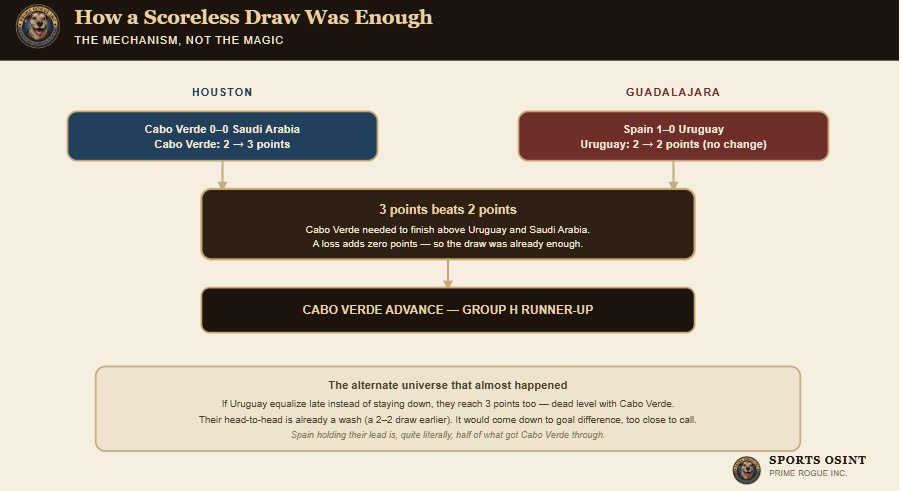
Group H’s final morning math: Cabo Verde and Uruguay entered the matchday level on 2 points apiece. Cabo Verde’s clean path was to beat Saudi Arabia outright. They didn’t. What actually happened was simpler and stranger: Uruguay lost to Spain instead of drawing or winning.
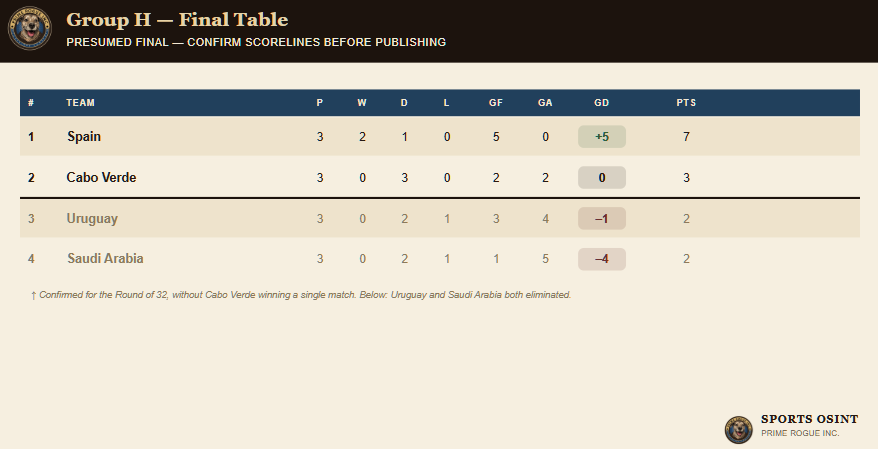
That’s the whole story. A Cabo Verde draw was only fatal to their hopes in the scenario where Uruguay also picked up a result against Spain. Uruguay didn’t. A loss adds zero points, full stop — so Cabo Verde’s draw-sourced 3 points walked straight past Uruguay’s stalled-out 2, with Saudi Arabia’s own draw only getting them to 2 as well. Cabo Verde needed to finish above two specific opponents. They finished above both without scoring a single goal in the match that decided it.
It’s worth being honest about how close the alternate version of this story sat. Had Uruguay equalized against Spain in the final minutes — turning a 1-goal deficit into a draw — Uruguay reaches 3 points too, dead level with Cabo Verde, with their head-to-head already a wash from an earlier 2-2 draw between the two sides this tournament. That match would have gone to overall goal difference, genuinely too close to call beforehand. Spain holding their lead in Guadalajara is, in a very literal sense, half of what got Cabo Verde through.
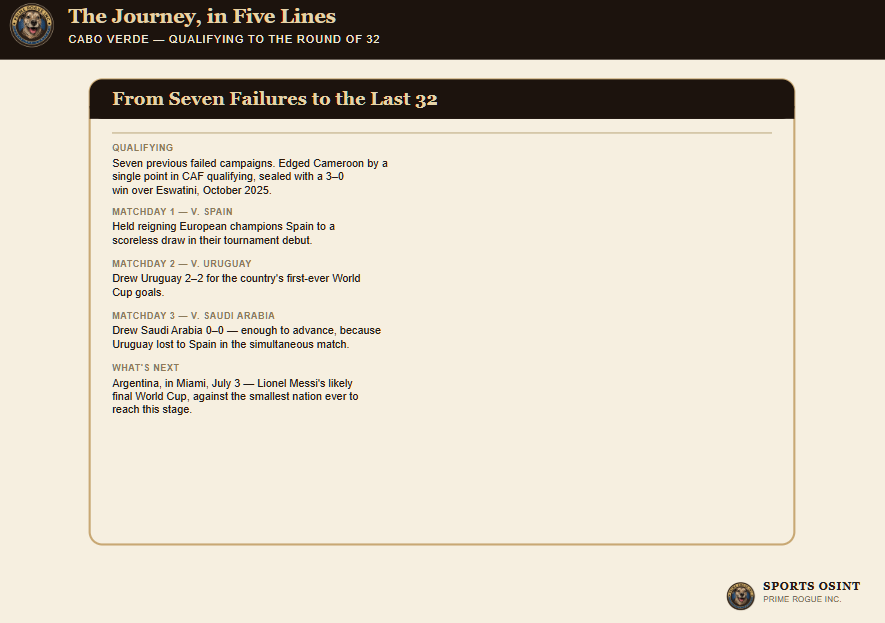
The qualifying story behind tonight’s result is worth retelling now that it has an ending. Cabo Verde had tried and failed to reach a World Cup seven times before this cycle. They got here by edging continental heavyweight Cameroon by a single point in CAF qualifying, a campaign that included a direct 1-0 win over Cameroon and was sealed with a 3-0 win over Eswatini in October 2025. The architect is Pedro Leitão Brito — Bubista — a former Cabo Verde international who’s managed the side since 2020 and was named CAF Coach of the Year in 2025 for getting them here.
Once they arrived, the group stage went better than almost anyone predicted. Most neutral previews written before the tournament pegged a group-stage exit as the realistic outcome — simply qualifying was already considered the achievement. Instead: a scoreless draw with reigning European champions Spain in their tournament opener, a 2-2 thriller with Uruguay for the country’s first-ever World Cup goals, and now a draw with Saudi Arabia that turned out to be enough. Captain Ryan Mendes, the country’s all-time leader in caps and goals at 36, and 39-year-old goalkeeper Vozinha anchored a squad that conceded only twice across three matches against three sides with considerably more individual talent on paper.
Cabo Verde’s Round of 32 opponent is set: Argentina, in Miami, on July 3 — the reward, if it can be called that, for finishing second in Group H rather than first. Lionel Messi’s side have already won Group J outright. A full breakdown of that matchup is coming separately; for now, the headline fact stands on its own. The smallest nation ever to reach this stage of a World Cup will play this generation’s greatest player in his likely final World Cup, on American soil, in front of what will almost certainly be the loudest neutral crowd of the round.
No team scored against Saudi Arabia tonight, and it didn’t matter. Cabo Verde’s tournament was decided by what happened 1,400 miles away in Guadalajara as much as by anything that happened in their own match — which is either a slightly unsatisfying way to make history, or the most fitting possible ending for a campaign that’s been built on doing just enough, against bigger names, for longer than anyone reasonably expected. Either way: roughly 525,000 people now have a Round of 32 match to watch.







[…] H entering tonight: Spain lead on 4 points and look close to safe regardless of their final match. Cape Verde and Uruguay are level on 2 points apiece. Saudi Arabia sit on […]