Category Donald J. Trump

Canada’s Sovereignty Challenges: Greenland & Trump

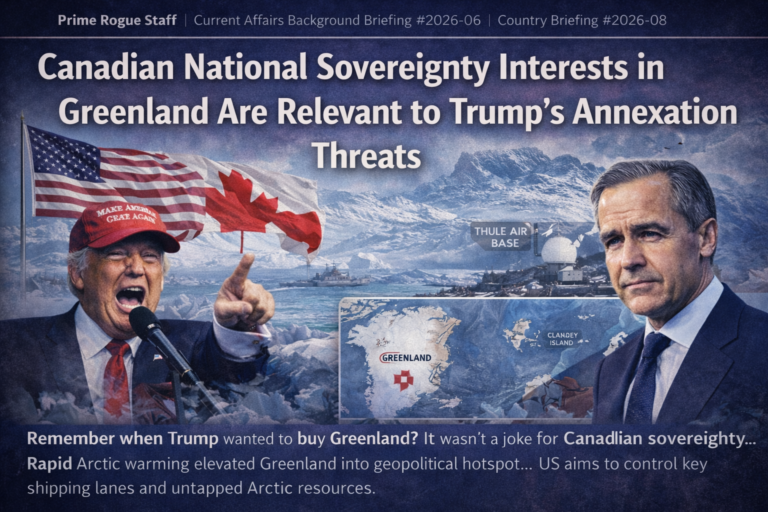
A header image depicting Canada's Sovereignty Challenges: Greenland & Trump

Prime Rogue Staff | Current Affairs Background Briefing #2026-06 | Country Briefing #2026-08 | Canadian National Sovereignty Interests in Greenland Are Relevant to Trump’s Annexation Threats Remember back in 2019 when the headlines sounded like a joke: “President Trump Wants…
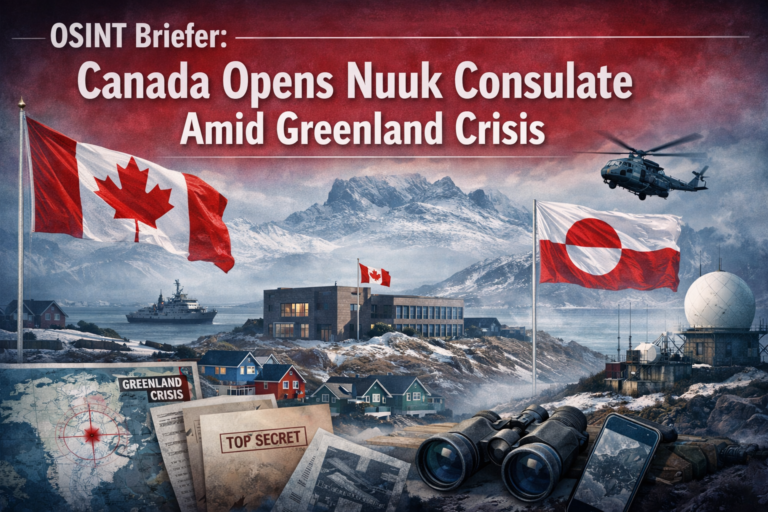
OSINT Briefer: Canada Opens Nuuk Consulate Amid Greenland Crisis

A header image depicting Prime Rogue Staff | Current Affairs Background Briefing #2026-06 | Country Briefing #2026-08 | Canadian National Sovereignty Interests in Greenland Are Relevant to Trump’s Annexation Threats Remember back in 2019 when the headlines sounded like a joke: “President Trump Wants to Buy Greenland”? It was easy to dismiss the idea as bizarre political theatre. But for Canadian security experts, it wasn’t a joke at all; it was a serious wake-up call about a fundamental shift happening on our northern doorstep. That giant, ice-covered island has long been a quiet neighbour. But its location at the crossroads of North America, Europe, and Asia makes it a crucial piece of geopolitical real estate. A change in who controls Greenland would fundamentally alter Canada’s position in the world, and the Trump Greenland purchase offer was a stark signal that the old rules for the Arctic were melting away. This global power shuffle is being driven by a simple, undeniable fact: the Arctic is warming twice as fast as the rest of the planet. For centuries, thick ice acted as a natural fortress, but as it disappears, it’s unlocking two things the world wants. Research from geologists points to vast, untapped natural resources, while shipping companies eye newly opened shortcuts like the Northwest Passage. Suddenly, a desire to control the region makes perfect strategic sense. The strange 2019 headline was more than a fleeting curiosity—it was a preview of the challenges now facing Canadian sovereignty as its quiet, icy frontier becomes a global hotspot. Who Actually Controls Greenland? (And Why It’s More Complicated Than You Think) When Donald Trump floated the idea of buying Greenland, many wondered why the offer was directed at Denmark. The answer reveals Greenland’s unique and often misunderstood place in the world. Greenland is not a simple Danish province; it’s a self-governing constituent country within the Kingdom of Denmark. Think of it less like a state and more like a distinct nation that has delegated some of its highest powers to a partner. This arrangement means that while Greenlanders manage their own domestic affairs—from education to healthcare, a system known as Home Rule—Denmark still controls foreign policy, defense, and currency. So, while Greenland’s government in its capital, Nuuk, would certainly have a voice, any deal involving the island’s international status or security would ultimately be negotiated in Copenhagen. This is precisely why the Danish government, not the Greenlandic one, was the one to firmly state the island was not for sale. To add another layer, the story isn’t over. Greenland holds a recognized right to pursue full independence. If its people choose to do so in the future, they can. This potential for a new, independent nation to emerge on Canada’s doorstep makes Greenland a major wildcard in a region that is rapidly changing for entirely different reasons. Why the Arctic Suddenly Became the World’s Hottest Real Estate The phrase “heating up” to describe Greenland’s strategic situation is more than just a metaphor. For centuries, the Arctic’s immense ice cap acted like a permanent lock on the region, keeping its potential buried. As climate change accelerates the annual melt, that lock is breaking. This isn’t simply a story about polar bears and rising sea levels; it’s about unlocking two world-changing economic prizes that have nations scrambling for position. First among these prizes is the promise of a shipping superhighway. Mariners have long dreamed of the Northwest Passage, a fabled shortcut through Canada’s Arctic islands that connects the Atlantic and Pacific oceans. As the ice recedes, this route is slowly becoming a reality, offering the potential to shave thousands of kilometres—and millions in fuel costs—off cargo journeys. It’s like a new global freeway suddenly opening through a once-impassable mountain range. Beneath the melting ice lies the second prize: a massive, untapped treasure chest. Geologists estimate the Arctic holds a significant portion of the world’s undiscovered oil and natural gas. More importantly for our modern economy, it is also believed to be rich in rare earth minerals—the essential ingredients for everything from smartphones to electric car batteries, sparking a quiet but intense 21st-century resource race. This powerful combination of new shipping lanes and critical resources is precisely what has turned the Arctic from a desolate frontier into prime geopolitical real estate. With everyone wanting a piece of the action, a critical question arises directly for Canada. Is that newly opened Northwest Passage a private Canadian driveway, or is it a public international street? A simple, clear map of the Arctic highlighting the Northwest Passage through Canada and the Northern Sea Route over Russia as two potential shipping shortcuts The Northwest Passage: Canada’s ‘Private Driveway’ or a Global ‘Public Street’? For Canada, the answer to that question is clear: the Northwest Passage is a private driveway. Officially, the route consists of internal waters, a legal term giving Canada the same authority over these channels as it has over the Great Lakes. Just like a homeowner can decide who uses their driveway, Canada’s Arctic sovereignty policy asserts the right to control all shipping, set environmental rules, and deny passage to any vessel. This stance is rooted in historical use by Inuit and a deep-seated belief that the islands of the Arctic Archipelago are an inseparable part of the country. The United States, along with most other major shipping nations, sees it differently. They view the passage not as a private drive, but as a public street connecting two major highways—the Atlantic and Pacific oceans. In their view, this makes it an international strait. Under this definition, foreign vessels would have the right of innocent passage, meaning they could travel through without Canada’s permission, provided their activities are peaceful. This perspective prioritizes freedom of navigation, a crucial principle for a global naval and commercial power like the U.S. This long-standing disagreement over legal status is the single most significant and persistent challenge to Canadian Arctic sovereignty. While the U.S. and Canada remain close allies, their fundamentally opposed views on the Northwest Passage create a constant, low-level friction that a changing climate threatens to inflame. Yet, even with this major issue unresolved, it doesn’t mean progress is impossible. A much smaller, yet symbolically important, territorial dispute with Denmark was recently solved in a uniquely neighbourly fashion. How a Tiny Rock and a Bottle of Whisky Solved a 50-Year Border Dispute While the debate over the Northwest Passage remains a major sticking point, Canada and Denmark recently proved that not all Arctic disagreements have to be so tense. For nearly half a century, the two nations were locked in a friendly standoff over a tiny, barren rock called Hans Island, situated exactly between Canada’s Ellesmere Island and Danish-controlled Greenland. The island is completely uninhabited and has no known resources, but since both countries could claim it was in their territorial waters, it became a quirky symbol of national pride. This led to one of the most polite territorial disputes in history. The conflict, affectionately called the “whisky war,” involved a simple ritual. When Canadian military personnel visited the island, they would take down the Danish flag, raise a Canadian one, and leave behind a bottle of Canadian Club whisky. Later, when the Danes arrived, they’d reverse the process, leaving a bottle of their schnapps. This good-natured tradition went on for decades, showing that even when sovereignty is on the line, neighbours can keep their sense of humour. Ultimately, diplomacy won the day. In 2022, Canada and Denmark officially ended the dispute by drawing a border right across the middle of the 1.3-square-kilometre island, creating Canada’s first land border with a European country. This peaceful resolution is now seen as a hopeful model for cooperation in the Arctic. It shows that even long-standing claims can be settled at the negotiating table—a crucial lesson as nations now turn their attention from tiny rocks to the vast, resource-rich seabed of the Arctic Ocean itself. The Great Arctic ‘Land Grab’: Why Nations Are Claiming the Seafloor Itself The peaceful division of Hans Island was a great start, but it was just the opening act. The main event is a far grander, invisible ‘land grab’ happening deep beneath the Arctic ice. While that tiny rock was about sovereignty over a physical spot you can stand on, this new contest is about claiming the rights to the seabed itself, stretching for hundreds of kilometres into the ocean. It’s a quiet competition, fought not with flags and whisky, but with sonar maps and geological data. This contest is governed by a massive international treaty called the UN Convention on the Law of the Sea (UNCLOS)—essentially, the rulebook for the world’s oceans. Normally, a country’s rights extend 200 nautical miles from its coast in an Exclusive Economic Zone (EEZ), giving it control over resources like fish and oil. But UNCLOS has a crucial exception: if a nation can scientifically prove its continental shelf—the natural, submerged extension of its landmass—stretches further, it can claim exclusive rights to the resources on and under that extended seabed. A simplified illustration showing a coastline and how a country's continental shelf can extend far under the ocean, with a label indicating the "Exclusive Economic Zone (EEZ)" near the coast and the "Extended Continental Shelf" further out This rule has kicked off a high-stakes scientific race. Using icebreakers and submarines, Canada, Russia, and Denmark (on behalf of Greenland) have all submitted massive, overlapping claims that stretch right to the North Pole. At the heart of the dispute is the Lomonosov Ridge, a huge underwater mountain range that all three nations argue is part of their own continental shelf. The prize is immense: potential control over vast, untapped deposits of oil, gas, and rare earth minerals. Unlike the ‘whisky war,’ this conflict is being fought by geologists and lawyers, who present their evidence to a special UN commission. This provides a formal guide to Arctic territorial claims, but a final decision could take decades. The sheer scale of this potential wealth is exactly why global powers like the United States and Russia are watching every move in the region—especially when it comes to Greenland. Why America and Russia Are Watching Greenland So Closely Beyond the hidden wealth under the seabed, the world’s biggest military powers see the Arctic through a different lens: strategy. For the United States, Greenland isn’t just a potential real estate deal; it’s a critical strategic asset. The island hosts Thule Air Base, a vital American radar installation that has served as a missile-warning outpost since the Cold War. Washington’s interest is clear: maintain its military footing, ensure its navy can travel freely through newly opening sea lanes, and secure access to resources. At the same time, Russia is aggressively re-establishing itself as the dominant Arctic power. It has been reopening dozens of old Soviet-era military bases along its massive northern coastline, creating a chain of steel from Europe to Asia. This enormous military buildup is designed to control the Northern Sea Route—a shipping lane through Russia’s Arctic waters that’s becoming a viable alternative to the Suez Canal. By controlling this route, Russia aims to dominate future Arctic commerce and project its military power across the top of the world. This rivalry places Canada in a familiar but increasingly tense position: geographically sandwiched between two global giants. For decades, North American defence has relied on NORAD, the joint US-Canada command that watches our shared airspace. But with new generations of Russian submarines and missiles designed for Arctic operations, the old playbook is no longer enough. The growing military activity from both sides means that modernizing Canada’s northern defences isn’t just a political talking point—it’s a pressing national security issue. Our Arctic territory has once again become the frontline. The Real ‘What If’: How a US-Controlled Greenland Changes Everything for Canada President Trump’s idea to buy Greenland might have sounded bizarre, but the strategic “what if” it represents is a serious reality check for Canada. A quick look at a map shows why. Greenland and Canada’s Ellesmere Island are separated by the Nares Strait, a narrow channel that acts as the northern gateway to the Northwest Passage. If the United States were to control Greenland, it would suddenly be Canada’s neighbour on both sides of this critical chokepoint. The strategic sandwich Canada already finds itself in between Russia and the US would become dramatically tighter. This geographic shift would bring the core disagreement over the Northwest Passage to a boil. For decades, Canada has maintained that the passage is part of its “internal waters”—essentially a private driveway through its territory. The US, along with other nations, argues it’s an “international strait”—a public highway that all ships can use. With a US-controlled Greenland, American vessels would be positioned to enter and exit the passage’s eastern approaches at will. This would give Washington immense geopolitical leverage, turning a long-standing diplomatic argument into a constant, on-the-ground challenge to Canada’s most important Arctic claim. Ultimately, such a move would be one of the greatest challenges to Canadian Arctic sovereignty in history. More than just a debate over one shipping lane, it would fundamentally alter the balance of power across the entire region. With its strategic and economic priorities now flanking Canada’s north, the US could more easily sideline Ottawa’s voice in crucial decisions about regional security, resource development, and environmental rules. But the lines drawn on a map by politicians don’t tell the whole story of the people who call this frozen land home. More Than Just Land: The Inuit Connection Across a Melting Arctic While governments in Ottawa and Copenhagen draw lines on maps, another reality exists on the ice. The Arctic is the traditional homeland of the Inuit, a territory they call Inuit Nunaat. This ancestral land isn’t defined by modern borders; it stretches across Greenland, Canada, Alaska, and Russia, connecting communities through shared language, culture, and family ties. For the Inuit, the channel separating Canada from Greenland isn’t a strategic chokepoint, but a highway that has connected relatives for centuries. To give this unified homeland a voice, the Inuit Circumpolar Council (ICC) represents roughly 180,000 Inuit across the region. Their vision of sovereignty isn’t about planting flags or controlling shipping lanes. Instead, it’s about Indigenous self-determination—the right to govern their own communities, protect the fragile Arctic environment they depend on, and ensure their culture thrives for future generations. They advocate for the Arctic as a peaceful, shared home, not a battleground for resources. This human-centric view offers a powerful counter-narrative to the geopolitical chess game. It reframes the Arctic from an empty expanse to be divided into a living community whose fate is tied to the ice. For the people of Inuit Nunaat, the greatest threat isn’t a foreign flag on a distant island, but the environmental changes that threaten their entire way of life. Any discussion of sovereignty in the North that ignores their voice is missing the most important piece of the puzzle. Canada’s New Arctic Reality What once seemed like a bizarre headline has revealed a new strategic reality. The melting ice is not just an environmental story; it is unlocking an era of competition for resources and influence right on Canada’s doorstep. This new era is defined by unresolved questions with immense implications for the nation’s security. Who truly controls the Northwest Passage? Where do the undersea property lines fall near the North Pole? These are no longer abstract debates for diplomats but active challenges to Canadian sovereignty. They are central to the complex story of Canada-Greenland relations and our nation’s place in a changing world. The Arctic is no longer a frozen, far-off abstraction. It is our northern frontier, and Greenland is the neighbour whose future is inextricably linked with our own. The region’s future will be defined by the challenges and opportunities emerging from the ice, making it a critical focus for Canada in the 21st century.

Date: February 7, 2026Classification: Open SourceAnalyst: Prime Rogue Intelligence TeamDistribution: Greenland Crisis Ongoing Coverage BLUF (Bottom Line Up Front) Canada formally opened its first consulate in Nuuk, Greenland on February 6, 2026, in a shared facility with Iceland’s existing mission.…
There Are No Friends: Why Carney Didn’t Go Far Enough at Davos

A header image depicting There Are No Friends: Why Carney Didn't Go Far Enough at Davos

Kevin J.S. Duska Jr. | Prime Rogue Inc. | Op-Ed February 2, 2025 Introduction: Carney Is Going to Canberra Mark Carney is going to Canberra. He is going to stand in the Australian Parliament and tell a room full of…
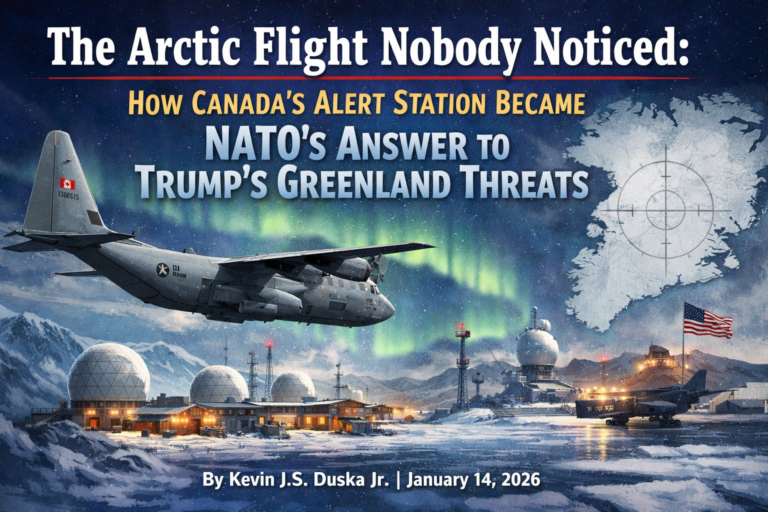
The Arctic Flight That Reveals NATO’s Greenland Strategy

an image depiciting The Arctic Flight Nobody Noticed: How Canada's Alert Station Became NATO's Answer to Trump's Greenland Threats

The Arctic Flight Nobody Noticed: How Canada’s Alert Station Became NATO’s Answer to Trump’s Greenland Threats Open-source intelligence reveals a pattern: every time Trump threatens Greenland, operations at Canada’s northernmost military installation intensify. Yesterday’s flight is just the latest. By…
Tucker Carlson’s Canada Invasion Rhetoric and the MAGA Fracture

an image depicting Tucker Carlson’s Canada Invasion Rhetoric and the MAGA Fracture

Tucker Carlson’s Canada Invasion Rhetoric and the MAGA Fracture Executive Summary On December 12, 2025, American commentator Tucker Carlson delivered a series of explicit, uninterrupted statements during a live interview with Matt Walsh that collectively amount to an open endorsement…
Trump’s “Autism Announcement” – Tylenol, Political Context and Stakes

an image depicting Trump’s “Autism Announcement” – Tylenol, Political Context and Stakes

Trump’s “Autism Announcement” – Tylenol, Political Context and Stakes Introduction President Donald Trump has repeatedly teased a “massive” announcement on autism scheduled for Monday, Sept. 22, 2025. Speaking at the memorial service in the wake of the assassination of Charlie…
Trump’s Antifa Terror Designation: Legally Questionable and Surely Dangerous

an image depicting Trump’s Antifa Terror Designation: Legally Questionable and Surely Dangerous

Trump’s Antifa Terror Designation: Legally Questionable and Surely Dangerous Executive Summary On September 17 2025, President Donald Trump reacted to the assassination of conservative activist Charlie Kirk by announcing that his administration would designate the antifascist movement known as “Antifa” as a terrorist organisation.…
The Suspension of Jimmy Kimmel Live! and the Free‑Speech Paradox: An OSINT Investigation

an image depicting The Suspension of Jimmy Kimmel Live! and the Free‑Speech Paradox: An OSINT Investigation

The Suspension of Jimmy Kimmel Live! and the Free‑Speech Paradox: An OSINT Investigation Executive Summary On 15 September 2025, Jimmy Kimmel opened his ABC late‑night show with a monologue addressing the assassination of far‑right activist Charlie Kirk two days earlier. Kimmel criticized the tendency of “MAGA”…
When Trump Stops Performing: The Geopolitical Honesty of an Accidental Truth

an image depicting When Trump Stops Performing: The Geopolitical Honesty of an Accidental Truth

When Trump Stops Performing: The Geopolitical Honesty of an Accidental Truth Executive Summary In a stunning moment of unfiltered candor that reverberated across global diplomatic circles, President Donald Trump’s explosive outburst — “they don’t know what the fuck they’re doing”…
The MAGA Purge and the Whistle: How Laura Loomer’s Loyalty Crusade Targets Tucker Carlson’s Epstein Codebreaking

an image depicting The MAGA Purge and the Whistle: How Laura Loomer's Loyalty Crusade Targets Tucker Carlson's Epstein Codebreaking

The MAGA Purge and the Whistle: How Laura Loomer’s Loyalty Crusade Targets Tucker Carlson’s Epstein Codebreaking Video Executive Summary Prelude: An Inquisition for the MAGA Age In medieval times, when a wayward priest dared to question the edicts of the…

Verified by MonsterInsights