Address
304 North Cardinal St.
Dorchester Center, MA 02124
Work Hours
Monday to Friday: 7AM - 7PM
Weekend: 10AM - 5PM

Address
304 North Cardinal St.
Dorchester Center, MA 02124
Work Hours
Monday to Friday: 7AM - 7PM
Weekend: 10AM - 5PM
One day before the U.S. Embassy published a warning about Canadian attempts to influence the American midterms, Ottawa had instructed its diplomats to stay away from election candidates. The Embassy cited public tariff advocacy, political meetings and an MP’s campaign volunteering. What it did not do was identify a consistent standard separating political influence from election interference.
Reader’s note — evidence without the jargon. This investigation separates what government documents actually say, what journalists established independently, and what Prime Rogue is asking. Every substantive section includes a plain-language explanation. An allegation is not a finding of illegality. The asterisk in Foreign Interference is deliberate: Terms and Conditions Apply*.
This investigation builds on two previously published Prime Rogue reports: the Full Spectrum political chronology of American activity in Canada and Full Spectrum 1.1’s detailed comparison of Ottawa’s memo and the Embassy’s fact sheet. Those are companion investigations, not new discoveries being claimed for this series. The original memo scoop belongs to The Canadian Press.
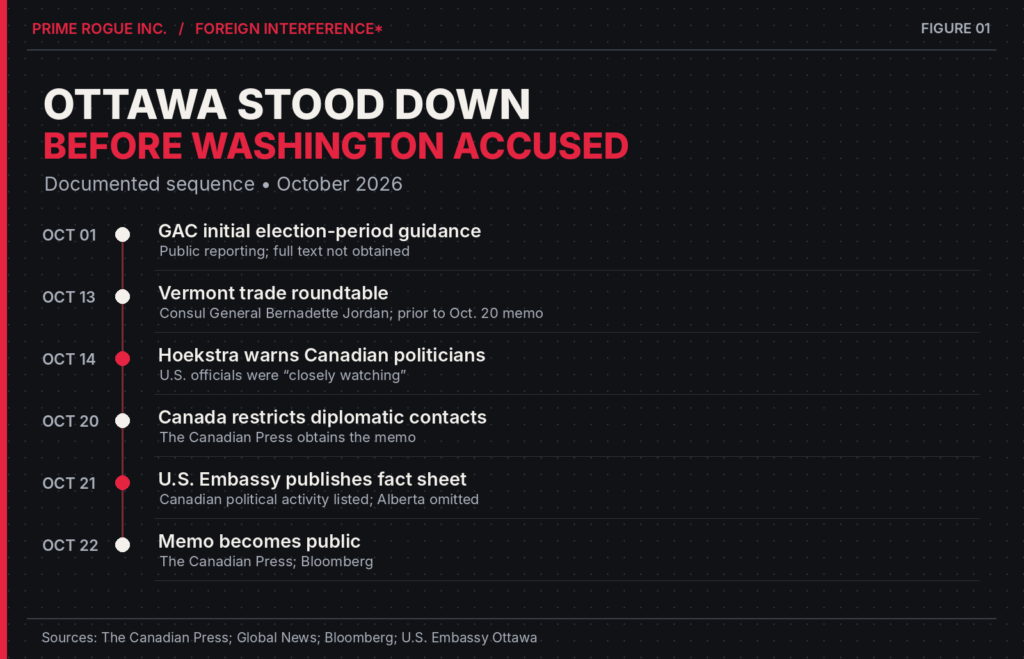
On October 20, 2026, Glen Linder, Global Affairs Canada’s assistant deputy minister for the Americas, circulated instructions to Canadian diplomatic personnel posted in the United States. Diplomats were told not to meet with or attend events involving candidates in the November 3 U.S. midterm elections. If they encountered a candidate or elected official, they were to avoid being photographed and having their names or positions used in public promotional material. Necessary dealings with elected officials not on the ballot required advance discussion with senior officials.
The reporting credit belongs to The Canadian Press, which obtained the internal memo and broke its contents on October 22. Brian Platt and Josh Wingrove independently reported the written restrictions for Bloomberg. A government spokesperson told The Hill that initial election-period guidance had been sent on October 1. The October 20 message summarized subsequent instructions.
On October 21, the U.S. Embassy in Ottawa published “Fact Sheet: Monitoring Canadian Activities in U.S. Politics”. It set out public statements and actions by Canadian politicians as evidence of plans to influence American politics. Its conclusion was blunt: “Americans decide America’s elections.” The Embassy did not acknowledge the prior day’s restrictions on Canadian diplomats. Nor did its text discuss Alberta.
This chronology is the lede: Ottawa constrained its official election-period contacts before Washington published its accusation. That does not mean every Canadian politician stopped discussing U.S. trade policy. It means Canada’s professional diplomatic service had already been instructed to minimize the appearance of partisan involvement.
In plain English: Canada’s diplomats were ordered to keep their distance from U.S. candidates. A day later, the U.S. Embassy publicly warned about Canadians influencing U.S. politics. Those two facts can coexist; they also deserve to be reported together.
The document did not arrive without warning. On October 14, Canadian reporting described remarks by U.S. Ambassador Pete Hoekstra on The Really Big Show podcast. Hoekstra said American officials were “closely watching” Canadian political conduct and warned Canadians to keep their “nose out” of U.S. politics ahead of the midterms. Catherine Morrison of The Canadian Press reported his warnings, including his concerns about Ontario’s trade advertisements and politically targeted retaliatory tariffs.
The Embassy’s nine examples followed a week later. They were not secret intercepts or an exposed clandestine operation. They were overwhelmingly materials already in the public domain: remarks by Industry Minister Mélanie Joly, a letter by Ontario Premier Doug Ford, publicly identified advertisements, an MP’s political campaigning, and a diplomatic trade roundtable. The document also cited 11 Canadians reportedly charged or sentenced in 2026 in connection with illegal voting in earlier U.S. elections.
A policy objection can still be substantive when the conduct is public. Prime Rogue has separately examined the broader Canada–U.S. tariff dispute and retaliation strategy; that economic-policy background is relevant without establishing a campaign-law violation. Joly’s remarks about creating political pressure in Republican states are direct evidence that Canadian officials understood the electoral politics of their trade strategy. But a stated intention to pressure a government over tariffs is not automatically evidence of a prohibited election contribution, a campaign operation, or an electoral offence.
In plain English: The Embassy showed that Canadian politicians wanted U.S. decision-makers to feel pressure over tariffs. The larger claim—that those activities were improper election interference—requires an additional definition and evidence.
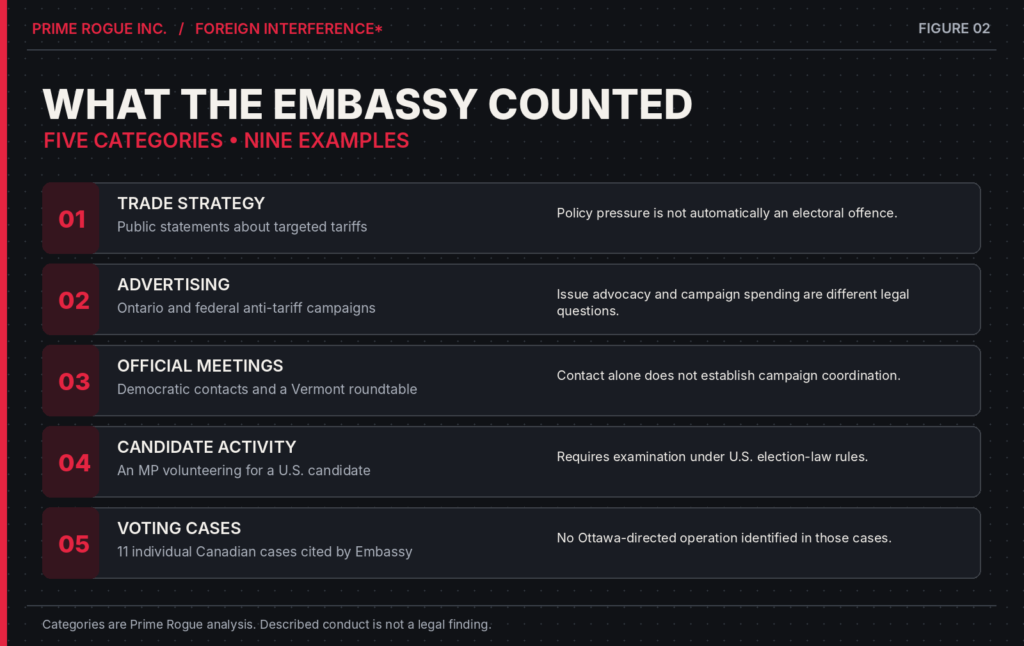
The fact sheet’s nine substantive examples can be sorted into five categories. The grouping below is Prime Rogue’s editorial analysis, not a reproduction of the Embassy’s numbering.
| Category | What was cited | What the evidence establishes |
| Trade strategy | Public statements by Mélanie Joly and Doug Ford, including political targeting of tariffs | Openly acknowledged efforts to pressure American policy-makers |
| Advertising | Ontario’s Ronald Reagan-themed anti-tariff campaign and federal anti-tariff billboards | Publicly attributed policy advocacy, potentially politically consequential |
| Political meetings | Joly’s meetings with Democratic figures and Consul General Bernadette Jordan’s Vermont roundtable | Contacts with American elected and political officials; not, without more, campaign coordination |
| Candidate activity | Liberal MP Anthony Housefather’s support for Rep. Debbie Wasserman Schultz in Florida | A candidate-specific activity warranting examination under election-law rules |
| Individual voting cases | At least 11 Canadians reportedly charged or sentenced in 2026 | Alleged or adjudicated individual electoral offences, with no stated link to Canadian government direction |
The Embassy’s claim that Canada had the second-highest total of foreign illegal-voting prosecutions was attributed generally to the U.S. Department of Justice; the fact sheet supplied no comparable country-by-country dataset or defined time series to substantiate the ranking. Individual charges must not be counted as convictions. The documented cases should not be dismissed, but neither should they be presented as evidence of an Ottawa-directed operation without such a connection.
Alex Boutilier of Global News, with reporting from Touria Izri, interviewed legal and political experts about the distinction. Carleton University national-security law professor Leah West explained that the Canadian threshold for foreign-influenced activities turns on clandestine, deceptive or threatening conduct. Former deputy prime minister John Manley questioned the utility of the Ambassador’s approach. Those are their independently reported interviews, not Prime Rogue’s original interviews.
In plain English: Nine examples do not add up automatically to nine violations. The critical question is what each person actually did, under what law, with what funding and coordination, and whether a rule was broken.
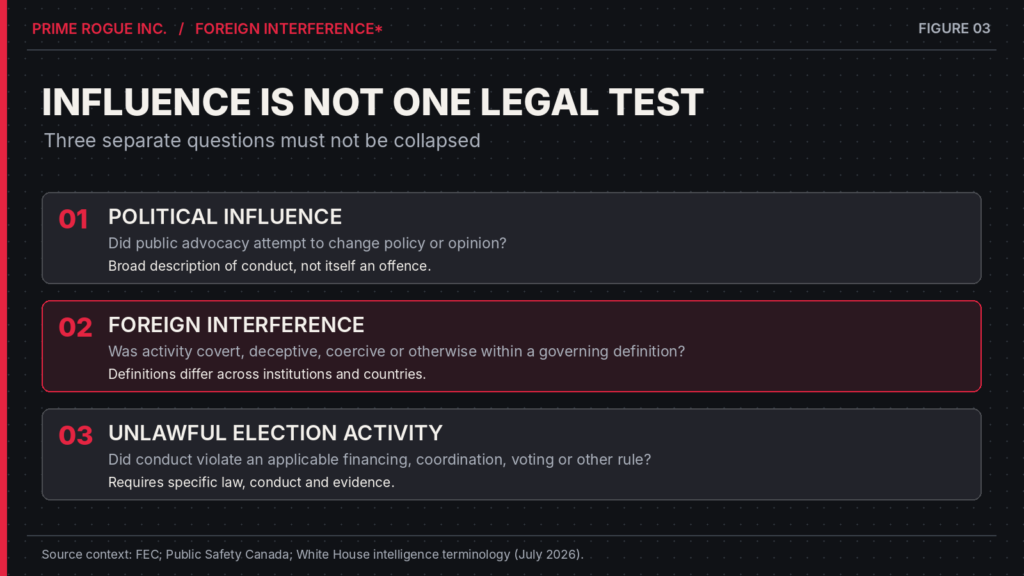
The argument is not that foreign involvement in an election is harmless. Federal election law does prohibit specific activities by foreign nationals. The Federal Election Commission’s guidance identifies prohibited contributions and expenditures, electioneering disbursements and participation in election-related decisions. At the same time, the FEC expressly permits uncompensated foreign-national volunteering when the volunteer does not take part in campaign management or decision-making. Whether Housefather’s activities met those conditions is a matter for verification, not inference from a photograph or an Embassy reference.
There is also a striking terminological distinction in a July 30, 2026 White House fact sheet, which reproduced a U.S. intelligence-community definition. Under that quoted framework, election influence includes a broad range of overt and covert efforts by foreign governments or their agents, while election interference is a narrower subset involving the election’s technical systems—including voter registration, ballot casting and counting, and results reporting.
That White House document addresses an intelligence definition in a particular context. It is not a blanket judicial definition, nor proof that the Embassy intended to invoke exactly the same framework. But it raises an obvious request-for-comment question: Was Ottawa being accused of political influence, illegal electoral participation, technical election interference—or some combination of the three?
Canadian definitions differ too. Public Safety Canada explicitly describes foreign influence as a normal part of international affairs, distinguishing it from covert, deceptive or coercive activity by a foreign government or those acting on its behalf. Canadian security-service terminology does not govern U.S. election law, but it helps explain why the words cannot be treated as interchangeable.
In plain English: Influence can mean trying to persuade. Interference can refer to conduct crossing a security or legal line. Illegal election activity is a separate, rule-specific question. The exact boundaries depend on the statute and institution using the term.
One Embassy example concerned Bernadette Jordan, Canada’s consul general in Boston, at an October 13 Vermont trade roundtable with Democratic Representatives Becca Balint and Jim McGovern. Both were running in the November 3 election. That meeting raises a fair question about how diplomats approach elected officials who are also candidates.
But the meeting occurred seven days before the October 20 memo. The memo is evidence of a later restriction, not proof that Jordan violated an instruction that had not yet been issued. The October 1 general guidance may be relevant, but its full provisions have not been established in the public reporting reviewed here. The right question is whether the October 13 meeting complied with the guidance then in force and the department’s customary non-partisanship rules.
Likewise, Ottawa’s October 20 restrictions applied to its diplomats, not automatically to every Canadian minister, provincial premier, parliamentarian, journalist or ordinary citizen speaking about trade policy.
In plain English: An official’s presence at a trade meeting can merit scrutiny without proving misconduct. We need the rule in force at the time, not a rule issued a week later.
The Embassy’s October 21 document did not mention Alberta, even though its opening quotation drew on Prime Minister Mark Carney’s warning that foreign governments—including the United States—should stay out of Alberta’s referendum. Prime Rogue’s earlier Full Spectrum 1.1 chronology identified the discrepancy in how the fact sheet dated Carney’s remarks.
The earlier Full Spectrum political dossier lays out the public chronology of American activity in Canada. This series will examine two American-associated tracks in Alberta while keeping them analytically separate. One concerns reported State Department staff meetings with Alberta separatist representatives. Alex Cosh at The Maple obtained a subsequent Embassy statement saying there would be no future meeting; the Embassy also said no commitments had been made. The other track concerns a private American political technology operation whose documented relationships with Alberta organizers were investigated by Canadian journalists, and whose Alberta-linked application’s Azure infrastructure was subsequently reconstructed by Prime Rogue.
The published Full Spectrum 02 forensic investigation documents Virginia-hosted application infrastructure and its relationship to the 10X Votes software environment. It does not demonstrate U.S. government direction of the application, control by the Ambassador or a proven electoral-law violation. The precise origin of the Alberta records and the persistent database’s location remain separate evidentiary questions.
Neither private American participation nor routine State Department contacts should be silently converted into government interference. Equally, official allegations of Canadian influence should not exempt American conduct from factual scrutiny or the same fair legal questions.
In plain English: There is evidence of American private political participation and separate official meetings relating to Alberta. There is not yet evidence that those two tracks constituted one coordinated U.S. government operation.
On October 21, Prime Minister Mark Carney responded by emphasizing that the United States had initiated the trade actions and that Canada’s countermeasures were intended to protect Canadian interests. Ford rejected any intention to interfere in the U.S. election. Carney later told reporters the allegations had no merit. The Canadian Press reported the initial responses; Alex Boutilier’s Global News reporting provides subsequent legal and diplomatic context.
On October 23, Prime Rogue sought on-record answers from the U.S. Embassy about whether its Canada-facing standard was consistent with its account of American activity in Alberta, whether any specific legal violations were alleged, whether the fact sheet had received approval from Washington, and how the material was assembled. No attributable substantive answers to those specific questions were available for the earlier Full Spectrum publication. A lack of on-record clarification is not evidence that the Embassy conceded any point. Publication proceeds independently of a response.
For this series, Prime Rogue is seeking a more precise answer to a narrower question: does the U.S. government regard independently researched, publicly attributed Canadian journalism about American political activity as legitimate reporting even when it is published close to an American election? If the Embassy contends otherwise, what specific conduct and law would it identify?
In plain English: We have asked officials to explain their standard. We will report what they say, correct factual mistakes if shown, and distinguish unanswered questions from proven facts.
This is a provisional evidentiary assessment, not a criminal allegation or legal ruling.
| Proposition | Assessment |
| Canadian diplomats were instructed on October 20 to avoid midterm candidates | Documented, through the memo obtained by The Canadian Press and parallel reporting |
| The Embassy published a fact sheet on October 21 alleging Canadian plans to influence U.S. politics | Documented, through the published document and contemporary reporting |
| The Embassy’s cited remarks and meetings show some deliberate attempts to pressure U.S. trade policy | Supported, particularly through openly stated tariff strategy |
| The cited evidence establishes an Ottawa-directed unlawful election-interference operation | Not established by the published materials reviewed here |
| The Embassy’s omission of Alberta proves it knew of or directed an American operation there | Not established; omission establishes no such knowledge or involvement |
For readers of Prime Rogue’s Full Spectrum 02 technical investigation, the ratings convention is different: Full Spectrum 02 uses Admiralty-style source-reliability and information-credibility assessments for discrete technical findings. This article does not grade political culpability on that scale.
In plain English: The underlying diplomatic confrontation is real. The public evidence shows political pressure. It does not, on its own, establish the much stronger conclusion of an unlawful election operation.
This investigation is being published before the November 3 U.S. midterm elections by a Canadian company, using public sources, openly attributed journalism, hyperlinks to primary records and explicit opportunities for comment. It is critical of some U.S. official statements. It may inform Canadian and American readers’ opinions.
The remaining installments will test the terms rather than assume the answer:
Part 02 — Meanwhile, in Alberta… examines the documented American private-sector activity and separate U.S. government contacts in Canada, with direct links to the full technical evidence.
Part 03 — How About Them Apples? compares the applicable Canadian and American legal frameworks without pretending that they are identical.
Part 04 — How to Legally “Interfere” in an American Election is a satirical, sourced examination of lawful journalism, expression and participation—and where prohibitions actually begin.
Foreign Interference is a question, not a conviction. The asterisk does the rest because Terms and Conditions Apply – always!



[…] supports investigating whether any of that conduct amounted to prohibited electoral activity or foreign interference. Prime Rogue does not conclude that foreign election interference occurred, that any particular […]