Address
304 North Cardinal St.
Dorchester Center, MA 02124
Work Hours
Monday to Friday: 7AM - 7PM
Weekend: 10AM - 5PM

Address
304 North Cardinal St.
Dorchester Center, MA 02124
Work Hours
Monday to Friday: 7AM - 7PM
Weekend: 10AM - 5PM
Canada’s foreign ministry ordered its diplomats in the United States to stay away from midterm candidates one day before the U.S. Embassy in Ottawa publicly accused Canadian officials of trying to influence American elections.
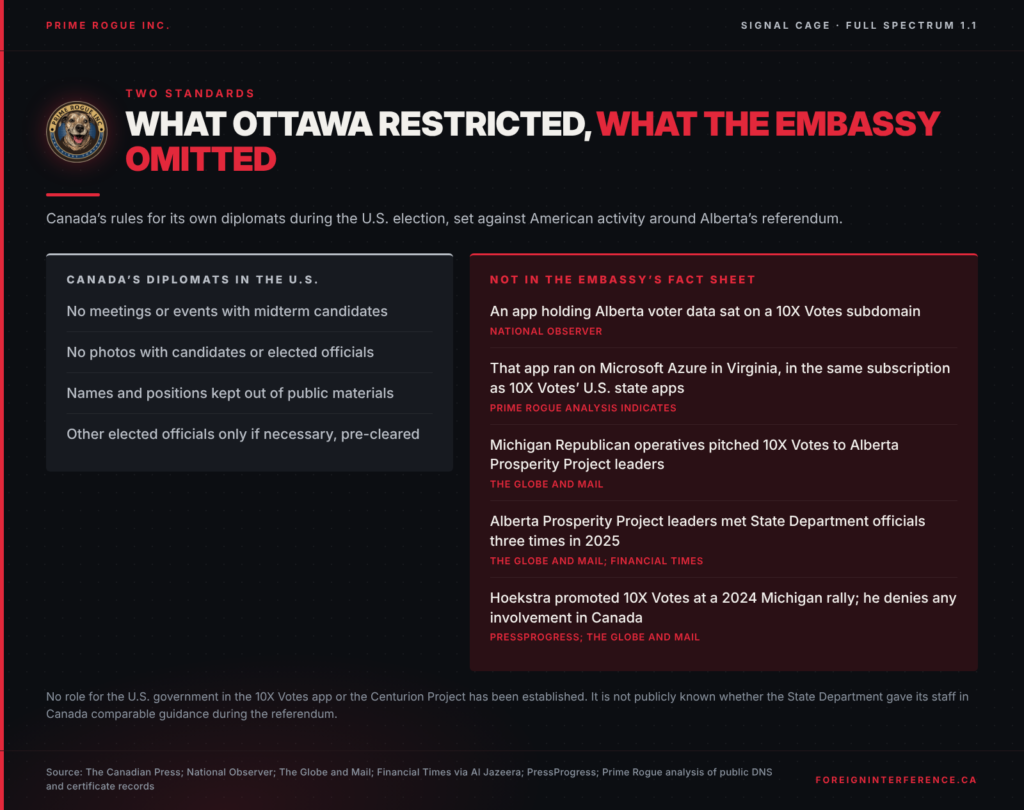
The embassy’s October 21 fact sheet closes with the line “Americans decide America’s elections.” It does not mention Alberta. An app holding Alberta voter data, hosted on the website of a Michigan political technology company linked to a separatist group, ran on Microsoft servers in Virginia, Prime Rogue’s analysis of public records indicates.
The U.S. Embassy in Ottawa did not answer Prime Rogue’s questions on the record.
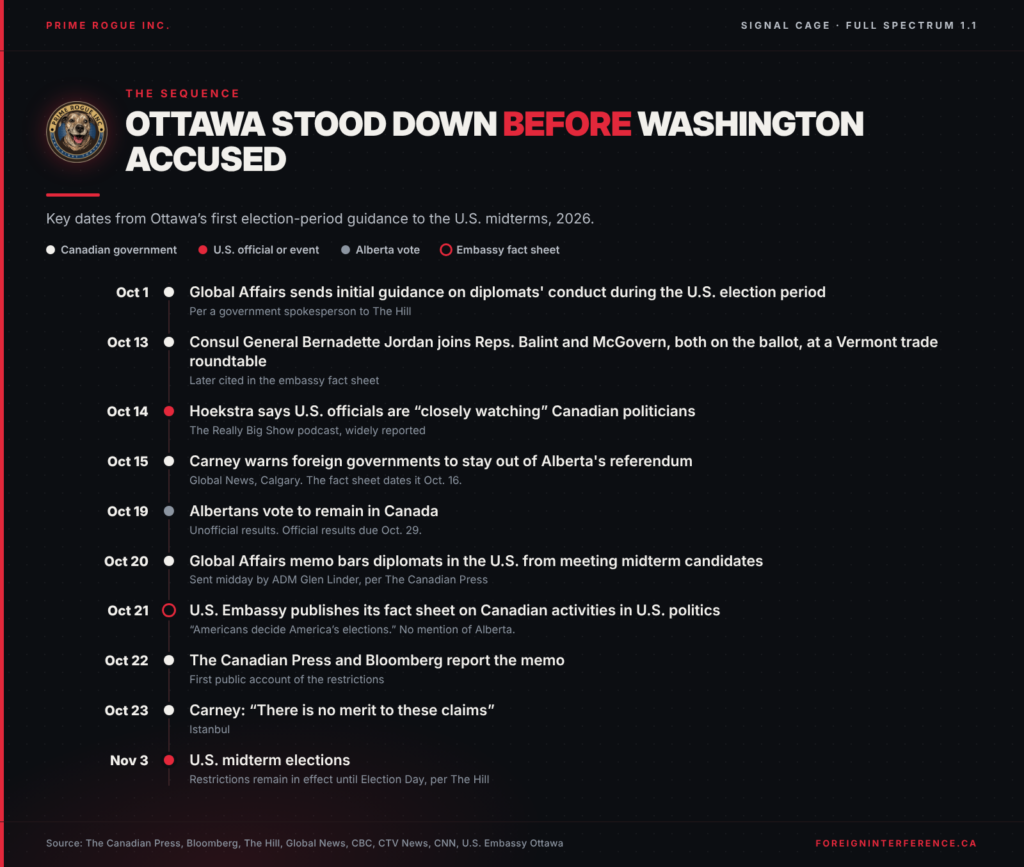
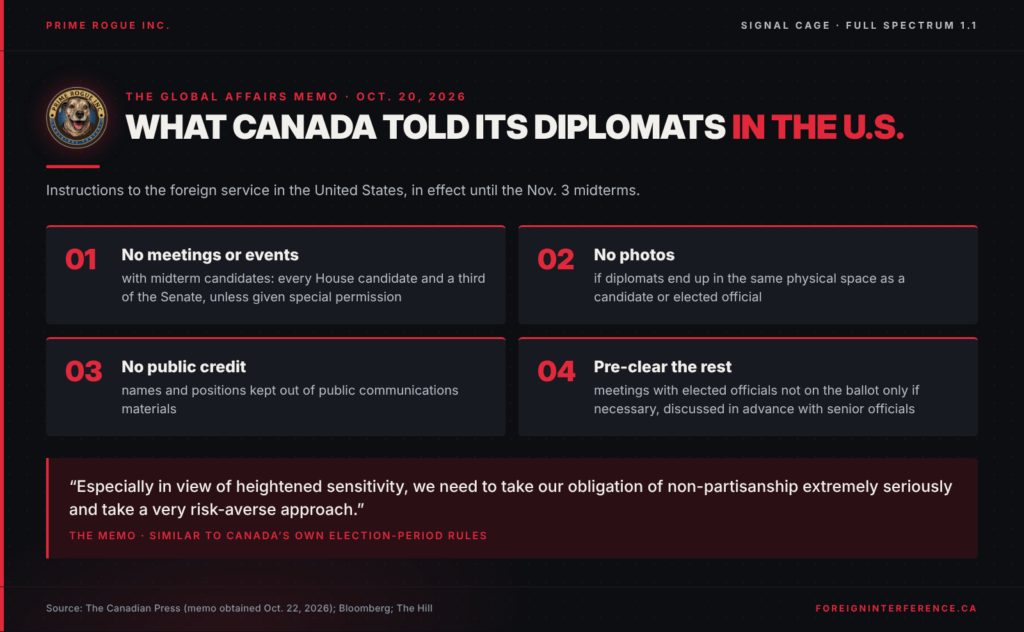
Glen Linder, assistant deputy minister for the Americas at Global Affairs Canada, sent the memo to members of the foreign service in the United States at midday on Tuesday, October 20. That’s according to The Canadian Press, which obtained it. Bloomberg also reported on the guidance on October 22, citing people familiar with it.
The memo bars Canadian diplomats from meeting with or attending events with midterm candidates. Bloomberg reported that this covers every House candidate and a third of the Senate, with exceptions only by special permission.
If diplomats find themselves “in the same physical space” as a candidate or elected official, they are to avoid being photographed. Their names and positions are not to appear in any public communications materials.
Meetings with elected officials who are not on the ballot may go ahead if necessary, but should be discussed in advance with senior officials. The memo says the instructions are similar to those Canadian public servants follow during Canada’s own election periods.
“Especially in view of heightened sensitivity, we need to take our obligation of non-partisanship extremely seriously and take a very risk-averse approach,” the memo says.
A Canadian government spokesperson told The Hill that initial guidance on diplomats’ conduct during the U.S. election period went out on October 1. The spokesperson said Tuesday’s message summarized takeaways from a regular meeting between the U.S. mission and headquarters.
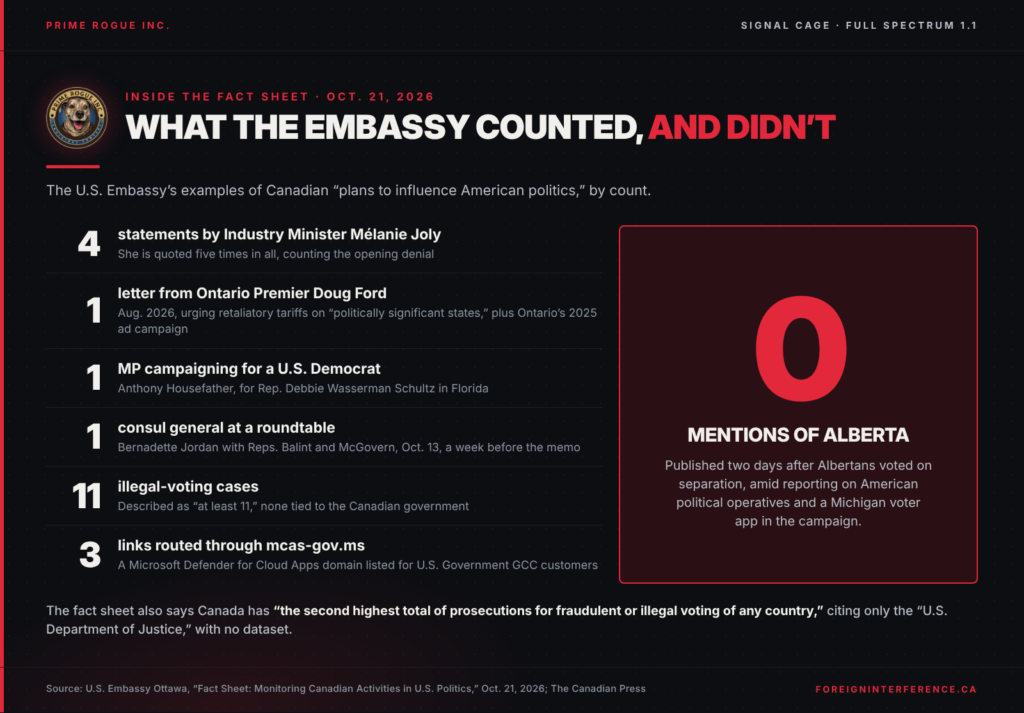
The embassy published “Fact Sheet: Monitoring Canadian Activities in U.S. Politics” on October 21. That was two days after Albertans voted to remain in Canada, according to unofficial results. The document is attributed to the “U.S. Mission to Canada” and carries no named author or signature.
It opens with two quotes. The first is Prime Minister Mark Carney’s statement that “we don’t get ourselves involved in their elections,” which the fact sheet dates to October 16. Carney actually made the remark to Global News in Calgary on October 15. He was warning foreign governments, the United States included, to stay out of Alberta’s referendum.
The second is Industry Minister Mélanie Joly’s October 14 denial that Canada would interfere. The document then presents Canadian trade retaliation and lobbying as evidence of “plans to influence American politics.”
Its examples include:
Both lawmakers are on the November 3 ballot (Balint, McGovern). That type of appearance is exactly what the Global Affairs memo barred, although the roundtable took place a week before the memo was sent.
The fact sheet also names 11 Canadians it says were charged or sentenced in 2026 for illegal voting in U.S. elections held between 2012 and 2024. It describes them as “at least 11,” and does not tie any of them to the Canadian government.
It asserts that Canada has “the second highest total of prosecutions for fraudulent or illegal voting of any country.” It attributes the claim only to the “U.S. Department of Justice,” without identifying a dataset.
Three of its source links route through mcas-gov.ms, a domain Microsoft says is used by its Defender for Cloud Apps service. Microsoft lists the domain for U.S. Government GCC customers. Microsoft’s documentation says web addresses take that suffix when a user’s browser session is routed through the service. The links in the fact sheet still carry it, and two include session parameters.
The document followed weeks of escalating warnings. Ambassador Pete Hoekstra gave an interview on The Really Big Show podcast that was widely reported on October 14. In it, he said U.S. officials were “closely watching” Canadian politicians and told them to keep their “nose out” of American politics.
“We’re monitoring it, we’re evaluating it, and if some of it becomes election interference, you know, then America will respond to it,” he said.
On October 21, Carney, flanked by Joly, responded to a question about the accusations by noting that the United States had started the trade actions. “All of our actions are in the interests of Canadian workers, Canadian families and the future of this economy,” he said. Ford said he has “no interest at all” in interfering in American elections.
Two days later in Istanbul, Carney was blunter. “There is no merit to these claims,” he told reporters. He added that he was “disappointed” that Hoekstra saw it as his role to make them.
The fact sheet is silent on American political actors and companies in Alberta’s referendum.
The Centurion Project is a separatist group led by David Parker. It is under investigation by Elections Alberta, Alberta’s privacy commissioner and the RCMP over a database of voters. Elections Alberta alleges the database was drawn from a political party’s copy of the province’s list of electors.
A lawyer for Elections Alberta told a court the group had improperly obtained data on 2.9 million voters, Canada’s National Observer reported.
Parker has said the group’s app grew out of his work with 10X Votes, a Michigan political technology company. PressProgress reported that he called it the “10x slash the Centurion Project app.”
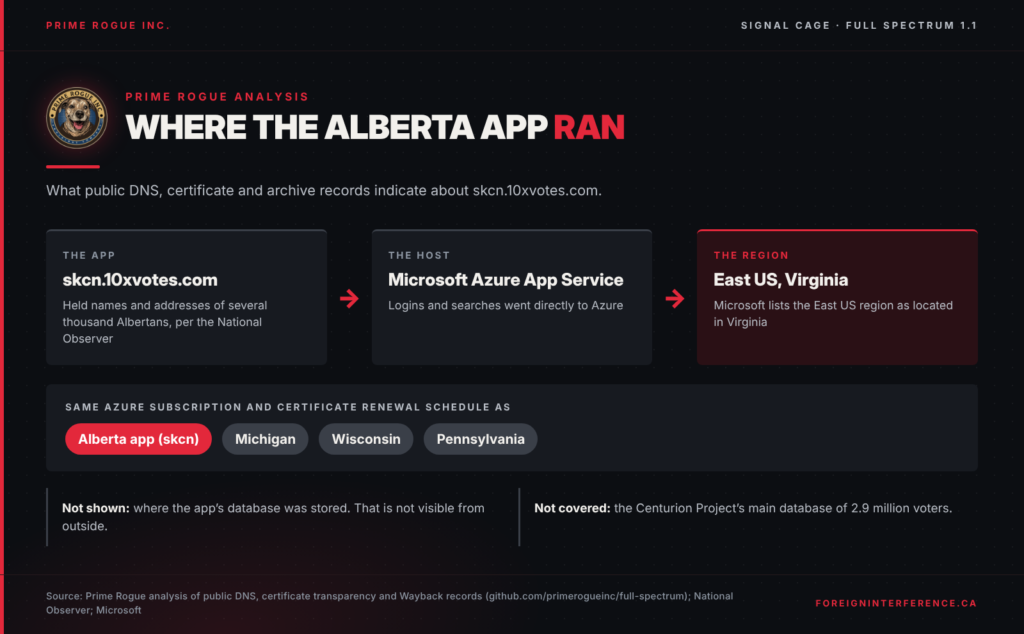
In May, Canada’s National Observer found an app on the 10X Votes subdomain skcn.10xvotes.com, registered in March 2025, “stocked exclusively with names and addresses of several thousand Albertans.” That data did not include the riding information or identifiers used in the electors list, and its origin had not been established, the Observer reported.
Prime Rogue’s analysis of public DNS, certificate and archive records indicates that the app was hosted in Microsoft Azure’s East US region. Microsoft lists that region as located in Virginia. The analysis also indicates the app sat in the same Azure subscription, and on the same certificate renewal schedule, as 10X Votes’ apps for Michigan, Wisconsin and Pennsylvania.
Where the app’s database was stored is not visible from outside, and the analysis does not cover the Centurion Project’s main database. The underlying records are published here, and the full analysis appears in the first part of Prime Rogue’s Full Spectrum series tomorrow. 10X Votes did not respond to a request for comment.
Hoekstra promoted 10X Votes at a November 2, 2024 Trump rally in Warren, Michigan, while chair of the Michigan Republican Party. He has since told PressProgress “I was not aware of the relationship.” He told The Globe and Mail he has “zero involvement with 10X Votes in Canada.”
The Globe has also reported that Republican operatives from Michigan pitched 10X Votes to Alberta Prosperity Project leaders in Calgary in January.
Leaders of the Alberta Prosperity Project, a separatist group, met State Department officials three times in 2025, on April 22, September 29 and December 16, the Globe reported. The Financial Times first reported the meetings in January. The State Department said at the time that it “regularly meets with civil society types” and that “no commitments were made.”
House of Commons petition e-7531 was initiated by Calgary resident Leanne Walker and is sponsored by Green Party Leader Elizabeth May. It asks that Hoekstra be declared persona non grata, and alleges he “has been linked to” the app used by the Centurion Project. Hoekstra denies involvement, and no role for him in the Centurion Project’s use of the app has been established.
The petition had 280,295 signatures on October 22, according to PetitionTracker.ca, and closes November 18.
Ottawa has applied election-period restraint to its own diplomats in the United States. It is not publicly known whether the State Department gave its staff in Canada any comparable guidance during Alberta’s referendum.
On October 23, Prime Rogue asked the U.S. Embassy in Ottawa:
The embassy did not answer these questions on the record.
Americans vote in the midterms on November 3. The Hill, citing Bloomberg’s reporting, said the Global Affairs restrictions remain in effect until Election Day.
 The Pot Calls the Kettle Black: Two Years of American Interference in Canadian Politics
 Rigged from Washington: How U.S. Disinformation is Engineering Canada’s 2025 Election Takeover
 Full Spectrum: Calgary Has Always Been an Intelligence Battleground — Right Now It’s the Most Contested City in Canada
 Alberta Voter Data Crossed Into the US When It Was Uploaded. We Proved It. | Prime Rogue


[…] the United States, the room erupted. Carney paused: “Careful, they might think that’s election interference. A little touchy.” The target was U.S. Ambassador Pete Hoekstra, who had warned […]
[…] become the enforcement wing of a parallel political economy. Add fentanyl, shell companies, and election interference pipelines, and you’ve got hybrid warfare without the courtesy of […]