Address
304 North Cardinal St.
Dorchester Center, MA 02124
Work Hours
Monday to Friday: 7AM - 7PM
Weekend: 10AM - 5PM

Address
304 North Cardinal St.
Dorchester Center, MA 02124
Work Hours
Monday to Friday: 7AM - 7PM
Weekend: 10AM - 5PM
Since the Oct. 17 fire that killed four soldiers at CFB Wainwright, some posts online have suggested an explosion, a gas line or a well was involved. National Defence has said it does not believe oil and gas infrastructure was involved at CFB Wainwright, and the Alberta Energy Regulator says no operator has reported an incident.
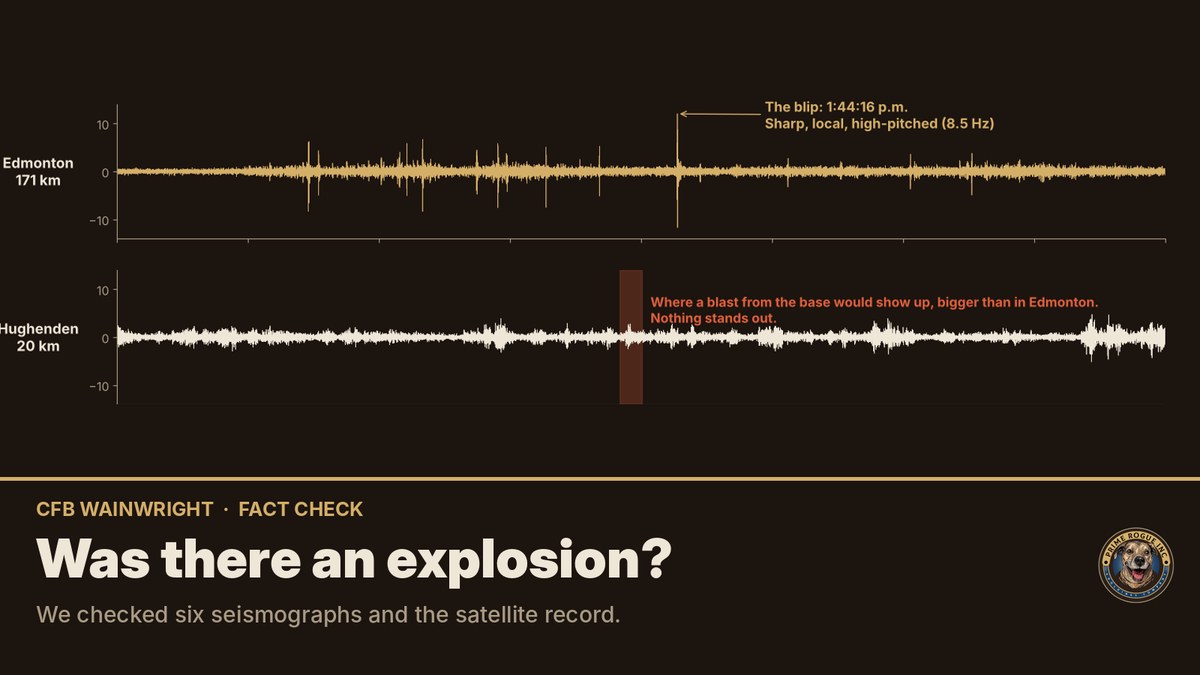
Several X posts went further. They shared a seismograph chart from Edmonton with a sharp spike in the early afternoon of Oct. 17, under the caption “CFB Wainwright – Explosion?” The post called it unconfirmed. We decided to check it properly.
The spike was real, but it was something near the Edmonton instrument, not a blast at Wainwright. The seismograph closest to the base recorded nothing at that moment. Satellites saw no heat at the base at that time either.
Here is how we checked, step by step.
A seismograph is a very sensitive motion detector buried in the ground. It records every tiny shake: earthquakes, but also trucks, trains, people walking past, and wind rocking trees and buildings nearby.
An explosion sends a shock through the ground. That shock travels outward at about 6 kilometres a second, getting weaker as it spreads. So the station closest to the blast feels it first and hardest. A station far away feels it later and much more faintly.
That gives us a simple test. If something blew up at Wainwright, the closest station has to show it, before the distant ones and more strongly.
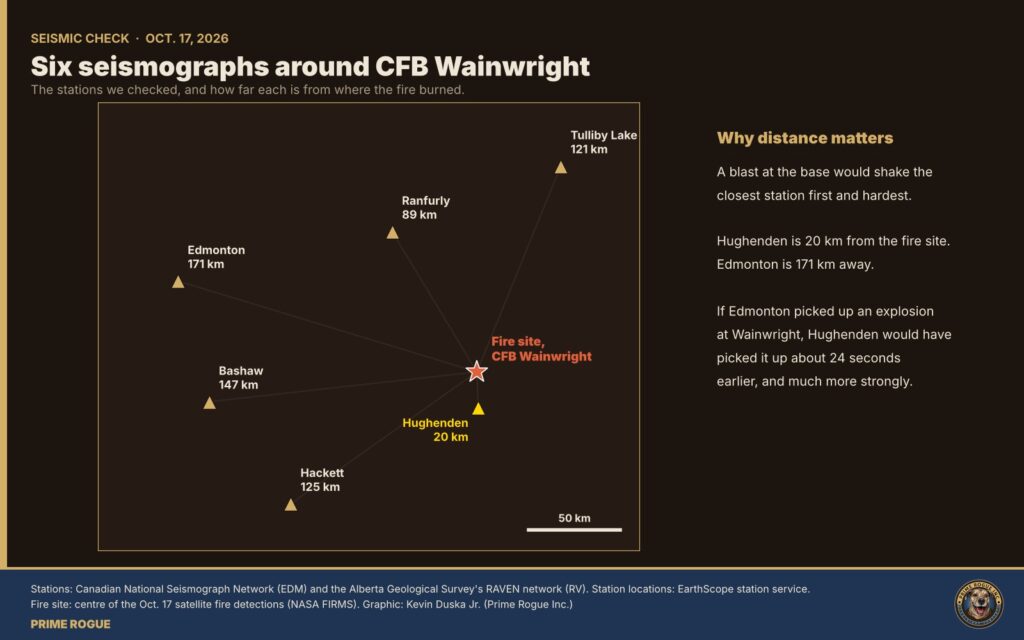
We found six seismographs within about 170 km of the fire site that were recording that afternoon. Five belong to the Alberta Geological Survey’s network. The sixth is the federal station in Edmonton, the one in the post.
The key station is Hughenden, about 20 km from where the fire burned. Edmonton is about 171 km away. If Edmonton felt a blast from Wainwright, Hughenden would have felt it roughly 24 seconds earlier, and far more strongly.
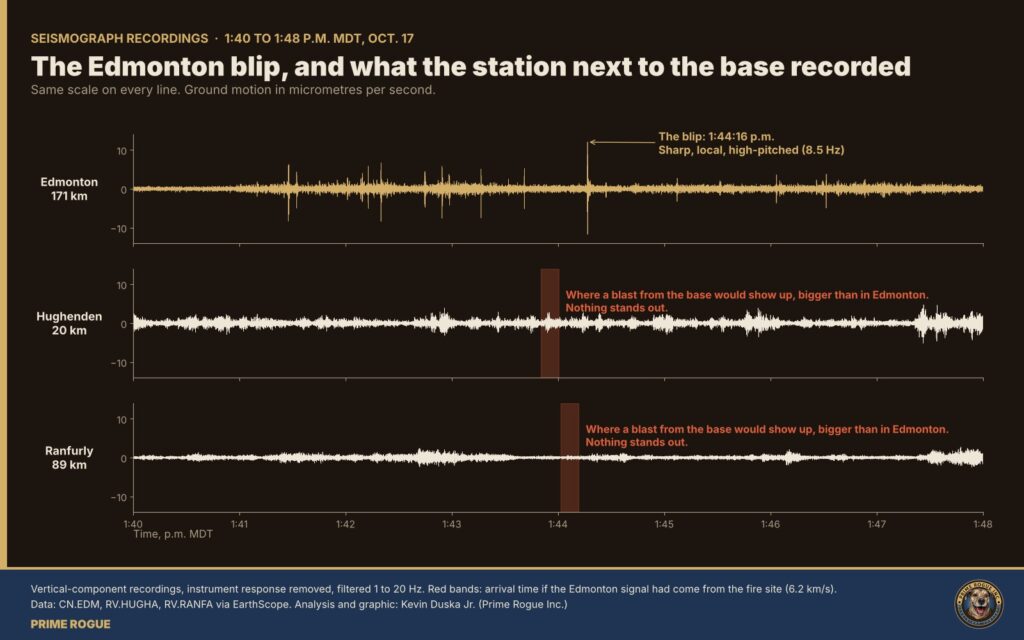
We downloaded the raw recordings from EarthScope, the public archive that stores data from these stations, and put them side by side on the same scale.
The Edmonton spike happened at 1:44:16 p.m. Mountain time. Seismograph charts run on universal time, which is why the post’s chart reads 19:44. It is sharp and short, and its energy is concentrated at a high pitch, about 8.5 vibrations a second. That is the signature of something close to the instrument: a vehicle, machinery, a door. Shaking that has travelled 171 km loses those high pitches along the way.
Then we looked at Hughenden at the moment a blast from the base would have arrived there, about 24 seconds earlier. Nothing stands out. The same is true at Ranfurly, 89 km from the base. At its biggest in that window, Hughenden’s shaking was about a fifth of Edmonton’s spike, and it does not line up in time.
Maybe the post had the wrong moment? We ran an automatic detector script over all six stations from noon to 5:30 p.m. It flags any moment when three or more stations jump at about the same time.
It found six such moments. We tested each one against a source at Wainwright. None fits. The timing between stations was off by 5 to 40 seconds, and in most cases Hughenden, the closest station, did not react first or did not react at all. These were coincidences between stations each picking up their own local noise on a very windy afternoon.
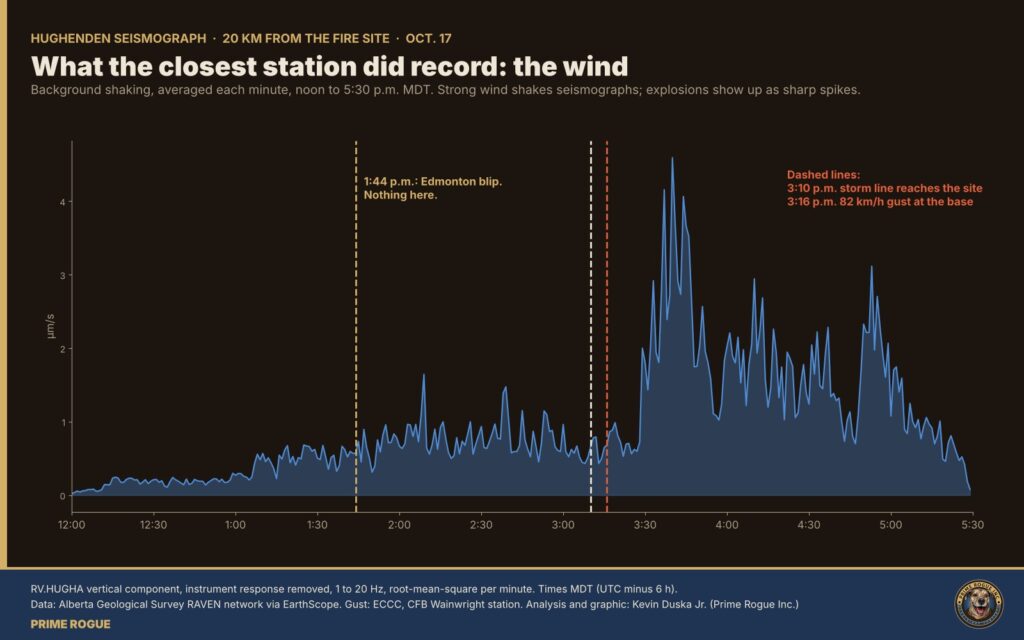
Hughenden did record something big that afternoon: the wind. Its background shaking creeps up through the early afternoon, then jumps sharply after about 3:20 p.m. and stays high until about 5 p.m.
That matches the weather record. A line of storms reached the training area around 3:10 p.m., and the base’s weather station recorded an 82 km/h gust at 3:16 p.m. Hughenden, 20 km south, felt the wind ramp up minutes later. There is no sharp spike at 1:44 p.m.
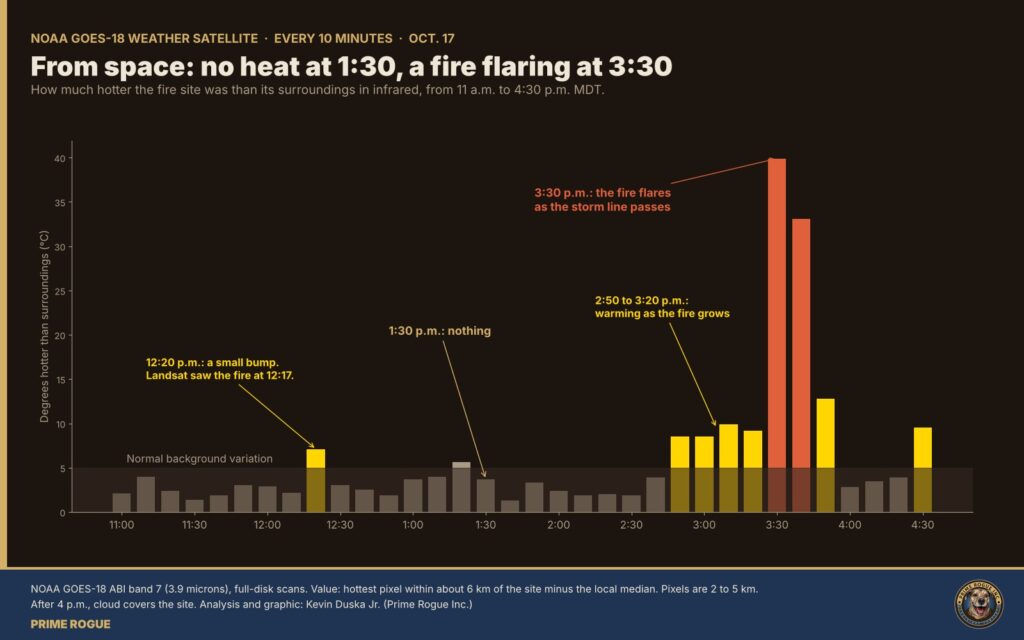
A blast big enough to register 171 km away would almost certainly start a fire or send up a hot plume. NOAA’s GOES-18 weather satellite takes a heat picture of the area every 10 minutes, and the data is publicly available.
At 1:30 p.m., the fire site was no warmer than its surroundings. The heat signal starts rising around 2:50 p.m. as the fire grows, then jumps at 3:30 p.m. as the storm line passes. That is the fire. It matches what NASA’s satellites and the weather records already showed.
There is one small bump at 12:20 p.m., three minutes after NASA’s Landsat 8 satellite first detected the fire on the range. It is too small on its own to prove anything, but it is in the right place at the right time.
This check rules out a large explosion, the kind the post suggested, big enough to show up in Edmonton. It does not tell us about small blasts on the range, such as training ammunition, which would be too weak to register far away. It also does not tell us what started the fire. Those answers are in National Defence’s records, which it has not released.
After four deaths, the families and the public deserve facts, not rumours. The records about CFB Wainwright already raise serious questions about what happened that afternoon: a fire burning on the range from at least 12:17 p.m., Extreme fire danger, and a wind warning that was in force while training continued. Our full reconstruction of the events at CFB Wainwright sets those out. False explosion claims make those questions easier to dismiss.
Everything here is public. You can view the same seismograph stations on the EarthScope station monitor: search for HUGHA, RANFA or EDM and set the date to Oct. 17. Remember the times are universal time, six hours ahead of Alberta. GOES-18 heat data is on NOAA’s open data archive.
Follow developments on our CFB Wainwright live updates page
Sgt. Morgan Wong, Pte. Shaun Farrell, Pte. Aidan Goulding and Pte. Hayden Lykkemark were killed in the fire. 39 Canadian Armed Forces members were injured. CAF Family Information Line (24/7): 1-800-866-4546.
 DND said the Wainwright fire “ignited” at 4 p.m. The military now says it was known for hours
 Satellites saw fire on CFB Wainwright range hours before DND says it ignited
 Every Warning Light Was On: What Most Likely Happened at CFB Wainwright
 Gas wells played no part in the CFB Wainwright fire, records show


[…] Wong, Pte. Shaun Farrell, Pte. Aidan Goulding and Pte. Hayden Lykkemark were killed in the fire. 39 Canadian Armed Forces members were injured. CAF Family Information Line (24/7): 1-800-866-4546. Canadian Forces Member […]