Address
304 North Cardinal St.
Dorchester Center, MA 02124
Work Hours
Monday to Friday: 7AM - 7PM
Weekend: 10AM - 5PM

Address
304 North Cardinal St.
Dorchester Center, MA 02124
Work Hours
Monday to Friday: 7AM - 7PM
Weekend: 10AM - 5PM
By Kevin J.S. Duska Jr. | Prime Rogue Inc | Calgary, AB
This follows Prime Rogue’s satellite analysis, published at 2 a.m. MT Sunday: Satellites saw fire on CFB Wainwright range hours before DND says it ignited, and our 7 a.m. follow-up.
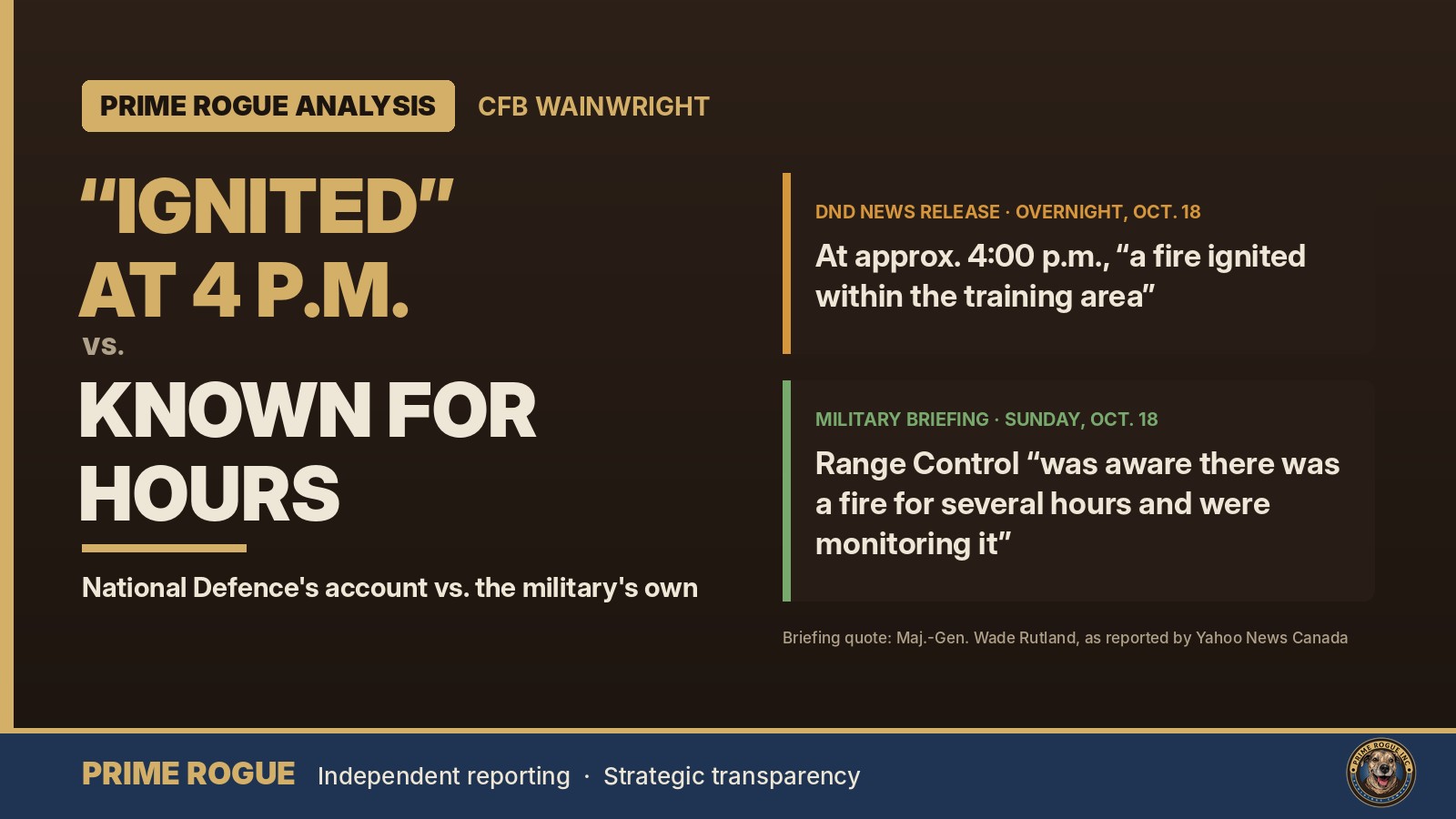
In the first hours after four soldiers were killed at CFB Wainwright, the Department of National Defence told Canadians that a fire “ignited within the training area” at about 4 p.m. on Saturday.
On Sunday, the military gave a fuller account. Range Control at the base had been aware of a fire for several hours and was monitoring it, according to accounts of the briefing in Edmonton, and training continued. At about 4 p.m. the wind shifted, and a fire about a kilometre away reached soldiers of C Company, 3rd Battalion, Princess Patricia’s Canadian Light Infantry, in 30 to 60 seconds.
The written record from National Defence makes no mention of that earlier fire. Read alone, the release told the public the fire began at the moment it became deadly. The military’s own account on Sunday is that a fire was already burning, and already known, for hours.
DND has not said whether the fire Range Control was monitoring is the same fire that reached the troops, or what exactly “ignited” at 4 p.m.
The Canadian Armed Forces’ first statement, issued Saturday evening, said: “At approximately 1600 on 17 October 2026, a fire was reported on the range at Canadian Armed Forces Base Wainwright. The fire has extended beyond the boundary of the training area and emergency services are responding.” That statement was later removed and replaced by National Defence’s overnight release.
A second release named the exercise, Exercise APOLLO SHOOTER, and said the fire overtook the unit’s administrative area. This release stated that “On October 17, 2026, at approximately 1600 hrs (MDT), members of 1 Canadian Mechanized Brigade Group from the 3rd Battalion, Princess Patricia’s Canadian Light Infantry, were conducting live fire training at CFB Wainwright as part of Exercise APOLLO SHOOTER… While conducting training a fire ignited and high wind speeds enabled the fire to grow and spread very rapidly overtaking the unit administrative area.” The release carries no time of publication. Rutland announced the soldiers’ names at the briefing, which suggests the release followed it. If so, National Defence again described a fire that “ignited” during training, with no mention of the fire its own commander had just said was known for hours.
Maj.-Gen. Wade Rutland, commander of 1st Canadian Division, said range control “was aware there was a fire for several hours and were monitoring it.” CBC News reported that it was decided training “could carry on for a certain amount of time,” and CNN reported that range control considered the fire “contained” and not expected to move “anywhere near” the soldiers. “The fire was a kilometre away when the wind shifted,” Rutland said. “It is not normal for a fire to move a kilometre in 30 to 60 seconds.” He added: “I spoke to my commander on the ground last night and this morning, and he said within 30 seconds to a minute they saw no fire, and then there was a fire right on top of them.” Rutland said the fire “did originate within the training area, and did cross established fire guards before being contained.”
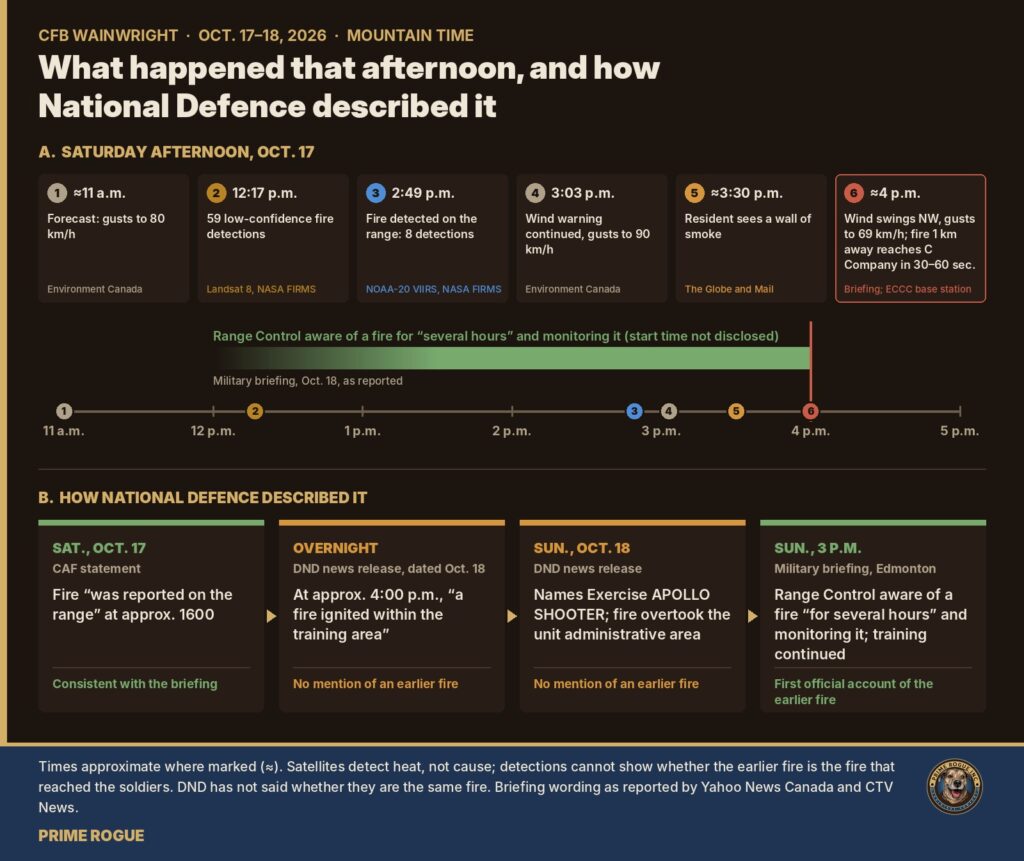
The first statement and the briefing are consistent with each other. A fire “reported” at about 4 p.m. can describe the moment it reached the soldiers. “Ignited” says something different: that the fire started then.
There are two ways to reconcile the release with the briefing, and DND has not said which is right.
The fire Range Control was monitoring is the fire that reached C Company. If so, it did not ignite at 4 p.m. It had been burning for hours, and 4 p.m. is when the wind turned it onto the troops. On this reading, the release gave the public a start time that the military’s own account does not support.
A separate grass fire started near the section attack range at about 4 p.m., while another fire elsewhere on the base was being monitored. The Sunday release’s wording, “while conducting training a fire ignited,” is the only official language that could support this reading. No account of the briefing describes a second fire: Rutland described one fire, burning about a kilometre away, that the wind drove onto the soldiers. If there were two fires, the release still left out that a fire was already burning on the base, a fact the military itself put at the centre of Sunday’s briefing.
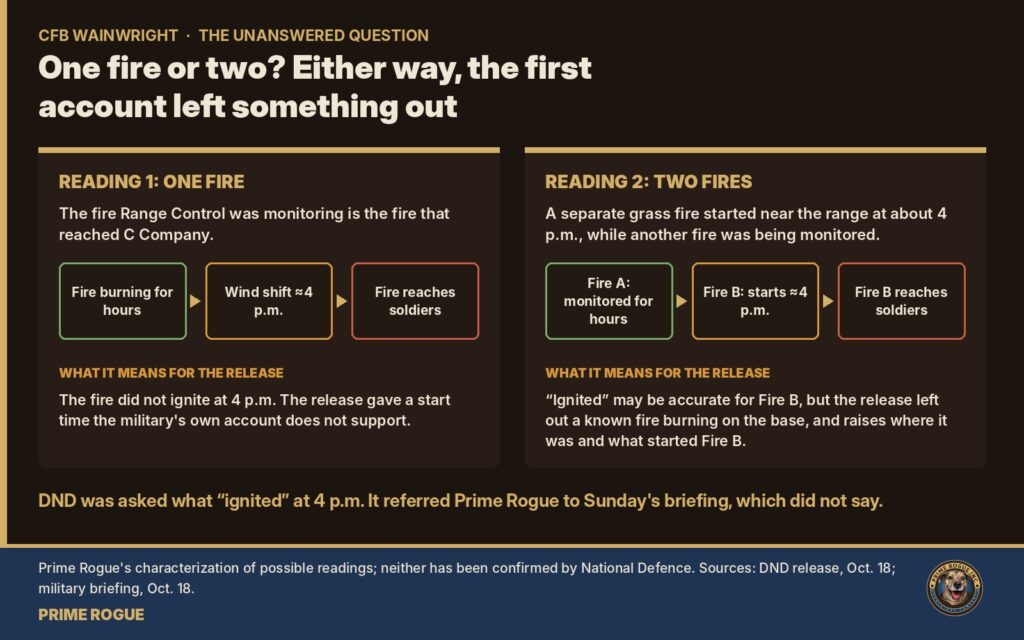
Either way, the first public account from National Defence omitted the fact that now matters most: a fire was known, and training went on.
The “two fires” reading would raise its own questions: where the monitored fire was, and whether the 4 p.m. fire was started by the training itself. Rutland said “a multitude of ordnance” was in use in the training area that day, “grenade launcher, grenades, small arms, ammunition,” and that the cause “could have been any of that, or none of it.”
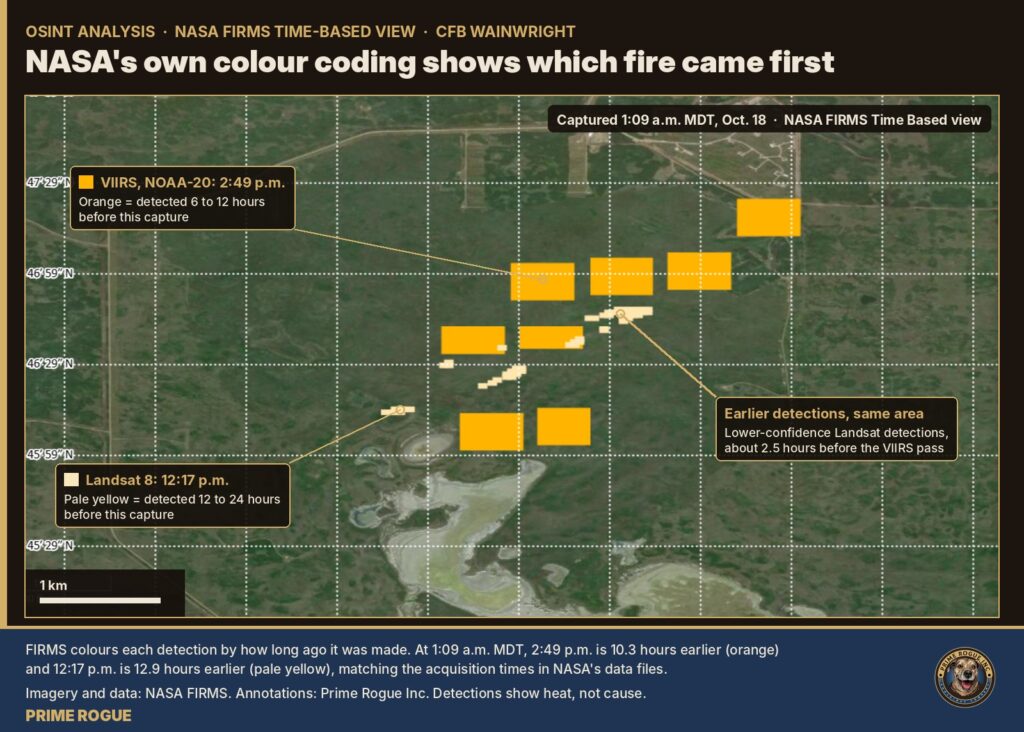
That record is consistent with a fire burning on the range for hours before 4 p.m., as the military now describes. It cannot show whether the fire NASA detected is the fire that reached the soldiers, and it cannot show cause. Satellites detect heat.
Environment Canada’s station at the base recorded a sharp wind shift at 4 p.m.: the wind swung to the northwest, gusting to 69 km/h, and the temperature fell about 10 degrees.
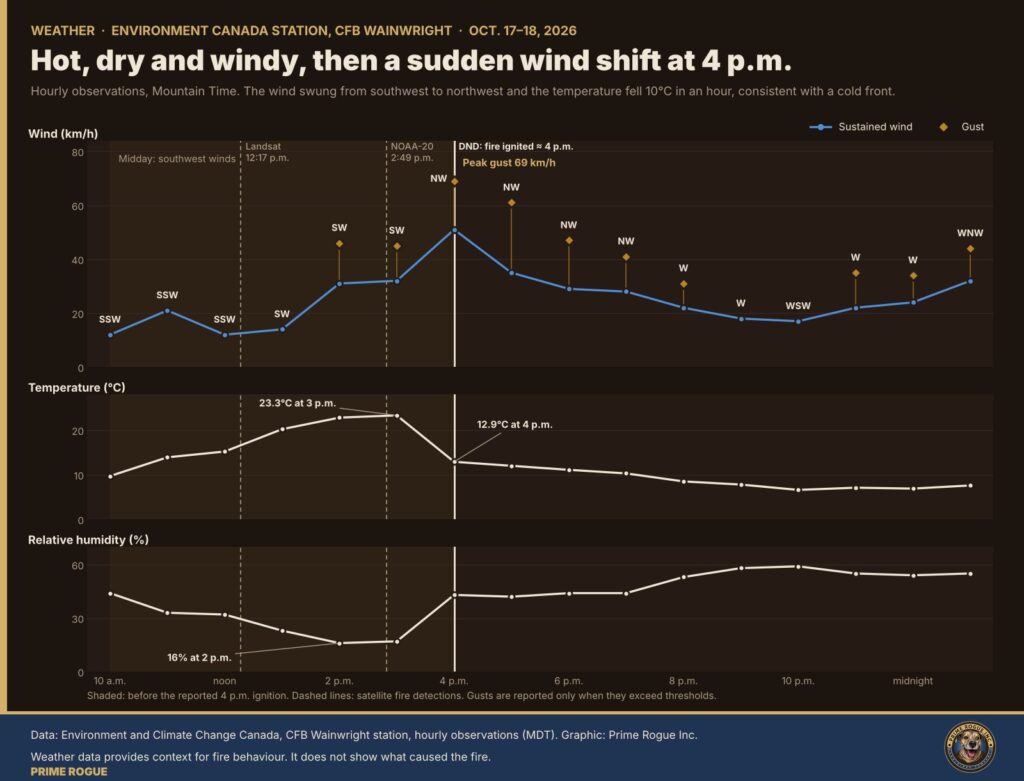
Environment Canada forecasts issued at about 5 a.m. and 11 a.m. Saturday called for gusts to 80 km/h in the afternoon, The Globe and Mail reported. At 3:03 p.m., about an hour before the shift, Environment Canada continued a yellow wind warning for Lloydminster – Wainwright – Vermilion – Provost, forecasting gusts to 90 km/h.
Around 3:30 p.m., Wainwright resident Tanya Porter saw a wall of smoke, The Globe and Mail reported.
Whether the forecast wind shift was weighed in the decision to keep training is one of the questions a Board of Inquiry will need to answer.
The first official account of a disaster shapes how the public understands it. For about 14 hours, from the overnight release to Sunday’s briefing, National Defence’s written account described a fire that ignited at 4 p.m. and spread rapidly. That account fits a sudden, unforeseeable event. The account given on Sunday, of a fire known for hours and a decision to continue training, raises questions about decisions made before anyone was hurt.
Prime Rogue is not suggesting that the release was written to mislead. It was issued within hours of a mass-casualty event, when information inside the military was still incomplete. But National Defence has not corrected or clarified it, and the military now knows, and has said publicly, that the fire had been monitored for hours.
On Sunday morning, Prime Rogue asked National Defence what “ignited” at 4 p.m., and whether Range Control knew of fire in the training area earlier in the afternoon, with a deadline of 6 p.m. MT. DND’s media relations office replied by directing Prime Rogue to the afternoon briefing. The briefing addressed the second question: Range Control knew. It did not explain the first. Prime Rogue sent DND a follow-up asking whether the two are the same fire, and will update this story with any response.
Prime Rogue has also filed requests under the Access to Information Act for recordings, dispatch records and imagery from the incident, and for initial casualty reporting and communications to Ottawa.
The four soldiers killed were Sgt. Morgan Wong, of the Loyal Edmonton Regiment, serving with 3rd Battalion, PPCLI, and Pte. Shaun Farrell, Pte. Aidan Goulding and Pte. Hayden Lykkemark, all of 3rd Battalion, PPCLI. Thirty-nine people received hospital care; Acute Care Alberta said 19 were in critical condition. Prime Rogue extends its condolences to their families, and our thanks to the soldiers and first responders who went toward the fire.
Ongoing coverage: CFB Wainwright fire: live updates.
CAF Family Information Line (24/7): 1-800-866-4546. Canadian Forces Member Assistance Program: 1-800-268-7708.
 Satellites saw fire on CFB Wainwright range hours before DND says it ignited
 Satellite record fits scenario that an exercise fire was burning before the CFB Wainwright incident
 The storm line, then the fire: every satellite record of the CFB Wainwright fire, on one map
 Gas wells played no part in the CFB Wainwright fire, records show


[…] Rogue downloaded NASA FIRMS 24-hour active-fire files for Canada and Alberta, covering every sensor FIRMS provides, four times between 11:50 p.m. Saturday and 4:27 a.m. Sunday. […]
[…] plans, has a twofold domestic effect: practically, it enhances readiness and potentially saves lives if war breaks out; psychologically, it unites the public in a wartime mindset and conveys that the government is […]
[…] 9 p.m. | NEW ANALYSIS: DND said the fire “ignited” at 4 p.m. The military now says it was known f… […]
[…] Rogue’s earlier reporting: the satellite timeline (2 a.m. Oct. 18), the 7 a.m. follow-up and DND’s statements (9 p.m.) on the CFB Wainwright Fire. Another analysis integrating additional data sources is forthcoming but […]