Address
304 North Cardinal St.
Dorchester Center, MA 02124
Work Hours
Monday to Friday: 7AM - 7PM
Weekend: 10AM - 5PM

Address
304 North Cardinal St.
Dorchester Center, MA 02124
Work Hours
Monday to Friday: 7AM - 7PM
Weekend: 10AM - 5PM
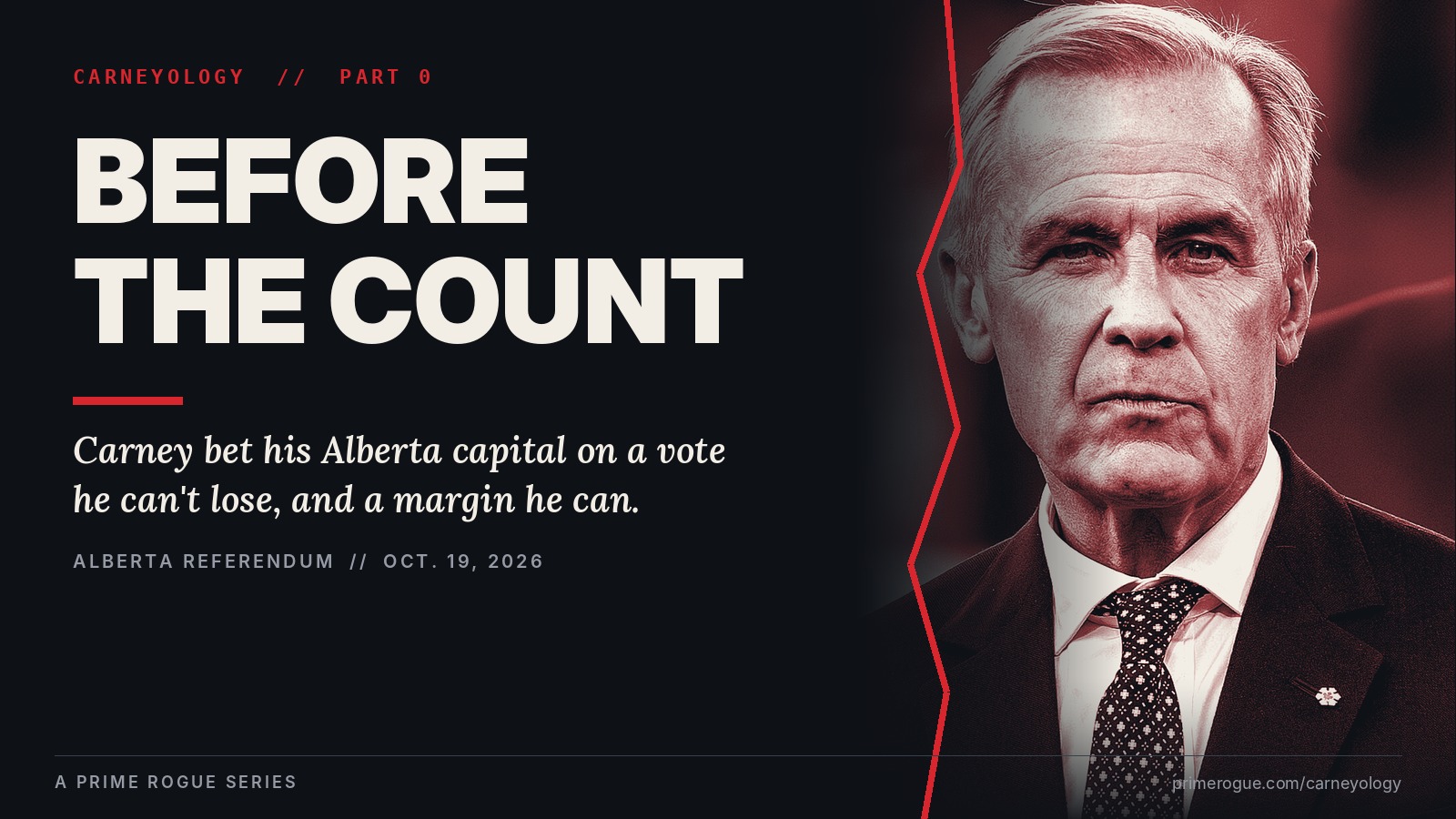
Alberta votes Oct. 19, 2026 on whether to start a legal process toward separation. Polls average roughly 67% remain to 27% (The Writ, Oct. 16). Prime Minister Mark Carney made the vote personal, campaigning in Calgary, Red Deer and Edmonton. His risk isn’t losing. It’s the margin. Our pre-registered call: Remain wins, Option 2 lands near 30%.
For now.
Let me show my work, because an analyst who hides his bias is just a propagandist with better posture.
What I don’t like is the résumé. Thirteen years at Goldman Sachs. Governor of two central banks. Chair of Brookfield, which moved its head office to New York on his watch, a fact he misstated and then corrected three days later: “I should have been more precise.” An ethics screen guarded by his own chief of staff and the Clerk of the Privy Council. A lawful-access bill pushed through with debate cut short. A Privy Council Office that ranks next-to-worst in the federal government for answering access-to-information requests. If you built a man in a lab to make a transparency journalist nervous, you’d build him.
What I love is that he says the quiet part. In Davos last January a sitting Canadian prime minister stood up and told the world the rules-based order was “partially false,” that we had all been living inside a story, and that the story was over. Then he went home and ran the most disciplined narrative operation Ottawa has seen in a generation. Against a hostile superpower. With a smile – a smirk – a shit-eating grin that has only grown in proportion to his public opinion polling.
Both of those men walked into the BMO Centre in Calgary on Thursday night. This series is about which one we’re actually getting.
On Oct. 15, about 5,000 people (the PMO’s estimate – the author was present and it looked about right) packed the Forever Canadian rally in Calgary, some waiting more than two hours to clear security. What they got wasn’t a stump speech. It was a narrative operation, run in real time, in four moves.
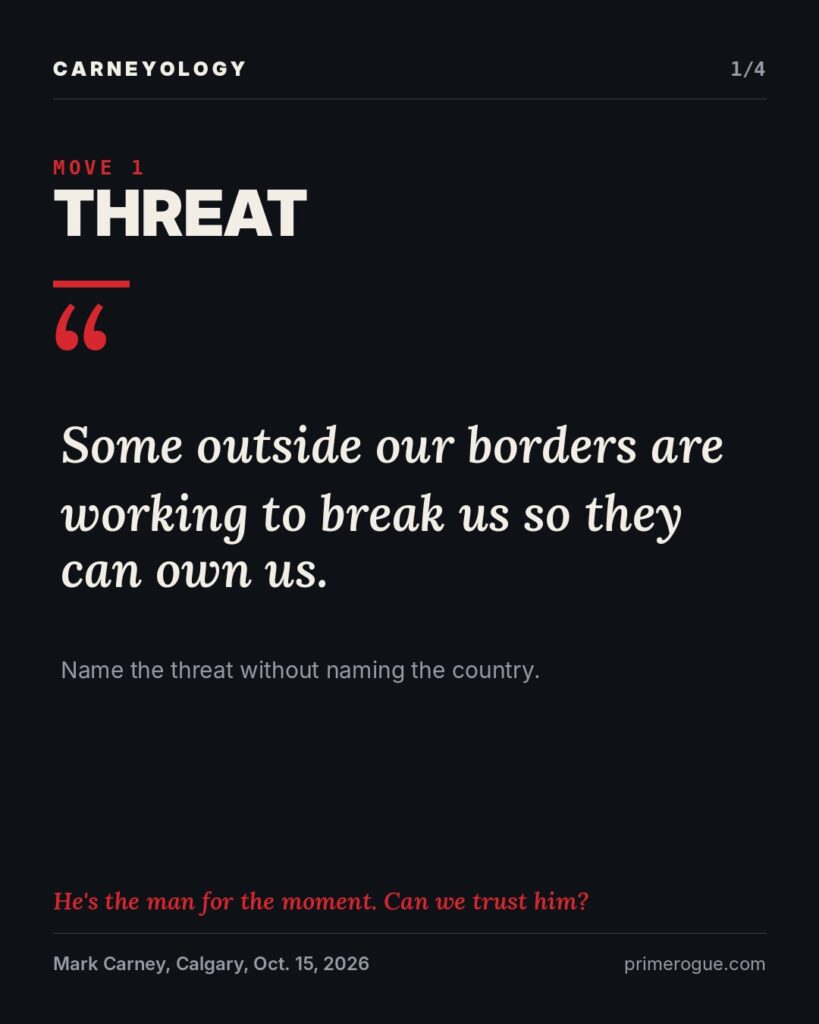
“This referendum comes at the worst possible time. The world has become more dangerous and divided. Some outside our borders are working to break us so they can own us.” No country named. Everyone in the room knew which one.
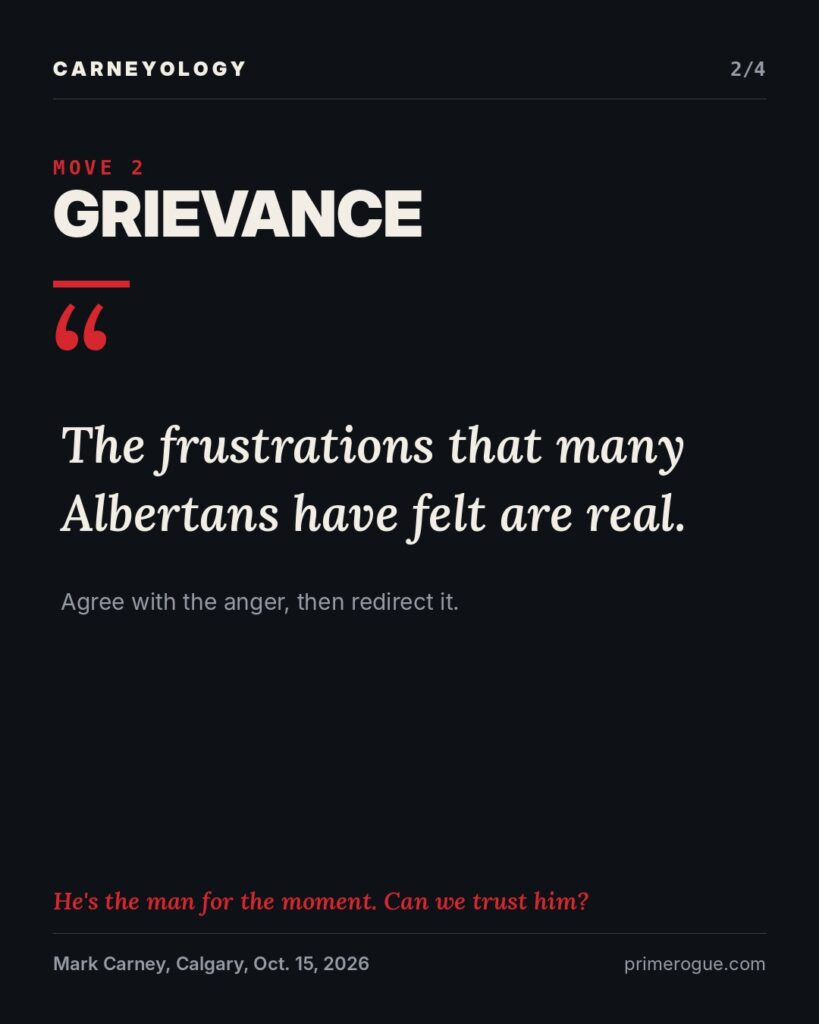
“The frustrations that many Albertans have felt are real.” He said Ottawa had made Albertans feel their resources weren’t their own. You don’t win a sovereignty fight by telling people their anger is fake. You win it by agreeing with the anger and redirecting it.
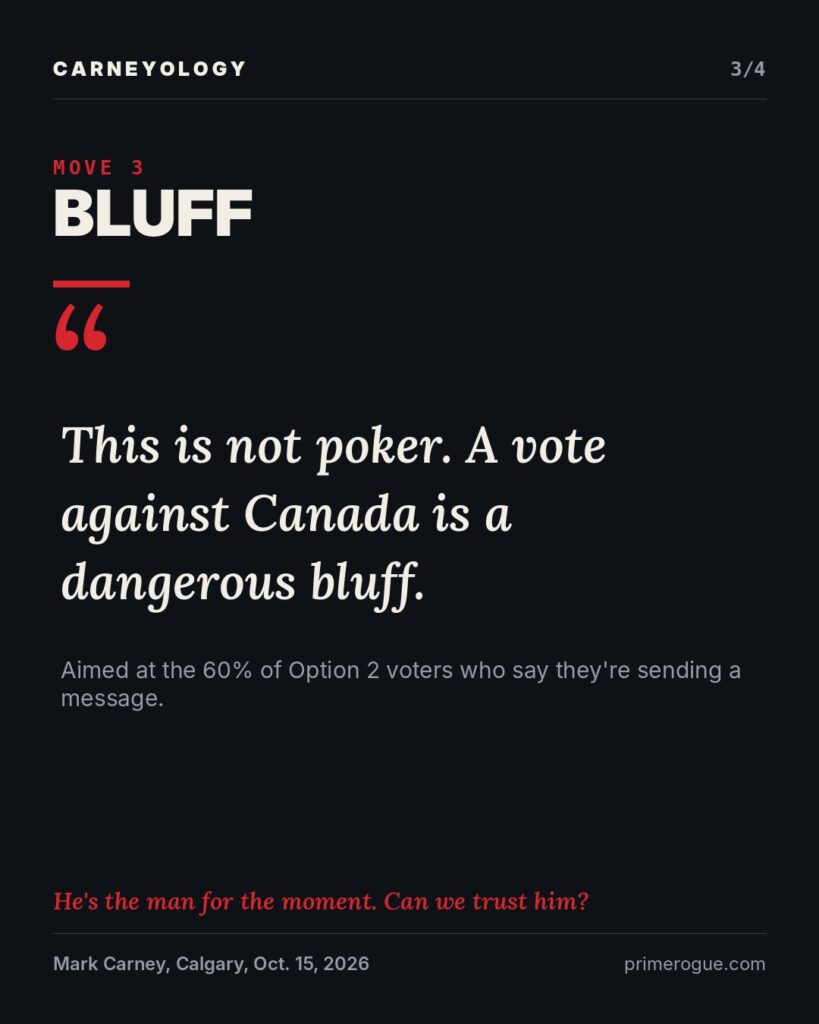
“Don’t be fooled by the idea you can ‘send a message’ with your vote. This is not poker. A vote against Canada is a dangerous bluff that will lead to years of deep division and great uncertainty.” That line aims straight at the soft separatist vote. Angus Reid found that 60% of Option 2 supporters say they’re sending Ottawa a message, not seeking separation.
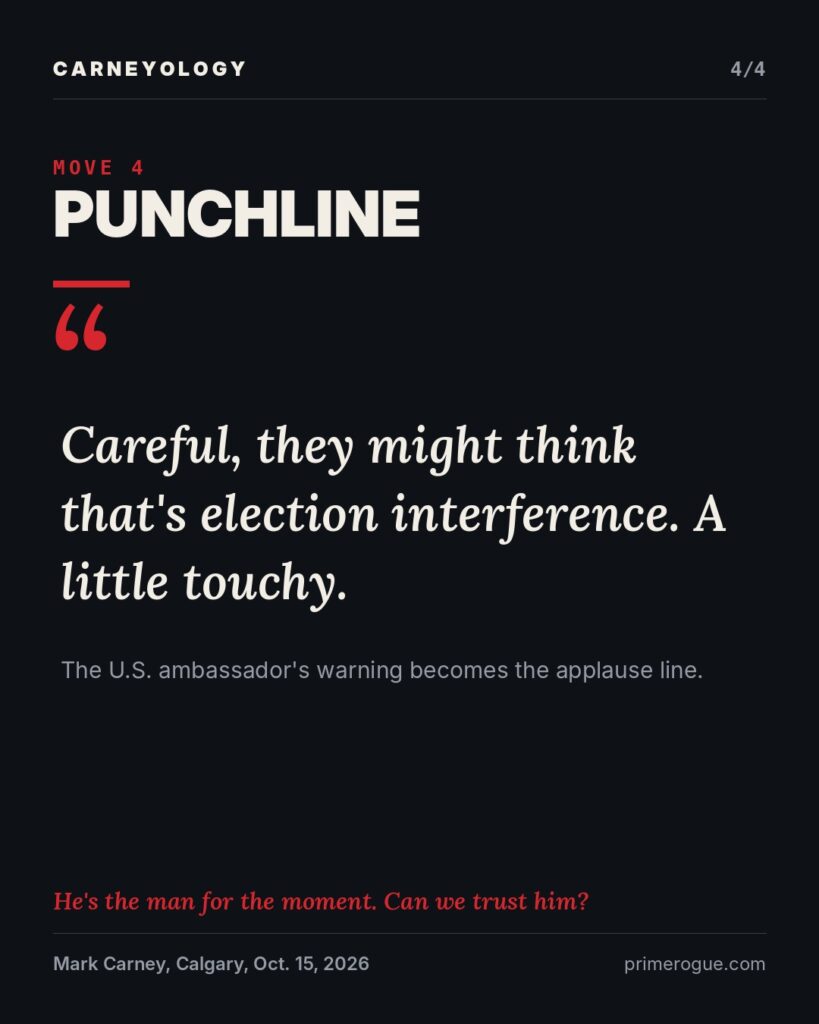
When he pitched the Pacific Link pipeline as a way to cut dependence on the United States, the room erupted. Carney paused: “Careful, they might think that’s election interference. A little touchy.” The target was U.S. Ambassador Pete Hoekstra, who had warned days earlier that Washington was “closely watching” Canadian politicians for meddling in the Nov. 3 midterms. One joke, and the crowd became co-conspirators. The applause was the interference.
The pattern is the same one he ran at Davos and in his teleprompter jabs this summer: never name Trump, set a frame, and let the other side’s reaction prove it. It’s deniable, it’s disciplined, and it works on the people in the room. Monday will tell us whether it works on the people who weren’t.
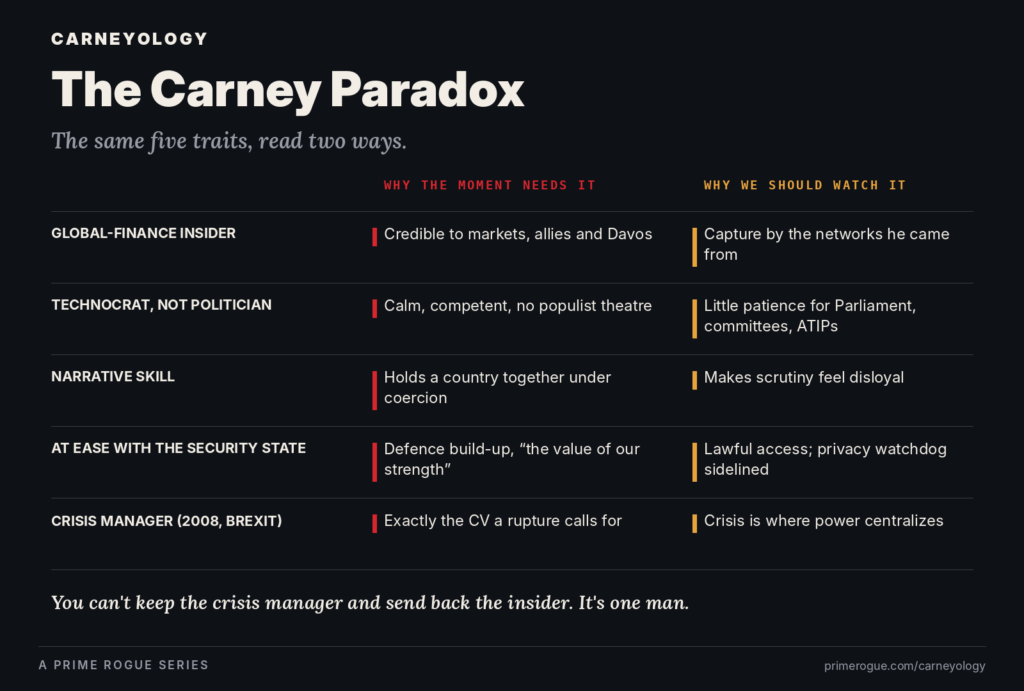
The traits that make Carney right for this moment are the same traits that make him worth watching. Not similar traits. The same ones, read two ways.
| Trait | Why the moment needs it | Why we should watch it |
|---|---|---|
| Global-finance insider | Credible to markets, allies and Davos | Capture by the networks he came from |
| Technocrat, not politician | Calm, competent, no populist theatre | Little patience for friction: Parliament, committees, access requests |
| Narrative skill | Holds a country together under coercion | Makes scrutiny feel disloyal |
| At ease with the security state | Defence build-up, “the value of our strength” | Lawful access, a privacy watchdog sidelined |
| Crisis manager (2008, Brexit) | Exactly the CV a rupture calls for | Crisis is where power centralizes, and he’s at home there |
It’s as if the crisis wrote a job description and his CV matched it line by line. A year ago the same résumé was a liability: “Carbon Tax Carney,” the Davos elitist. Trump’s coercion turned the same facts into credentials. He didn’t change. The frame did.
And here’s the twist. Canadians are applying Carney’s own doctrine to Carney. “Take on the world as it is, not wait for the world as we wish it to be.” In a world of tariffs, populists and separatist brinkmanship, backing the Goldman-Brookfield technocrat is the realist choice. The values say be wary. The realism says vote for him anyway.
That’s a rational choice. It’s also the kind that needs an expiry date. So this is the question Carneyology will chase, every week:
He’s the man for the moment. Can we trust him?
Carney could have stayed in Ottawa and let a provincial vote be provincial. He didn’t. In three days (Calgary on Oct. 15, Red Deer and Edmonton on Oct. 16) he made Question 10 his own. That choice carries three stakes.
By framing the U.S. as an actor “working to break us,” he turned a referendum on Alberta’s grievances into a referendum on Canadian sovereignty. If Remain wins big, the frame worked. If Option 2 runs hot, separatists get to say Ottawa interfered and Albertans pushed back anyway.
The ballot holds nine other questions, mostly Danielle Smith’s immigration and autonomy agenda. Carney opposed them: “We do not need to have a referendum to make progress on taking control of immigration.” Smith fired back on X, saying he “has yet to fully understand just how damaging the open-border policies of his predecessor were.” A day later they tapped a keg together in Red Deer. The partnership held, but it cracked in public. If those nine questions pass, Albertans will have voted with Carney on unity and against him on everything else.
On Oct. 1 in Fort McMurray, Carney and Smith designated Pacific Link as the first project of national interest under the Building Canada Act: about 1 million barrels a day, an Ottawa cost estimate of $35.2 to $43.7 billion, 45% federal and 45% Alberta ownership during construction. As one official put it, “There’s no approval yet.” Pierre Trudeau promised Quebec renewed federalism in 1980, and Quebec nationalists spent decades calling it a betrayal. Carney’s promise is a pipe in the ground. It’s easier to audit, and it’s riskier if it stalls.
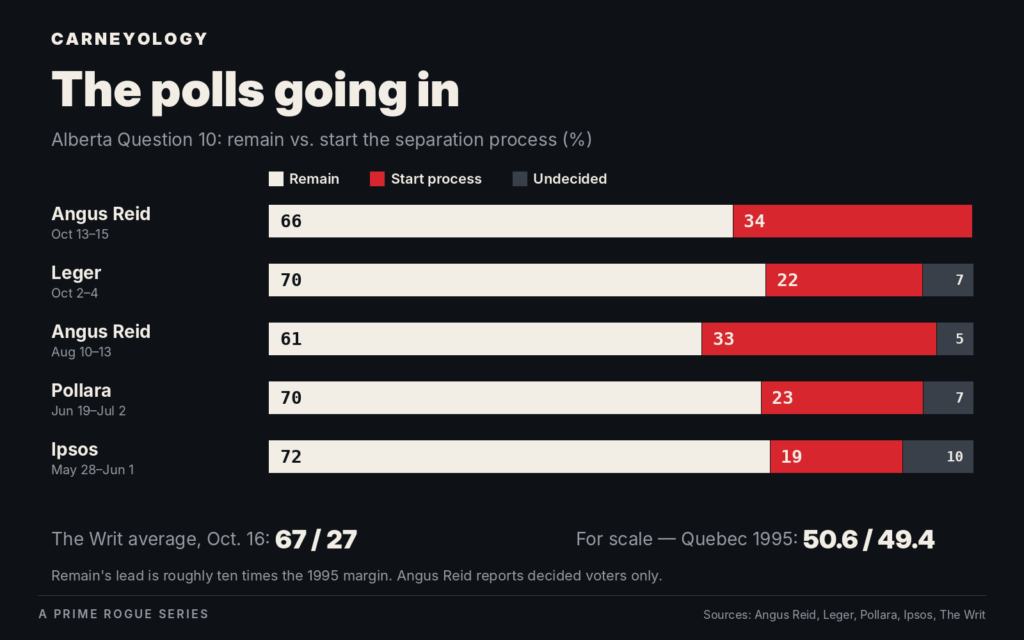
Remain has led every published poll since May by 27 points or more; the only real argument is how big the Option 2 floor is. The Writ’s average stood at 67% remain to 27% start-the-process on Oct. 16 (71 to 29 with undecideds removed). Éric Grenier says the latest uptick for Option 2 comes from adding Angus Reid’s poll, not from voters moving.
| Pollster | Field dates | Remain (%) | Start process (%) | Undecided (%) |
|---|---|---|---|---|
| Angus Reid | Oct. 13–15 | 66 | 34 | decided only |
| Leger | Oct. 2–4 | 70 | 22 | 7 |
| Angus Reid | Aug. 10–13 | 61 | 33 | 5 |
| Pollara | Jun. 19–Jul. 2 | 70 | 23 | 7 |
| Ipsos | May 28–Jun. 1 | 72 | 19 | 10 |
Two other numbers matter more than the topline. Abacus (Oct. 7–13) found 61% of Albertans expect another separation vote regardless of Monday’s result, and only 14% think a Remain win settles the question for a generation. In September, Option 2 supporters told Abacus they expected to win 57% of the vote. Their stated support was 24%.
Turnout is running at record pace. More than 1 million ballots were cast by Thursday out of roughly 3 million electors, and Elections Alberta told CBC it is preparing for turnout of about 85%. That would beat the 1935 record of about 82%. Polls open 9 a.m. to 8 p.m. MT Monday; Question 10 is counted first, with a full count expected between 1 a.m. and 4 a.m. Tuesday.
For scale: Quebec’s 1995 referendum was decided by 54,288 votes, 50.58% to 49.42%, and final polls there overstated the Yes side by about four points. The Alberta gap is roughly ten times wider. A Remain loss would take a polling failure far larger than any on record.
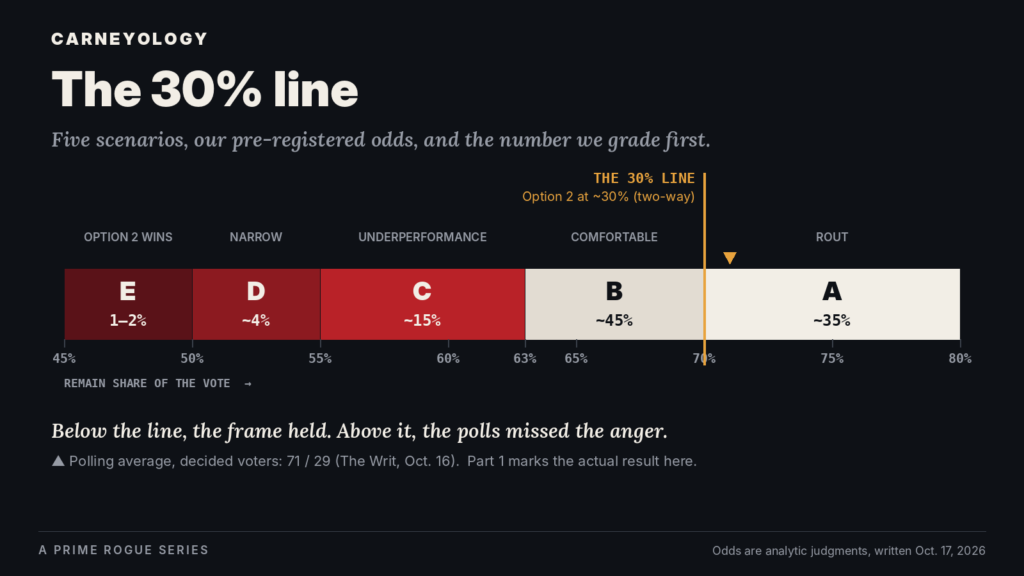
Intelligence work means committing to judgments before you know the answer, then grading yourself in public. These are ours, written Saturday, Oct. 17. Part 1 will score them. The percentages are analytic confidence, not a model.
| Scenario | Remain share | Our odds | What it means for Carney |
|---|---|---|---|
| A. Rout | 70% or more | ~35% | Vindication. “The bluff was called.” Unity capital he can spend on the trade fight. |
| B. Comfortable | 63–69.9% | ~45% | A win, but the one-third “message” vote becomes the story. Grievance politics presses harder. |
| C. Underperformance | 55–62.9% | ~15% | The “nationalizing” backfire narrative. Questions about “no to the nine.” |
| D. Narrow | 50–54.9% | ~4% | A 1995-style shock. His Alberta strategy looks discredited. |
| E. Option 2 wins | under 50% | ~1–2% | Strategic defeat and a constitutional crisis. |
The single line we’ll grade first: does Option 2 finish above or below roughly 30%? Below, the operator’s frame held. Above, the polls missed the anger, and the man for the moment met a room he couldn’t read.
The first Question 10 batches arrive after 8 p.m. MT, and advance ballots are counted from 5 p.m. Don’t call anything until Calgary, Edmonton and rural returns are all in.
When is the Alberta referendum?
Monday, Oct. 19, 2026. Polls are open 9 a.m. to 8 p.m. MT. Elections Alberta expects the Question 10 count to finish between 1 a.m. and 4 a.m. on Oct. 20.
What is Alberta voting on?
Ten questions. Question 10 asks whether Alberta should remain a province or start the constitutional process toward a binding separation referendum. Questions 1–9 cover immigration, voting rules and constitutional changes. The result on Question 10 is not binding.
Will Alberta separate from Canada?
Not on Monday. Even an Option 2 win would only start a legal process, and every published poll since May shows Remain ahead by 27 points or more.
What did Mark Carney say at the Calgary rally?
On Oct. 15 he told about 5,000 people that “some outside our borders are working to break us so they can own us,” called a vote to start the process “a dangerous bluff,” and joked that the crowd’s applause might be called “election interference,” a jab at U.S. Ambassador Pete Hoekstra.
What is “no to the nine”?
Carney’s opposition to Danielle Smith’s nine other ballot questions, mostly on immigration and provincial autonomy. Smith answered with “yes to the rest.”
What is Carneyology?
A weekly analysis series and podcast from Prime Rogue Inc. on Prime Minister Mark Carney: his doctrine, his narrative operations, his record on transparency and privacy, and whether Canadians can trust him.
He’s the right man for the moment for exactly the reasons we should be watching him. You can’t keep the crisis manager and send back the insider. It’s one man. The paradox doesn’t get solved. It gets watched.
So that’s what this is. Every week, Carneyology tests the doctrine, tracks what he says against what he does, and files the access requests his government would rather not answer. On Tuesday, Part 1 grades this piece against Monday’s count.
I don’t like Mark Carney. I love him. For now. Let’s find out how long now lasts.
Coming in Carneyology
Disclosure: The author lives in Calgary and will vote remain in this referendum. This piece takes no position on how anyone should vote. Prime Rogue Inc. takes no government contracts and has no affiliation with the Prime Minister’s Office, any party or any referendum campaign. The author has publicly advocated a Finnish-style total defence model for Canada since March 2025. No paid promotion of this piece will run before polls close.
About the author: Kevin J.S. Duska Jr. is president of Prime Rogue Inc., a Calgary private intelligence and transparency firm. He trained in international relations under Alexander Wendt and Randall Schweller at Ohio State, spent more than a decade in intelligence work, and is a member of the Canadian Association of Journalists.




[…] direct pipeline connects Alberta’s oil sands to Atlantic Canada, so Eastern Canadian refineries like Irving Oil import virtually all of their crude by tanker […]
[…] director Daniel Rogers confirmed publicly in May 2026 that the Alberta referendum is, in his words, “rife for amplification” and the kind of foreign interference Russia […]
[…] 2025 Alberta G7 Summit will proceed under one of Canada’s most comprehensive security operations in years. Nevertheless, the combination of spirited domestic […]
[…] 2025 federal election has concluded with a Liberal victory for Mark Carney against a backdrop of intense political polarization, heightened distrust in institutions, and […]
[…] hostility toward Canada is not just about trade—it is about control. His annexation rhetoric and sovereignty challenges […]
[…] happens when the U.S. administration decides Canada is a “security risk” that needs to be “stabilized”? What happens when Washington decides […]
[…] finally take full control of its security, led by a Franco-British-Polish nuclear umbrella? Does Canada integrate deeper with Europe to shield itself from U.S. pressure? Or does the unraveling of NATO […]