Address
304 North Cardinal St.
Dorchester Center, MA 02124
Work Hours
Monday to Friday: 7AM - 7PM
Weekend: 10AM - 5PM

Address
304 North Cardinal St.
Dorchester Center, MA 02124
Work Hours
Monday to Friday: 7AM - 7PM
Weekend: 10AM - 5PM
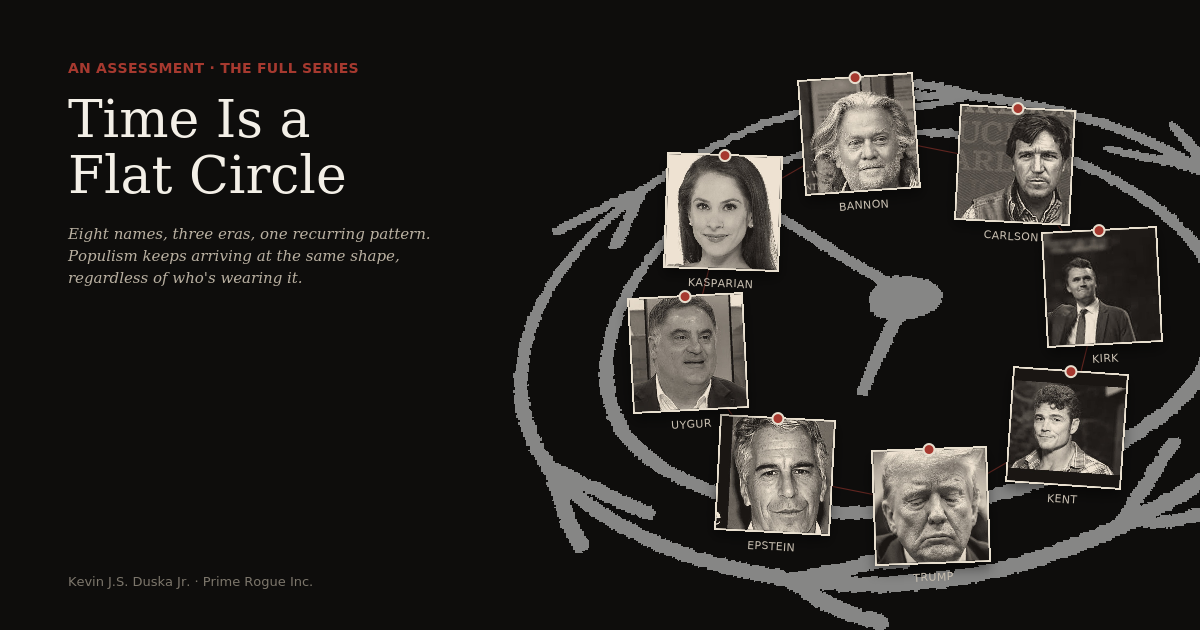
Tucker Carlson and The Young Turks’ Ana Kasparian and Cenk Uygur have spent the past year finding common ground on Israel, the Epstein files, corporate media, and foreign war. Commentators are calling this a left-right “horseshoe” convergence. That framing is wrong, and the correction matters. What’s actually happening is that ideological content is being subordinated to a shared populist form: the claim that only “the people,” as each speaker defines them, are legitimate, and every institution that disagrees is corrupt by definition. That form has a history, and it does not end well for pluralism, though it does not have to end in catastrophe either. Time is a flat circle. Whether it closes on this loop is still, barely, up to us.
A note on method: this analysis does not assess whether Carlson, Kasparian, Uygur, or anyone else quoted here is correct on the substance, on Israel funding, on the Epstein files, on the war in Iran. They may be right, wrong, or some mix on any given claim, and that question is separate from the one this piece is built to answer. What follows tracks a pattern, not a scorecard. The subject under review is what happens when enough people, across the ideological map, start reaching for the same structural claim, regardless of whose underlying facts turn out to hold up.
Nearly two years after Hamas’s October 7, 2023 attack on Israel and the war that followed, the fault line running through American politics is no longer reliably left versus right. On July 25, 2025, Ana Kasparian sat across from Tucker Carlson for an episode titled “Epstein Cover-Up, Israel Strikes Gaza Church, & the Great American Political Shift.” A progressive host who had spent two decades on the American left was, by her own account, agreeing with a man Fox News built into the most-watched voice of the populist right. She told him she cared about “this country representing the American people” over a foreign government’s interests. She pressed him on Israel funding while Medicaid faced cuts, calling the arithmetic beyond angry-making. She backed the demand, made by what she called a loud and aggressive wing of the MAGA base, for full transparency on the Epstein files. Carlson, for his part, offered the thesis in miniature: wanting the U.S. government to improve Americans’ lives, he said, isn’t a partisan statement.
Six months later, on January 30, 2026, Cenk Uygur, TYT’s founder and a man who has spent twenty years building a media empire on progressive politics, did the full sit-down: “Epstein, JFK, 9-11, Israel’s Terrorism and the Consequences of Opposing It.” His pitch to Carlson was explicit. Break the Republican-versus-Democrat, right-versus-left frame, because it exists to keep ordinary people fighting each other instead of “fighting up.” Carlson agreed, and reached for empire, not economics, as the analogy: it’s how the British ruled India.
This was not improvised. Uygur had told Carlson’s producers as much in June 2025, praising him on X for opposing war and noting that some of MAGA was, in this narrow respect, “actually principled.” It also wasn’t the whole story. Both hosts kept disagreeing on-air about plenty else, and neither pretended otherwise.
The right’s civil war is the louder of the two. On October 27, 2025, Carlson interviewed Nick Fuentes, an avowed white nationalist who has praised Hitler, and the interview moved tens of millions of views across platforms within days. Ben Shapiro called Carlson a coward for normalizing “trash.” Heritage Foundation president Kevin Roberts then defended Carlson publicly as a “close friend,” accused critics of running a “venomous coalition,” and detonated his own institution: five members of Heritage’s antisemitism task force resigned, his chief of staff left, a twelve-year staff economist quit, and Mitch McConnell, Ted Cruz, and Shapiro all condemned him by name. Roberts eventually apologized to his own staff. Shapiro escalated again in December, warning from a Heritage podium against a “strain of conservatism” drifting toward conspiracy and antisemitism. Layer onto that a parallel and older Trump-Carlson rupture over Iran. Carlson urged restraint in mid-2025, Trump called him “kooky,” and after the U.S. and Israel struck Iran in early 2026, Carlson called the operation “disgusting and evil” and, by spring, apologized to his own audience for helping elect a president who did it.
The left’s version is quieter but not gentler. Kasparian had already announced she was leaving the Democratic Party in 2024 and launched an independent Substack. Progressives online called her a traitor for sitting across from Carlson, Glenn Beck, and Piers Morgan. Some TYT viewers demanded Uygur fire her. He didn’t, and the show kept airing their on-camera disagreements rather than smoothing them over, which is, itself, worth noticing. Whatever this is, it isn’t a merger.
Neither coalition is converging into the other. Both are fracturing along the same fault line, from opposite directions, at the same time. That is a more precise, and more alarming, description than “horseshoe.”
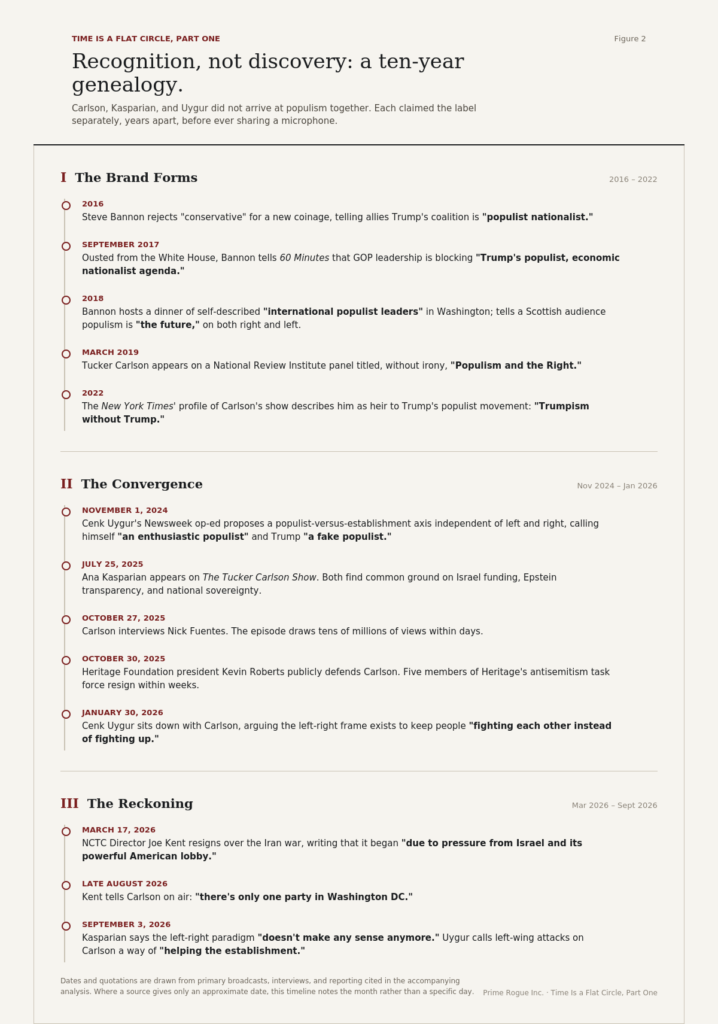
Here is the detail most commentary on this convergence misses entirely: none of the three principals is newly arriving at populism. All three had already claimed the label, on the record, before they ever shared a microphone.
Start with the man who branded the word for this whole era. During the 2016 campaign, Steve Bannon deliberately rejected “conservative” for his new coinage: “we’re populist nationalists,” he told allies, precisely to distinguish Trump’s coalition from movement conservatism. After Trump’s inauguration and Bannon’s ouster, he spent his September 2017 60 Minutes interview accusing his own party’s leadership of blocking “Trump’s populist, economic nationalist agenda.” By 2018 he’d taken the brand on tour, hosting a dinner of self-described “international populist leaders” in Washington and telling a Scottish audience flatly that “populism is the future,” on both the right and the left. Bannon didn’t discover a convergence. He manufactured a vocabulary, and it outlived his tenure in the White House.
Carlson had absorbed that vocabulary as a personal brand years before he ever spoke to Kasparian. By March 2019 he was appearing on a National Review Institute panel titled, without irony, “Populism and the Right.” By 2021, Jacobin was already treating “Tucker Carlson likes to style himself a populist” as old news, worth debunking rather than reporting. By 2022, the New York Times’ seven-page investigation into his show was describing him as positioned to inherit Trump’s populist movement outright: “Trumpism without Trump.” None of that required Ana Kasparian.
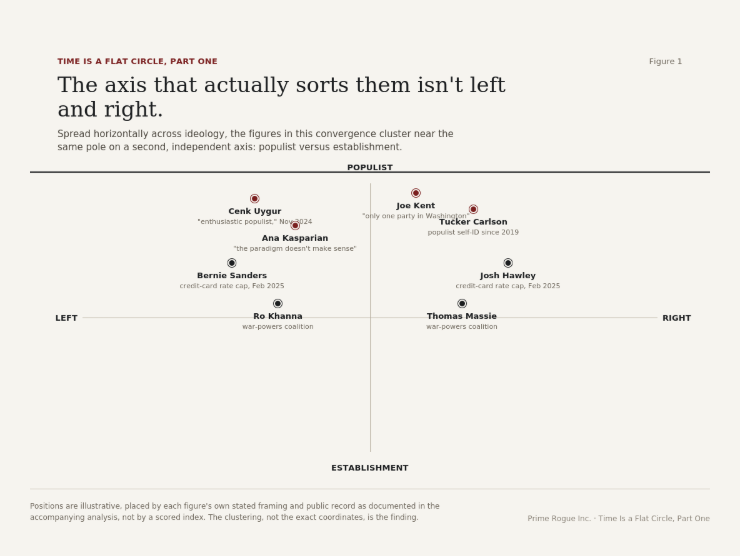
And Uygur’s case is the one that should embarrass every columnist who’s treated this as a sudden left-right mashup. On November 1, 2024, eight months before Kasparian ever sat across from Carlson, Uygur published an op-ed in Newsweek proposing exactly the analytical move this essay is making: that the left-right spectrum is not the operative axis of American politics anymore, and that a second axis, populist versus establishment, cuts across it and explains more. He placed himself, explicitly, as “an enthusiastic populist” on that second axis, regardless of his center-left positions on the first. He called Trump “a fake populist who gives the rest of us a bad name,” staking populism as an authentic identity to be defended, not conceded to the right. He’d been circling this idea in public commentary and on his own show for months prior.
So the accurate genealogy isn’t “left meets right.” It’s this. Bannon manufactures the brand in 2016. It becomes ambient on the right by 2019. It gets independently reinvented on the left, as an explicit alternative to the left-right frame, by late 2024. Two people who had each already adopted populism as a personal governing identity finally noticed the other existed, and had a podcast about it. That is a structurally different, and structurally more inevitable, story than a sudden ideological romance. It is also why the title of this piece is not a metaphor about a horseshoe. It’s a description of recurrence.
Not in the form most people invoke it. The term comes from French philosopher Jean-Pierre Faye’s 1972 analysis of Weimar Germany, where he argued the KPD and the Nazi Party mirrored each other in organization and rhetoric even as they fought in the streets. It has never enjoyed strong empirical support. Political scientist Simon Choat’s frequently cited rebuttal makes the essential point cleanly: the extremes both reject the liberal center, but for opposite reasons and toward opposite ends. One acts in the name of ethnic and national purity, the other in the name of international solidarity and redistribution. Choat goes further, and it’s worth sitting with: he argues horseshoe theory persists in centrist commentary largely because it lets the center discredit the left while quietly disclaiming its own complicity with the right. Cas Mudde’s critique lands in the same place. The far right wants to preserve hierarchy, the far left wants to dismantle it, and no amount of shared hostility toward elites erases that difference.
This is the trap a lazier version of this essay would fall into: pointing at Carlson and Uygur agreeing on Epstein and Israel, calling it horseshoe theory vindicated, and stopping there. That’s not analytically honest, and it isn’t what’s actually interesting about what’s happening.
The better instrument comes from Jan-Werner Muller and Cas Mudde, and it doesn’t require pretending the left and right have quietly agreed on economics or immigration, because they haven’t. Mudde defines populism as a thin ideology that splits society into two homogeneous, antagonistic camps, the pure people against the corrupt elite, and insists that politics should simply enact the people’s will. Muller sharpens the diagnostic test: populism’s defining move is the claim to exclusive representation. Not “we have a mandate this time,” but “we alone speak for the real people,” which makes every rival, every institution, every unfavorable court ruling or election result illegitimate by definition, not merely wrong.
Run that test against Carlson and Uygur and the picture sharpens considerably. Sanders and Hawley co-sponsoring a credit-card interest-rate cap in February 2025 is cross-partisan coalition politics. Nobody involved is claiming exclusive custody of the general will over a 10 percent rate ceiling, and that kind of coalition should worry no one. Massie and Khanna working together on war powers is the same genre. But when Carlson says wanting the government to help Americans isn’t a partisan statement, and when Uygur frames the entire left-right spectrum as an establishment trick to keep “us” fighting each other instead of “fighting up,” that is populist form asserting itself over ideological content. The content, redistribution versus markets, intervention versus restraint, becomes secondary to a shared structural claim: legitimate politics is us against a corrupt, unified elite, and everyone still playing the old left-right game has been suckered.
The clearest illustration yet arrived on September 3, 2026, when Kasparian and Uygur used a Michigan Senate race to say the quiet part all the way out loud. Carlson had broken with the GOP’s establishment-backed candidate, Mike Rogers, to back an anti-war progressive, Abdul El-Sayed. Kasparian didn’t hedge about why she was fine with that. She’d rather back a conservative anti-Zionist focused on fixing the country than a liberal beholden to pro-Israel donors, she said, because she doesn’t buy into the left-right frame at all: it “doesn’t make any sense anymore.” Uygur then supplied the enforcement half of the same move. Attacking an ally over antisemitism on the one issue where he agrees with you, while he’s also right about the war and the candidate, isn’t principle, he argued. It’s doing the establishment’s own work of keeping a winning coalition divided. Neither of them is describing a policy position anymore. They are describing a test of loyalty to the coalition itself, and declaring the old spectrum void in the same breath.

That is the actual convergence. Not policy. Not values. A shared grammar for delegitimizing whatever institution currently disagrees with you, deployed by people who, on the ideological content underneath it, still disagree with each other plenty, and say so on camera.
This grammar has recurred before, and it is worth being precise about what recurred and what didn’t. Weimar Germany’s “Querfront,” cross-front politics, produced actual attempts to fuse nationalist and socialist appeals. Ernst Niekisch’s National Bolshevism argued Germany’s future lay with Soviet Russia against Anglo-French “plutocracy,” fusing anti-capitalism with ethnonationalism into a single anti-pluralist claim. It never captured mass power on its own. What it did do was help corrode the idea that the liberal center had any legitimate claim to govern at all, an idea both the Communist Party and the Nazi Party were, by 1932, attacking from opposite ideological directions using structurally identical rhetoric.
Jacques Doriot is the individual case worth remembering. A Communist Party central committee member and Comintern executive, expelled in 1934 for advocating a Popular Front before Moscow approved one, he founded France’s most collaborationist fascist party two years later and died fighting for the Wehrmacht. The ideological content of his politics inverted completely. The structural grievance, the establishment betrayed me, therefore the establishment is illegitimate, therefore I alone represent the people it betrayed, never changed at all. Doriot is the proof that the content is genuinely disposable once the form takes over.
The corrective case is Germany’s Sahra Wagenknecht, whose Bundnis Sahra Wagenknecht split from Die Linke in January 2024 to fuse left-wing economics with immigration restriction and detente with Russia: a deliberate, self-aware Querfront strategy. It won nearly 16 percent in Thuringia in September 2024. Fourteen months later it had fallen below the 5 percent federal threshold and lost every seat in the Bundestag. The pattern is real. It is also fragile, reversible, and frequently self-destructing, which is the detail every doomsayer skips and every dismissive skeptic should sit with equally.
Gallup’s September 2025 polling put American trust in mass media at 28 percent, a record low, with more than a third of the country reporting no confidence at all, and Republican trust cratering into single digits for the first time. Pew found, that same September, that 85 percent of Americans across party lines believe politically motivated violence is increasing. This is the actual terrain the Carlson-Uygur convergence is walking across: not a stable democracy occasionally entertaining fringe cross-pollination, but a legitimacy crisis in which the two loudest independent media figures in the country have each, separately, concluded that the entire ideological spectrum is a management technique used against ordinary people.
They may not be wrong about the diagnosis. Thomas Piketty’s research on “Brahmin left, merchant right” cleavages documents a genuine and durable realignment: educated elites moved left, wealthy elites stayed right, and the resulting “multi-elite” party systems left a working-class, cross-racial coalition with no natural home on either side. Piketty’s own warning is blunt. Without a serious egalitarian-internationalist offer, that coalition will keep going to whoever sounds most like it’s on their side, left-right label be damned. Carlson and Uygur are not causing this vacuum. They are two of the loudest people currently filling it.
The clearest illustration of the stakes arrived nine days ago, in a different venue entirely. Carlson devoted a full episode to Joe Kent, the former National Counterterrorism Center director who resigned his post in March 2026 explicitly over the Iran war, writing to Trump that the conflict began “due to pressure from Israel and its powerful American lobby.” On air, the two men laid out a message, not a verified fact, and the distinction matters, that Pentagon planners have discussed using tactical nuclear weapons against Iran, and that an unelected national-security apparatus, outlasting any president, actually runs foreign policy regardless of who holds office. Whether that specific nuclear-planning claim is accurate is a separate question from what the message signals. Kent supplied the uniparty diagnosis in almost the same words Kasparian used to reject the left-right frame: “there’s only one party in Washington DC.” Two people from opposite ends of the spectrum, one a sitting cable host, the other a resigned administration insider, independently naming the same axis, populist versus establishment, not left versus right, is stronger evidence that this axis is real than any single crossover interview could be. And once the stakes claimed for that axis reach nuclear war, the distance between institutional critique and full anti-pluralist alarm collapses to almost nothing.
So: is this dangerous? Conditionally, and the condition is doing all the work. Institutional critique, this war was sold on lies, this file should be public, this donor class owns both parties, is not populism’s dangerous form. It’s accountability journalism, and both Carlson and Uygur have, at various points, practiced real versions of it. The dangerous form starts the moment “this institution failed us” becomes “this institution has no legitimate claim on us at all, only we do,” the moment losing an election, a court case, or a fact-check becomes proof of conspiracy rather than evidence you were wrong.
Neither man has fully crossed that line. Both are standing closer to it than either would like to admit, and both have audiences actively pulling them the rest of the way (Fuentes on one side, whatever the TYT comment section is currently demanding of Kasparian on the other). That is the actual stake of Part One, and it’s the question the rest of this series is built to keep answering, case by case, as it develops: not whether the horseshoe is real, but whether the people bending it still recognize an election, a court, or a fact they don’t like as legitimate when it isn’t theirs.
None of this turns on whether Carlson is right about Israel, or Uygur is right about the establishment, or Kasparian is right that the left-right paradigm no longer applies. They might be. This assessment takes no position on any of it. What it tracks is behavior: whether disagreement gets treated as evidence of enemy allegiance, and whether that treatment is spreading. That is a pattern that can be tracked accurately regardless of whose facts turn out to hold up.
Part Two traces the American throughline directly: how the October 7, 2023 attack and the war that followed reshaped opinion on both the populist right and the populist left, how Charlie Kirk’s assassination accelerated a civil war already brewing inside MAGA, and how Marjorie Taylor Greene’s break with Trump over the Epstein files put a Republican through the same exile Ana Kasparian faced from the left. Part Three then takes the historical instrument built here and runs it fully against Doriot and the Querfront, and against the Wagenknecht Alliance’s rise and collapse, as tests of whether the American version is heading toward power or toward the same wall. Time is a flat circle. The only open question left is who’s driving, and whether they’ve noticed the loop yet.
Kevin J.S. Duska Jr. is President of Prime Rogue Inc, a career intelligence professional, and the author of “Echo State” – an upcoming book about mass surveillance in the Canadian ATIP regime.
 The MAGA Purge and the Whistle: How Laura Loomer’s Loyalty Crusade Targets Tucker Carlson’s Epstein Codebreaking
 The Trump Doctrine: Isolationism, Dominance, and the Death of Partnership
 The Fed Versus the MAGA State: What Happens If Trump Fires Jerome Powell?
 April 25, 2025: The Death of American Democracy Began With a Judge in Handcuffs



[…] versus 42% to remain in the UK although nationalists appear to be growing as a proportion of the population alongside generational […]
[…] its core, the ONA was different from every other part of the Pentagon because it thought in 20- to 50-year time horizons rather than the usual 5-year cycle dictated by […]
[…] leaves behind nothing but half-finished plans and empty rhetoric about sustainability. By the time a USAID project moves past the initial assessment phase, China has already built an […]
[…] perspectives on JFK’s assassination. Newly released intelligence reports may include KGB assessments of whether Oswald was a lone actor or part of a larger plot. Previous Soviet documents suggest the KGB initially feared the assassination was […]
[…] can harden narratives that domestic populations might have softened over time, especially in exile or post-defeat […]