Address
304 North Cardinal St.
Dorchester Center, MA 02124
Work Hours
Monday to Friday: 7AM - 7PM
Weekend: 10AM - 5PM

Address
304 North Cardinal St.
Dorchester Center, MA 02124
Work Hours
Monday to Friday: 7AM - 7PM
Weekend: 10AM - 5PM
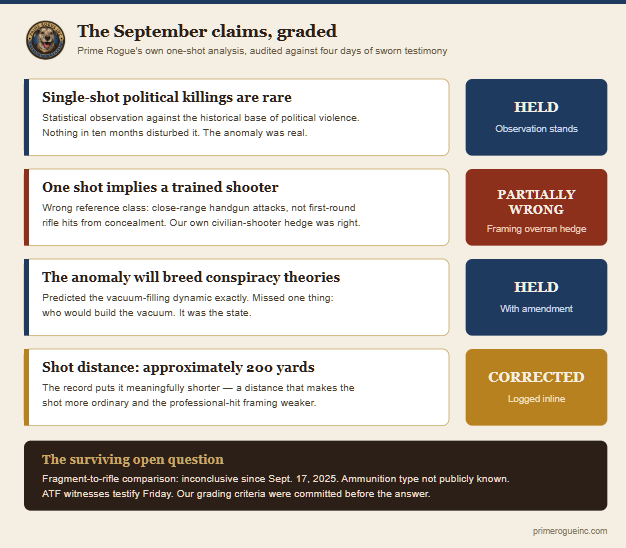
The September piece argued that one-shot fire discipline “indicates training” — that the restraint of a single round, followed by immediate exfiltration, fit “professional sniper doctrine” better than lone-actor violence, and justified suspicion of a military, law enforcement, or paramilitary background.
The suspect the state has spent four days describing is a 22-year-old from Washington County with no military record, no law enforcement history, and no paramilitary affiliation in any evidence presented — a rural Utah kid from a firearms household, allegedly shooting an heirloom rifle. If the state is right about its man, the September profile missed. It is worth being precise about how it missed, because the failure is instructive and it was visible in the piece’s own reasoning at the time.
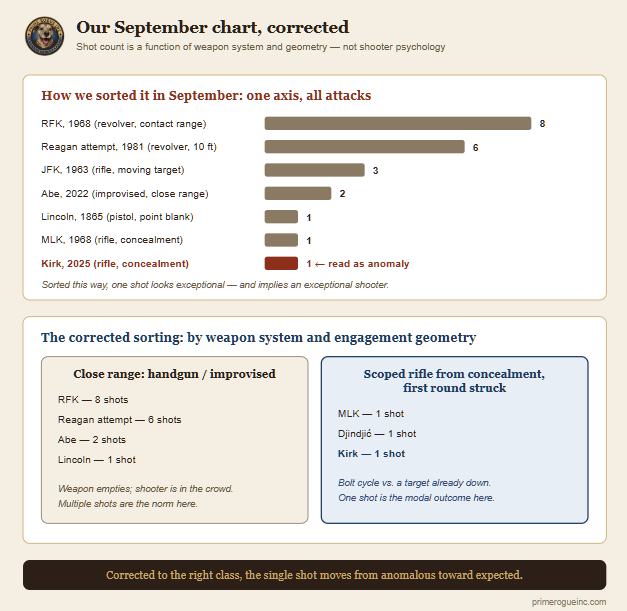
First: the reference class was wrong. The September analysis compared the Kirk shooting against Sirhan, Hinckley, Booth, and Abe, close-range handgun and improvised-weapon attacks, and found the single shot anomalous. That said, shot count is substantially a function of weapon system and engagement geometry, not shooter psychology. Sirhan emptied a revolver because a revolver at contact distance empties. A bolt-action rifle at 140-plus yards is a different machine: the follow-up is not a trigger pull but a full cycle of the action while reacquiring a target that is now slumping behind a panicking crowd. When the comparison class is corrected to scoped rifle attacks from concealment where the first round connected , the King assassination being the obvious American precedent, and one the September piece itself cited, the single shot stops being an anomaly and becomes close to the modal outcome. One shot is not what discipline looks like. It is what a hit looks like, from that weapon, at that range.
Second: the piece treated the single shot as a decision revealing self-control, when it is better understood as the null action. The first round struck. What does a second round purchase, for any shooter of any background, except doubled exposure on a rooftop with one ladder? The restraint framing required a counterfactual, a miss followed by disciplined silence, that never existed. We graded the shooter on a test the situation never administered.
Third: “untrained” did the same illegitimate work in our analysis that it does in every profile that reaches for it. It conflated tactical training with marksmanship. A roughly 140-yard prone, supported, scoped shot at a stationary seated target is not a sniper’s problem; it is an unremarkable shot for the enormous population of North Americans who grew up shooting deer rifles — a population that conspicuously includes rural Utah. The September piece even said so, in its hedge about civilian self-training and the lone actor who “meticulously prepared.” The hedge was correct. The headline framing outran it. That is on us.
For the record, one more correction while the ledger is open: September reporting, ours included, placed the shot at “approximately 200 yards.” The figures used in subsequent reporting and the geometry of the Losee-to-courtyard position put it meaningfully shorter — a distance that makes the shot easier, and the “professional hit” framing weaker, than our original analysis assumed.
The September piece made one prediction with no hedge at all: “If authorities eventually present a lone suspect with a standard extremist background, many will ask: how did this nobody pull off such an expert hit? If the explanation isn’t convincing, it will fuel theories of accomplices or higher powers at play.”
Ten months later, that paragraph reads less like analysis and more like a production schedule for the entire Kirk-truther economy. The frame-by-frame wound analysts, the second-rooftop cartographers, the exploding-mic theorists, the “no ordinary kid makes that shot” chorus — all of it is downstream of exactly the dynamic we named: an anomaly, an unpersuasive information environment, and a vacuum.
But here is what our September piece did not predict, and should have: that the vacuum would be state-manufactured. This week’s testimony demonstrated it in miniature, live, in a single 24-hour sequence. On Tuesday, defense counsel asked lead investigator David Hull about an unfired round found on the roof of another campus building. When was it found? He didn’t know. What type of round? Didn’t know. Where is it now? Didn’t know. On redirect: it was “accounted for” — believed ejected by an officer clearing a patrol rifle. On Wednesday, co-lead investigator Brian Davis supplied what Hull could not: computer science building, far east side, live round, no line of sight to the tent – something which remains contested and which Prime Rogue plans to analyze more directly in a forthcoming piece.
We spent Wednesday afternoon verifying that testimony independently, because taking a case agent’s geometry on faith is the same sin as taking a frame-analyst’s ballistics on faith. It checks out. The CS building sits roughly 275 metres east of the courtyard, and, decisively, the Losee Center itself stands between the CS roof and the tent. The building the shooter fired from physically blocks the sightline from the building where the round was found – at least partially. The round is unfired, so it has no trajectory. It is the wrong caliber for the recovered Mauser and exactly the right caliber for the patrol rifles saturating that quadrant during the response. Every checkable data point converges on the boring answer, and every check is replicable by any reader with the campus map and ten minutes. At present, it thus appears unlikely, but not yet confirmed as impossible, that a shot could have been fired from the top of the CS building.
So the round was always, in all likelihood, innocent. Which sharpens the only question that matters: the state has possessed the when, what, and where of that round since approximately September 11, 2025. It reached the public record in July 2026, extracted piecemeal by adversarial cross-examination, from the second of two witnesses. An investigation that behaves this way about its likely innocuous evidence, while its ballistic comparison of the autopsy fragment against the rifle sits publicly unaddressed at “inconclusive” since September 17, and the autopsy itself sits sealed, is an investigation that builds the theorists’ scaffolding for them. The cranks did not invent a single gap in this record. They rented space in the ones the state left vacant.
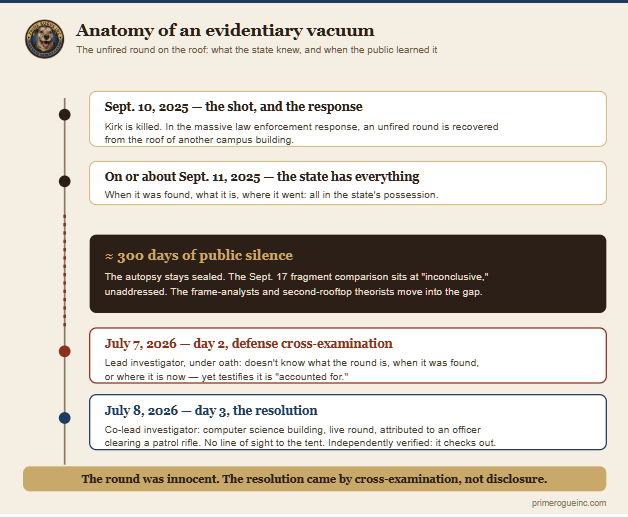
Anatomy of an evidentiary vacuum: the state held every fact about the stray rooftop round within a day of the shooting; the public record got them ten months later, extracted under adversarial cross-examination. Information vacuums are load-bearing structures for conspiracy. © Prime Rogue Inc. 2026This morning belonged to Lance Twiggs, or rather to their (Prime Rogue is using the pronoun their as there appears to be some confusion as to his gender identification) April 20 recorded interview, because Twiggs himself has never taken the stand. Judge Graf ruled the video admitted in its entirety for probable-cause purposes while ordering roughly sixteen minutes withheld from public broadcast, after defense counsel invoked Estes v. Texas and Rideau v. Louisiana, the Supreme Court’s televised-confession doctrine, against airing it.
Read that defense posture carefully, because it is being misreported in both directions. There is no retraction here: a retraction would require Robinson to have adopted these statements and disavowed them, and he has adopted nothing — he has entered no plea, and his attorneys have said nothing about guilt or innocence. Any retraction is likely to come at trial. What the defense has done is decline to characterize the note and texts as a confession, in the same breath as litigating their broadcast under precedent that exists specifically to protect defendants from televised confessions. That pairing is not hypocrisy; it is standard two-track capital defense – treat the material as devastating for jury-pool purposes, concede nothing about what it is. But it should be reported as what it is. The defense’s precedent selection tells you their prejudice assessment. Their characterization refusal tells you their trial strategy. Neither is a retraction, and anyone selling you one is describing a procedural event that has not occurred.
The structural facts about this evidence matter more than its shock value. Twiggs was interviewed under use immunity. He has never been cross-examined. The defense contends the recorded interview consists substantially of a deputy county attorney narrating with Twiggs agreeing. All of that is fully admissible at a preliminary hearing, where Utah permits hearsay and the judge views the evidence in the light most favorable to the state. Essentially none of it is admissible in this form at trial, where the Confrontation Clause requires Twiggs live and crossed or the statements do not come in. Everything the public heard this morning was heard under rules that expire the moment a jury exists. The defense has preserved that issue twice at the Utah Supreme Court already. The distance between prelim-admissible and trial-admissible is the honest measure of how much of this week was case and how much was preview.
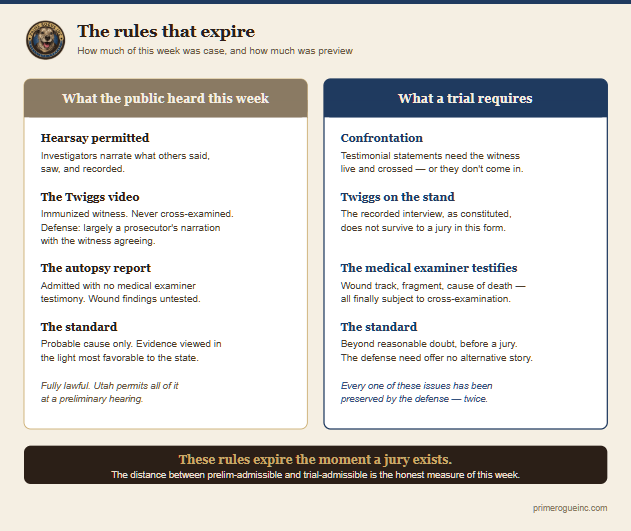
The rules that expire: everything the public heard at the Robinson preliminary hearing was admitted under probable-cause rules — hearsay permitted, evidence viewed in the state's favor. At trial, the Confrontation Clause and the reasonable-doubt standard govern instead. © Prime Rogue Inc. 2026Tomorrow the hearing ends — Graf has said 5 p.m. Friday, hard stop. Two things happen inside that window, and they are the two things this publication has been waiting on.
First, the defense calls its witnesses from the Bureau of Alcohol, Tobacco, Firearms and Explosives. The construction and mass of the bullet jacket fragment recovered at Kirk’s autopsy, the fragment whose comparison against the Mauser came back inconclusive, is precisely what competent examination can put on the record. That fragment is where the last legitimate open question in the physical evidence lives, and we have pre-committed, in the companion piece, to the grading criteria for whatever tomorrow’s testimony shows, before knowing the answer. Watch what the defense actually asks those witnesses. If the cross goes to chain of custody and comparison methodology, that tells you their own experts read the fragment as consistent with the state’s rifle. If it goes to caliber class, everything changes, and we will say so in those words.
Second, the bindover. Under a probable-cause standard with the evidence viewed in the state’s favor, the outcome is close to a formality, and nothing in four days of testimony suggests otherwise. The trial that follows will be a different proceeding under different rules — which is where every preserved objection, every unconfronted witness, and every anomaly that survives tomorrow’s testimony actually gets litigated.
Ten months ago we wrote that the one-shot anomaly would become “a magnet for conjecture.” It did. What we understand better now, watching the state stumble through its own evidence locker on a livestream, is that the magnet was never the shot. It was the silence around it. The shot has an explanation. The silence has only excuses — and tomorrow, for the first time in ten months, it runs out of room.
Corrections to our September 2025 analysis are noted inline above and will be shortly be logged at primerogueinc.com/corrections. The companion methodology piece — coordinates, campus geometry, wound-ballistics audit, and the replicable sightline verification — publishes following Friday’s session.
In September, within days of Charlie Kirk’s assassination, this publication ran an analysis titled “The One-Shot Assassination Anomaly.” Its core observation: single-shot political killings are historically rare, the one-shot-one-kill profile pattern-matches to trained shooters, and the sheer uncommonness of the thing would — quote — “practically invite people to fill the explanatory vacuum with their fears and biases.
Four days of sworn testimony into the preliminary hearing of the man accused of firing that shot, it is time to do what almost nobody in this information ecosystem ever does: pull the September piece back out, lay it against the record, and grade it in public. Some of it held up. Some of it did not. The part that held up best is the part about everyone else — which is exactly why the part that didn’t must be owned first.
Four days of testimony have put the following on the record, under oath, subject to cross-examination by one of the most aggressive capital defense teams in the country.
A fired cartridge casing was recovered at the Losee Center rooftop firing position and matched by the ATF to the bolt-action Mauser found wrapped in a towel in the wooded area nearby. Surveillance footage shows a figure climbing onto the Losee roof, crossing it in a crouch, going prone at the edge overlooking the courtyard at the moment of the single audible shot, then recrossing the roof, dropping to the ground, and fleeing. The state’s timeline, built from what investigators described as hundreds of hours of footage, places Robinson on campus across four separate entries on September 10, including a reconnaissance visit hours before the shot, and connects his silver Dodge Challenger to the movements. FBI DNA analysis attributes the genetic material on the rifle, casing, unfired rounds, and towel to two people — Robinson’s roommate and romantic partner Lance Twiggs, whose presence is unremarkable given shared living quarters, and “likely” Robinson, a qualifier the defense spent most of Tuesday attacking on methodology. And this morning, the court heard the redacted video statement of Twiggs, immunized and unconfronted, describing texts in which Twiggs asked Robinson “you werent the one who did it right???” and Robinson replied, “I am, I’m sorry” — alongside a message reading “I had hoped to keep this secret till I died of old age,” and Twiggs’s account of Robinson saying, the next day, that he wished he hadn’t done it.
That is the record. Now for the audit.
The September piece argued that one-shot fire discipline “indicates training” — that the restraint of a single round, followed by immediate exfiltration, fit “professional sniper doctrine” better than lone-actor violence, and justified suspicion of a military, law enforcement, or paramilitary background.
The suspect the state has spent four days describing is a 22-year-old from Washington County with no military record, no law enforcement history, and no paramilitary affiliation in any evidence presented — a rural Utah kid from a firearms household, allegedly shooting an heirloom rifle. If the state is right about its man, the September profile missed. It is worth being precise about how it missed, because the failure is instructive and it was visible in the piece’s own reasoning at the time.
First: the reference class was wrong. The September analysis compared the Kirk shooting against Sirhan, Hinckley, Booth, and Abe, close-range handgun and improvised-weapon attacks, and found the single shot anomalous. That said, shot count is substantially a function of weapon system and engagement geometry, not shooter psychology. Sirhan emptied a revolver because a revolver at contact distance empties. A bolt-action rifle at 140-plus yards is a different machine: the follow-up is not a trigger pull but a full cycle of the action while reacquiring a target that is now slumping behind a panicking crowd. When the comparison class is corrected to scoped rifle attacks from concealment where the first round connected , the King assassination being the obvious American precedent, and one the September piece itself cited, the single shot stops being an anomaly and becomes close to the modal outcome. One shot is not what discipline looks like. It is what a hit looks like, from that weapon, at that range.
Second: the piece treated the single shot as a decision revealing self-control, when it is better understood as the null action. The first round struck. What does a second round purchase, for any shooter of any background, except doubled exposure on a rooftop with one ladder? The restraint framing required a counterfactual, a miss followed by disciplined silence, that never existed. We graded the shooter on a test the situation never administered.
Third: “untrained” did the same illegitimate work in our analysis that it does in every profile that reaches for it. It conflated tactical training with marksmanship. A roughly 140-yard prone, supported, scoped shot at a stationary seated target is not a sniper’s problem; it is an unremarkable shot for the enormous population of North Americans who grew up shooting deer rifles — a population that conspicuously includes rural Utah. The September piece even said so, in its hedge about civilian self-training and the lone actor who “meticulously prepared.” The hedge was correct. The headline framing outran it. That is on us.
For the record, one more correction while the ledger is open: September reporting, ours included, placed the shot at “approximately 200 yards.” The figures used in subsequent reporting and the geometry of the Losee-to-courtyard position put it meaningfully shorter — a distance that makes the shot easier, and the “professional hit” framing weaker, than our original analysis assumed.
The September piece made one prediction with no hedge at all: “If authorities eventually present a lone suspect with a standard extremist background, many will ask: how did this nobody pull off such an expert hit? If the explanation isn’t convincing, it will fuel theories of accomplices or higher powers at play.”
Ten months later, that paragraph reads less like analysis and more like a production schedule for the entire Kirk-truther economy. The frame-by-frame wound analysts, the second-rooftop cartographers, the exploding-mic theorists, the “no ordinary kid makes that shot” chorus — all of it is downstream of exactly the dynamic we named: an anomaly, an unpersuasive information environment, and a vacuum.
But here is what our September piece did not predict, and should have: that the vacuum would be state-manufactured. This week’s testimony demonstrated it in miniature, live, in a single 24-hour sequence. On Tuesday, defense counsel asked lead investigator David Hull about an unfired round found on the roof of another campus building. When was it found? He didn’t know. What type of round? Didn’t know. Where is it now? Didn’t know. On redirect: it was “accounted for” — believed ejected by an officer clearing a patrol rifle. On Wednesday, co-lead investigator Brian Davis supplied what Hull could not: computer science building, far east side, live round, no line of sight to the tent – something which remains contested and which Prime Rogue plans to analyze more directly in a forthcoming piece.
We spent Wednesday afternoon verifying that testimony independently, because taking a case agent’s geometry on faith is the same sin as taking a frame-analyst’s ballistics on faith. It checks out. The CS building sits roughly 275 metres east of the courtyard, and, decisively, the Losee Center itself stands between the CS roof and the tent. The building the shooter fired from physically blocks the sightline from the building where the round was found – at least partially. The round is unfired, so it has no trajectory. It is the wrong caliber for the recovered Mauser and exactly the right caliber for the patrol rifles saturating that quadrant during the response. Every checkable data point converges on the boring answer, and every check is replicable by any reader with the campus map and ten minutes. At present, it thus appears unlikely, but not yet confirmed as impossible, that a shot could have been fired from the top of the CS building.
So the round was always, in all likelihood, innocent. Which sharpens the only question that matters: the state has possessed the when, what, and where of that round since approximately September 11, 2025. It reached the public record in July 2026, extracted piecemeal by adversarial cross-examination, from the second of two witnesses. An investigation that behaves this way about its likely innocuous evidence, while its ballistic comparison of the autopsy fragment against the rifle sits publicly unaddressed at “inconclusive” since September 17, and the autopsy itself sits sealed, is an investigation that builds the theorists’ scaffolding for them. The cranks did not invent a single gap in this record. They rented space in the ones the state left vacant.
Anatomy of an evidentiary vacuum: the state held every fact about the stray rooftop round within a day of the shooting; the public record got them ten months later, extracted under adversarial cross-examination. Information vacuums are load-bearing structures for conspiracy. © Prime Rogue Inc. 2026This morning belonged to Lance Twiggs, or rather to their (Prime Rogue is using the pronoun their as there appears to be some confusion as to his gender identification) April 20 recorded interview, because Twiggs himself has never taken the stand. Judge Graf ruled the video admitted in its entirety for probable-cause purposes while ordering roughly sixteen minutes withheld from public broadcast, after defense counsel invoked Estes v. Texas and Rideau v. Louisiana, the Supreme Court’s televised-confession doctrine, against airing it.
Read that defense posture carefully, because it is being misreported in both directions. There is no retraction here: a retraction would require Robinson to have adopted these statements and disavowed them, and he has adopted nothing — he has entered no plea, and his attorneys have said nothing about guilt or innocence. Any retraction is likely to come at trial. What the defense has done is decline to characterize the note and texts as a confession, in the same breath as litigating their broadcast under precedent that exists specifically to protect defendants from televised confessions. That pairing is not hypocrisy; it is standard two-track capital defense – treat the material as devastating for jury-pool purposes, concede nothing about what it is. But it should be reported as what it is. The defense’s precedent selection tells you their prejudice assessment. Their characterization refusal tells you their trial strategy. Neither is a retraction, and anyone selling you one is describing a procedural event that has not occurred.
The structural facts about this evidence matter more than its shock value. Twiggs was interviewed under use immunity. He has never been cross-examined. The defense contends the recorded interview consists substantially of a deputy county attorney narrating with Twiggs agreeing. All of that is fully admissible at a preliminary hearing, where Utah permits hearsay and the judge views the evidence in the light most favorable to the state. Essentially none of it is admissible in this form at trial, where the Confrontation Clause requires Twiggs live and crossed or the statements do not come in. Everything the public heard this morning was heard under rules that expire the moment a jury exists. The defense has preserved that issue twice at the Utah Supreme Court already. The distance between prelim-admissible and trial-admissible is the honest measure of how much of this week was case and how much was preview.
The rules that expire: everything the public heard at the Robinson preliminary hearing was admitted under probable-cause rules — hearsay permitted, evidence viewed in the state's favor. At trial, the Confrontation Clause and the reasonable-doubt standard govern instead. © Prime Rogue Inc. 2026Tomorrow the hearing ends — Graf has said 5 p.m. Friday, hard stop. Two things happen inside that window, and they are the two things this publication has been waiting on.
First, the defense calls its witnesses from the Bureau of Alcohol, Tobacco, Firearms and Explosives. The construction and mass of the bullet jacket fragment recovered at Kirk’s autopsy, the fragment whose comparison against the Mauser came back inconclusive, is precisely what competent examination can put on the record. That fragment is where the last legitimate open question in the physical evidence lives, and we have pre-committed, in the companion piece, to the grading criteria for whatever tomorrow’s testimony shows, before knowing the answer. Watch what the defense actually asks those witnesses. If the cross goes to chain of custody and comparison methodology, that tells you their own experts read the fragment as consistent with the state’s rifle. If it goes to caliber class, everything changes, and we will say so in those words.
Second, the bindover. Under a probable-cause standard with the evidence viewed in the state’s favor, the outcome is close to a formality, and nothing in four days of testimony suggests otherwise. The trial that follows will be a different proceeding under different rules — which is where every preserved objection, every unconfronted witness, and every anomaly that survives tomorrow’s testimony actually gets litigated.
Ten months ago we wrote that the one-shot anomaly would become “a magnet for conjecture.” It did. What we understand better now, watching the state stumble through its own evidence locker on a livestream, is that the magnet was never the shot. It was the silence around it. The shot has an explanation. The silence has only excuses — and tomorrow, for the first time in ten months, it runs out of room.
Corrections to our September 2025 analysis are noted inline above and will be shortly be logged at primerogueinc.com/corrections. The companion methodology piece — coordinates, campus geometry, wound-ballistics audit, and the replicable sightline verification — publishes following Friday’s session.
 The One-Shot Assassination Anomaly: Charlie Kirk, Tactical, Psychological, and Security Implications
 The Mauser Rifle & Shooter Profile in the Charlie Kirk Assassination
 Is Tyler Robinson, the Charlie Kirk Shooter, A Groyper or Nick Fuentes Supporter?
 George Hodgson Zinn and the Charlie Kirk Shooting: OSINT Profile