Address
304 North Cardinal St.
Dorchester Center, MA 02124
Work Hours
Monday to Friday: 7AM - 7PM
Weekend: 10AM - 5PM

Address
304 North Cardinal St.
Dorchester Center, MA 02124
Work Hours
Monday to Friday: 7AM - 7PM
Weekend: 10AM - 5PM
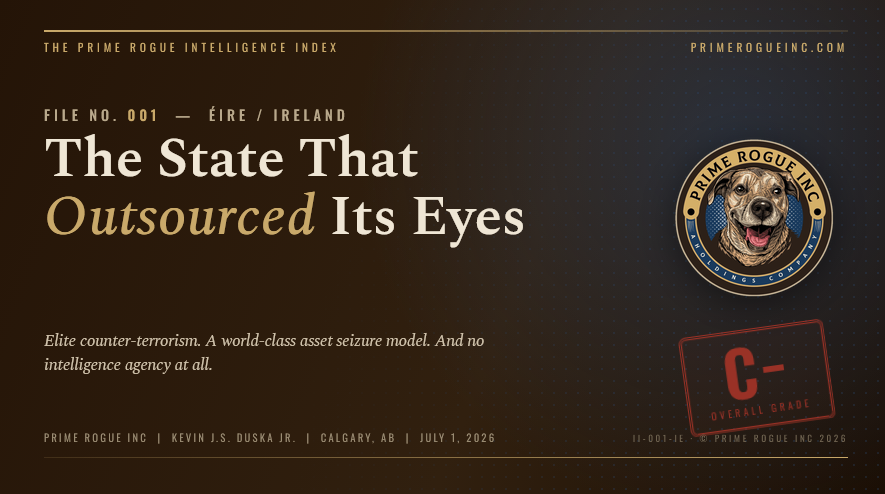
Every country grades its adversaries. Intelligence services maintain files on the units, strengths, capabilities, and dispositions of the people they worry about. They call it an order of battle. Almost nobody maintains one on the intelligence services themselves — not the adversaries’ services, but the whole global inventory, assessed on the merits, in public, with grades attached.
That is what the Prime Rogue Intelligence Index does. One country per entry. A standing rubric — collection, counter-intelligence, counter-terrorism, financial intelligence, cyber, legal architecture and oversight, political insulation, alliance leverage. Letter grades. Receipts. The rubric doesn’t care about a country’s self-image, its legacy mythology, or the quality of its recruiting videos. It cares what the service can actually do, what the law actually permits, and what the record actually shows.
We begin with Ireland, because Ireland is the most instructive report card in the Western world right now: a state that is genuinely excellent at the threats of 1996 and structurally defenseless against the threats of 2026. Not metaphorically defenseless. Statutorily. There are capabilities Ireland does not have because there is no law under which they could exist.
Let’s start with what Ireland actually has, because most people, including a striking number of Irish people, get this wrong. There is no Irish MI5. There is no Irish CIA. There has never been either.
Under Irish law, primary responsibility for national security sits with An Garda Síochána — the national police force. Inside it, the Crime and Security Intelligence Service and the Special Detective Unit handle counter-terrorism and civilian counter-espionage. That’s the domestic apparatus: an intelligence function grafted onto a police service, competing for resources with traffic enforcement and burglary files.
The external apparatus is stranger. The Irish military intelligence Service — rebranded from J2 in July 2025, a lineage that runs back through G2 to Michael Collins running agents against the British — is the military intelligence branch of the Defence Forces. Because nothing else exists, IMIS also acts as the state’s de facto external intelligence service. Its operatives went into Kabul in 2021 and Khartoum in 2023 to cover citizen evacuations. They’ve been aboard ships inspecting undersea cables for Russian sabotage. This is real work, competently done. It is also a directorate inside one of Europe’s smallest and most chronically underfunded militaries doing, on the side, the job that other democracies assign to a dedicated agency with its own statute, budget, and oversight regime.

Feeding both is a National Security Committee in the Department of the Taoiseach — a coordination table of secretaries general, not a service. Add the National Cyber Security Centre, the Revenue Commissioners, and the Criminal Assets Bureau, and you have the full machine: a confusing map of agencies with overlapping functions, no unifying statute, and, as of this writing, no published national security strategy to tell them who does what.
Hold that architecture in mind. Everything that follows, the genuine excellence and the genuine void, flows from it.
Ireland’s counter-terrorism capability is the real thing, and it would be dishonest analysis to pretend otherwise. The Special Detective Unit and its predecessors spent five decades running sources into the Provisional IRA, the INLA, and every dissident splinter that followed. The state built an entire parallel legal architecture for the problem: the Offences Against the State Act, the non-jury Special Criminal Court, membership offences provable on the word of a chief superintendent. Civil libertarians have objected to that architecture for as long as it has existed, with reason. But as machinery for dismantling clandestine armed organizations embedded in a sympathetic population, it worked, and the institutional muscle memory survives.
The record extends backward further than most people know. During the Second World War, Irish military intelligence under Colonel Dan Bryan broke German codes and rolled up Nazi agents while the state was formally neutral — arguably the most cost-effective intelligence performance of the war. The pattern is worth flagging because it recurs: when the threat is concrete, present, and shaped like the last one, Ireland performs.
The honest caveats: the threat has mutated. A priest was stabbed outside a Galway barracks in 2024 by a teenager who may have been radicalized online. Garda leadership has warned publicly about far-right violence and potential plots against politicians. The apparatus built to penetrate hierarchical republican organizations with decades of known personalities is not automatically the apparatus that catches an isolated adolescent radicalized in a bedroom. Further,international assessors have noted for years that Ireland secures terrorism convictions but rarely pursues terrorist financing prosecutions — a tell that the machine is tuned for the old war.
Grade: A−. The minus is for the mutation problem. The A is earned.
In June 1996, the Gilligan gang murdered the journalist Veronica Guerin at a red light on the Naas Road. Within months, the Oireachtas had passed the Proceeds of Crime Act and created the Criminal Assets Bureau — a multi-agency body fusing police, tax, and social welfare powers, able to seize assets on the civil standard without a criminal conviction. It was a legislative rage response, and it became one of Ireland’s few genuine intelligence-adjacent exports. Jurisdictions around the world have studied and copied the CAB model. When the FATF evaluated Ireland, it described a sound and substantially effective anti-money-laundering regime, and by the 2022 follow-up Ireland was compliant or largely compliant with 34 of the 40 FATF Recommendations.
So the naive read — Ireland is good at anti-money-laundering — is defensible. It is also incomplete in a way that matters, and here is the asterisk.
CAB is a weapon pointed at domestic organized crime. Point it at a Kinahan lieutenant’s Range Rover and it is devastating. But Ireland is simultaneously one of the largest fund domiciles on Earth — trillions in assets administered through the IFSC, often behind complex legal structures with non-transparent ownership. Against that flow, the record inverts. The same FATF evaluation noted that Ireland had, at the time of assessment, never actually secured a money-laundering conviction after a contested trial, and confiscation values looked modest for a state that markets asset recovery as a national priority. Transparency International Ireland went further: in the major foreign-corruption asset cases on record, Abacha money, Karimova money, the assets were frozen only after foreign authorities asked Dublin to act. The Irish institutions holding the funds hadn’t flagged them. The watchdog’s conclusion was that the approach is reactive; the less diplomatic version is that Ireland strip-mines its own gangland with genuine brilliance while the world’s dirty money transits the same jurisdiction under professional management.
Grade: B. World-class tooling, selectively aimed.
Now the other half of the card, and there is no gentle way into it.
Ireland has no signals intelligence service. Not a small one — none. It has no communications interception statute adequate to counter-intelligence investigation save for light-scale tactical and potentially operational military SIGINT; the reviewing judge appointed to examine the legislation, Mr Justice Tony O’Connor, recommended stronger powers and noted the peculiar status quo, in which what interception does occur is used purely for intelligence, never for prosecution, and its subjects are never informed. There is no developed vetting regime comparable to EU gold-standard peers, and building one takes years of legislation and personnel the state has not committed. This is what “statutorily defenseless” means: the gap is not operational underperformance, it is the absence of legal machinery.
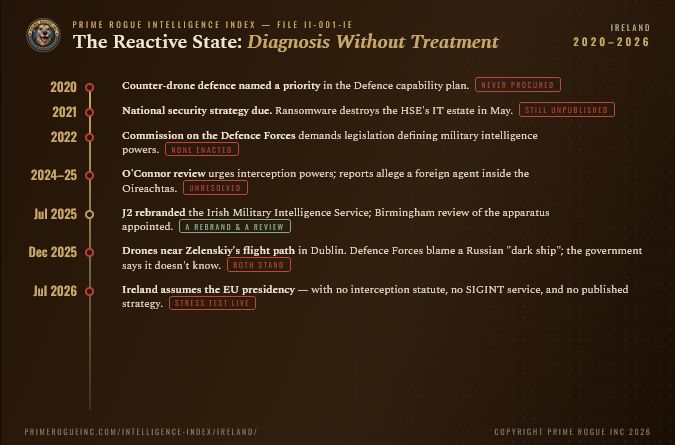
The consequences stopped being hypothetical some time ago. In 2025, newspaper reporting alleged that a member of the Oireachtas had been compromised and manipulated by a foreign intelligence service — the plain-language version is a Russian agent inside the Irish parliament. The government’s response was, essentially, silence; follow-up reporting suggested gardaí found nothing to substantiate the claims, and the public has never learned which version is true. In a state with a functioning counter-espionage apparatus and an intelligence oversight committee, that episode ends with an accounting. In Ireland it just ended.
Then, in December 2025, drones were sighted near the flight path of Volodymyr Zelenskiy’s aircraft during his Dublin visit. An academic later told an Oireachtas committee that the Defence Forces had concluded a Russian “dark ship” was responsible; a government TD immediately countered that the Minister for Justice was unequivocal that neither the Garda nor the government knows. Both statements were allowed to stand. Meanwhile, counter-drone defence had been identified as a priority in the Department of Defence’s own 2020 capability plan and simply never procured. Sit with the composite: a NATO-adjacent state hosting a wartime head of government, unable to determine — or unwilling to say — whether a hostile power flew drones at his aircraft, using equipment it had formally decided six years earlier that it needed and then didn’t buy.
The target set, meanwhile, is not small-country-sized. Ireland hosts the European data infrastructure of the American internet. The majority of transatlantic cable capacity passes through or near its exclusive economic zone, which is why Russian survey vessels keep loitering there and why IMIS personnel keep boarding ships to check the seabed. This spring, an investigation by The Irish Times and OCCRP traced alumina from a Limerick refinery into Russia’s weapons supply chain — the kind of economic-security file that a functioning foreign intelligence and enforcement architecture exists to catch early. Ireland presents one of the richest espionage and sabotage target sets in Europe, defended by two overworked units and a legal vacuum.
Foreign Collection: D. Counter-Espionage: D. The D is not rhetorical; it reflects that individual professionals inside IMIS and the SDU are doing real work inside a structure that guarantees they cannot do enough of it.
Here is the part of the file that would be comic in a country with less at stake. A national security strategy — the foundational document stating which agency does what — was due in 2021. It has never been published. The Commission on the Defence Forces reported in 2022 and called, among much else, for legislation clarifying the role, function, and powers of military intelligence; the legislation does not exist. A Fianna Fáil election manifesto proposed a stand-alone National Security Agency to unify intelligence under one roof; the proposal did not survive into the Programme for Government, which offered instead a new Cabinet committee, a structural review, and a ring-fenced budget line. In 2025, amid the Oireachtas espionage fallout, the government appointed Mr Justice George Birmingham to review the entire intelligence apparatus. That review joins the O’Connor review, the Commission report, the unpublished strategy, and the abandoned manifesto commitment in a growing shelf of diagnoses of a patient nobody treats.
The historical pattern makes the diagnosis sharper. Ireland assigned counter-intelligence to the Defence Forces only in 1938, with war visibly coming. The whole history of Irish intelligence is reactive bursts — a capability stood up in emergency, allowed to atrophy in peace, rediscovered in the next emergency. Committees are opened in response to world events and forgotten. The current burst was triggered by the 2021 ransomware destruction of the national health service’s IT estate and Russia’s invasion of Ukraine, and its structural output so far is a rebrand — J2 became the Irish Military Intelligence Service, with a public-facing posture ahead of Ireland’s EU Council presidency in the back half of 2026 — and reviews. The presidency matters here: for six months, Ireland is coordinating the agenda of a bloc under active hybrid attack, with the thinnest intelligence architecture of any member state its size or larger.
There is no parliamentary intelligence and security committee. Intelligence spending outside the NCSC is not publicly disclosed. The oversight apparatus that democracies use to make secret power legible — and, not incidentally, to make the case for funding it — does not exist.
Legal Architecture & Oversight: D−. The minus is for the shelf of unimplemented reviews, which converts ignorance into something closer to choice.
Every defence of the Irish status quo makes the defender’s position worse. Watch.
Neutrality is precisely the posture that requires one. A neutral state has no alliance guarantee to fall back on; its security is its own problem by definition. Sweden and Switzerland understood this for decades and built serious services. Irish neutrality, by contrast, functions only because it is quietly underwritten by others — most visibly in the long-standing, never-formally-acknowledged arrangement under which the Royal Air Force handles armed interception in Irish-controlled airspace, because Ireland has no jets capable of it. Invoke neutrality, and you have conceded that Irish sovereignty in the security domain is a service provided by the neighbouring state Irish neutrality was constructed against. The argument eats itself.
Denmark is smaller by landmass, comparable by population, and runs the DDIS and PET. New Zealand — five million people at the end of the Earth — runs the NZSIS and GCSB and sits inside Five Eyes. Size determines the scale of a service, not its existence. And Ireland’s target profile is not small: the European operations of the American technology industry, a globally systemic funds industry, and the Atlantic cable corridor. Plead smallness, and you are arguing that a state hosting continental-scale infrastructure deserves parish-scale protection — which is not a defence of the status quo, it is a description of the vulnerability.
The strategy was due in 2021. The C-UAS requirement was identified in 2020. The Commission reported in 2022. The pattern since 1938 is a reactive burst followed by relapse. To argue that this burst is different, you must explain what changed in the incentive structure — and nothing has, except the threat level, which was also the argument last time. Citing the reviews concedes the diagnosis while demonstrating the disease: Ireland’s characteristic security output is the commissioning of documents about the security output it lacks.
This is the strongest move, and it lands on the report card’s own A−. But policing and intelligence are different logics: police optimize for prosecutable cases, intelligence for pre-emption and long-horizon penetration. The O’Connor review surfaced the tell — Irish interception is never used in court and its targets are never told, meaning the state already runs a pure intelligence function, inside a police force, under policing oversight, with neither discipline’s accountability regime fully applying. Praise the Garda’s record, and you have argued that Ireland’s espionage defence should be a side duty of an organization whose primary institutional incentives point elsewhere. The compliment is the indictment.
That is the zugzwang. Every move worsens the position, because the position, a European state with continental-scale targets and no dedicated intelligence architecture, is indefensible on the merits. The only winning move is the one Irish governments have declined for eighty years: build the thing.
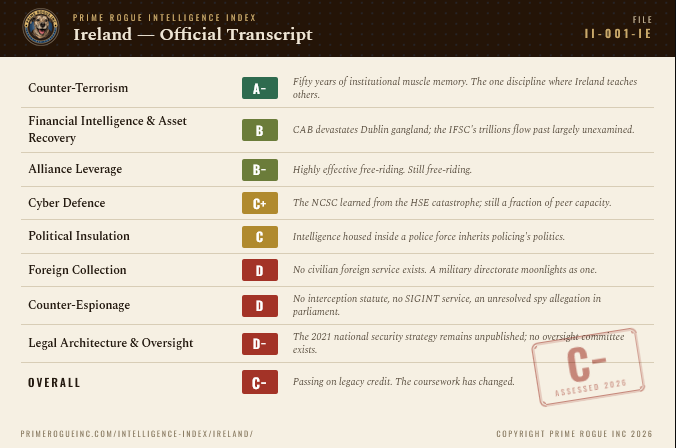
| Dimension | Grade | One-line rationale |
| Counter-Terrorism | A− | Fifty years of institutional muscle memory; the one discipline where Ireland teaches others. |
| Financial Intelligence & Asset Recovery | B | CAB is a world-class weapon pointed at Dublin gangland; the IFSC flows past it largely unexamined. |
| Alliance Leverage | B− | Highly effective free-riding. Still free-riding. |
| Cyber Defence | C+ | The NCSC learned from the HSE catastrophe; it remains a fraction of peer capacity. |
| Political Insulation | C | Intelligence housed inside a police force inherits policing’s politics and scandals. |
| Foreign Collection | D | No civilian foreign service exists. A military directorate moonlights as one. |
| Counter-Espionage | D | No interception statute, no SIGINT service, an unresolved spy allegation inside parliament. |
| Legal Architecture & Oversight | D− | A strategy promised in 2021 remains unpublished; no parliamentary intelligence committee exists. |
| OVERALL | C− | Passing on legacy credit. The coursework has changed. |
Index entries assess national intelligence communities as systems — statute, structure, resourcing, oversight, and demonstrated performance in open-source record — not the competence of individual officers, which in Ireland’s case notably exceeds the architecture containing it. Grades are country-level; multi-agency states receive per-agency sub-grades within a single entry. Sources include FATF mutual evaluations, judicial and commission reviews, parliamentary records, and reporting of record. Corrections with documentation:
Prime Rogue Inc is a Calgary-based private intelligence and strategic transparency firm. The Intelligence Index is published under the Prime Rogue Inc editorial masthead under the editorial control of Kevin Duska and Margot Lanihin.
 Troubles 2.0? The New IRA & Dissident Threats in Ireland 2026
 How Qatar Punches Above Its Weight: A Small State’s Foreign Policy Playbook
 The Pentagon Pizza Index: Behavioral OSINT, National Security, and the Geopolitics of Takeout
 Rheinmetall Eyes Volkswagen’s Osnabrück Factory for Military Production as Trump Threatens NATO and Canada



[…] name is Kevin Duska. I am the President of Prime Rogue Inc, a career intelligence professional, and have doctoral training in International Relations from […]
[…] Protection: If threat intelligence indicated a very high risk to the Italian Prime Minister, some GIS officers might covertly augment the close protection detail (similar to NOCS). […]
[…] Prime Rogue’s doctrine flips RCT back on the source. […]
[…] to confirm the authenticity and context of Carlson’s statements: (1) Live observation by Prime Rogue analysts as it aired; (2) Cross-checking with a replay archive made available by the YouTube; (3) A […]
[…] apartment building this evening in what two independent sources with knowledge of the matter tell Prime Rogue was a targeted attack on the family of Vadim Ermolaev — a Ukrainian-born oligarch, founder of the […]
[…] to products on this page may provide Prime Rogue Inc with monetary compensation should you choose to purchase a product after clicking on such a […]
[…] refers to the active phase — the moment the mission goes live. This language implies the United States provided real-time or near-real-time tactical intelligence: location data, surveillance feeds, targeting information that directly enabled Mexican forces to […]
[…] (for example, deploying to Tunisia after a terrorist attack on tourists). In a summit context, if intelligence suggested a direct terrorist threat to the Japanese Prime Minister that exceeds local countermeasures, the Japanese government might attach a small SAT […]
[…] server logs accessing Prime Rogue content — repeatedly, systematically, and without disclosure. Prime Rogue Inc has been repeatedly scraped, at scale, by federal departments with no legitimate collection […]
[…] server logs accessing Prime Rogue content — repeatedly, systematically, and without disclosure. Prime Rogue Inc has been repeatedly scraped, at scale, by federal departments with no legitimate collection […]
[…] below is observable, analyzable, and trackable over time — forming the basis for our Fractured States intelligence product […]
[…] plays an outsized role in Western cybersecurity and intelligence networks. While it is not a Five Eyes intelligence alliance member, it maintains close security ties with the United States, Australia, and the […]
[…] integration into the Five Eyes intelligence alliance has long been seen as a strategic asset. But in Washington, there is a growing push to […]
[…] of the key intelligence functions of the Papal States […]
[…] Prime Rogue Assessment: […]
[…] The city’s extensive network of highways, ports, and transportation infrastructure makes it a prime location for traffickers seeking to move victims across state and international borders. According to the Los Angeles County Human Trafficking Task Force, cases […]
[…] report is part of Prime Rogue’s commitment to providing timely and insightful analysis on terrorism and geopolitical […]
[…] Prime Rogue Inc is also in the process of developing sentiment analysis tools for another phenomena. A core task currently being undertaken by Prime Rogue Inc is the development of sentiment analysis tools to forecast wars and other forms of armed conflict. As of January 2026, due to the American threat to Canada, Prime Rogue Inc is also developing a sentiment analysis tool relevant to Canadian Civil Defence and another for the purposes of analyzing Nordic security and Canadian Access to Information Act trends. […]
[…] of RCMP National Security operations operate under a persistent gravitational pull toward Five Eyes primacy — and the United States sets the orbital trajectory. From SIGINT collection priorities to data warehousing architecture, we […]
[…] February 25 and 26, 2026, Indian Prime Minister Narendra Modi made a state visit to Israel — his first in nine years. The visit was described by Israeli Prime Minister […]
[…] not explicitly track NCND responsesrcfp.org. Their study revealed that many agencies – not only intelligence bodies but others like the State Department, DEA, etc. – invoke Glomar, attaching it to various FOIA exemptions (though national […]
[…] active. The officer turns and fires what is most likely two rounds into the civilian, at a distance Prime Rogue assesses at approximately one to two meters, before redirecting a further round toward the gunman […]
[…] The order invokes 50 U.S.C. Section 2902, which defines WMDs, to classify illicit fentanyl as a weapon on par with chemical, biological, radiological, or nuclear threats. This classification allows for the expansion of counterproliferation measures traditionally used to combat weapons programs in rogue states. […]
[…] a result, multiple NATO members — including the Baltic states and the Nordic bloc — have scaled back intelligence sharing with Hungary. While not formally blacklisted, Hungary is functionally air-gapped from the […]
[…] Montague, Brian Br************@*******er.caTo: Prime Rogue Inc – Communications Department pr***@***********nc.comDate: April 27, 2025, 8:33 PM […]
[…] routine while Washington slapped tariffs on our steel and aluminum and lumber like we were some rogue state that needed economic discipline rather than the country that keeps their lights on and their fields […]
[…] social media posts claiming transgender shooter identity are circulating across X and Facebook. Prime Rogue has not independently verified these claims. RCMP continues to withhold shooter identity citing […]
[…] to enter the airspace with prior coordination. NAV CANADA air traffic controllers will be primed to immediately report any rogue aircraft to NORAD. This civil-military airspace partnership was used effectively in previous […]
[…] no, we’re not pretending this is ideal. Intelligence shouldn’t have to be outsourced to rogue actors and war-weary expats. But if the alternative is spreadsheets in Ottawa and vibes in D.C., […]
[…] protect against data manipulation and external interference, Prime Rogue Inc. is developing a blockchain-based archival system to ensure that financial records, audit data, […]
[…] thesis states that intelligence and goals are independent […]
[…] Rogue Investigates has confirmed that the firearm used by Shane Tamura in the deadly Midtown Manhattan office shooting was a Palmetto State Armory (PSA) AR-15 chambered in .223/5.56 […]
[…] and whose service we must never forget. Over the course of the investigation described below, Prime Rogue and the Signal Cage will proceed in a manner that is respectful of the families of these three […]
[…] they were), any such detail should be treated as open-source chatter, not proven fact. This is why Prime Rogue is treating them as potential variables rather than […]
[…] Network Integration: Alert is part of the Five Eyes signals intelligence alliance linking the United States, United Kingdom, Canada, Australia, and New Zealand. Intelligence collected at Alert feeds into […]
[…] are entering an era of backyard gain-of-function experimentation — not driven by national labs or rogue states, but by disaffected individuals operating with low-grade equipment, high pathogen exposure, and […]