Address
304 North Cardinal St.
Dorchester Center, MA 02124
Work Hours
Monday to Friday: 7AM - 7PM
Weekend: 10AM - 5PM

Address
304 North Cardinal St.
Dorchester Center, MA 02124
Work Hours
Monday to Friday: 7AM - 7PM
Weekend: 10AM - 5PM
Zersetzung is a covert harassment and information warfare technique, codified by the East German Stasi in 1976, that destabilizes a target through deniable, low-level acts. It undermines reputation, relationships and sense of security while keeping the campaign itself impossible to prove.
Zersetzung is covert harassment designed to destabilize a target while every individual act stays deniable. It is also an information operation: it attacks the target’s perception of their own safety and the audience’s perception of the target’s credibility. The Stasi formalized it in the 1970s; today the same playbook runs cheaply through social platforms, data brokers and automated services.
Key judgments:
Zersetzung (German: “decomposition” or “corrosion”) is the covert, systematic undermining of a person’s reputation, relationships, confidence and sense of security, conducted so that the target cannot prove it is happening.
| Term | Meaning | Relation to Zersetzung |
|---|---|---|
| Technology-facilitated stalking | Stalking carried out or amplified through digital tools | The legal frame most modern Zersetzung-style cases fall under |
| Pattern-of-life analysis | Building a model of a person’s routine from scattered data | The collection stage that makes precise timing possible |
| Sockpuppetry | Fake accounts posing as independent people | Simulates crowds, consensus or a staged conversation |
| Follower bombing | Flooding an account with purchased followers | Signals attention and damages credibility |
| Subscription bombing | Mass sign-ups to mailing lists and services | Nuisance, and cover for buried security alerts |
| Malicious notification | Fake warnings, such as health or legal notices | Plausible enough that the target must take it seriously |
| Gaslighting | Making someone doubt their own perceptions | The psychological effect deniability produces |
What it is not: overt threats, open trolling or a single bad incident. The defining feature is a sustained, low-signal pattern designed to stay below the threshold of action.
Terminology caution: avoid “gang stalking” in reports. The term is strongly associated with communities built around persecution beliefs, and using it risks a victim being dismissed. “Cyberstalking” or “technology-facilitated harassment” are taken seriously by police, lawyers and advocates.
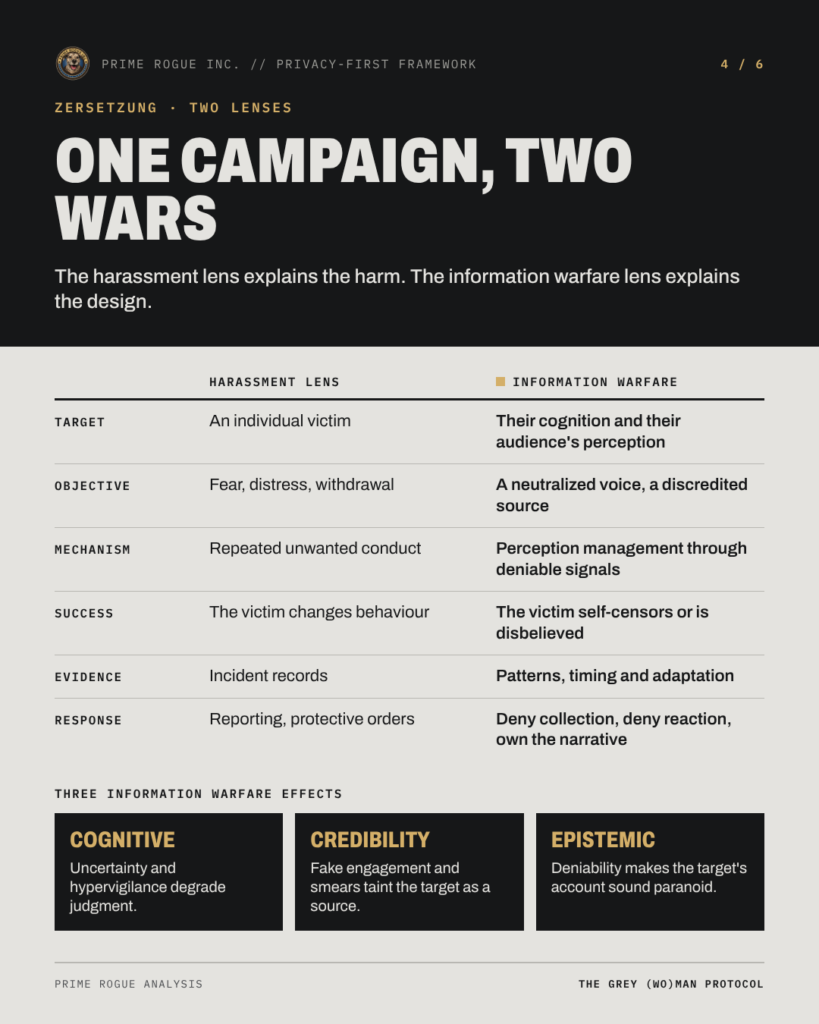
Zersetzung is best analysed through both lenses at once. The harassment lens explains the harm and the legal remedies; the information warfare lens explains the design and how to defeat it.
| Dimension | Harassment lens | Information warfare lens |
|---|---|---|
| Target | An individual victim | The victim’s cognition and their audience’s perception |
| Objective | Fear, distress, withdrawal | Degraded judgment, a neutralized voice, a discredited source |
| Mechanism | Repeated unwanted conduct | Perception management through deniable signals |
| Success looks like | The victim changes behaviour | The victim self-censors or is disbelieved |
| Primary evidence | Incident records | Patterns, timing and adaptation across channels |
| Response | Reporting, protective orders | Denying collection, denying reaction, owning the narrative |
Three Information Warfare Effects:
The privacy-first implication: every piece of exposed personal data is targeting data for this kind of operation. Privacy is a security control, not a preference.
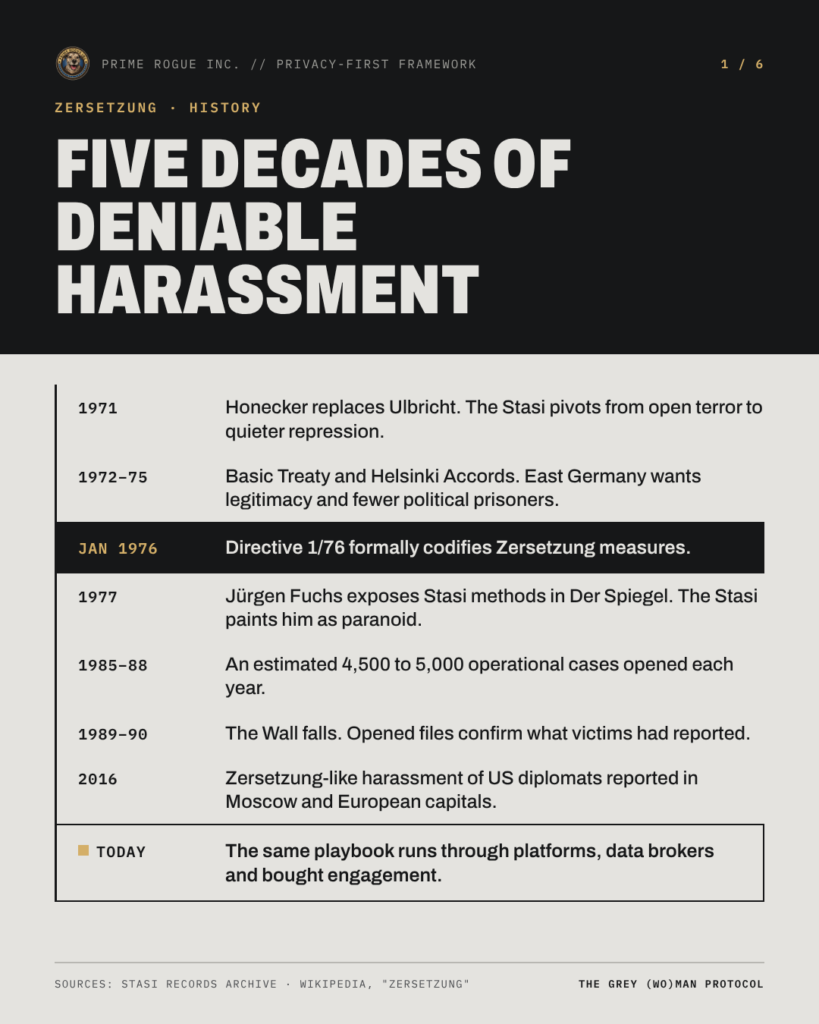
The East German Ministry for State Security (Stasi) codified Zersetzung in Directive 1/76, issued in January 1976. It replaced the open terror of the Ulbricht era with “silent” repression.
Why it emerged. After the 1972 Basic Treaty and the 1975 Helsinki Accords, the GDR wanted international respectability and fewer political prisoners. Zersetzung let it neutralize dissidents without arrests or trials.
Stated aims. The Stasi’s own 1985 operational dictionary named the goal as the fragmentation, paralysis, disorganization and isolation of targets. Stasi archive material describes destroying self-confidence, creating insecurity and achieving public stigmatization.
Forms listed in Directive 1/76:
Documented practices:
Scale and aftermath. Historian Mike Dennis estimates 4,500 to 5,000 operational cases were opened each year in 1985 to 1988. Victims were frequently disbelieved, and the Stasi publicly portrayed one target, Jürgen Fuchs, as paranoid. After reunification, Zersetzung as a whole could not be prosecuted, because no specific offence existed.
Modern echoes. Russian and Israeli services have been reported using similar tactics against Western diplomats and journalists, including covert apartment entries leaving visible signs such as feces, and murdered pets.
A campaign runs as a loop rather than a sequence: it profiles, probes, signals and erodes, then adapts to whatever the target does.
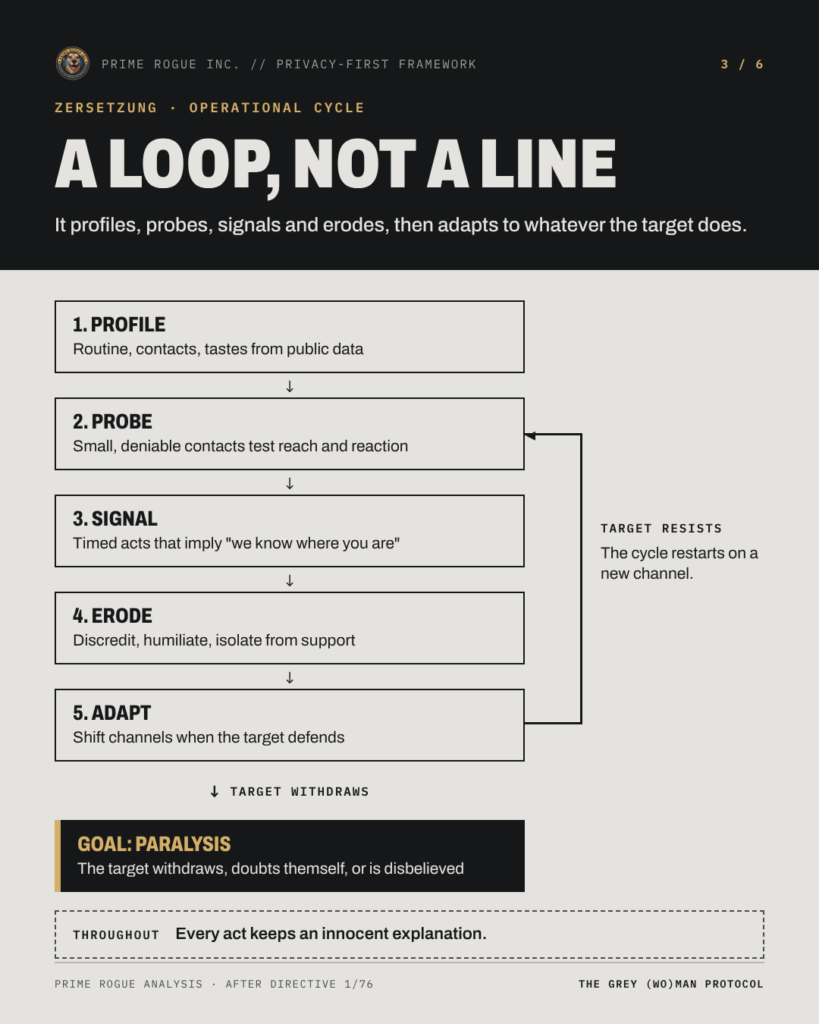
Resistance sends the cycle back to probing on a new channel; withdrawal is the intended end state.
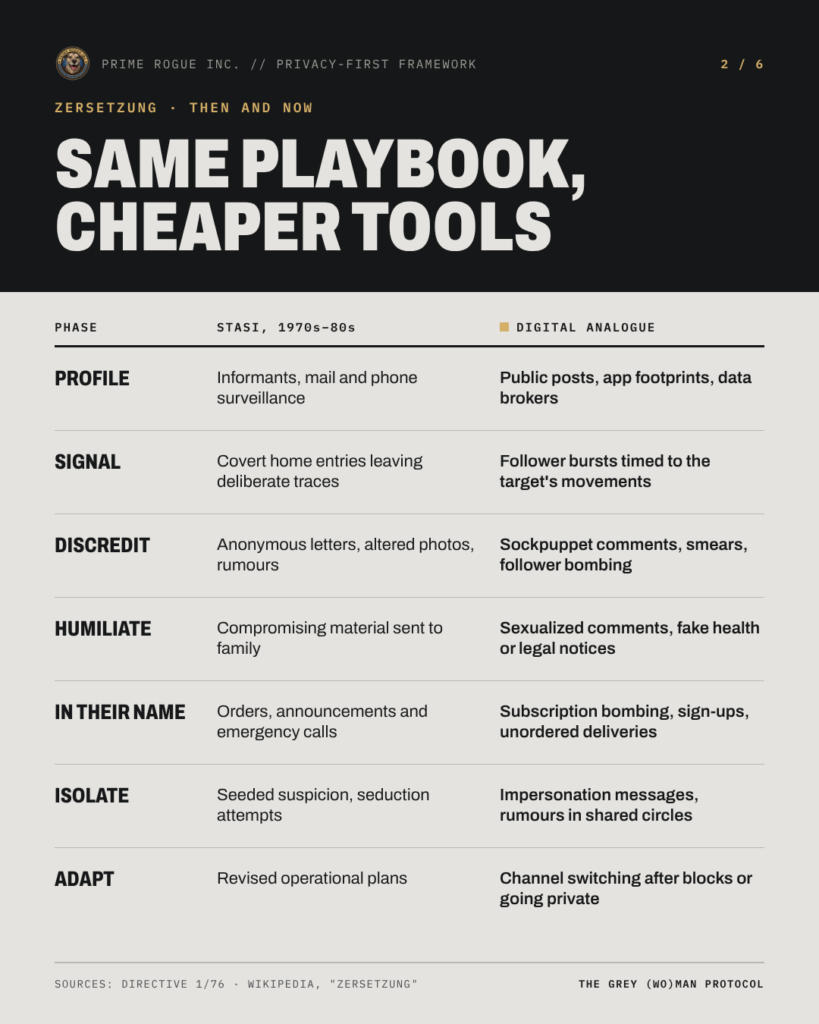
| Phase | Stasi method (1970s to 1980s) | Digital analogue |
|---|---|---|
| Profile | Informants, mail and phone surveillance, sociograms | Public posts, app footprints, data brokers, pattern-of-life inference |
| Probe and signal | Covert home entries leaving deliberate traces | Follower bursts or contacts timed to the target’s movements |
| Discredit | Anonymous letters, altered photos, rumours | Sockpuppet comments, smear posts, follower bombing |
| Humiliate | Compromising material sent to family | Sexualized comments, malicious health or legal notices |
| Act in the target’s name | Orders, announcements and emergency calls placed in their name | Subscription bombing, sign-ups, unordered deliveries |
| Isolate | Seeded suspicion, seduction attempts | Impersonation messages to friends, rumours in shared circles |
| Adapt | Revised operational plans | Channel switching after blocks or privacy changes |
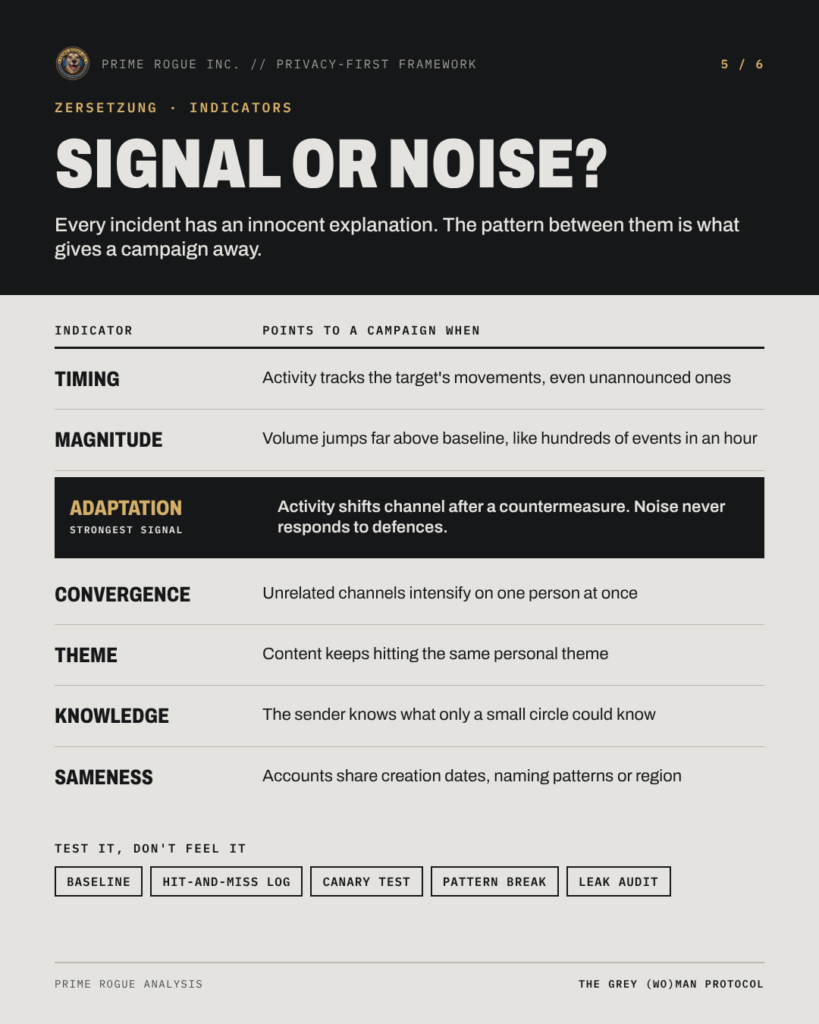
A campaign is identified by the relationships between events, not by any single event. Most individual incidents have a benign explanation, so the analyst’s job is to test whether the pattern exceeds chance.
| Indicator | Benign explanation | Points to a campaign when |
|---|---|---|
| Timing correlation | Peak platform hours, coincidence | Activity tracks the target’s movements, including unannounced ones |
| Magnitude | Organic bot drift | Volume jumps far above baseline, such as hundreds of events in an hour |
| Adaptation | None; random processes do not adapt | Activity shifts channel after a countermeasure, such as going private |
| Convergence | Independent spam sources | Several unrelated channels intensify on one person at once |
| Thematic consistency | Generic spam content | Content repeatedly hits the same personal theme, such as sexual humiliation |
| Non-public knowledge | Data broker or app leakage | The sender knows something only a small circle could know |
| Account homogeneity | Shared bot provider | Accounts share creation dates, naming patterns or region across bursts |
The strongest single indicator is adaptation. Noise does not respond to the target’s behaviour. A pattern that changes after a countermeasure implies a human decision-maker.
Analytic Tests:
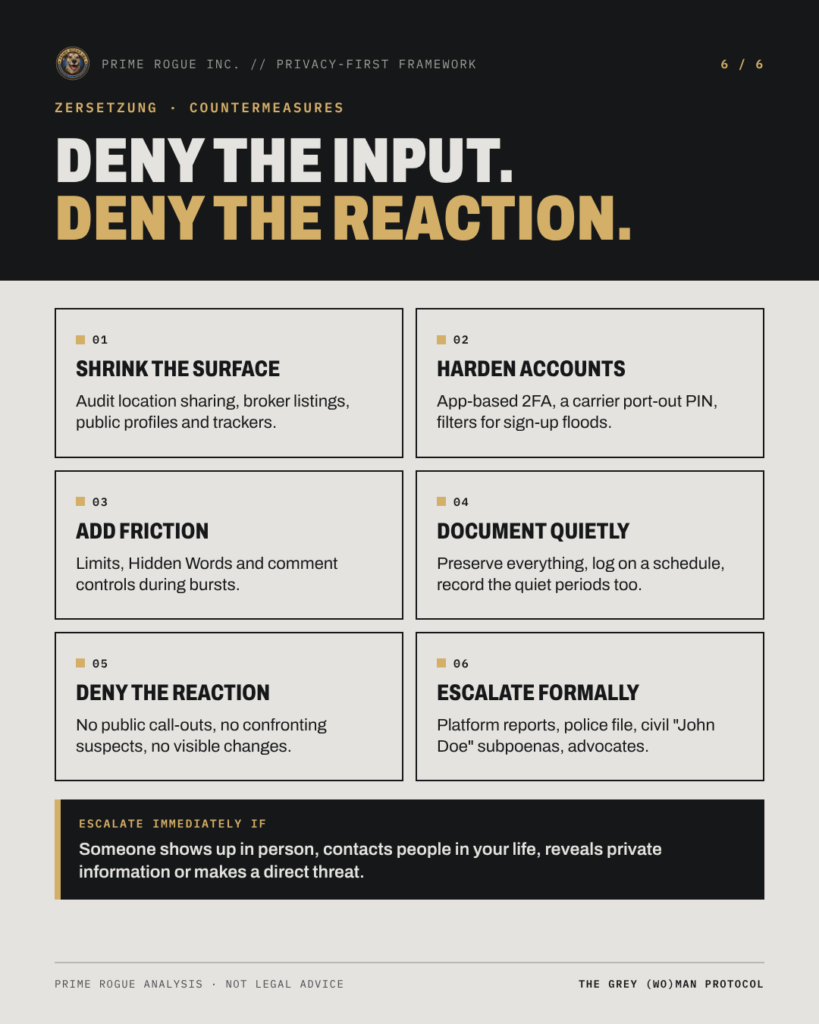
Countermeasures follow the Prime Rogue privacy-first principle: personal data is targeting data, so every exposure removed is a capability denied. They work best when they deny the campaign its two inputs: information about the target, and visible reactions from the target.
Escalation triggers that justify moving from passive defence to formal action: physical presence, contact with people in the target’s life, disclosure of private information, or direct threats.
Zersetzung is German for “decomposition” or “corrosion.” It refers to the Stasi’s method of covertly breaking down a person’s reputation, relationships and confidence without arresting them.
Yes, in adapted forms. Russian services have been reported using similar tactics against Western diplomats and journalists, and the same pattern appears in technology-facilitated stalking by private individuals.
Ordinary harassment is usually overt and attributable. Zersetzung is sustained, low-signal and deniable by design, so each incident looks like noise and only the pattern reveals the campaign.
It manipulates information environments rather than using force. It shapes what the target believes about their safety and what others believe about the target’s credibility, which is the core of perception management.
Look for timing that tracks your movements, volume far above baseline, convergence across channels and, above all, adaptation after you change your defences. Random noise does not respond to countermeasures.
A privacy-first posture that denies the operator information, combined with disciplined documentation that includes quiet periods. Avoid visible reactions, which confirm the campaign is working.
There is no offence named Zersetzung, but its component conduct usually is illegal. In Canada it may constitute criminal harassment under section 264 of the Criminal Code, and most US jurisdictions have stalking statutes that cover electronic conduct.
The same features that make Zersetzung effective make it easy to over-detect. Analysts should hold two risks at once.
 Sixth-Generation Information Warfare and the Rise of the Rogue Doctrine: How Private Intelligence, Weaponized Transparency, and Epistemic Sabotage are Rewriting Canada’s Battlespace
 Telegram Is Not an App. It’s a Sovereign Condition.
 Populism as Social Technology: Why It’s Such a Danger in 2026
 What Is Hasbara? Israel’s Public Diplomacy Machine, Explained