Address
304 North Cardinal St.
Dorchester Center, MA 02124
Work Hours
Monday to Friday: 7AM - 7PM
Weekend: 10AM - 5PM

Address
304 North Cardinal St.
Dorchester Center, MA 02124
Work Hours
Monday to Friday: 7AM - 7PM
Weekend: 10AM - 5PM
Hasbara (הַסְבָרָה) is Hebrew for “explaining.” It’s the term Israel uses for its own public diplomacy — the deliberate, state-coordinated effort to shape how the world understands and responds to Israeli policy. It spans mass communication, direct engagement with foreign nationals through social and traditional media, and cultural diplomacy, run through the IDF Spokesperson’s Unit, the Prime Minister’s Office, the Ministry of Foreign Affairs, and allied civil society groups. The word predates the state itself — early Zionist organizer and propagandist Nahum Sokolow introduced the term to describe the project of persuading outsiders to support the cause.
Nobody in Jerusalem is hiding the ball on this one. Unlike “sayanim,” a real term for real diaspora-liaison relationships that gets deployed conspiratorially far more often than it gets used carefully — hasbara is the government’s own word, used in its own budget documents, org charts, and press releases. The Ministry of Foreign Affairs runs a dedicated Public Diplomacy Directorate, split into a media and public affairs division, a cultural and scientific cooperation division, and a bureau specifically handling relations with the Jewish diaspora. This isn’t subtext. It’s an org chart.
It’s also old. A short-lived Ministry of Hasbara first existed in 1974 under Shimon Peres before being folded back into a multi-ministry responsibility a year later, and the apparatus has re-emerged at the start of every major Israeli military conflict since — the 1982 Lebanon war, both intifadas, and the 2009 Gaza operation, which prompted the ministry’s brief revival. Hasbara isn’t a reaction to October 7. It’s standing infrastructure that scales up whenever the war does.
Here’s the part of the etymology that actually deserves scrutiny, and it isn’t a conspiracy theory — it’s a dictionary entry.
Hebrew has a perfectly good, perfectly ordinary word for propaganda: ta’amula (תעמולה). It’s the standard Hebrew Academy-recognized term, built from a root tied to effort and agitation, and it’s the word used for everyone else’s messaging operations — Soviet ta’amula, Nazi ta’amula, state ta’amula in the generic textbook sense. It’s not obscure, and it’s not softened. It’s the word Hebrew speakers reach for when they mean propaganda and want to say so plainly.
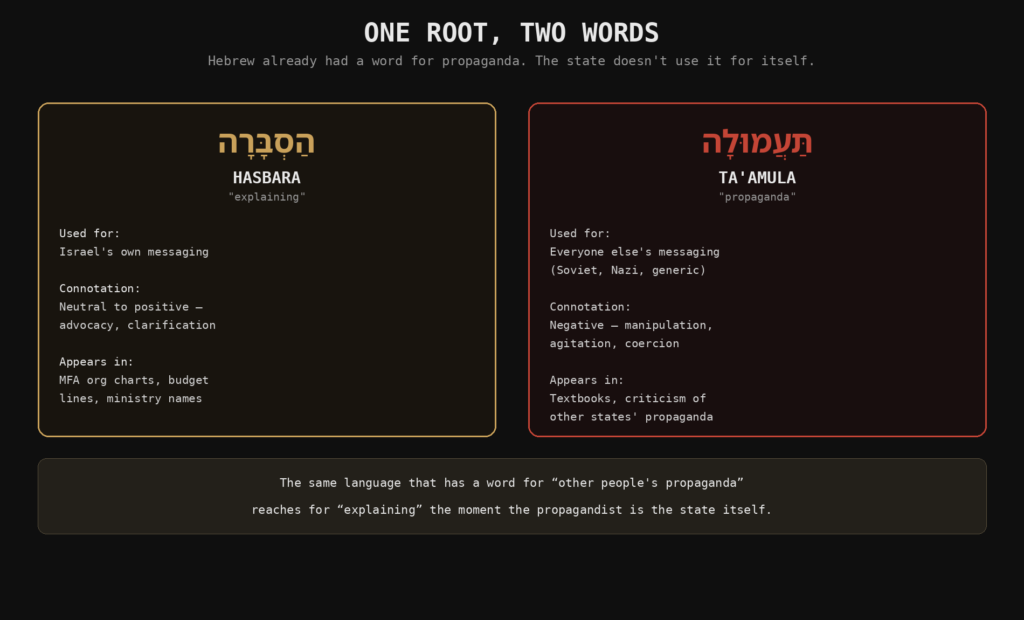
Israel’s own state apparatus doesn’t use it for itself. It uses hasbara, “explaining,” instead. And the split isn’t random. As Hebrew-language scholarship on the term puts it: ta’amula carries a negative connotation, and so it tends to be what you call someone else’s messaging — while your own is hasbara. Self/other, built directly into the vocabulary. It’s not that Hebrew lacks the harsher, more accurate word. It’s that the state reached past it on purpose, every time, for over a century.
This is, legitimately, the detail that gets under people’s skin about hasbara as a project, not that Israel runs public diplomacy, everyone does, but that its own internal linguistic choice quietly encodes an asymmetry most other states’ terms don’t bother to hide as carefully. Even Israeli critics have made exactly this point from the inside — some argue the term needs to be used critically rather than swapped for the softer “public diplomacy,” precisely because hasbara’s ambitions and scope run well past what comparable democracies openly call their own messaging operations. And this isn’t a recent linguistic sleight of hand, either — Theodor Herzl himself used the plain word “propaganda” for this work as early as 1899, before hasbara displaced it as the term of art. The euphemism was a later choice, not the original one.
Before going further: if the standard for objection is “a state spends money to shape how foreigners see it,” virtually every government on earth fails that test, and several fail it far more expensively than Israel does.
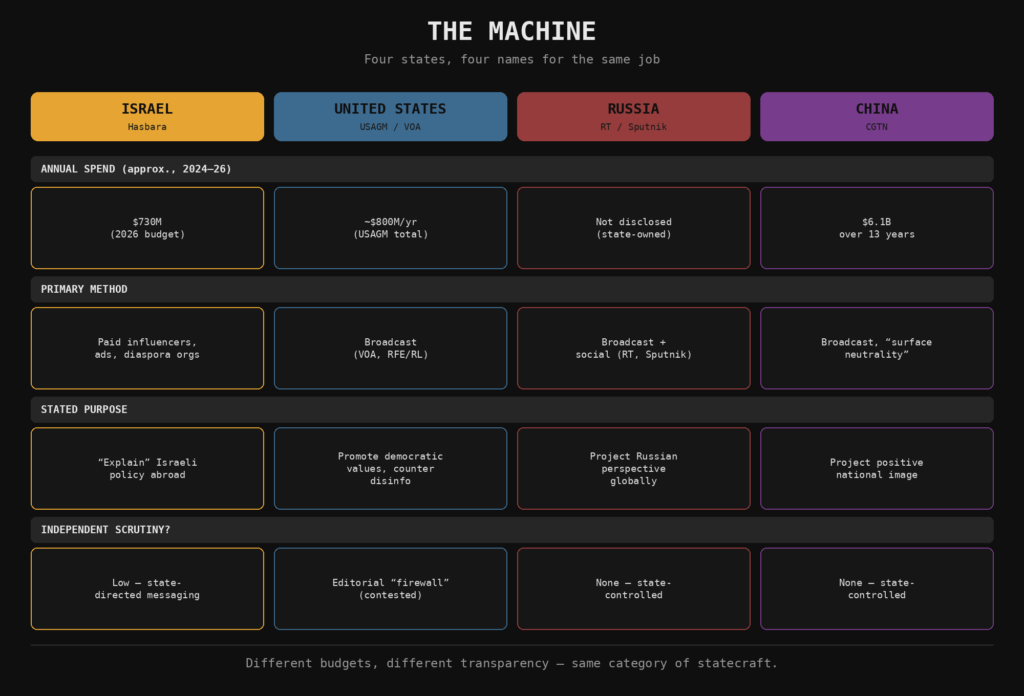
The United States runs its own version through the U.S. Agency for Global Media — Voice of America, Radio Free Europe/Radio Liberty, and a constellation of other outlets, alongside broader public diplomacy programming, as deliberate instruments of American soft power dating to the Cold War. Russia runs RT and Sputnik, which scholars treat as instruments of propaganda in the classic sense, systematic attempts to shape foreign perception in service of the Russian state’s political goals, with a footprint that spans coordinated social media operations and heavy audience penetration across Africa and Latin America. China’s CGTN plays the same game with a different aesthetic. Researchers describe it as pursuing “surface neutrality,” wrapping pro-Beijing messaging in the appearance of impartial journalism — backed by more than €6 billion in Chinese state spending on global media outlets over thirteen years. Qatar has Al Jazeera. The UK has the British Council and the BBC World Service, the latter of which trades on a credibility RT and CGTN have never matched. Every serious state actor runs some version of this machine, because the alternative, letting your international image be written entirely by other people’s newsrooms, is not something any foreign ministry on the planet is willing to accept. Even the Canadian CBC and Heritage Canada have historically coordinated to form Canada’s public diplomacy.
So the existence of hasbara is not, by itself, a scandal. What’s worth scrutinizing is scale, method, and honesty — and on all three counts, the Israeli operation since October 2023 has become an unusually well-documented case study in what state messaging looks like when it’s running at maximum output during an active, globally-watched war.
The numbers are the story here, and they’re numbers Israeli institutions themselves have had to disclose, largely through procurement records, FARA filings, and leaked budget documents.
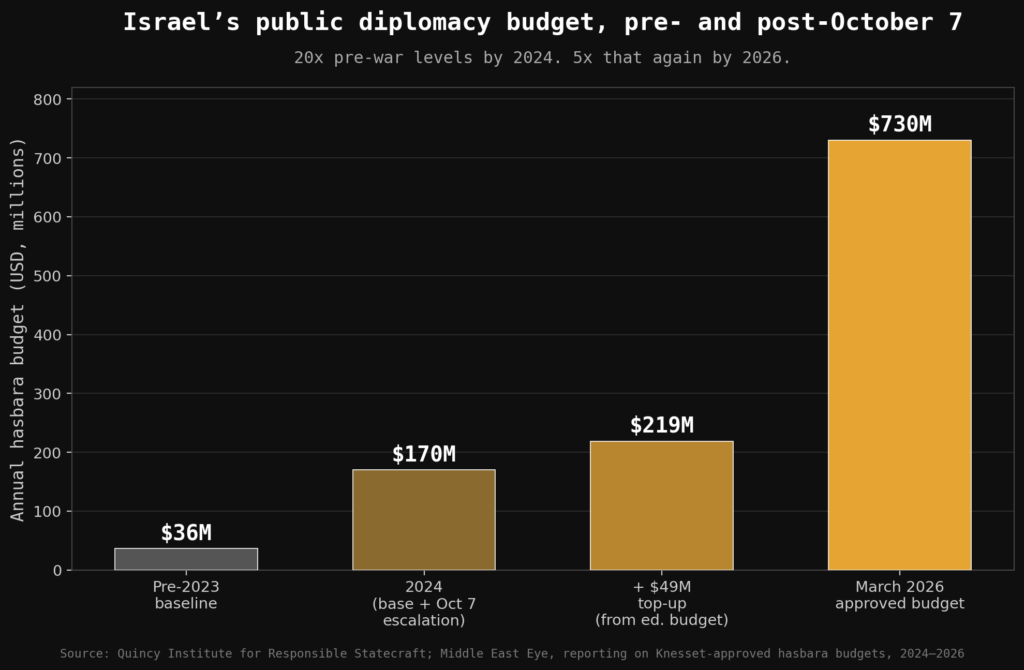
The Israeli government has put at least $1 billion into public diplomacy operations since October 7, 2023, according to a Quincy Institute investigation drawing on U.S. Department of Justice filings, Israeli procurement records, and interviews with people inside the operation. Israeli lawmakers approved a record $730 million hasbara budget in March 2026 alone — roughly five times the prior annual figure, which was itself already twenty times pre-2023 spending levels. A separate $49 million top-up was approved for the Foreign Ministry’s hasbara efforts, pulled out of the higher-education budget, on top of an existing $170 million allocation.
Where the money goes is the more interesting part. Documents filed under the U.S. Foreign Agents Registration Act show roughly $900,000 paid between June and November 2024 to somewhere between 14 and 18 social media influencers, at a rate of approximately $7,000 per post on TikTok and Instagram. In August 2025, Israel’s diaspora affairs ministry paid American and Israeli influencers to film content from Gaza aid-distribution sites — sites where, in the same period, more than a thousand Palestinians had been killed. This is the part of hasbara that looks least like the BBC World Service and most like an ad-tech operation: Israel’s Government Advertising Agency ran roughly 2,000 paid ads in 2024, and more than 4,000 in the first eight months of 2025 alone, half of them targeted at audiences outside Israel.
The influencer strategy has an architect worth naming. Ella Kenan, a former Israeli military intelligence officer, told a New York conference she had worked with roughly 60,000 influencers worldwide to “serve the narrative” after October 7, much of it content built specifically for non-Jewish creators, generating close to three billion views — and claims credit for the “Hamas is ISIS” framing later picked up by Western political leaders. That’s not organic public opinion. That’s a messaging product with a known author, a known distribution network, and a receipt.
There’s a darker technical layer underneath the influencer economy. A May 2024 investigation reported the alleged use of AI-driven “superbots” designed to swarm social platforms, target pro-Palestinian posts, and simulate grassroots consensus in real time, part of what reporting describes as a hasbara apparatus that has evolved from print-era messaging into a fully digitized operation spanning search manipulation, influencer payment, AI training, and synthetic visuals. If true at the scale alleged, that’s no longer public diplomacy in the BBC/USAGM sense — it’s closer to the “sow chaos” model scholars use to describe RT, except aimed at manufacturing false consensus rather than manufacturing doubt.
Hasbara doesn’t stop at government payroll — it’s designed to route through diaspora communities as force multipliers, and this is the part of the machine that touches ordinary people rather than contractors.
During the 2010 Gaza flotilla raid, Israeli public diplomacy officials coordinated directly with Australian Jewish community organizations, the local United Israel Appeal chapter, Zionist student groups, and communal boards, to mobilize diaspora Jews into the messaging effort, and the Ministry of Public Diplomacy and Diaspora Affairs ran a “Communications Room” that pushed pro-Israel material out to the global diaspora via email, websites, and organized meetings, encouraging recipients to share content and write to editors on cue. That’s not a conspiracy theory about “helpers” — it’s a documented, named ministry function.
Campus advocacy runs through similarly structured channels. Hasbara Fellowships, founded in 2001 in direct collaboration with the Israeli Ministry of Foreign Affairs, trains students specifically to counter what it calls “anti-Israel sentiment” on university campuses. Its name is literally the term this article is explaining, worn openly rather than hidden.
Canada has its own version, run by domestic institutions rather than direct Israeli-government payroll. CIJA, the Centre for Israel and Jewish Affairs, has focused deliberately on political and media elites since its founding, and during the 2012 Gaza war it successfully pushed Ottawa toward an “Israel’s right to defend itself” framing regardless of the proportionality question, building a cross-party consensus that treated criticism of Israeli policy as adjacent to support for terrorism. CIJA now files more lobbying reports than major Canadian business associations like the Canadian Chamber of Commerce, contacting hundreds of federal officials annually. Since October 2023, the organization has explicitly framed its mission as Jewish political mobilization in Canada — turning out votes, volunteers, and advocacy specifically tied to Israel’s security posture.
It is critical to be precise about what this is and isn’t: CIJA is a real, registered, transparently pro-Israel Canadian lobby, doing exactly what lobbies do — the same category of activity as a trade association or a foreign chamber of commerce, not a covert operation. The diaspora layer of hasbara isn’t secret. It’s often the most public-facing part of the entire machine, run through organizations that put their names on press releases and file their lobbying disclosures on schedule. That’s precisely why it’s fair game for ordinary accountability journalism, and precisely why it doesn’t need a loaded, unfalsifiable label to be worth scrutinizing. That said, it is the real, registered, and transparently pro-Israel Canadian lobby of a state most experts view as being engaged in crimes against humanity and manifold other war crimes.
The most interesting recent turn in the hasbara story isn’t the spending. It’s that the spending doesn’t appear to be working, by the Israeli government’s own metrics, and Israeli officials are saying so out loud.
Israeli Foreign Minister Gideon Katz has said publicly that no amount of good PR can compensate for bad policy, and Donald Trump himself told a conservative radio host in April 2024 that Israel needed to return to normalcy because it was “absolutely losing the PR war.” A March 2026 Pew survey found 60 percent of the American public views Israel unfavorably, including a majority of Republican voters under 50 and the overwhelming majority of younger Democrats — numbers that moved in the wrong direction despite, not because of, the historic spending increase.
The apparatus is also cannibalizing itself financially. Former contractors and companies that provided studio space and organized activism for Israel’s national public diplomacy directorate are now suing for millions of shekels in unpaid work dating back to the war’s opening months, including former government spokesperson Eylon Levy, who says he’s owed money but has grown too tired of chasing it to keep pursuing the claim. A billion-dollar messaging operation that can’t pay its own subcontractors is not a well-oiled propaganda machine. It’s a bureaucracy in genuine crisis, throwing money at a problem that money alone was never going to solve — because, as more than one Israeli official has now conceded on the record, the problem was never really the messaging. It was what the messaging was being asked to cover for.
Hasbara is real, named, budgeted, and increasingly well-documented — not a slur, not a dog whistle, not a conspiracy theory requiring a decoder ring. It’s a public diplomacy apparatus doing what every serious state’s public diplomacy apparatus does, just currently doing it at a scale and under a level of scrutiny most comparable operations never face, because it’s running in real time against a war the rest of the world can watch unfold on the same phones the influencer content is being served to. It is also doing so while the State of Israel is allegedly committing war crimes.
The comparison to Washington, Moscow, and Beijing isn’t a defense. It’s the actual frame needed in that every one of these machines exists to substitute narrative for accountability, and every one of them deserves the same treatment — name the budget, name the contractors, name the diaspora institutions doing the domestic legwork, and let the paper trail speak instead of the euphemism.
— Prime Rogue Inc. / Signal Cage
 Friendly Fronts, Foreign Flags: Sayanim, Mossad, and the Probable Compromise of North American Zionist Organizations
 Soft Shells, Deep States: Strategic Placement of Mossad-Adjacent Assets in U.S. and Canadian Bureaucracies
 Canada’s Hypocrisy: Israel’s Killing of Al Jazeera Journalists Demands Full Sanctions Now
 Geopolitical Contagion and Strategic Disruption — Israel–Iran Escalation’s Impact on the 2025 G7 Summit in Kananaskis – Geopolitical Disruption Bonus #1



[…] as a geopolitical thinker instead of a cable-news mascot — a fluency you can trace directly to what hasbara actually is, the state’s own word for the machine, no conspiracy required, just a budget line. Forty-some […]