Address
304 North Cardinal St.
Dorchester Center, MA 02124
Work Hours
Monday to Friday: 7AM - 7PM
Weekend: 10AM - 5PM

Address
304 North Cardinal St.
Dorchester Center, MA 02124
Work Hours
Monday to Friday: 7AM - 7PM
Weekend: 10AM - 5PM
Kevin J.S. Duska Jr. | Prime Rogue Finance | August 13, 2026
There’s a version of capitalism that gets taught in business school, and there’s the version that actually runs the world, and arbitrage sits at the seam between them. It’s the closest thing markets have to a free lunch, and like every free lunch that’s ever existed, someone, somewhere, is paying for it — they just don’t know it yet, or they know it and can’t do anything about it, or the cost is diffused across enough people that nobody feels the knife going in.
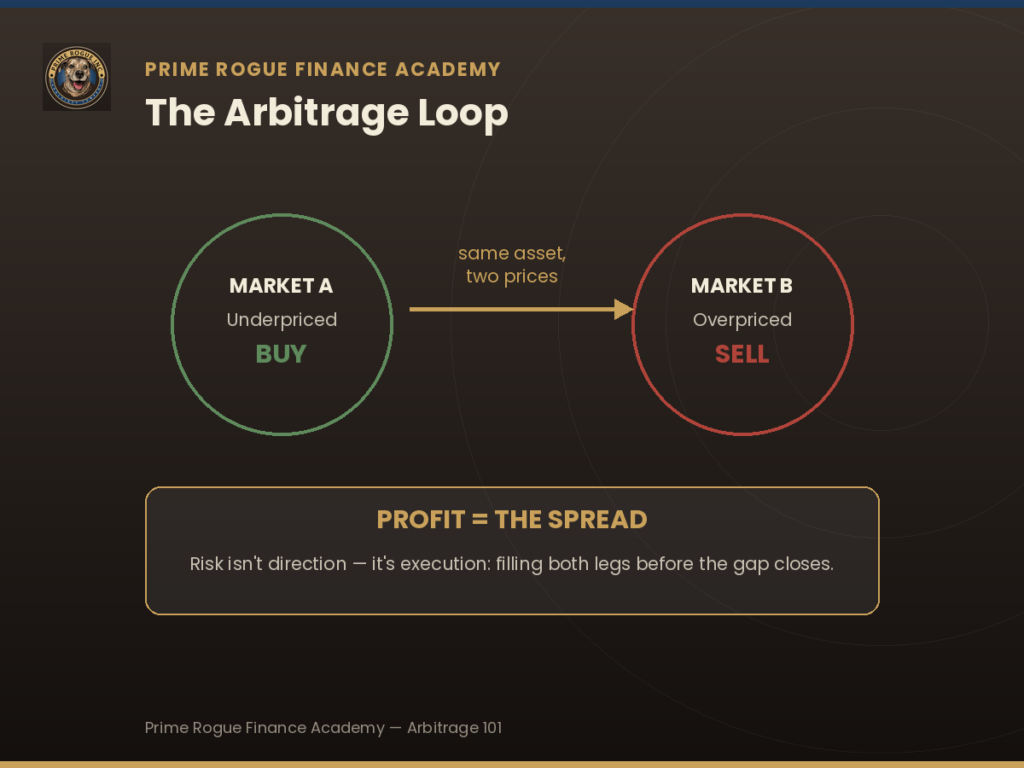
Arbitrage, stripped down to its skeleton, is the simultaneous purchase and sale of an asset — or something functionally equivalent to it — in different markets, to profit from a price discrepancy. That’s the textbook definition. In practice it’s closer to this: somewhere, information hasn’t finished traveling yet. A price hasn’t caught up to a fact. A regulation in one jurisdiction hasn’t been reconciled with a regulation in another. A bookmaker’s model disagrees with a sharper bookmaker’s model. A blockchain’s liquidity pool hasn’t rebalanced against a centralized exchange’s order book. Arbitrage is what happens in the gap before the world notices its own contradictions and closes them.
Two markets are quoting the same asset. Plug in the numbers and see whether there’s a real arbitrage — and what it’s actually worth after fees.
The reason it’s profitable — genuinely, structurally profitable, not just “profitable until it isn’t” — is that it’s not a bet on direction. You’re not long or short anything in the conventional sense. You’re long the convergence itself. You buy the cheap leg, sell the expensive leg, and you don’t actually care whether the underlying goes up or down, because you’re holding both sides. The risk isn’t market risk, it’s execution risk: can you get both legs filled before the gap closes, before your counterparty figures out what you’re doing, before the regulator, the exchange, or the casino operator decides you’re no longer welcome at the table.
This is why arbitrage is less a trading strategy than an epistemics problem. You are, functionally, in the business of finding places where the map has diverged from the territory, and getting paid to redraw it.
Long before anyone called it “arb,” this was statecraft. Currency arbitrage between empires, grain arbitrage between famine and surplus regions, the entire triangular trade — brutal, monstrous, but structurally an arbitrage of labor cost differentials across jurisdictions with no shared legal framework to close the gap. The mechanism is morally neutral even when the application is not, which is a sentence I hate typing but which is true.
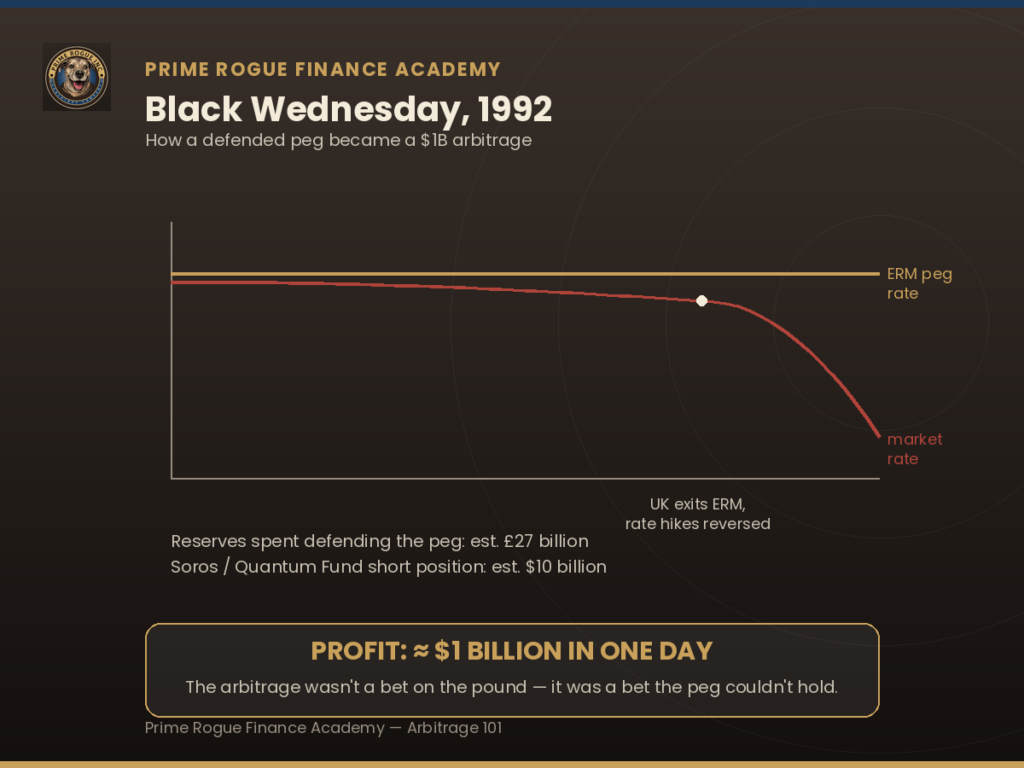
The modern textbook case is Black Wednesday, September 1992. The UK had pegged the pound to the Deutsche Mark inside the European Exchange Rate Mechanism at a rate the British economy couldn’t actually support — high UK interest rates domestically, a currency that was structurally overvalued relative to what German reunification-era interest rates demanded. George Soros and Quantum Fund looked at that peg and saw a government promise that the market fundamentals didn’t back up. They shorted the pound at a scale — reportedly around $10 billion — that the Bank of England’s reserves couldn’t absorb. The Bank tried to defend the peg, burned through billions in reserves, hiked rates twice in a single day, and still had to pull the pound out of the ERM. Soros made roughly a billion dollars in a day. That’s not speculation in the pejorative sense — that’s arbitrage between a stated policy and an economic reality, with the state on the losing side of its own promise.
You see the same structure everywhere international relations meets price formation:
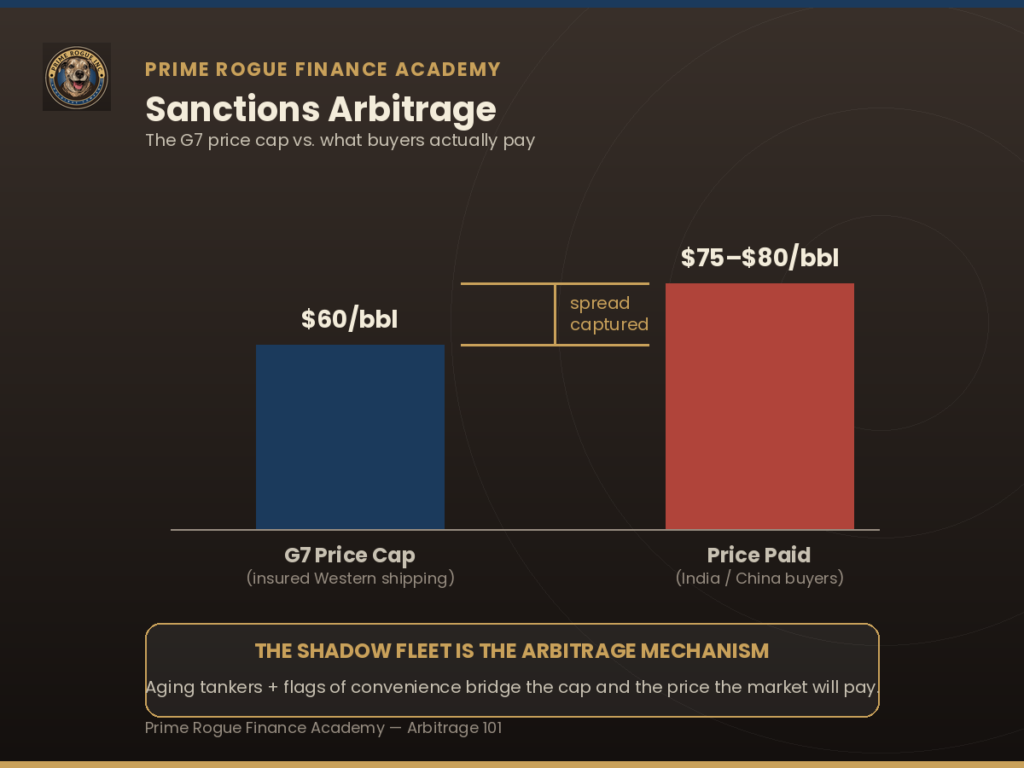
Sanctions arbitrage. The G7 price cap on Russian seaborne crude, imposed after the 2022 invasion, created a textbook two-tier market almost instantly. Western insurers and shippers wouldn’t touch cargoes above $60/barrel; Russia needed to move oil anyway. The “shadow fleet” — aging tankers, opaque ownership structures, flags of convenience, ship-to-ship transfers in international waters off Greece or Malaysia — exists entirely because of the spread between the sanctioned price and what buyers in India and China were actually willing to pay. Every tanker in that fleet is a floating arbitrage position, and the traders running it are pricing geopolitical risk (interdiction, secondary sanctions, insurance voids) the same way a crypto arb bot prices slippage.
Regulatory and tax arbitrage. The “Double Irish with a Dutch Sandwich” wasn’t a loophole so much as an arbitrage between three separate national tax codes that had never been designed to interact with each other, exploited at scale by nearly every major American tech company for a decade. Ireland closed it in 2015 under EU pressure, and the arbitrage simply migrated — Singapore, Bermuda, wherever the next structural mismatch in how jurisdictions define a “permanent establishment” opened up. Flags of convenience in shipping (Panama, Liberia, the Marshall Islands) are the same mechanism applied to labor and safety regulation instead of tax.
Interest rate arbitrage — the carry trade. Borrow in a currency with near-zero rates (yen, for decades), convert, and invest in a currency with meaningfully higher rates (Australian dollar, Mexican peso, US Treasuries at various points). You pocket the differential. This is enormous — hundreds of billions of dollars of global capital flow — and it’s also exactly what unwound so violently in August 2024, when the Bank of Japan raised rates unexpectedly and forced a rapid, brutal unwind of yen-carry positions that hit global equity markets in a matter of days. The arbitrage was real and profitable for years. The unwind was the bill coming due all at once, which is the recurring lesson of every arbitrage strategy that scales past the size the underlying inefficiency can actually support.
CUSMA and tariff engineering. Anyone paying attention to the current renegotiation cycle around CUSMA — and I’ve been elbow-deep in this through the Alberta interference file — has watched companies arbitrage rules-of-origin thresholds in real time: shifting a percentage of component sourcing across the Mexican, Canadian, and American legs of a supply chain specifically to stay inside preferential tariff treatment. It’s not smuggling. It’s reading the treaty text more carefully than the people who wrote it, and structuring accordingly.
In traditional finance, arbitrage gets less romantic and more mechanical, but the underlying logic is identical.
Merger arbitrage is probably the purest form retail investors ever encounter. Company A announces it’s acquiring Company B for $50/share. Company B’s stock, pre-announcement, was trading at $38. It jumps to $47 on the news — but not to $50, because there’s deal risk: regulatory blocks, financing falling through, shareholder votes failing. The arbitrageur buys at $47, collects the $3 spread when the deal closes, and is effectively getting paid to underwrite the probability that a merger completes as announced. This is exactly the trade that made Ivan Boesky famous and then infamous — merger arb is legal and enormous, insider trading on merger arb is what took him down.
ETF creation/redemption arbitrage is the unglamorous machinery that keeps ETF prices tracking their underlying net asset value. When an ETF trades at a premium to its basket of holdings, authorized participants create new shares by delivering the underlying basket and selling the new ETF shares into the premium. When it trades at a discount, they do the reverse. Nobody talks about this at dinner parties, but it’s a permanent, structural, low-margin arbitrage that processes billions daily and is a large part of why ETFs track so tightly.
Statistical arbitrage is the quant version — pairs of historically correlated securities (Coke and Pepsi, two regional banks, an ETF and its component-weighted basket) that temporarily diverge from their historical relationship. You short the outperformer, go long the underperformer, and wait for reversion to the mean. This is Renaissance Technologies territory, and it’s the closest arbitrage gets to pure statistics rather than fundamental analysis — you don’t need to know why the pairs diverged, only that the historical relationship has a strong enough prior to bet on reversion.
This is where it gets genuinely interesting to me, because in DeFi, arbitrage isn’t a strategy layered on top of the market — it is the market’s error-correction mechanism, running autonomously, 24/7, with no human in the loop half the time.
Cross-exchange arbitrage is the simplest form: BTC trades at $61,200 on Coinbase and $61,340 on Binance. Bot buys on Coinbase, sells on Binance, pockets the spread minus fees and withdrawal friction. This used to be enormous in crypto’s early years — 2017-2018 saw kimchi premiums (Korean exchanges trading 10-40% above global spot due to capital controls) that were genuinely one of the best risk-adjusted trades of the decade, if you could actually get capital in and out of Korea, which was the whole problem.
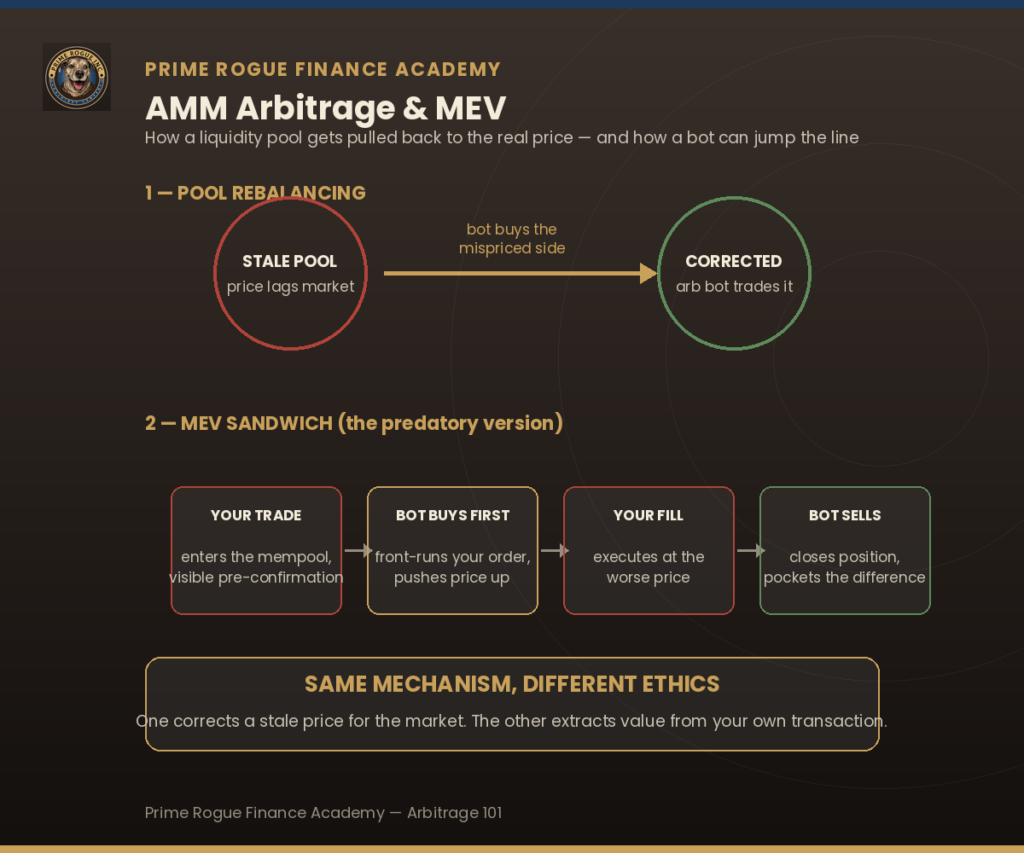
AMM arbitrage is the more structurally interesting version, and it’s the one I’ve been picking apart on WAX and its Alcor DEX pools — including a walk-through of how a rebalancing bot doubles as an involuntary defense against liquidity-draining shitcoin operators. Automated market makers like Uniswap, or the WAX-native DEXs, price assets algorithmically based on pool ratios (the constant-product formula, x*y=k, being the most common). That pricing only reflects reality when someone external corrects it. If ETH moves 2% on centralized exchanges in the sixty seconds it takes a block to confirm, the AMM pool is now mispriced relative to the rest of the market — and arbitrage bots race to trade against that stale price, pulling it back into line and pocketing the difference. This isn’t a bug being exploited; it’s the intended mechanism. AMMs are designed to be arbitraged — that’s how they stay accurate. The arbitrageurs are unpaid (well, paid, but not paid by the protocol) oracle-correction infrastructure.
MEV — maximal extractable value — is arbitrage’s more predatory younger sibling, and it’s the part of on-chain extraction that should bother people more than it does. A searcher bot sees your pending swap in the mempool, calculates it’ll move the pool price, and sandwiches you: buys ahead of your trade (pushing the price up before you fill), lets your trade execute at the worse price, then sells immediately after. You didn’t do anything wrong. You just got arbitraged against your own transaction, by someone who front-ran your intent using information that was, in principle, public — sitting in an unconfirmed mempool that anyone running a node could read. This is the sharpest illustration of the whole thesis: arbitrage profits from information gaps, and on a public blockchain, the “gap” is literally just the few hundred milliseconds between when you broadcast a transaction and when it confirms.
Triangular arbitrage rounds this out — three-way currency loops (BTC → ETH → USDT → BTC) where compounding small pricing inefficiencies across three pairs nets out to a risk-free profit if the loop closes favorably. This is nearly entirely bot territory now; the windows close in milliseconds, and it’s a genuine infrastructure and latency arms race, not unlike high-frequency equity trading in the 2000s.
And then there’s the one most people can actually access without a Bloomberg terminal or a Solidity contract: matched betting and sportsbook arbitrage, which has gotten dramatically more viable in Canada since single-event sports betting was legalized federally and Alberta deregulated its market to allow competing private operators.
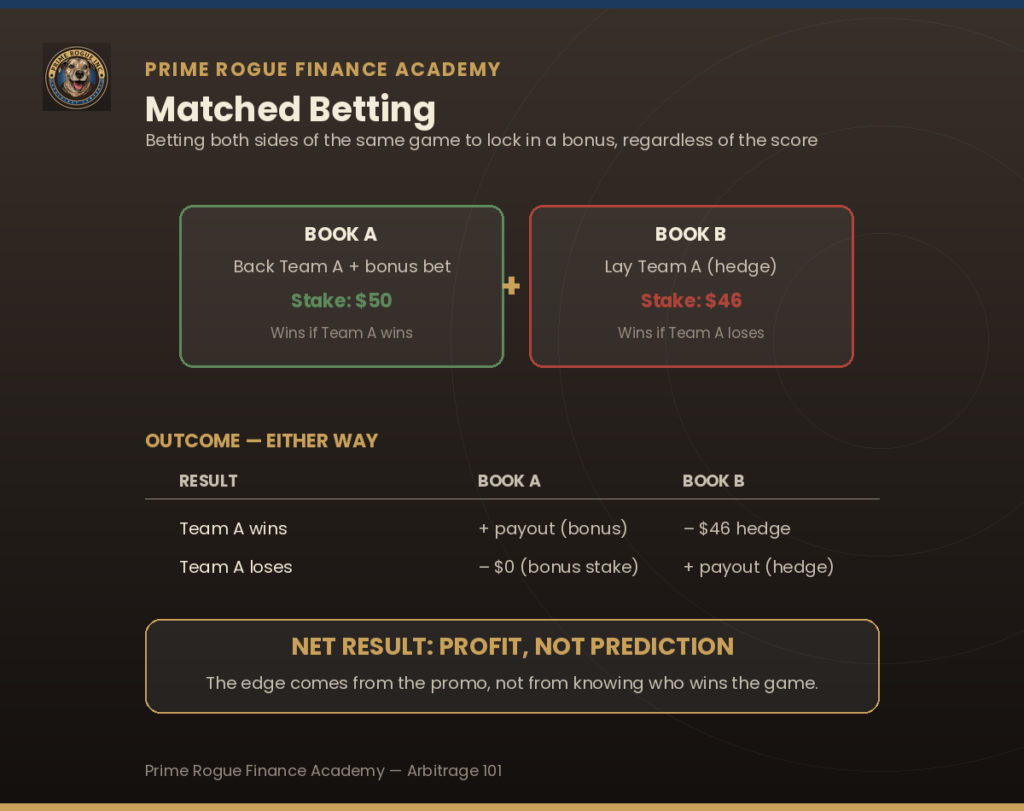
The mechanism is simple. Bookmakers set odds independently, based on their own models and their own liability books (how much they’ve already got riding on each outcome). Occasionally, two books disagree enough on a given match that you can bet Team A to win on Book One and Team B to win on Book Two, at odds that guarantee a profit regardless of the outcome — a true surebet. These are rare and small in efficient markets, but Alberta’s newly deregulated field, with 50+ operators aggressively acquiring market share since the July 2026 market opening, has produced exactly the kind of odds dispersion that creates them.
Two sportsbooks, two sides of the same game. Enter the decimal odds each one is offering and find out whether it’s a guaranteed profit — and exactly how to split your stake.
The more reliable version isn’t the pure surebet, though — it’s bonus arbitrage. Sportsbooks offer matched deposit bonuses, risk-free bet promotions, odds boosts, to acquire customers. If you back an outcome at the bookmaker (using their bonus funds or a promo) and simultaneously lay off the opposite outcome on a betting exchange like Betfair (or a competing sportsbook), you can extract a large percentage of the bonus’s face value as guaranteed profit, independent of which side actually wins. The bookmaker is pricing the promotion as a customer-acquisition cost; you’re pricing it as a mispriced free option. Both parties are being rational. Only one of them is doing math the operator would rather you didn’t. The same logic extends to casino wagering-requirement math — a 1× or 5× playthrough on a deposit match is just a bonus arb with a slot machine instead of a sportsbook as the instrument.
This isn’t a loophole in the sense of being unintended — the operators know matched bettors exist, they build customer-acquisition-cost models that account for the leakage, and they’ll eventually flag and restrict accounts that do it too cleanly, too often (a practice called “gubbing” in the UK, where books quietly cap winning accounts to stakes too small to matter). This is arbitrage’s universal endgame across every domain: the inefficiency gets found, gets exploited, and gets closed — by the counterparty adjusting, by regulators intervening, or by enough capital piling in that the spread compresses to nothing. The Bank of England eventually stopped defending indefensible pegs. Ireland closed the Double Irish. Exchanges deepened liquidity until kimchi premiums collapsed. Sportsbooks got better fraud models. AMMs got better oracle feeds and MEV-resistant ordering (Flashbots, private mempools).
The deeper point — and this is the part I actually care about, more than the yield — is that arbitrage is a diagnostic. Every arbitrage opportunity is a receipt for somebody’s mispricing of reality: a central bank defending a peg the fundamentals don’t support, a tax code written before anyone imagined a Bermuda holding company, an AMM pool that hasn’t heard the news yet, a sportsbook model that weighted an injury report wrong. Watching where arbitrage clusters — geographically, sector by sector, chain by chain — tells you more about where institutions are lying to themselves, or to the public, than almost any other signal available to an outside observer. It’s not a coincidence that the periods of richest arbitrage opportunity — post-Soviet privatization, the early DeFi summer of 2020, the immediate aftermath of major sanctions regimes — are also periods of maximum structural confusion, where old rules haven’t caught up to new realities.
Find the gap. Understand why it exists, not just that it does. That’s usually the more valuable output than the trade itself — the trade just pays the rent while you figure out what the gap is telling you about the system that produced it.
Prime Rogue Finance covers market structure, DeFi mechanics, and the places where geopolitics and price formation collide. For deep dives on WAX blockchain extraction patterns, Alberta sportsbook deregulation, and sanctions-market interaction, see related coverage on the site.
 The Hormuz Cycle: Why the Iran War Keeps Whipsawing Oil Markets
 BMO Banking Outage 2026: BMO Communications Gone Dark During Stampede
 Would Donald Trump Strike Iran During the State of the Union – With Markets Opening the Next Morning?
 The M10 Booker Is Dead: Why the U.S. Army Killed Its ‘Light Tank’ in the Age of Near-Peer War