Address
304 North Cardinal St.
Dorchester Center, MA 02124
Work Hours
Monday to Friday: 7AM - 7PM
Weekend: 10AM - 5PM

Address
304 North Cardinal St.
Dorchester Center, MA 02124
Work Hours
Monday to Friday: 7AM - 7PM
Weekend: 10AM - 5PM

Unverified social media posts claiming transgender shooter identity are circulating across X and Facebook. Prime Rogue has not independently verified these claims. RCMP continues to withhold shooter identity citing privacy and ongoing investigation, creating information vacuum that fuels speculation and misinformation. New section added analyzing transparency failure and statistical context: whether shooter was biological female (rare), transgender (rarer), or misidentified, institutional failures remain constant.
RCMP confirmed shooter identity matches emergency alert description but stated investigators will “struggle to ever determine a motive” for the massacre. Grade 12 student Darian Quist describes barricading classroom with tables for over 2 hours while receiving photos of the shooting on his phone. BC Solicitor General Nina Krieger confirmed RCMP arrived on scene within 2 minutes of initial call. Mayor Darryl Krakowka: “I will know every victim. I’ve been here 19 years… I don’t call them residents. I call them family.” Article updated throughout with student testimony, official statements, and investigative details. Schools closed remainder of week; trauma counselors deployed to region.
Initial publication contained two factual errors corrected below:
Distance Error: Originally stated “97km from Dawson Creek” — corrected to 117km (Highway 52 driving distance per BC government tourism data and mapping sources).
Investment Clarification: Originally stated “$500 million investment” without distinguishing purchase price from operational capex. Corrected: Conuma Resources purchased Quintette Mine from Teck Resources for $120 million (February 2023), then invested approximately $500 million to restart operations (equipment, rail infrastructure, processing plant rehabilitation). Total commitment: ~$620 million.
Source: Cross-referenced official Conuma Resources statements, BC Ministry of Energy announcements, and local journalism (Tumbler RidgeLines, September 2024).
Analysis Impact: None. Resource town pathology thesis, geographic isolation metrics, and institutional accountability framework remain valid. Distance error affected one descriptive data point; investment clarification strengthens economic context for boom-bust cycle analysis.
The logs can’t lie — including our own.
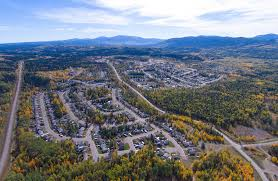
Ten people are dead—nine victims and one shooter—after a mass shooting at Tumbler Ridge Secondary School in northeastern British Columbia turned a Tuesday afternoon into Canada’s deadliest school massacre. Six died inside the 160-student school, one en route to hospital, and two more at a residence connected to the incident per reports available at 19:58 MST on February 10, 2026. The shooter, found dead from a self-inflicted gunshot wound inside the school, has not been publicly identified by RCMP despite an emergency alert describing the suspect as a “female in a dress with brown hair.”
Twenty-five others were assessed for injuries at the town’s small health centre, which remains on restricted access. Two victims were airlifted to regional hospitals with life-threatening injuries. In a community of 2,400 people where “everyone knows everyone,” as local pastor George Rowe described it, the casualty list represents roughly 1.5% of the entire population directly impacted in a single afternoon.
This was not random violence visiting a peaceful Canadian town. This was the predictable eruption of pathologies baked into resource extraction economies—boom-bust psychological whiplash, geographic isolation creating service deserts, and planned communities built for profit extraction rather than human resilience. Tumbler Ridge didn’t just experience a school shooting. It experienced the consequences of being designed as a disposable colony for metallurgical coal.
Before examining the systemic failures that created the conditions for this massacre, two statistical outliers demand documentation.
Tumbler Ridge may surpass École Polytechnique (Montreal, 1989) as the deadliest school shooting in Canadian history. That anti-feminist massacre by Marc Lépine killed 14 women plus the shooter for a total of 15 dead. Tumbler Ridge’s toll currently stands at 10, but with two victims in critical condition and 25 others injured, the final count remains uncertain.
Previous major Canadian school shootings:
Tumbler Ridge represents a threshold crossing. For 37 years, École Polytechnique stood as the worst. That marker may have fallen in a town of 2,400 that most Canadians couldn’t locate on a map.
The emergency alert described the suspect as a “female in a dress with brown hair.” RCMP has not released the shooter’s identity, age, or biographical details as of this writing, citing ongoing investigation. This creates a significant analytical gap.
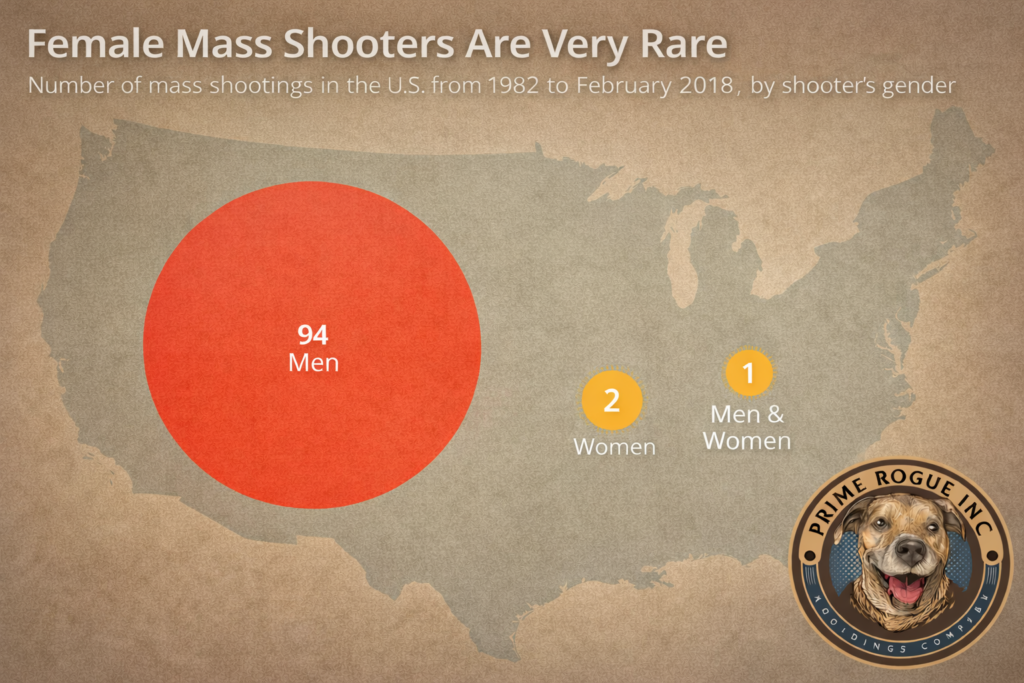
Female school shooters represent less than 3% of all school shooting perpetrators according to FBI data spanning 2000-2019. In that dataset, only 13 of 345 active shooter perpetrators were female. The National Center for Education Statistics found 94% of active shooters in education settings between 2000-2022 were male.
Of 349 K-12 school homicides since 2000, only 12 known shooters were female, with just 9 being juveniles—less than 3% of the total. Juvenile females who carry out mass school shootings with multiple fatalities are even rarer. Prior to the December 2024 Abundant Life Christian School shooting in Wisconsin (carried out by a 15-year-old girl), it had been 45 years since a juvenile female shooter took multiple lives on school grounds.
The transgender question requires evidence, not speculation. Some reporting and social media commentary has suggested the shooter may have been transgender, but as of publication, RCMP has released no confirmation of the shooter’s identity or gender history. The Violence Prevention Project’s database of 200+ mass shootings since 1999 identifies only one transgender shooter: Audrey Hale in the 2023 Nashville Covenant School shooting. That represents 0.5% of mass shooters in their dataset.
Broader data from the Gun Violence Archive shows 5 confirmed transgender shooters out of 5,748 mass shootings between January 2013 and September 2025—less than 0.1% of incidents. Meanwhile, 97.7% of mass shooting perpetrators from 1966-2019 were cisgender male according to Justice Department data.
We do not speculate on the Tumbler Ridge shooter’s gender identity. The emergency alert’s description of “female in a dress” could indicate:
What matters for this analysis is that RCMP’s information blackout, regardless of the shooter’s identity., represents a transparency failure that prevents public understanding of motive, planning, and foreseeable intervention points. Whether the shooter was female, male, transgender, or misidentified, the institutional failures that allowed this massacre remain the same.
The statistical rarity of a female perpetrator, if confirmed, intersects with resource town social pathology in ways that require investigation rather than assumption. Female mass shooters, according to research published in the Journal of Mass Violence Research, differ from male shooters in motivation patterns—they are less likely to be motivated by romantic grievances and more likely to target workplaces or act as part of ideologically motivated pairs.
We will update this analysis as RCMP releases biographical details. For now, we focus on what we know: a 2,400-person resource extraction town experienced Canada’s deadliest school shooting, and the systems designed to prevent such tragedies failed comprehensively.
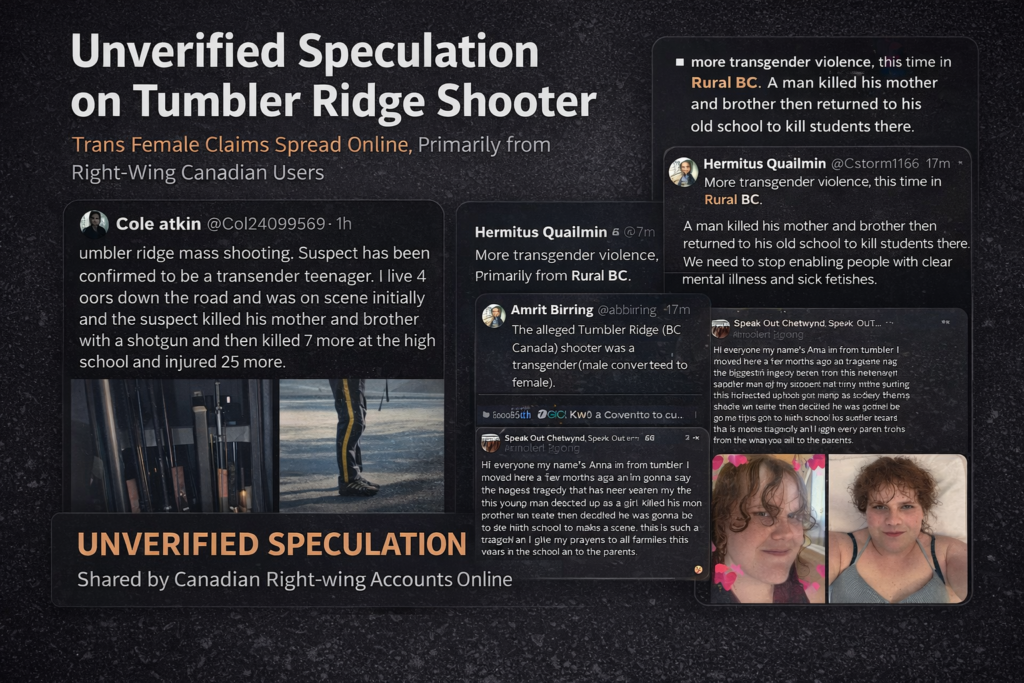
RCMP’s decision to withhold the shooter’s identity—citing privacy concerns and ongoing investigation—has created an information vacuum rapidly filling with unverified social media claims. Within hours of the shooting, posts circulating on X (formerly Twitter) and Facebook began asserting the shooter was a transgender individual who killed family members before attacking the school.
Prime Rogue has not independently verified these claims and cannot confirm their accuracy based on available evidence.
The unverified speculation centers on:
Some elements align with confirmed facts—RCMP did confirm two deaths at a residence “believed to be connected to the incident,” though they have not disclosed the relationship between those victims and the shooter. The emergency alert’s description of “female in a dress with brown hair” is ambiguous enough to support multiple interpretations. But alignment with partial facts does not equal verification.
This pattern—official information vacuum → social media speculation → misinformation cascade—illustrates why transparency is a public safety imperative, not bureaucratic nicety.
If the shooter were confirmed to be transgender, this would represent an intersection of two separate statistical anomalies:
Female mass shooters (any identity): Less than 3% of perpetrators (FBI, National Center for Education Statistics)
Transgender mass shooters: Approximately 0.1% of mass shooting incidents according to Gun Violence Archive data (5 confirmed transgender shooters out of 5,748 mass shootings January 2013-September 2025). The Violence Prevention Project’s database of 200+ mass shootings since 1999 identifies only one transgender shooter: Audrey Hale in the 2023 Nashville Covenant School shooting (0.5% of their dataset).
A transgender female school shooter would exist at the intersection of two rare perpetrator profiles. Statistical rarity, however, does not equal impossibility. Nor does it provide explanatory power without understanding individual context, motive, and institutional failures.
The Charlie Kirk assassination (September 10, 2025, Utah Valley University) involved similar early speculation. Media initially reported transgender motivations based on social media claims and misinterpreted evidence at the scene. The actual investigation revealed the shooter Tyler Robinson (22, cisgender male) had a transgender roommate who became central to motive investigation, but Robinson himself was not transgender. The speculation created culture war narratives that obscured the actual complexity: Robinson’s anger at Kirk’s views on gender identity stemmed from his roommate’s transition, not his own identity.
Early speculation shaped media framing, political responses, and public perception—all before verified facts emerged. Tumbler Ridge risks repeating this pattern.
RCMP North District Chief Superintendent Ken Floyd’s statement that investigators “will struggle to ever determine the ‘why'” behind the massacre raises critical questions about what is known versus what is being disclosed:
Floyd confirmed police “believe they have identified the shooter” but declined to release name, age, or confirm whether the shooter was a minor or adult. Privacy considerations for deceased perpetrators must be balanced against public safety analysis, prevention research, and democratic accountability. The shooter has no privacy interest that outweighs public safety imperatives.
Canadian privacy law allows disclosure of deceased persons’ information when there is clear public interest. The Access to Information Act and provincial Freedom of Information and Protection of Privacy Act both contain public interest override provisions. RCMP’s blanket refusal suggests either legal overcaution or deliberate information control pending investigation completion.
In a school of 160 students with approximately 20 in the graduating class, warning signs rarely go completely unnoticed. Modern mass shooters leave digital trails: social media posts, manifestos, communications with peers, search histories, threats, grievances. RCMP has access to:
Floyd’s admission that investigators will “struggle to determine” motive suggests either:
None of these possibilities justify information blackout. All of them demand transparency.
In small communities where social dynamics are inescapable and anonymity is impossible, troubled youth are visible. The shooting occurred five months into economic revival after 24-year mine closure—a period of renewed optimism but also social disruption as newcomers arrive, housing prices shift, and the fragile equilibrium of a depopulated town gets disrupted.
Did School District 59 conduct threat assessments? Did counselors identify warning signs? Did peers report concerning behavior? Did social media monitoring systems (if any exist) detect threatening content? These questions have answers. RCMP has those answers. The public does not.
The social media speculation—whether accurate or not—demonstrates how official opacity breeds conspiracy theories, misinformation, and ideological exploitation:
Conservative accounts, many associated with the trucker convoy and the Maple MAGA movement, are framing unverified transgender identity claims as evidence of a “transgender violence epidemic” despite statistical data showing transgender individuals account for 0.1% of mass shooters while cisgender males account for 97.7% (DOJ data 1966-2019). Some posts assert “most US shootings are done by transgenders because they are on hormone blockers”—a claim with zero empirical support and contradicted by comprehensive shooting databases.
Progressive accounts are dismissing any possibility of transgender identity as right-wing propaganda, calling such speculation inherently transphobic. Some argue that even discussing the statistical possibility constitutes hatred. This position conflates evidence-based analysis with bigotry and shuts down legitimate questions about whether gender dysphoria intersects with mental health crises in resource town contexts.
Both approaches weaponize the information vacuum. Conservatives use unverified speculation to advance anti-trans narratives. Progressives use privacy arguments to shut down investigation of uncomfortable possibilities. Neither side serves public safety, prevention research, or democratic accountability.
The truth—whatever it is—matters more than either side’s preferred narrative.
Tumbler Ridge is not a community. It is a planned extraction colony that briefly pretended to be a town.
Built in 1981 by the British Columbia provincial government under the Northeast Coal Development plan, Tumbler Ridge was designed with a single purpose: house workers for two open-pit metallurgical coal mines serving Japanese steel mills. The government committed to building the entire town infrastructure—housing, two highways off Highway 97, a power line from the W.A.C. Bennett Dam 140km away, and a branch rail line through the Rocky Mountains featuring two major tunnels (9.7km Table Tunnel and 5.5km Wolverine Tunnel).
This was not organic settlement. This was industrial logistics.
The 1977 conceptual plan projected population growth to 10,584 by 1987. Reality delivered different numbers:
The town’s population has never exceeded half of its original projected stabilization point. For 43 years, Tumbler Ridge has existed in a state of unrealized expectation—built for 10,000, never reaching 5,000, collapsing to 2,000, crawling back to 2,400.
The economic history reads like a case study in induced trauma:
Boom 1 (1983-2000): Quintette mine employs 1,200, Bullmoose mine employs 300. The town peaks near 5,000 population. Families invest in homes, children grow up believing in permanence.
Bust 1 (2000-2014): Quintette closes August 2000 due to coal price collapse. Bullmoose exhausts reserves and closes 2003. The population crashes. Housing prices collapse. Businesses shutter. 23% unemployment in 2016. People who bought homes at peak prices are underwater, trapped in a town with no economy.
Fragile Recovery (2016-2024): Conuma Resources purchases mines, restarts Wolverine (2017), begins operating Willow Creek and Brule. The population stabilizes around 2,400.
Boom 2 (September 2024-Present): Quintette mine restarts after 24-year closure. Conuma invests $500 million, projects 400-450 permanent jobs at $50-60 million annual wages. First coal shipment in over two decades leaves September 2024. The town experiences cautious optimism—emphasis on cautious.
The shooting occurred February 10, 2026—five months into the new boom cycle.
This timing matters. The psychological impact of sudden economic revival after decades of decline creates its own stressors. Longtime residents who survived the bust watch newcomers arrive for mining jobs. Housing prices rise. The fragile equilibrium of a depopulated town gets disrupted. For youth who grew up in the bust years—watching parents struggle, businesses close, friends leave—the mine restart doesn’t erase trauma. It adds complexity.
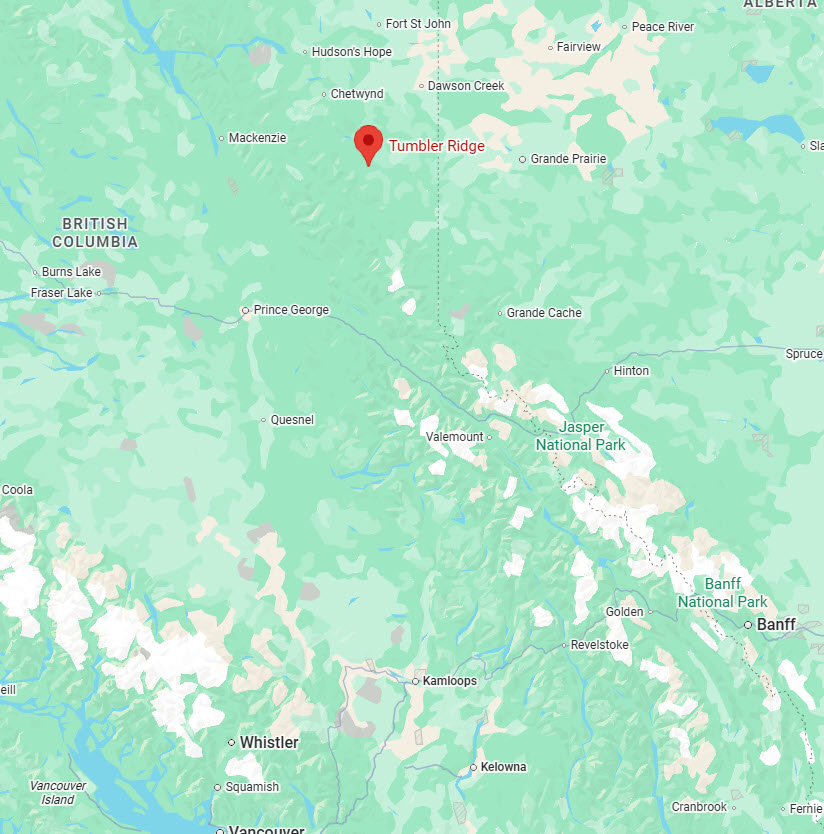
Tumbler Ridge sits in the foothills of the Rocky Mountains in a position designed for mine access, not emergency response:
When the shooting began at 1:20 PM, the town’s response infrastructure consisted of:
For 25+ casualties, the town had:
Distance killed in Tumbler Ridge. One victim died en route to hospital—the nearest trauma centers being Fort St. John (170km) or Grande Prairie (249km). With two victims airlifted in critical condition, the question becomes: how many of the 25 assessed at the health centre needed care beyond what a facility in a town of 2,400 can provide?
The emergency alert went to a massive area—Tumbler Ridge, Chetwynd, Dawson Creek, and surrounding communities—because the response required drawing resources from across the entire Peace River region. In urban Canada, this level of mass casualty triggers coordinated metro-area emergency response. In Tumbler Ridge, it triggers a helicopter airlift and hope.
Planned communities built for resource extraction lack the organic social infrastructure that develops in settlements with mixed economic foundations. Tumbler Ridge has:
We don’t know these numbers because they’re not routinely tracked or reported for communities this small. The ATIP cascade we’re deploying will force disclosure, but the preliminary analysis suggests severe service deserts.
Pastor George Rowe, a 35-year Tumbler Ridge resident and former substitute teacher at the secondary school for eight years, described the community as “very closely knit” where “we all share this tragedy as if it was my family, or my neighbour’s family.”
That closeness has a dark side. In a town of 2,400 where everyone knows everyone, there is nowhere to hide, nowhere to escape reputation or history, and limited capacity for anonymity that urban youth take for granted. The intimacy that creates community resilience also creates inescapable social pressure.
1:20 PM MT: Tumbler Ridge RCMP receives report of active shooter at Tumbler Ridge Secondary School
~1:20-2:15 PM: Initial RCMP response, school entry, suspect located deceased inside school from self-inflicted gunshot wound, casualty assessment begins
2:15 PM PT (3:15 PM MT): Emergency alert issued across massive area (Tumbler Ridge, Chetwynd, Dawson Creek, Beaverlodge, Hythe) describing suspect as “female in a dress with brown hair,” ordering shelter-in-place
Evening:
Two victims found dead at a residence “connected to the incident” suggest a domestic origin point before the school attack. This pattern has precedent:
La Loche, Saskatchewan (2016): 17-year-old shooter killed two brothers at home before going to La Loche Community School and killing two teachers, wounding seven others.
The domestic-to-school sequence indicates planning, targeted violence beyond random school attack, and potential for victimology patterns RCMP is not yet disclosing. Key questions:
RCMP’s silence on these details, while tactically sound for investigation integrity, prevents public understanding of threat patterns and intervention failures. The ATIP cascade must force disclosure once investigative needs allow.
The 2020 Portapique, Nova Scotia massacre—where Gabriel Wortman killed 22 people over 13 hours in Canada’s deadliest mass shooting—triggered sweeping promises of emergency response reform. Retired RCMP major crimes investigator Bruce Pitt-Payne stated he believes “police will take what they learned from the 2020 mass shooting in Portapique, N.S., that left 22 people dead, and apply it to this situation.”
But what actually changed?
The three official investigations following École Polytechnique (1989) “severely condemned the emergency response”—specifically:
Post-Polytechnique reforms led to “immediate, active intervention by police” protocols. These were credited with minimizing casualties at the 1992 Concordia University shooting, the 2006 Dawson College shooting, and the 2014 Parliament Hill attack.
Portapique revealed those reforms were insufficient for:
Tumbler Ridge tested the post-Portapique promises in a resource town context:
The preliminary assessment: RCMP entered the school immediately, located the deceased shooter quickly, and prevented additional deaths. This represents successful implementation of active shooter protocols.
But the casualty count—10 dead, 2 critical, 25+ injured—raises questions about prevention rather than response. Active shooter protocols minimize deaths after shooting begins. They don’t prevent shootings from starting.
School shootings are rarely spontaneous. Research from the U.S. Secret Service National Threat Assessment Center analyzing 67 incidents of targeted school violence found:
The Tumbler Ridge shooter existed in a context of observable stressors:
We don’t yet know what specific warning signs existed because RCMP has not released biographical details, social media analysis, or threat assessment history. The ATIP cascade will force these disclosures:
The pattern we expect to find: known warning signs, inadequate resources to respond, systemic failures masked by geographic isolation.
Within 72hours of publication, Prime Rogue Inc. will file the following Access to Information and Privacy requests under British Columbia’s Freedom of Information and Protection of Privacy Act (FIPPA):
The goal is systematic documentation of foreseeable failures. In resource extraction towns with boom-bust cycles, geographic isolation, and limited social infrastructure, youth mental health crises are predictable. The question is whether institutions documented the risks, allocated resources to address them, and took action to prevent violence.
We expect to find paper trails of recognized gaps, unfunded mandates, and deferred action. The ATIP cascade will force those documents into public record.
Tumbler Ridge is not unique in its pathology. Canadian resource extraction communities demonstrate consistent patterns:
The research literature consistently identifies these risk factors in resource extraction communities:
Tumbler Ridge exhibits all six risk factors. The February 10 shooting is not an aberration. It is the violent manifestation of structural pathologies inherent to resource extraction colony design.
In the aftermath of school shootings, political responses invariably turn to technology: metal detectors, security cameras, AI threat detection, social media monitoring, facial recognition. These are expensive distractions from systemic failures.
Metal detectors don’t prevent determined shooters—they displace attacks to entry points or create security theater. In a 160-student school in a town of 2,400, metal detectors would be performative absurdity.
Security cameras document violence but rarely prevent it. Tumbler Ridge Secondary likely had basic security systems. They didn’t stop the shooting.
AI threat detection for social media monitoring faces fundamental problems in resource towns beyond being highly unethical – as is the case with most AI social media monitoring:
The real prevention infrastructure isn’t technological—it’s social and economic:
Tumbler Ridge’s Quintette Mine restart in September 2024 represents a significant economic investment. First Conuma Resources purchased Quintette Mine from Teck Resources for $120 million in February, 2023. Conuma Resources then invested $500 million to restart operations, creating 400-450 jobs, and approximately $50-60 million annual wages. But no equivalent social infrastructure investment accompanied the restart. No expanded mental health services, no youth counseling capacity increase, no community programs addressing the psychological impact of economic whiplash.
The mine restart created optimism, but optimism without social infrastructure is just renewed vulnerability.
None of this will happen because resource extraction economics don’t account for social costs. Tumbler Ridge exists to extract metallurgical coal for Asian steel mills. The town’s population, mental health, and social cohesion are externalities.
Ten people died because externalities eventually internalize as violence.
The documented timeline reveals systemic failures at every level:
Federal: No national framework for youth mental health in resource communities
Provincial: No social infrastructure requirements for mine development/restart
Regional: No mental health service standards for isolated communities
School District: Unknown (pending ATIP) threat assessment and counseling capacity
RCMP: Five officers for 1,558 km² municipality with 2,400 residents
The shooter, whose identity RCMP has not released, existed within these systemic failures. Whether the emergency alert’s description of “female in a dress with brown hair” indicates a biological female (statistically rare), transgender individual (statistically rarer), or misidentification (possible), the institutional failures remain constant.
Female school shooters represent less than 3% of perpetrators. If confirmed, this demographic anomaly intersects with resource town pathology in ways that demand investigation, not speculation. The statistical rarity of female mass violence—contrasted with 97.7% male perpetrators—suggests different motivational patterns that research has only begun to document.
But speculation without evidence is irresponsible. RCMP’s information control, whether for investigative integrity or privacy protection, creates a vacuum that invites narrative-filling. We resist that temptation.
What we know with certainty:
The ATIP cascade will force documentation of those failures. The logs can’t lie.
Tumbler Ridge represents the violent endpoint of a model—resource extraction colonies designed for profit maximization and population disposability. Build a town, extract resources, abandon when prices fall, restart when markets recover. Repeat. The human costs—mental health, social cohesion, community stability—are externalities until they manifest as body counts.
Canada will mourn Tumbler Ridge, promise reform, and continue building resource extraction colonies on the same pathological model. The next town, the next boom-bust cycle, the next generation of vulnerable youth, the next shooting.
Unless the fundamental model changes—unless resource development requires equivalent social infrastructure investment, unless geographic isolation is addressed through regional service hubs, unless economic diversification becomes mandatory, unless youth mental health is treated as essential rather than optional—Tumbler Ridge will not be the last.
The metallurgical coal extracted from Quintette Mine will be shipped to Prince Rupert, then to Asian steel mills. It will be formed into construction materials, vehicles, and infrastructure. Physical remnants of Tumbler Ridge’s reason for existence will be distributed globally.
The human cost will remain in a 2,400-person town in the foothills of the Rocky Mountains, where ten people died on a Tuesday afternoon because Canada builds colonies instead of communities.
______
Kevin Duska is an intelligence professional, investigative journalist, and scholar of international politics who completed undergraduate and graduate studies in International Relations at McGill University and the Ohio State University specializing in constructivist theory, national security, narrative management, and institutional breakdown. He runs Prime Rogue Inc., a geopolitical risk analysis and private intelligence firm, and is an avid user of the Canadian Access to Information regime in his anti-surveillance and pro-transparency activism. His forthcoming book Echo State: The Logs Can’t Lie Yet (Autumn 2026) examines mass surveillance and transparency warfare in the age of institutional collapse.
 China Antimony Leverage: Geopolitics, Supply Chain Risks, and the Race for Resource Security
 George Hodgson Zinn and the Charlie Kirk Shooting: OSINT Profile
 Canada’s Potash Empire: The Untapped Power That Could Break U.S. Agriculture
 Dassault Rafale vs. F-35, Eurofighter vs. F-35: Can Europe Break Free from U.S. Airpower?