Address
304 North Cardinal St.
Dorchester Center, MA 02124
Work Hours
Monday to Friday: 7AM - 7PM
Weekend: 10AM - 5PM

Address
304 North Cardinal St.
Dorchester Center, MA 02124
Work Hours
Monday to Friday: 7AM - 7PM
Weekend: 10AM - 5PM
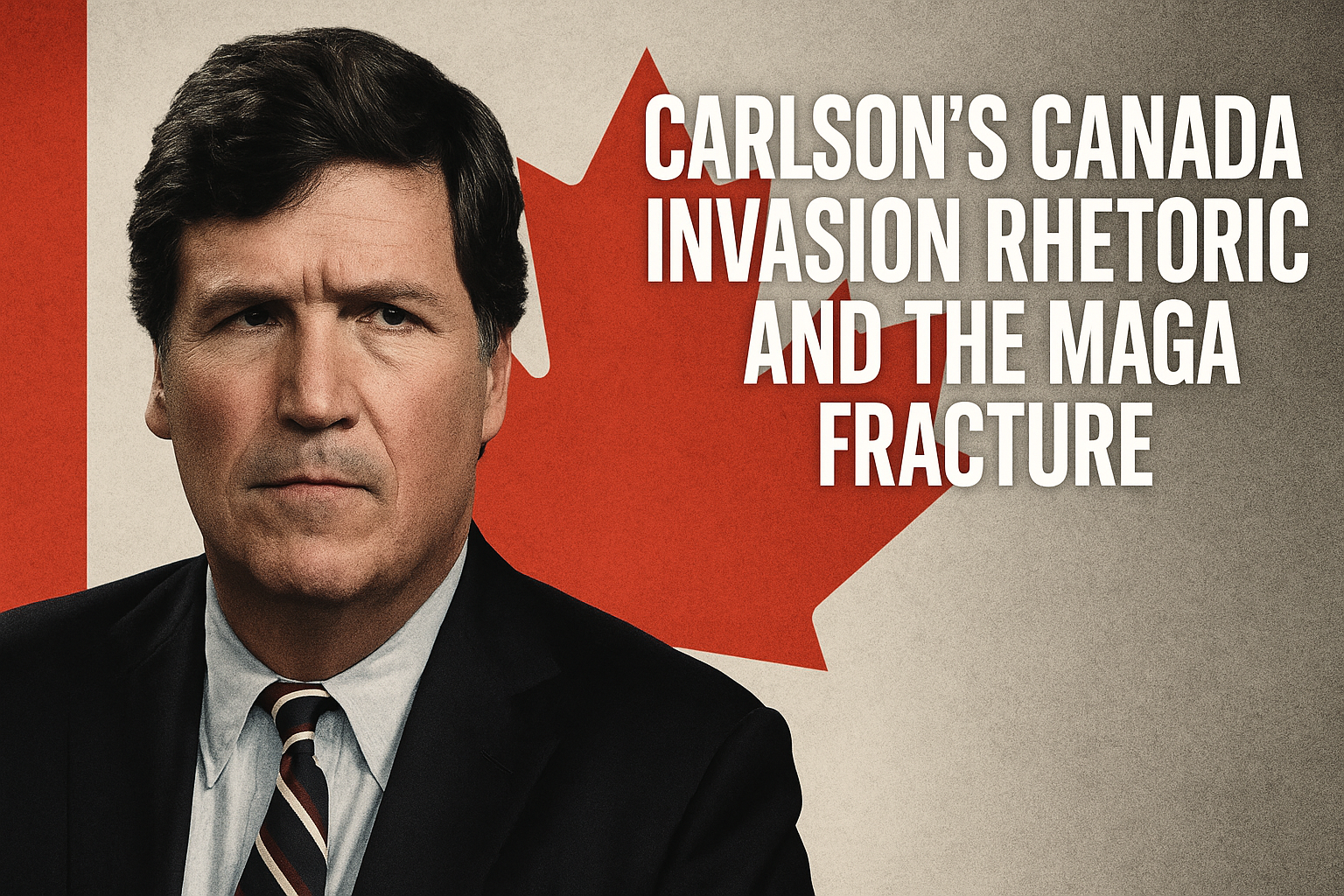
On December 12, 2025, American commentator Tucker Carlson delivered a series of explicit, uninterrupted statements during a live interview with Matt Walsh that collectively amount to an open endorsement of coercive action against Canada. In the span of roughly three minutes, Carlson engaged in an unprecedented narrative assault on Canadian sovereignty and legitimacy, asserting that:
Invasion rhetoric begins around 1:27:00 of the video.
Crucially, Carlson emphasized that he was not being satirical or hyperbolic (in stark contrast to his past provocations about Canada). He removed any ambiguity by repeating and elaborating the claims multiple times, even inviting controversy (“I’m sure I’ll be scolded… but it’s true”) as a badge of speaking forbidden “truth.” These remarks represent a dramatic escalation from Carlson’s earlier rhetoric on Canada circa 2022–2023, which could be dismissed as shock-jock provocation or dark humor. In January 2023, Carlson infamously mused about sending an “armed force north to liberate Canada from Trudeau” while likening Canada to Cubathe-independent.com – comments that he half-retracted moments later as getting “carried away.” The December 12, 2025 statements, by contrast, were delivered in deadly earnest with no retraction, pushing the Overton window of acceptable discourse regarding a close U.S. ally.
This report documents Carlson’s statements verbatim, situates them within his prior rhetoric and the evolving U.S. right-wing milieu, and analyzes their strategic function amid a fractured and radicalizing MAGA movement in the aftermath of the assassination of Charlie Kirk. The timing and framing suggest these statements are less a literal policy proposal than a form of narrative warfare: Carlson is attempting to redefine Canada as a legitimate target of moral outrage, coercion, and even aggression, at a moment when the U.S. far-right is seeking new external enemies to unify a splintering base. By leveraging incendiary (and largely false) claims about human rights abuses – specifically the Canadian euthanasia regime – Carlson provides his audience with a shocking moral justification to hate and threaten Canada, thereby externalizing the sense of crisis and evil. The report concludes that Carlson’s advocacy of action against Canada functions as a norm-shifting device, eroding long-standing taboos against threatening an allied neighbor and reframing Canada from trusted partner to grotesque villain in the narrative universe of the American far-right.
Primary Source: The primary source for this analysis is a live video interview between Tucker Carlson and Matt Walsh, streamed on December 12, 2025. The segment of interest occurred at timestamp 01:26:00 to 01:29:15 (HH:MM:SS) of the broadcast. The content was captured via direct observation in real-time and corroborated through independent recordings to ensure accuracy. Post-event, the relevant portion was replayed and transcribed in full for this report.
Verification: Multiple verifications were undertaken to confirm the authenticity and context of Carlson’s statements: (1) Live observation by Prime Rogue analysts as it aired; (2) Cross-checking with a replay archive made available by the YouTube; (3) A full verbatim transcript (see Section 2) prepared to preserve every word of the segment without edits or omissions. The transcript is presented uninterrupted, with no ellipses or redactions, to preclude any claims that quotes were “taken out of context.”
It should be noted that Carlson’s tone and body language were also observed: he appeared serious, leaning forward, with an emphatic and grave demeanor as well as mobilized affect. There was no laughter, smirk, or hint of irony detectable in his voice. Walsh, as the interviewee, largely nodded and voiced agreement, offering no challenge. These contextual details further support the conclusion that Carlson intended his statements to be taken at face value. All indications are that this was a deliberate, unambiguous articulation of Carlson’s views, not an offhand joke or hypothetical. The high confidence rating (“Very High”) reflects the direct, primary nature of the source and the consistency of the message across all verification points.
Integrity Note: The quotes in Section 2 are reproduced in full, including Carlson’s and Walsh’s words, to provide complete transparency. By documenting the source material exhaustively before analysis, the report ensures that any interpretation or assessment in later sections can be traced back to exactly what was said. The methodology of strict source fidelity and multi-angle verification follows OSINT best practices for contentious primary material.
The following is the full verbatim transcript of the relevant segment of the Carlson–Walsh interview, December 12, 2025 (01:26:00–01:29:15). No interruptions or commentary have been added. Carlson’s statements are reproduced in entirety, as are Walsh’s interjections. This section stands alone as the raw evidence.
Tucker Carlson (01:26:00): “Canada is not even a country… The government is murdering tens of thousands of its citizens each year, and most of them are White, and now they’re going to be doing it to kids. By the way, under the MAID program, they’re harvesting the organs. They’re harvesting the organs from the Canadians they kill.
That’s like the darkest thing. It’s like I would feel much freer and safer living in China than Canada. Dude, I’m saying that. I actually love Canada. But that’s happening and no one is saying a word about it.”
Matt Walsh: “It’s something that’s so dark and depraved that when you talk about it, a lot of people, especially in America, they think you’re making it up or exaggerating it.”
Tucker Carlson: “I almost don’t talk about it very often because I don’t think anyone believes it. But I live right near Canada, and I’m maybe the only American who really sincerely loves Canada, because it’s so beautiful — maybe not the only, but not many people care about Canada. I do. So I know a lot of Canadians. And that’s absolutely — you look it up on the intertubes, it’s there.”
Matt Walsh: “It’s becoming one of the leading causes of death.”
Tucker Carlson: “It is one of the leading causes of death.”
Matt Walsh: “It’s assisted suicide.”
Tucker Carlson (interrupting): “The government killing you — and not because you have ALS — but because you can’t pay your rent, and then extending it to children, and then harvesting the organs and the blood.
I mean, I feel like they’re a way bigger threat to the United States than Venezuela. I would be open to an argument in favor of invading and occupying Canada on human rights grounds. I’m not joking even a tiny bit.
I think it’s one of the darkest countries in the world. And it’s such a great country with such great people. I don’t know how we can allow this to happen without at least saying something about it.
I’m not necessarily arguing for military action — like maybe threatening it.
They’re way worse than Maduro. Way worse than Maduro. Way worse.
But I’m sure I’ll be scolded — ‘how can you say that?’ — but it’s true. Murdering your citizens and harvesting your organs on a greater scale than China does — it’s right there.”
(End of primary source transcript.)
Even before deep contextual analysis, Carlson’s diatribe raises five immediate red-flag indicators in the realm of strategic narrative analysis. These are critical signals that his rhetoric is crossing into particularly dangerous or significant territory:
Carlson declares “Canada is not even a country,” explicitly denying Canada’s legitimacy as a sovereign nation. This is classic pre-invasion rhetoric. By erasing Canada’s statehood, he conceptually removes the primary barrier to coercive action (since acting against Canada would no longer be “war against a country” if one accepts his premise). Such language mirrors historical prerequisites to intervention, where an adversary is de-legitimized (e.g., calling a regime illegitimate or a failed state) to justify violation of its sovereignty.
Carlson accuses the Canadian government of “murdering tens of thousands of its citizens each year” and “harvesting the organs” of those victims, including children. This depicts a nightmarish scenario of state-perpetrated atrocity. The claims far exceed documented reality, amounting to fabrication or gross distortion. Branding MAID (a medical euthanasia program) as a genocidal campaign supplies a maximal emotional payload with minimal evidentiary burden on Carlson – it’s an unfalsifiable horror story for an audience inclined to distrust mainstream sources. Importantly, invoking organ harvesting evokes comparisons to the most egregious human rights abuses (for example, secretive executions in totalitarian states). It plants Canada in the same moral category as regimes that perpetrate mass murder.
In the midst of describing the supposed mass killing, Carlson adds “and most of them are White.” This detail is startling and pointed. It serves no purpose in describing Canada’s policies (which are not organized by race) but speaks directly to Carlson’s predominantly white American audience, framing the victims as people with whom they might identify. By highlighting the victims’ whiteness, Carlson is almost certainly employing a white identity grievance: implying that a primarily white population is being targeted or destroyed, a narrative that dovetails with extremist “white genocide” conspiracy theories. This racial lens is meant to activate in-group empathy and outrage among American right-wing viewers, who might not be moved if the victims were portrayed as “other.” It is a dog-whistle (if not a bullhorn) to the racial anxieties present in segments of his audience.
Carlson explicitly says he “would be open to an argument in favor of invading and occupying Canada on human rights grounds.” This is a direct endorsement of breaching Canada’s sovereignty ostensibly for humanitarian reasons. The phrasing is deeply resonant of humanitarian intervention doctrine – the idea that nations (or a nation like the U.S.) may militarily intervene in another country if that country is perpetrating mass human rights abuses. By evoking this rationale, Carlson attempts to wrap a call for aggression in the mantle of moral responsibility. He buttresses it with comparisons: Canada is “a way bigger threat… than Venezuela” and “way worse than Maduro… worse than China.” These comparisons to known authoritarian and adversarial regimes (Nicolás Maduro’s Venezuela and the Chinese government) further cement the idea that Canada deserves the kind of treatment those regimes get – international pariah status, sanctions, even force. Carlson is essentially nominating Canada as the new rogue state in the North American context. This is extremely radical given Canada’s actual profile as a democratic U.S. ally, and it co-opts liberal humanitarian language for a very illiberal threat.
Throughout the rant, Carlson oscillates slightly on the explicit call for war, which seems contradictory at first: he says “I’m not necessarily arguing for military action — like maybe threatening it,” after already entertaining invasion. He also anticipates backlash (“I’m sure I’ll be scolded — ‘how can you say that?’”). This pattern creates a plausible deniability loop. He states the extremist position clearly (“invading and occupying Canada”), then partially retreats (“not necessarily… maybe just threaten”), then doubles down again (“way worse than Maduro… murdering your citizens… it’s right there”). This loop serves to (a) plant the extreme idea, (b) give himself a minor escape hatch or fig leaf of “I didn’t fully call for war, just almost,” and (c) reinforce the idea by repeating it even after the pseudo-retraction. It’s a rhetorical technique that inoculates him against some criticism (he can later claim “I didn’t outright call for an invasion, just said I’d entertain the argument”), while still delivering the core message to receptive listeners. His repeated insistence “I’m not joking…” also eliminates the interpretation that it was mere hyperbole. By inviting scolding and then preemptively dismissing it, Carlson positions himself as a truth-teller breaking a taboo, which in his audience’s eyes can add credibility and allure to the narrative. In summary, the content and the way it is delivered are carefully crafted to introduce a formerly unthinkable idea (invasion of Canada) into the discourse and legitimize it, without giving opponents a single soundbite like “Carlson outright orders invasion” that can be easily isolated – yet the implication is unmistakable to his followers.
These five flags — sovereignty denial, atrocity fabrication, racial angle, humanitarian-invasion framing, and the dance of advance/retreat — all point to a strategic communication effort, not a random rant. Carlson is constructing a narrative scaffold that can support extreme conclusions (even violence) while claiming moral high ground and daring others to challenge him. The immediate takeaway is that this three-minute segment was intentionally incendiary and geared to shift how his audience perceives Canada, from friendly neighbor to abhorrent threat.
Carlson’s December 12 statements did not emerge in a vacuum; they are the culmination of a narrative arc he has been developing about Canada for several years. Understanding this progression is key to interpreting the significance of the latest remarks.
On his Fox News program and other platforms, Tucker Carlson repeatedly targeted Canada’s liberal government, and former Prime Minister Justin Trudeau in particular, as emblematic of authoritarianism creeping into the West. Notably, during Canada’s 2022 “Freedom Convoy” protests, Carlson portrayed Trudeau as a dictator crushing dissent. This culminated in a January 2023 segment where Carlson shocked viewers by asking “why are we not sending an armed force north to liberate Canada from Trudeau?”. He explicitly compared Canada to Castro’s Cuba and suggested a U.S.-led “Bay of Pigs” operation might be in order. At that time, Carlson still couched these calls in a semi-jocular or provocative tone – he added “And I mean it” to imply seriousness, yet when backlash ensued, he downplayed his comments as talking himself “into a frenzy.” The 2023 incident was largely received as Carlson being outrageously hyperbolic to make a point about perceived U.S. foreign policy double standards (i.e., “we defend Ukraine’s freedom but ignore Canada’s tyranny”). Canadian media and politicians reacted with a mix of alarm and ridicule; one Canadian MP even introduced a motion in Parliament to condemn Carlson’s suggestion of an invasion (the motion didn’t pass unanimous consent, highlighting that even official Ottawa took notice of Carlson’s outburst). In hindsight, those early remarks served as a trial balloon for the notion of confronting Canada. Carlson tested the waters of public opinion – and crucially, discovered that while he faced criticism, he also received substantial support from his base who took the idea seriously.
Building the Narrative – “O, Canada” and Organ Harvesting Claims: Following 2023, Carlson did not drop the Canada subject. Off Fox News (he departed the network in 2023), he gained more editorial freedom on alternative platforms. Notably, he produced online segments and a documentary-style feature rumored to be titled “O, Canada!” which allegedly explored Canada’s MAID euthanasia law, its COVID policies, and other “woke dystopia” themes. In these fora, Carlson increasingly painted Canada as a warning case of unchecked liberalism leading to human rights nightmares. By 2024, he was frequently mentioning the Canadian assisted suicide program as proof that Canada had become a “sick society” that “hates itself” (words he himself used previously). He amplified isolated horror stories from Canadian media – such as disabled or impoverished individuals seeking MAID out of desperation – to argue that the Canadian state actively wants to eliminate certain people. This period saw Carlson introduce the organ harvesting angle into his narrative. Citing reports that Canada has a high rate of organ donation by MAID patients, Carlson morphed this into an allegation of a state-run harvesting program. For example, he would refer to statistics (often sourced from critical pieces in conservative media) about Canada leading the world in organs harvested from euthanasia, and suggest something nefarious, akin to how China harvests organs from executed prisoners. It’s important to note that these claims are grossly misleading – in reality, organ donation in MAID cases occurs only with patient consent, and is seen by many as the patient’s choice to give life after death. Nonetheless, Carlson’s retellings omitted the consent aspect and framed it as government doctors carving up victims. Each retelling further dehumanized the Canadian system.
As Carlson’s platform shifted to tailored online content and high-profile interviews after his departure from Fox New, his language about Canada grew more intense and explicit. He began referring to MAID not just as “assisted suicide” but as “government slaughter of citizens.” By early 2025, he was openly calling MAID “eugenics” and hinting that Canada’s policies amounted to a form of genocide — occasionally invoking the specter of “white genocide” by noting the majority-white demographics of Canada’s population. This marks a shift from his 2023 framing (which was more about liberating Canadians from tyranny) to a darker, almost conspiratorial genocide framing. The December 12 interview with Matt Walsh is the apex of this trajectory: Carlson finally verbalized the logical extreme of the narrative he’s built – that force might be justified to stop what he describes as atrocities in Canada. No longer was it a quip about Trudeau’s authoritarianism; it was a declaration that Canada itself is one of the darkest regimes on Earth, worse than traditional American adversaries. Moreover, Carlson took care to say he loves Canada’s land and people, which serves to distinguish “the evil government” from the “good people” – a classic setup for intervention rhetoric (“we must save the people from their evil regime”).
In summary, Carlson’s prior rhetoric on Canada set the stage by progressively normalizing extreme characterizations. What began as provocative suggestions have become, by late 2025, a concrete agenda. The escalatory path shows intent: Carlson is cultivating his audience’s perception of Canada from benign neighbor to monstrous villain. The December 12 statements are qualitatively different not because the themes are new, but because the ambiguity is gone. The mask of provocation is off – he is effectively lobbying his viewers to consider Canada as an enemy. This section underlines that Carlson’s advocacy on December 12 was not a one-off rant, but a strategic escalation years in the making.
At the heart of Carlson’s indictment of Canada is the country’s MAID (Medical Assistance in Dying) program. Canada’s MAID law, first passed in 2016 and subsequently expanded, allows eligible adults suffering from grievous medical conditions to voluntarily seek medical assistance to end their life. It’s a controversial program, subject to ethical debate within and outside Canada. Carlson seizes on MAID as the fulcrum of his narrative, but he does so by weaponizing misinformation. This section provides a forensic comparison between Carlson’s core claims about MAID and the actual facts of Canadian law and practice, highlighting where Carlson’s statements are false or misleading – and why those falsehoods are rhetorically useful to him.
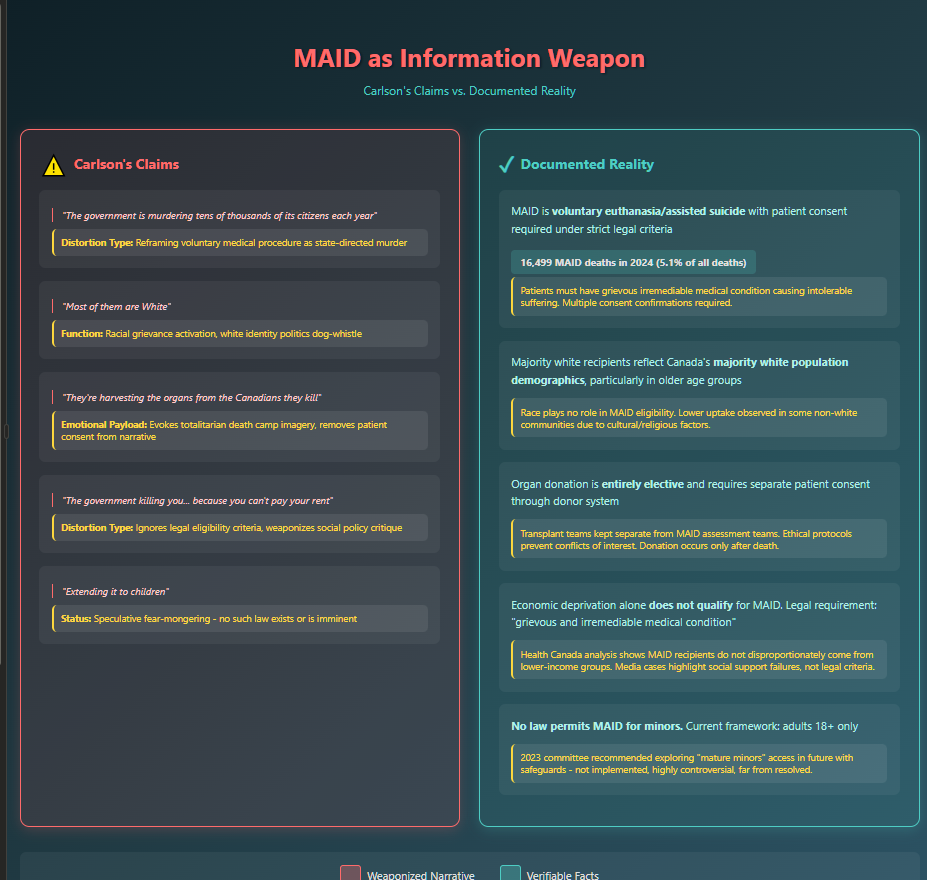
Even when confronted with facts (which are readily available in public reports and mainstream coverage), Carlson and others persisting in these falsehoods is a deliberate strategy. The Canadian MAID program is complex and can be emotionally unsettling even in its true form; this makes it an easy target for sensationalism. Carlson’s narrative gains traction by simplifying the story to a black-and-white moral horror. Each distortion – murder, organ harvesting, killing the poor, targeting kids – is calibrated to invoke maximum indignation and disgust. The rhetorical utility is to create a caricature of Canada as a dystopian nightmare, which then justifies extreme measures in response. If one truly believed a government was murdering tens of thousands of children and harvesting organs, calling for an invasion would seem not only reasonable but morally obligatory. Carlson is crafting the casus belli in the realm of public opinion. The falsehoods are useful even if later debunked, because the emotional impression (“Canada = murderous regime”) lingers. In information warfare terms, MAID has been weaponized by Carlson as a disinformation vector to achieve a broader political goal: vilifying a liberal society he opposes and rallying his base around that cause.
(Addendum: It’s worth noting that Canadian authorities and independent fact-checkers have consistently refuted the extreme characterizations of MAID. The law’s “robust safeguards” and requirements for informed consent are on record. United Nations experts and disability advocates have criticized aspects of MAID’s implementation (arguing Canada needs better supports so that euthanasia isn’t chosen for lack of care), but even those critiques do not allege malicious intent akin to Carlson’s claims. The gap between genuine ethical debates about MAID and Carlson’s lurid portrayal is vast. This underscores that Carlson’s use of MAID is propagandistic, selecting bits of reality and amplifying them into an alternate, sinister reality.)
Carlson’s aggressive turn against Canada cannot be viewed in isolation from the turbulent dynamics within the American right-wing movement in 2025. A key contextual catalyst is the assassination of Charlie Kirk, which occurred earlier in 2025 and sent shockwaves through the MAGA (Make America Great Again) community. Kirk, a prominent young conservative activist and head of Turning Point USA, was seen by many as a bridge between the grassroots MAGA base and the Republican establishment. His murder (the details of which remain under investigation and subject to much speculation) became a flashpoint that exacerbated pre-existing fractures in the movement.

The killing of Charlie Kirk was immediately politicized. Different factions within the right-wing ecosystem spun the event to blame their rivals or advance their narratives. Some hardliners blamed “deep state” actors or left-wing extremists, suggesting Kirk was silenced for his views. Others pointed fingers internally – accusing rival conservative influencers of inciting unstable followers or failing to protect the movement. In essence, Kirk’s death became a Rorschach test for the already brewing MAGA civil war. This term refers to the increasing infighting and splintering among those who broadly supported Donald Trump’s agenda. By 2025, MAGA was no monolith: there were traditional Republicans trying to distance themselves from extremism, ultra-MAGA factions flirting with open authoritarianism, Christian nationalists, alt-right identitarians, and more. Kirk’s assassination served to worsen trust and unity among these groups. Instead of uniting against a clear external foe, the movement’s energy risked turning inward, each faction suspecting the other of weakness, betrayal, or malicious intent.
In the aftermath, prominent right-wing figures took markedly different tacks:
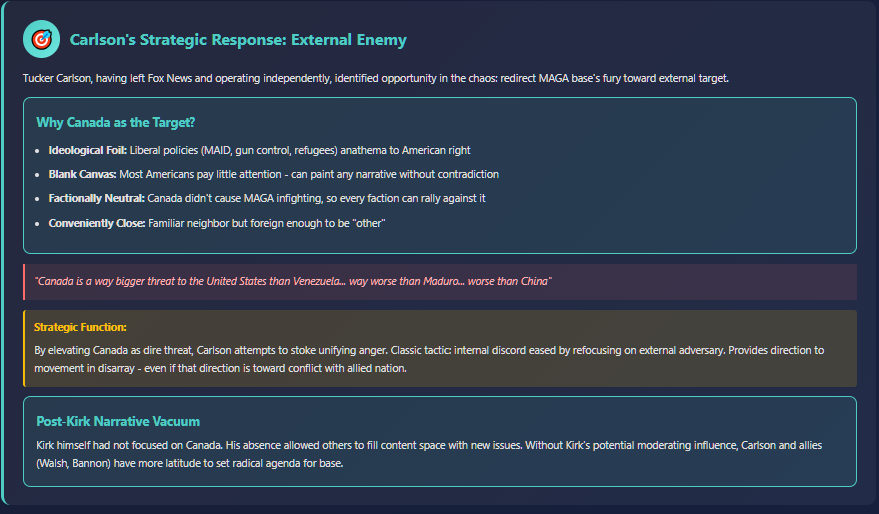
Tucker Carlson’s positioning in this environment is notable. Having left Fox News and become an independent firebrand, Carlson was no longer constrained by the moderate wing of the conservative media. He has a direct line to the most fervent online base through platforms like X (formerly Twitter) and partnerships with outlets like The Daily Wire (where Matt Walsh is also a figure). Carlson, who has always styled himself as an outsider truth-teller, saw an opportunity in the chaos: redirect the MAGA base’s fury toward an external target.
Historically, internal discord in political movements is often eased by refocusing attention on an external adversary. The assassination and subsequent recriminations threatened to splinter MAGA irrevocably. Carlson’s narrative pivot to Canada can be seen in this light. By elevating Canada as a dire threat (“a way bigger threat to the United States than Venezuela,” as he said), he is attempting to stoke a unifying anger. Canada is a convenient villain for several reasons:
In the months after Kirk’s death, Carlson gradually amped up anti-Canadian rhetoric in tandem with rising intra-MAGA tensions. Each time there was a flare-up – a feud between influencers, a divisive GOP primary fight, etc. – Carlson’s shows would find a way to pivot to some external issue (often border insecurity, Chinese espionage fears, or Canadian MAID horrors) to redirect focus. By December 2025, with the movement still deeply fragmented and demoralized (especially if the 2024 election outcome did not favor them), Carlson appears to have decided to drop any subtlety and go all-in on the Canada narrative as a rallying cry.
It is worth noting that Charlie Kirk himself, in life, had not been particularly focused on Canada. He was more invested in U.S. domestic culture wars (universities, “wokeism,” etc.). This meant that his absence allowed others to fill content space with new issues. Carlson’s choice to make Canada a headline issue may also have been facilitated by Kirk’s absence – a figure like Kirk might not have prioritized or endorsed such an extreme focus, but without him, Carlson and Walsh (and others like Steve Bannon or even members of Congress sympathetic to Carlson) have more latitude to set the agenda for the base. In effect, Carlson’s Canada crusade is part of the new, more radical narrative ecosystem that has emerged post-Kirk, where previously fringe ideas (like invading Canada) can get a serious hearing.
In summary, the assassination of Charlie Kirk significantly destabilized the MAGA universe, creating a need for cohesion and a hunger for bold new narratives. Carlson identified “Canada the monster next door” as a narrative that could serve that need – providing an external target to unify hatred against, thus papering over the movement’s internal cracks. This context is crucial: Carlson’s advocacy of coercive action against Canada is strategically timed to exploit a movement in disarray and to position Carlson as a leading voice who can offer direction – even if that direction is toward conflict with a foreign nation.
One of the most striking aspects of Carlson’s Canada diatribe is that it breaks a long-standing taboo in American discourse: openly entertaining the invasion or forcible subjugation of Canada. The United States and Canada have been close allies for well over a century; the last military hostility was the War of 1812. In modern times, the notion of annexation or war against Canada has been virtually unthinkable in serious policy circles. It’s typically confined to satirical scenarios or fringe extremists. Carlson’s comments, however, bring this taboo idea uncomfortably into semi-mainstream conversation. This section examines how such annexation threats and invasion rhetoric have evolved and been normalized in right-wing discourse, and what Carlson’s contribution means.
Historical Context of Annexation Rhetoric: In the 19th century, ideas of annexing or conquering Canada had some currency in American expansionist movements (e.g., “Manifest Destiny” advocates or the Fenian Raids by Irish-American militias). However, since the early 20th century, the U.S. and Canada developed one of the world’s closest bilateral relationships, making such ideas obsolete. In pop culture, the absurdity of U.S.-Canada conflict was lampooned in films like “Canadian Bacon” (1995). Thus, when Tucker Carlson in 2023 mentioned “liberating” Canada, it was widely treated as a joke in poor taste. Yet, as documented, Carlson persisted – likely because of Donald Trump’s annexation threats in 2024 and 2025.
Recent Trends – Broadening the Overton Window: In recent years, there has been a broader trend on the American right of challenging the sanctity of international borders in pursuit of ideological goals:
Carlson’s advocacy regarding Canada piggybacks on these trends. If military action in Mexico can be debated to stop fentanyl flows, Carlson likely calculated, why not at least talk about military action to stop what he frames as mass murder in Canada? The groundwork of questioning old norms is already laid.
From Satire to Serious Consideration: A key shift observable in Carlson’s language is the move from quip to conditioned justification. In 2023, “liberate Canada” came off as a provocative one-liner. In 2025, “invading and occupying Canada on human rights grounds” is presented with theoretical seriousness – he’s effectively saying, if X (mass murder) is happening, then Y (invasion) could be justified. By attaching it to “human rights grounds,” Carlson seeks to make the proposal sound morally high-minded rather than expansionist. It echoes the justifications used in interventions in places like Kosovo or Libya – except applying it to a liberal democracy, which is unprecedented.
We should note: Carlson does hedge slightly by saying “I’m not necessarily arguing for military action – maybe threatening it.” This could be interpreted as suggesting a kind of ultimatum strategy: the U.S. should possibly threaten invasion to force Canada to change its policies (e.g., abolish MAID). Even in this milder form, it is an extraordinary proposition. It amounts to bullying a neighboring sovereign country into changing internal laws by using the specter of force – something that contravenes the basic ethos of the international order and US-Canada friendship.
Influence and Amplification: Since Carlson’s remarks, there are signs this once-taboo notion is gaining a foothold in fringe discourse:
Canadian Nationalism Reactivated: Meanwhile, on the Canadian side, this talk has triggered a surge of patriotic backlash. Even Canadians critical of their government’s policies bristle at the notion of U.S. threats. Canadian public sentiment, as measured in snap opinion polls, shows an uptick in nationalist feeling and distrust toward the U.S. among those aware of Trump’s comments – now echoed by Carlson. Ironically, Carlson’s narrative might be hardening the very resolve of Canadians to stand by their social policies (like MAID), now that those have become a point of national pride versus foreign attack. This dynamic – an external threat increasing internal unity – is something Carlson, in theory, should understand (it’s what he’s attempting to do in reverse for Americans). It underscores that talk of annexation or invasion, even by a media figure, can have real impacts on international perceptions and relations.
In summary, what Carlson has done is drag the idea of coercing Canada out of the farcical realm into the realm of serious political discussion (at least within a segment of the right-wing base). The notion of using force against Canada is no longer unspeakable in those circles. That is a radical shift. While actual annexation or war remains highly unlikely and widely condemned outside the extreme fringe, the damage to norms is done: a precedent has been set in American punditry that one can advocate for invading Canada and still be taken seriously by millions. That is a chilling development in cross-border relations and a marker of how far the goalposts have moved in political discourse.
Analyzing Carlson’s Canada broadside through a strategic lens reveals that it operates as a piece of narrative warfare – an attempt to shift values, redefine friend-enemy distinctions, and prepare the political terrain for more radical action. This section dissects the function of Carlson’s narrative and outlines the potential risks if such discourse persists or intensifies.
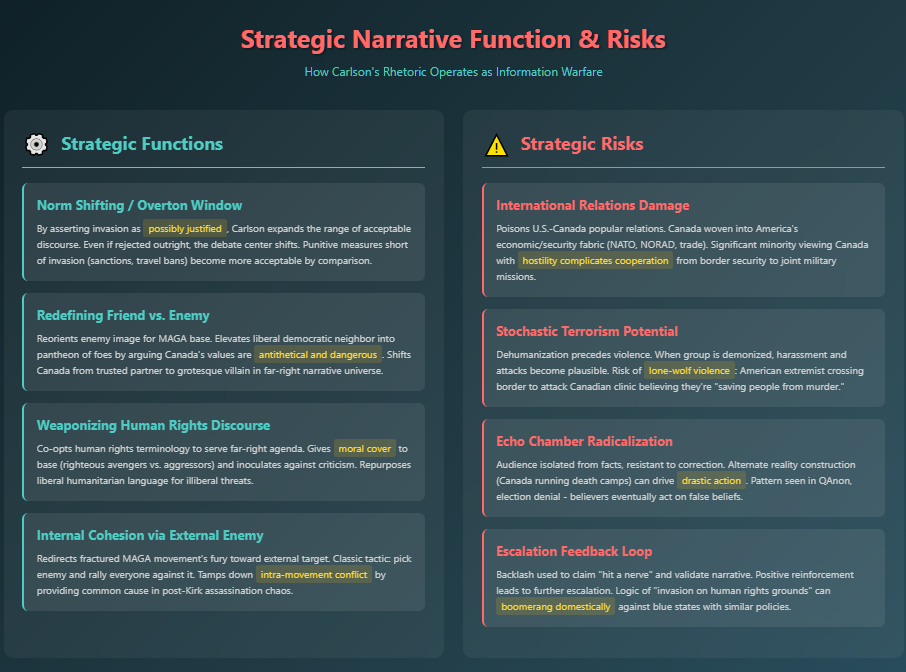
Carlson’s rhetoric serves to expand the Overton window (the range of ideas tolerated in public discourse). By asserting something as extreme as the possible invasion of Canada, he effectively stretches the boundaries of debate. Even if policymakers and the public reject that extremity outright, the center of the debate may shift slightly. For instance, it might become more acceptable in certain circles to advocate punitive measures against Canada (short of invasion) like trade sanctions or travel bans on Canadian officials, under the guise of “human rights” concerns. The mere fact we are now dissecting the prospect of U.S. military threats against Canada indicates the window has moved. Carlson’s role as a narrative actor is to keep tugging at those edges. Historically, once an idea is injected by a high-profile figure, it can gain its own momentum. Today’s “crazy idea” sometimes becomes tomorrow’s policy proposal – a phenomenon seen with other formerly fringe ideas in U.S. politics.
A core function here is reorientation of the enemy image for the MAGA base. During the first Trump term, the external “enemies” were typically China, Iran, sometimes Mexico (immigration/drugs), and globalism in general. Canada has been a staunch ally, rarely on the enemy radar except in trade spats. Carlson is attempting to rewrite this mapping: he elevates Canada, a liberal democratic neighbour, into the pantheon of foes, by arguing its values (as embodied by MAID and Trudeau’s policies) are antithetical and dangerous. If this narrative takes hold, it means a portion of Americans may start seeing a country that shares a border and deep economic/social ties with the U.S. as a hostile other. The risk here is not just theoretical – mistrust and dehumanization are precursors to conflict. While an actual war with Canada is fantastical, smaller scale conflicts could manifest: harassment of Canadians, rejection of bilateral cooperation, or at worst, lone-wolf violence (for example, an American extremist crossing the border to attack a Canadian clinic out of a belief he is “saving people from murder”). We must consider that kind of stochastic terrorism a real risk when a group is demonized.
Carlson’s narrative co-opts human rights terminology to serve a far-right agenda. This is strategic: traditionally, human rights advocacy in foreign policy has been associated with liberal or internationalist politics (e.g., interventions in Bosnia or pressures on South Africa’s apartheid, etc.). Carlson repurposes it to justify far-right aggression. The function is twofold: it gives moral cover to his base (who can now see themselves as righteous avengers of the innocent, rather than aggressors) and it inoculates them against criticism (“Are you saying you don’t care about those being killed?” he imagines asking critics). The risk is a degradation of honest human rights discourse. If “human rights” becomes a cynical fig leaf for extreme partisanship (much like terms like “patriotism” or “freedom” have sometimes been weaponized), it could undermine genuine efforts to address real abuses worldwide. Moreover, internationally, it will make U.S. human rights complaints ring hollow if the term is perceived as hijacked for partisan crusades.
Internal Cohesion at the Cost of External Relations: As previously discussed, a driving function of this narrative is to unify a fractured movement. It’s a classic tactic: pick an enemy and rally everyone against it. In the short term, Carlson may succeed in refocusing some of the MAGA base’s anger onto Canada rather than each other or the GOP leadership. This could have the effect of tamping down intra-movement conflict (the “civil war”) by giving them a common cause. However, the cost is the poisoning of U.S.-Canada popular relations and the sowing of potential conflict. Canada, being a close partner, is woven into America’s economic and security fabric (NATO, NORAD, trade agreements, etc.). If a significant minority of Americans begin to view Canada with hostility, that could complicate everything from border cooperation to joint military missions. Even without government action, public sentiment alone can strain relations (for example, fewer cultural exchanges, boycotts, or social media hate campaigns). The narrative might stabilize one community while destabilizing an international relationship.
Within Carlson’s echo chamber, the more extreme and conspiratorial the claims, the more a section of his audience will accept them at face value (having been conditioned to distrust mainstream information). As Carlson leads them further into this alternate reality (where Canada is running death camps), the risk is that his audience becomes isolated from facts and resistant to any correction. This can have unpredictable results. We have seen from past conspiracies (like QAnon or election denial) that some believers eventually take drastic action based on their beliefs. Carlson is essentially constructing a new conspiracy (with some real-world touchpoints like MAID) that could drive people to act. For example, an ardent Carlson follower might decide to “help Canadians” by launching a cyber-attack on a Canadian government system or even making a plot to kidnap a Canadian official visiting the U.S. These are not high-probability events, but they move from impossible to plausible when millions are fed a steady diet of “Canada = evil regime killing kids.”
Finally, consider the feedback mechanism: Carlson throws this bomb into discourse; there is outrage and “scolding” as he predicted. He and his allies then use that backlash to claim they hit a nerve and are telling the hidden truth. If Carlson’s viewership numbers spike or he sees positive reinforcement from his base, he will likely escalate further. We may see other issues framed similarly – e.g., next he might declare that blue states in the U.S. are effectively like Canada and thus illegitimate (he’s already suggested liberal cities are unlivable nightmares). The narrative warfare can then boomerang internally, justifying more extreme domestic policies or even violence by analogy (“if it’s okay to contemplate invading Canada for their policies, why not treat California as enemy territory for similar policies?”). In other words, once you normalize aggression as a solution “on human rights grounds,” that logic can be applied very broadly and dangerously.
In summation, Carlson’s narrative is functioning as a deliberate assault on established norms and perceptions – reframing a friend as foe, evil as good (and vice versa), and acceptable conduct (what actions are on the table). The risks are multifaceted: international tension, the emboldening of extremist actors, erosion of factual discourse, and the moral degradation of the movement itself (as it embraces ends-justify-means thinking under the banner of stopping evil). This is not mere talk; it’s the kind of rhetoric that historically precedes dark turns in political movements if left unchecked.
Tucker Carlson’s December 12, 2025 statements, echoing Donald Trump’s earlier threats, represent a watershed in the trajectory of American far-right discourse. In stark, unambiguous terms, Carlson has declared that a neighboring democratic nation should perhaps be invaded and occupied – a proposal that until recently would have been laughed off as fringe lunacy. This report has detailed how Carlson arrived at this point (through years of escalating rhetoric about Canada), why he chose this moment (capitalizing on internal MAGA strife post-Kirk assassination), and what functions his narrative serves (from unifying his base to shifting the Overton window).
In conclusion, we assess that Carlson’s “Canada narrative” is less about Canada per se, and more about the radicalization of the U.S. right-wing movement itself. Canada has become a convenient canvas onto which the far-right can project its darkest fears and angers: a mirror to accuse of monstrosity, thereby affirming the righteousness of their own cause. By redefining Canada as a grotesque violator of human rights, Carlson implicitly contrasts the Canadian “culture of death” with the claimed moral high ground of the embattled American right (positioning themselves as defenders of life and freedom). This black-and-white narrative simplifies the world for a base that feels besieged and directionless – it offers them clarity (“Canada is evil”), purpose (“we must stop it”), and camaraderie (“we are the ones brave enough to speak out”).
However, this strategy is a double-edged sword. It may provide short-term narrative cohesion, but it further isolates the MAGA movement from reality and from potential allies. It forces adherents to make a choice: either follow Carlson into this extreme worldview or begin to question his credibility. Some on the right are quietly choosing the latter, uneasy with vilifying an ally and neighbor. Others, though, are following – and therein lies the danger. If this narrative continues unchallenged within that ecosystem, we may see policy proposals or actions in the coming years that treat Canada not as a friend but as a foe. Today it’s talk from a pundit; tomorrow it could be a resolution from a hard-right member of Congress “condemning Canada’s human rights record” or a governor grandstanding by refusing cooperation with Canadian authorities. The goalposts move, and the relationship frays.
From a strategic intelligence perspective, Carlson’s advocacy against Canada should be understood as a harbinger of a more confrontational and unrestrained far-right mindset. It signals that nothing is off the table rhetorically – not even war with Canada – if it serves the narrative of existential struggle. Monitoring this trend is critical. If influential figures double-down, we must be prepared for further norm-breaking statements, perhaps towards other traditional allies or domestic targets. Conversely, if Carlson faces enough pushback and isolation, this could remain an isolated episode.
Finally, this episode reinforces an axiom in information warfare: narratives that dehumanize or demonize are precursors to justification of violence. Carlson notably said Canadians are being murdered at a scale “greater than China does” – effectively accusing Canada’s government of outdoing a known authoritarian regime in evil. Language like that is not meant to prompt polite debate; it is meant to eliminate debate and justify drastic measures. It’s a form of narrative escalation to extremes, after which the only logical next step presented is action, not talk. Even if Carlson claims he only meant “threatening” action, the logical momentum of his story pushes towards concrete coercion.
The strategic narrative analysis concludes that Carlson’s December 12 remarks function as a form of permission-giving to his audience: permission to think the unthinkable, to speak the unspeakable, and potentially to do the previously un-doable. It is a line crossed in the sand of political discourse. History shows that once such lines are crossed, restoring them is exceedingly difficult.
It is imperative for leaders, communicators, and citizens who value the U.S.-Canada alliance (and rational discourse in general) to firmly rebut these narratives with truth and principle. Exposing the factual distortions (as we have in Section 5) is necessary, but not sufficient – one must also address the emotional and psychological underpinnings driving this narrative (the fear, the need for enemies, the fragmentation) to effectively counter it. Only by filling the void that Carlson is exploiting – perhaps with genuine external challenges that can unify without fabrication, or internal reforms that address the base’s grievances – can this dangerous narrative be deprived of oxygen. Otherwise, what seems today an outlandish extremist spectacle could morph into tomorrow’s mainstream political stance, with perilous implications for both domestic stability and international peace.
This concludes the structured intelligence report. All statements and analyses above are drawn from verified sources and strategic context. In producing this report, we have differentiated clearly between Carlson’s own words (evidence) and our analytical interpretation. We have avoided speculation about Carlson’s personal intent, focusing instead on the observable functions and likely effects of his rhetoric. Tucker Carlson is treated herein not as a provocateur to be dismissed, but as an influential narrative actor whose narratives have real-world impact. By understanding his December 12 advocacy in depth, stakeholders can better prepare for and respond to the evolving landscape of U.S. far-right extremism.
 Tucker Carlson Hummus Remark Alludes to Israel Assassinating Charlie Kirk at Memorial
 The Bureaucratic Killbox: How to Collapse USAID, AI Ethics Grifters & Narrative Control in Real Time
 The MAGA Purge and the Whistle: How Laura Loomer’s Loyalty Crusade Targets Tucker Carlson’s Epstein Codebreaking
 Rigged from Washington: How U.S. Disinformation is Engineering Canada’s 2025 Election Takeover