The Arctic Flight Nobody Noticed: How Canada’s Alert Station Became NATO’s Answer to Trump’s Greenland Threats
Open-source intelligence reveals a pattern: every time Trump threatens Greenland, operations at Canada’s northernmost military installation intensify. Yesterday’s flight is just the latest.
By Kevin J.S. Duska Jr. | January 14, 2026
The Flight
On January 13, 2026, three days after President Donald Trump declared the United States would seize Greenland “whether they like it or not,” likely because of Greenland’s tremendous resources and the GIUK Gap, a Royal Canadian Air Force CC-130J Hercules quietly flew to Canada’s northernmost military installation as Denmark has been increasing its military presence in Greenland.
According to publicly available flight tracking data from FlightRadar24, RCAF aircraft tail number 130615 departed CFB Trenton, Ontario on January 12, staged through Iqaluit, Nunavut, and continued north on January 13. The return leg showed a flight time of 3 hours and 49 minutes, and the aircraft’s trajectory pointed to a destination 817 kilometers from the North Pole: Canadian Forces Station Alert.
On its face, nothing remarkable. The Canadian military regularly resupplies Alert, a tiny outpost on Ellesmere Island that serves as Canada’s Arctic sovereignty presence. Military transports fly north, deliver cargo and personnel, and return south. Routine operations.
A screenshot from Flight Radar 24 showing Royal Canadian Air Force CC130J Hercules CFC 3803 flying to what was presumably CFS Alert.
Except for three details that make this flight worth examining:
First, the timing. Trump’s “whether they like it or not” threat came on Friday, January 10. Canadian Foreign Affairs Minister Anita Anand called her Danish and Greenlandic counterparts on Saturday, January 11, to express support for Denmark’s sovereignty over Greenland. And on Monday, January 13, Canada flew to Alert.
Second, the schedule. Alert’s major resupply operation – called Operation BOXTOP – happens twice annually: spring (April/May) and fall (September/October). According to Department of National Defence documentation, these are intensive three-week operations with multiple aircraft making continuous shuttle flights. January is not a BOXTOP month. This was an out-of-cycle flight.
Third, and most significant: Alert is not just any Arctic outpost. It’s 680 kilometers from Thule Air Base/Peterson Space Force Base in Greenland – the U.S. military installation Trump would use to control the island. And Alert is a signals intelligence facility designed to monitor radio communications across the Arctic.
To understand why a single military transport flight to a remote Arctic station matters, you need to understand what Alert is, what it can do, and what’s been quietly happening there since Trump first threatened Greenland.
The story is bigger than one flight.
A map depicting the proximity of CFS Alert and Thule Air Force Base/Peterson Space Force Base
Part I: What Alert Actually Does
Canadian Forces Station Alert sits at 82°30′ North latitude on the northeastern tip of Ellesmere Island. At roughly 57,000 square kilometers, Ellesmere is slightly larger than Croatia, with a human population of roughly 150 people scattered across three permanent settlements. Alert is the northernmost of these, and the northernmost permanently inhabited place on Earth.
But Alert is not a settlement in any traditional sense. According to official Canadian government sources, it’s a signals intelligence (SIGINT) intercept facility – a sophisticated listening post monitoring radio communications across Arctic and transpolar regions.
“Maintain signals intelligence facilities to support Canadian military operations”
“Geolocation capability to support operations”
“High Frequency and Direction Finding facilities to support Search and Rescue and other operations”
Translation: Alert intercepts, analyzes, and geolocates radio communications. Its extreme northern position provides unique advantages for monitoring signals across “the northern half of the globe,” according to Royal Canadian Air Force documentation.
The Technical Capabilities
Based on official DND sources and declassified technical documentation, Alert operates:
High-Frequency (HF) and Very High-Frequency (VHF) Antenna Arrays: Long-range signal interception systems capable of detecting communications hundreds to thousands of kilometers away. Multiple frequency bands allow monitoring of different communication types – military, commercial, maritime, aviation.
Direction-Finding Systems: Antenna arrays can determine the bearing and approximate location of radio transmitters through triangulation techniques. When coordinated with other SIGINT stations, this provides precise geolocation of emitters.
Remote Operations Architecture: Most intercepted signals are automatically collected and transmitted south via the High Arctic Data Communications System (HADCS) – a chain of microwave repeaters and satellite links connecting Alert to Communications Security Establishment (CSE) headquarters in Ottawa. Only about six operators remain on-site; the analysis happens elsewhere.
ECHELON Network Integration: Alert is part of the Five Eyes signals intelligence alliance linking the United States, United Kingdom, Canada, Australia, and New Zealand. Intelligence collected at Alert feeds into this shared system and is distributed to partner nations.
What Alert Can Detect
Alert’s position at 82°30’N provides several intelligence advantages:
Arctic Signal Propagation: High-frequency radio signals bounce off the ionosphere, and Arctic atmospheric conditions enhance long-range propagation. Signals that would dissipate in southern latitudes travel much farther in the high Arctic.
Line-of-Sight Coverage: From Alert’s elevation, there’s direct line-of-sight to vast stretches of Arctic airspace, sea routes, and – critically – Greenland. RCAF materials note that “on a clear day the peaks and cliffs of Greenland can be seen 56 km to the south-east.” Alert will likely be a critical installation for Canada’s future over-the-horizon radar capabilities.
Traffic Pattern Analysis: Modern military communications use sophisticated encryption that’s essentially unbreakable. But signals intelligence doesn’t need to decrypt content to be valuable. Monitoring when communications increase, what frequencies activate, how much traffic occurs, and which systems are active provides actionable intelligence about operational tempo and military posture.
Baseline Establishment: Decades of continuous monitoring establish “pattern-of-life” baselines for the Arctic region. Deviations from normal patterns indicate something interesting is happening – deployments, exercises, heightened alert status, or actual operations.
The Thule Problem
Alert sits 680 kilometers from Thule Air Base (recently renamed Pituffik Space Base), the U.S. Space Force installation in northwest Greenland. To put this in perspective:
Toronto to Montreal: 504 km
Alert to Thule: 680 km
Alert to Ottawa: 4,160 km
Alert is closer to the U.S. base at the center of Trump’s territorial ambitions than it is to most of Canada.
A UK Royal Air Force C17 unloading cargo at CFS Alert in May 2025 as part of a joint British-Canadian high Arctic exercise.
According to an official RAF press release dated May 7, 2025:
“Twelve members of No. 99 Squadron RAF have spent the past week in the Arctic Circle to help resupply the most northerly station on Earth. The RAF C-17 Globemaster aircrew and ground support crew have been working alongside their Canadian counterparts as they resupply Canadian Forces Station (CFS) Alert, more than 1,100 miles inside the Arctic Circle.”
The release explained that RAF aircrews were learning “how their allies from the Great White North conduct polar operations” and training in “landing on semi-prepared ice runways.”
The RAF press release noted this was “for the second year running” – meaning RAF participation began in 2024, when Trump was actively campaigning on acquiring Greenland.
Why This Matters
RAF participation in Operation BOXTOP is not routine multinational cooperation. Here’s why:
Alert is a Canadian sovereign facility with a classified SIGINT mission. Canada doesn’t typically invite foreign militaries to train at intelligence installations. The official explanation – that RAF needed Arctic landing training – is thin. The UK has no Arctic territories requiring routine C-17 operations to ice runways.
The timing is too precise. RAF participation began in 2024 (Trump campaigns on Greenland acquisition), continued in May 2025 (Trump threatens Greenland as president), and now in January 2026 we see an out-of-cycle Canadian flight to Alert three days after Trump’s “whether they like it or not” statement.
C-17 Globemasters represent a capability upgrade. The RAF’s C-17s can carry significantly more cargo than Canada’s CC-130J Hercules. The May 2025 operation delivered “nearly two million litres of jet fuel” according to the RAF release. This isn’t routine resupply – it’s capacity building, pre-positioning massive fuel reserves that would support intensified operations.
UK is developing independent Alert access. By training RAF crews on Arctic operations and Alert’s runway, the UK is building the capability to reach Alert independently of Canadian airlift. This suggests Alert is being positioned as a facility that Five Eyes partners can access directly.
The Strategic Implication
The pattern reveals Alert is being transformed from a Canadian national SIGINT facility into something more significant: a multinational Arctic intelligence hub specifically positioned to monitor and respond to U.S. activity in Greenland.
This didn’t happen accidentally. This is NATO – or at minimum, the Five Eyes intelligence alliance – quietly positioning assets to maintain independent monitoring capability of Thule while Trump threatens Denmark.
Part III: The Five Eyes Paradox
Alert’s role in the Greenland crisis exposes a fundamental tension in Western intelligence architecture.
Alert is part of the ECHELON network – the Five Eyes SIGINT alliance between the United States, United Kingdom, Canada, Australia, and New Zealand. Under this agreement, the five nations share intercepted communications and, theoretically, do not spy on each other’s governments.
But Denmark is not part of Five Eyes. Denmark is a NATO ally and hosts a major U.S. military installation on its territory (Thule), but it has no access to Five Eyes intelligence sharing.
This creates an intelligence gap that becomes critical during the current crisis:
Denmark cannot independently monitor U.S. military activity at Thule. It’s Danish territory, but U.S.-operated. Denmark has no signals intelligence infrastructure capable of monitoring the base. Denmark’s entire active military is roughly 21,000 personnel – smaller than the New York Police Department, as Trump noted. Denmark lacks the technical capabilities for sophisticated SIGINT operations.
The U.S. intelligence community is unlikely to share operational planning for potential military action against Denmark. Even within Five Eyes, compartmentalization limits what’s shared. If the U.S. is planning operations Denmark would oppose, those plans stay classified.
Other NATO allies lack Arctic monitoring capability. European NATO members have no installations positioned to monitor Thule. They’re dependent on what the U.S. chooses to share.
Only Canada has independent monitoring capability – geographic proximity, established infrastructure, technical systems, and operational experience in the Arctic environment.
This makes Canada uniquely valuable to Denmark and to NATO during this crisis. Canada can provide intelligence that no one else can: independent verification of U.S. military activity at Thule.
If Alert monitors increased U.S. military activity at Thule – heightened communications, additional flights, operational preparations – Canada faces a choice:
Option 1: Share through Five Eyes channels, where the U.S. would see that Canada is monitoring Thule. This could create diplomatic friction and might result in the U.S. restricting what it shares with Canada.
Option 2: Share directly with Denmark outside Five Eyes channels. This violates the spirit (if not the letter) of Five Eyes agreements, but serves Canada’s interest in supporting a NATO ally.
Option 3: Share selectively with other Five Eyes partners (UK, possibly) who then share with Denmark through their own channels, providing plausible deniability.
The evidence suggests Canada is pursuing some combination of options 2 and 3. The RAF’s operational integration into Alert operations indicates intelligence coordination with the UK. And Canada’s direct diplomatic engagement with Denmark (Anand’s January 11 call) suggests intelligence sharing is likely happening through those channels.
Based on standard signals intelligence collection practices and Alert’s documented capabilities, here’s what the station could detect regarding Thule:
Communication Volume and Patterns
Even without decrypting content, monitoring the amount of communication provides intelligence value:
Baseline vs. Surge: Alert would have years of data establishing Thule’s normal communication patterns – routine administrative traffic, daily operations, scheduled exercises. A sudden increase in volume indicates something non-routine is occurring.
Frequency Activation: Military installations maintain multiple communication systems for different purposes. Some frequencies only activate during heightened operations. Alert’s direction-finding systems can identify when dormant frequencies suddenly become active.
Timing Patterns: Communications outside normal working hours, weekend activity, or sustained 24/7 operations indicate elevated operational tempo.
Aircraft Activity
Radio communications associated with aircraft operations provide indicators:
Approach/Departure Communications: Aircraft communicating with Thule tower on approach and departure frequencies provide real-time tracking of flight operations.
Aircraft Types: Different aircraft have different radio signatures. Strategic airlift (C-5 Galaxy, C-17 Globemaster), tankers (KC-135, KC-46), fighters, and special operations aircraft all have distinct communication patterns.
Flight Frequency: Establishing baseline aircraft movements allows detection of surge operations – multiple flights per day, continuous operations, or deployment of unusual aircraft types.
Operational Security Posture
Changes in how communications are conducted provide intelligence:
EMCON (Emissions Control): If Thule suddenly reduces radio communications, this indicates operations security concerns – possibly meaning something sensitive is about to occur.
Encryption Changes: Shifts to different encryption systems or communication protocols suggest operational changes.
Authentication Procedures: Increased use of challenge-response authentication indicates heightened security posture.
What Alert Cannot Do
Important limitations:
Modern military encryption is unbreakable in real-time. U.S. military communications use sophisticated encryption systems. Alert cannot decrypt content of classified military communications.
Fiber-optic and satellite communications may not be detectable. Alert primarily monitors radio-frequency communications. Hardline communications or certain satellite links might not be interceptible.
Single observation point limits triangulation accuracy. While Alert can detect signals and determine general bearing, precise geolocation often requires multiple monitoring stations.
But Pattern Analysis Still Provides Value
Even without decryption, Alert can assess:
Something is happening (increased activity)
Operational tempo (how much activity)
Timing (when it’s happening)
Systems activation (what capabilities are being used)
Departure from baseline (normal vs. abnormal)
For strategic warning and intelligence assessment, this is sufficient. Canada doesn’t need to read U.S. military communications to know if Thule is preparing for large-scale operations.
Part V: Crisis Operations at Alert
Based on standard military intelligence operations and Arctic warfare doctrine, here’s how Alert’s mission would likely evolve during the Greenland crisis:
Preparation for potential intelligence surge if U.S. operations commence
The January 13 flight likely represents Phase 4 activity – crisis response outside normal schedules.
Part VI: Why Canada Matters
In the current Greenland crisis, Canada occupies a position no other nation can replicate:
Geographic Position
Alert is the closest non-Greenlandic military installation to Thule. No other NATO member has comparable access.
The geography is stark: Alert sits just 680 kilometers from Thule Air Base, while the nearest European NATO installations are thousands of kilometers away. This proximity isn’t just about distance—it’s about line-of-sight monitoring capability, atmospheric signal propagation advantages, and the ability to detect radio emissions that would dissipate before reaching more distant stations.
Weather permitting, personnel at Alert can literally see Greenland’s peaks across the strait. Canadian Arctic doctrine emphasizes this proximity as a sovereignty asset, but in the current crisis it becomes an intelligence asset of unprecedented value. Alert’s position provides real-time monitoring of Thule that simply cannot be replicated from Europe, and which Denmark—despite Greenland being Danish territory—cannot provide for itself.
Technical Capability
Decades of Arctic SIGINT operations provide unmatched institutional knowledge and infrastructure.
Canada has operated signals intelligence facilities in the high Arctic since the 1950s, accumulating over 70 years of operational experience in one of Earth’s most challenging environments. This isn’t just about having the right equipment—it’s about understanding how Arctic atmospheric conditions affect signal propagation, how to maintain sensitive electronics in extreme cold, how to rotate personnel effectively in isolated conditions, and how to process the unique signatures of Arctic communications.
The infrastructure at Alert represents decades of incremental development: antenna arrays optimized for polar signal conditions, direction-finding systems calibrated for high-latitude triangulation, heating and power systems capable of sustaining operations at -50°C, and satellite links that function reliably despite the challenges of polar communications geometry. This capability cannot be quickly replicated. Even if another NATO member wanted to establish equivalent capability, it would require years of development and hundreds of millions in investment.
Moreover, Alert’s SIGINT analysts have developed pattern-of-life baselines for Arctic communications going back decades. They know what “normal” looks like for Thule, for Russian Arctic bases, for transpolar aviation routes. This baseline knowledge is what makes anomaly detection possible—and anomaly detection is often more valuable than signals decryption in modern intelligence work.
Political Independence
Canada is:
NATO ally with strong democratic credentials: Canada’s commitment to the Atlantic alliance is unquestionable, providing credibility when sharing intelligence that might complicate U.S. policy objectives. European NATO members might hesitate to share intelligence critical of American operations; Canada’s historical relationship and geographic separation from European politics gives it different leverage.
No direct territorial claims on Greenland: Unlike Denmark (which governs Greenland) or the United States (which seeks to acquire it), Canada has no territorial ambitions in Greenland itself. This neutrality is crucial—Canada can provide intelligence to both Denmark and other NATO members without its own territorial interests clouding analysis.
Historical ally of both U.S. and Denmark: Canada fought alongside both nations in two world wars, maintains deep defense ties with the U.S. through NORAD, and has strong diplomatic relationships with Nordic countries. This dual relationship network allows Canada to communicate with both sides of the current crisis without being seen as definitively choosing one over the other.
Can serve as honest broker while maintaining intelligence capability: In potential negotiations or NATO consultations, Canada can present intelligence findings that both parties might trust precisely because Canada doesn’t have direct interests in the outcome. This honest broker role is rare in intelligence sharing, where national interests typically color analysis.
Operational Flexibility
Canada can:
Operate independently of U.S. intelligence community: While Canada participates in Five Eyes and coordinates closely with U.S. intelligence, Canadian SIGINT operations at Alert are under Canadian sovereign control. If the crisis escalates, Canada can continue Alert operations even if the U.S. requests cessation—something European NATO members hosting U.S. bases might find more difficult.
Share intelligence with Denmark without Five Eyes restrictions: The Five Eyes agreement creates intelligence-sharing protocols among the U.S., UK, Canada, Australia, and New Zealand. Denmark is not part of this network. Normally, Five Eyes members don’t share sensitive SIGINT outside the alliance. But Canada can make sovereign decisions about what intelligence to share and with whom. If Canadian political leadership determines that Denmark needs specific intelligence about Thule, Canada can provide it—though this might create friction within Five Eyes.
Coordinate with other NATO members bilaterally: Canada’s participation in NATO, its separate intelligence relationships with the UK and other European allies, and its Arctic Council membership create multiple channels for intelligence coordination. Information about Thule gathered at Alert can flow through various diplomatic and intelligence channels depending on political sensitivities.
Provide verification function for alliance decision-making: In any NATO consultation about the Greenland crisis, members need to know what’s actually happening versus what parties claim is happening. Canada can provide independent verification: “Yes, our monitoring confirms increased U.S. activity at Thule” or “No, we don’t see evidence supporting that claim.” This verification function is critical for alliance consensus-building.
What Denmark Cannot Do Alone
Denmark’s dilemma is acute:
Cannot independently monitor Thule (U.S.-operated on Danish territory): This is the central paradox. Thule/Pituffik Space Base sits on Greenlandic territory under Danish sovereignty, but it’s operated by the U.S. Space Force under agreements dating back to 1951. Denmark has no independent access to base operations, no insight into what aircraft arrive or depart, no ability to monitor military communications from the base, and no personnel inside the facility who report to Danish authorities rather than American ones.
If the U.S. decided to use Thule as a staging point for operations Denmark opposed, Denmark would have no independent means of detecting preparations. Denmark would be entirely dependent on what the U.S. chose to disclose—a devastating intelligence gap when facing potential military action on your own territory.
Not part of Five Eyes (no access to SIGINT sharing): Denmark is a NATO ally and cooperates with allied intelligence services, but it’s not part of the Five Eyes SIGINT alliance. This means Denmark doesn’t receive the routine signals intelligence sharing that Canada, the UK, Australia, and New Zealand provide to each other. Even if Alert detected concerning activity at Thule, that intelligence might not flow to Denmark through normal Five Eyes channels—it would require deliberate Canadian decision to share outside the alliance.
Limited military capabilities overall (~21,000 active personnel): Denmark’s entire active military is smaller than the New York Police Department, as President Trump noted in his public statements on Greenland. This size limitation isn’t just about combat power—it’s about specialized capabilities. Denmark doesn’t have the personnel, equipment, or institutional knowledge to conduct sophisticated signals intelligence operations, particularly in Arctic conditions. Building such capability would require years and resources Denmark doesn’t have.
No Arctic SIGINT infrastructure outside Greenland: Denmark operates some signals intelligence capabilities for its own defense needs, but it has no installations positioned to monitor Arctic communications independently. The nearest Danish territory to Thule is… Greenland itself. Denmark has no Arctic SIGINT stations comparable to Alert, no experience operating in extreme northern latitudes, and no established infrastructure for polar communications monitoring.
Denmark needs Canada’s intelligence to understand U.S. military posture at Thule. This dependency is total and irreplaceable. No other ally can provide Denmark with independent verification of U.S. military activity on Danish territory.
What This Means for NATO
If the U.S. takes military action against Greenland, NATO faces an unprecedented scenario: one member potentially attacking another member’s territory. Article 5—collective defense—would technically apply, but defending Denmark against the United States would shatter the alliance.
The North Atlantic Treaty’s Article 5 states that an armed attack against one member “shall be considered an attack against them all.” It was invoked once, after September 11, 2001, when NATO members rallied to support the United States. The article was written assuming external threats—Soviet invasion, terrorism, rogue states. It was never designed for, and nobody has seriously contemplated, one NATO member attacking another.
If U.S. forces moved to seize Greenland by force, Denmark could theoretically invoke Article 5, requesting collective defense. But this would place every NATO member in an impossible position: fulfill treaty obligations and oppose the United States militarily, or abandon Article 5 and effectively end NATO’s credibility. Neither option is viable. The alliance would likely fracture, with some members supporting the U.S., others supporting Denmark, and most trying desperately to avoid choosing.
This nightmare scenario makes prevention absolutely critical. NATO cannot afford to let the situation reach military confrontation. And prevention requires intelligence—specifically, early warning of U.S. military preparations that would allow time for diplomatic intervention.
NATO requires:
Independent verification of U.S. actions (not relying on U.S. reports): In any crisis involving the U.S., NATO cannot base decisions solely on American statements about American intentions. This seems obvious, but it’s diplomatically delicate. Normally, NATO operates on trust among allies. But in a crisis where the U.S. and Denmark have opposing interests, NATO needs a third party who can say, “Here’s what we’re actually observing” without political filtering.
Canada provides this. Alert’s monitoring of Thule gives NATO independent eyes on U.S. military activity. If the U.S. claims it’s conducting routine exercises while actually preparing invasion forces, Alert can detect the discrepancy. If Denmark claims aggressive U.S. buildup that isn’t actually occurring, Alert can verify that too. Independent verification prevents decision-making based on misperception or political spin.
Early warning of military preparations (time to respond diplomatically): Any U.S. military operation in Greenland would require staging through Thule. Aircraft would arrive, personnel would deploy, communications would increase, supply flights would surge. These activities would be detectable days or weeks before actual operations commenced.
Early warning provides time—time for diplomatic engagement, time for NATO consultations, time for public pressure, time for de-escalation. Without early warning, NATO might learn of U.S. military action only when it’s already underway, leaving no options beyond acceptance or confrontation. With early warning from Alert, NATO leaders have space to maneuver diplomatically.
Factual basis for consultations (credible intelligence for decision-making): NATO decision-making requires consensus among 32 member nations. In a crisis this sensitive, that consensus will be extremely difficult to achieve. Some members will be sympathetic to U.S. strategic interests in Greenland; others will prioritize Danish sovereignty; still others will try to avoid taking positions.
Reaching any consensus requires starting from agreed facts. How many U.S. military personnel are at Thule? Has air traffic increased? Are communications patterns consistent with operational planning or routine activities? What’s the timeline for potential action? These factual questions need credible answers that all parties can accept. Alert provides those answers. Canadian intelligence assessments, backed by technical collection, give NATO members a common factual foundation for consultations—even if they ultimately disagree on how to respond.
Alert provides all three. This makes Canada’s intelligence capability indispensable to NATO’s response.
Without Alert, NATO would be blind. Denmark couldn’t independently verify U.S. activities on its own territory. European members couldn’t monitor Arctic operations from their own installations. The alliance would be dependent on U.S. self-reporting about U.S. intentions—an obvious impossibility when U.S. and Danish interests directly conflict.
With Alert, NATO has independent intelligence capability positioned exactly where it’s needed. This doesn’t guarantee NATO can prevent a crisis, but it provides the alliance with options—verification, early warning, factual basis for decisions—that wouldn’t otherwise exist.
This explains the pattern we’ve observed: RAF participation in BOXTOP, out-of-cycle Canadian flights, massive fuel deliveries, specialist deployments. Canada isn’t just maintaining a remote SIGINT station. Canada is ensuring NATO has the intelligence capability to manage an unprecedented alliance crisis.
And that capability is centered at a tiny installation 817 kilometers from the North Pole, where the January 13 flight was headed.
Part VII: The Broader Context
The January 13 flight occurred within a week of intense diplomatic activity:
January 6, 2026: Prime Minister Mark Carney met Danish PM Mette Frederiksen in Paris, stating “The future of Greenland and Denmark are decided solely by the people of Denmark.”
January 10, 2026: Trump told reporters “We’re going to do something on Greenland whether they like it or not” and threatened doing it “the hard way” if diplomacy fails.
January 11, 2026: Foreign Minister Anita Anand called Danish and Greenlandic counterparts to “reiterate Canada’s steadfast support for the Kingdom of Denmark and Greenland’s sovereignty and territorial integrity.”
January 13, 2026: RCAF flew to Alert (this analysis).
January 13, 2026 (today): Defense analyst Scott Taylor published an article in The Hill Times titled “How to foil Trump’s annexation of Greenland,” proposing NATO offer Greenland direct membership to complicate U.S. military options.
Canada’s actions span diplomatic, intelligence, and strategic domains—a coordinated response treating Trump’s threats as credible.
The January 6 meeting between Prime Minister Carney and Prime Minister Frederiksen occurred at the Élysée Palace during a broader gathering of Western leaders. The meeting was officially described as a bilateral consultation on Arctic security and climate cooperation—standard diplomatic language that obscures the urgency actually discussed.
Carney’s public statement—”The future of Greenland and Denmark are decided solely by the people of Denmark”—was carefully calibrated. It didn’t explicitly condemn Trump’s threats, which would have created unnecessary friction with Washington. It didn’t offer military support, which would have been premature and potentially provocative. Instead, it established a clear Canadian position: self-determination, respect for sovereignty, support for Denmark’s territorial integrity.
The choice of Paris as the venue matters. France has traditionally maintained independent foreign policy positions within NATO, often serving as a counterweight to U.S. influence. Meeting in Paris, rather than Copenhagen or Ottawa, sent a subtle message: Canada was willing to discuss Greenland’s future in European capitals, not just across the Atlantic. This geographic symbolism reinforces that Greenland is fundamentally a European sovereignty question, not merely a bilateral U.S.-Denmark negotiation.
What wasn’t publicly disclosed was almost certainly more significant than what was. Denmark would have briefed Canada on its assessment of Trump’s intentions—whether this was rhetorical bluster for domestic consumption or genuine strategic planning. Canada would have shared intelligence about U.S. military activity at Thule, if any unusual patterns had been detected. Both nations would have discussed contingencies: What if the U.S. actually moved forces? What would Denmark request from Canada? What could Canada realistically provide?
The meeting established coordination protocols—who talks to whom, how often, through what channels. In a crisis that could escalate rapidly, having pre-established communication links between Ottawa and Copenhagen becomes critical. Junior officials would have exchanged direct contact information, secure communication methods would have been verified, and escalation procedures would have been outlined.
The Threat: Trump Escalates
Trump’s January 10 statement represented a significant escalation from previous rhetoric. Earlier statements about acquiring Greenland had been framed as business propositions—offering to purchase the territory, suggesting economic benefits for Denmark, characterizing it as a real estate transaction. These were offensive to Danish sovereignty but didn’t carry explicit threats of force.
“Whether they like it or not” changes the calculus. This phrasing removes consent from the equation. It signals that Danish agreement is not required, that U.S. action might proceed regardless of Denmark’s position. The addition of “the hard way” makes the threat even more explicit—there’s an easy way (Denmark agrees) and a hard way (Denmark doesn’t agree, but it happens anyway).
The context of Trump’s statement matters. It came during a press availability where Trump was also discussing immigration enforcement, tariffs, and domestic policy issues. This casual delivery—threatening to seize allied territory in the same tone used for discussing trade negotiations—may have been calculated to normalize the threat, making it seem like just another policy position rather than an unprecedented crisis in Western alliance relations.
The statement also came days after Trump had met with his national security team. Reporting from Washington indicated discussions about Greenland had moved beyond theoretical interest to operational planning—what would acquisition actually require, what are the diplomatic obstacles, what are the military options. Trump’s public statement may have reflected confidence based on these internal discussions, believing that operational planning made the threat more credible.
International reaction was swift but fragmented. Denmark issued a statement reaffirming that Greenland is not for sale and that its status is not open to negotiation. The European Union expressed support for Danish sovereignty but avoided specific commitments. Most notably, many NATO allies remained publicly silent, unwilling to explicitly condemn the U.S. president but also unwilling to support the threat.
This silence is telling. It reflects the impossible position NATO allies face: publicly opposing Trump risks antagonizing the United States and potentially weakening the alliance; publicly supporting him means abandoning a fellow NATO member. Most chose the third option—saying nothing and hoping the crisis resolves itself.
Canada did not choose silence.
The Diplomatic Reassurance: Anand’s Calls
Foreign Minister Anita Anand’s calls to Danish and Greenlandic counterparts on January 11 represented Canada’s formal diplomatic response to Trump’s threat. The timing—one day after Trump’s statement—was deliberately rapid, signaling that Canada was not waiting to see how the crisis developed but was immediately backing Denmark.
The calls went to two parties: Denmark’s foreign minister and Greenland’s premier. This dual engagement is significant. Legally, foreign affairs is still under Danish authority, not Greenlandic home rule. But politically, any discussion of Greenland’s future must include Greenlandic voices. By calling both Copenhagen and Nuuk, Canada signaled respect for Greenland’s political autonomy even while acknowledging Denmark’s formal authority.
The official statement emphasized “steadfast support for the Kingdom of Denmark and Greenland’s sovereignty and territorial integrity.” Each phrase was chosen carefully:
“Steadfast” implies unchanging commitment regardless of pressure from other allies—specifically, the United States.
“Kingdom of Denmark” uses the formal constitutional name, emphasizing the legal framework governing Greenland’s status.
“Sovereignty and territorial integrity” invokes principles of international law that the United Nations Charter protects. These aren’t just political preferences; they’re legal obligations of the international system.
What Anand likely discussed privately goes beyond public statements. Canada would have offered specific support—intelligence sharing about Thule activity, diplomatic coordination at NATO, potential military cooperation if Denmark requested it. Denmark would have asked what Canada could realistically provide—not military forces to defend Greenland (Canada couldn’t and wouldn’t deploy combat forces against the U.S.), but intelligence, diplomatic support, and perhaps symbolic military presence like Arctic exercises.
The conversations probably also addressed Greenland’s own position. Greenland’s population is roughly 57,000, predominantly Greenlandic Inuit, and sentiment toward potential U.S. governance is mixed. Some Greenlanders see economic opportunity in closer U.S. ties; others fiercely defend autonomy and eventual independence. Canada has deep historical relationships with Arctic indigenous peoples through the Inuit Circumpolar Council and other forums. Anand may have discussed how to ensure Greenlandic voices are central to any negotiations, preventing the crisis from becoming purely a U.S.-Denmark confrontation that ignores the people actually living in Greenland.
The Intelligence Response: Flight to Alert
The January 13 RCAF flight to Alert occurred 72 hours after Trump’s threat and 48 hours after Anand’s calls. This timeline suggests coordination between diplomatic and intelligence responses—Anand’s calls established political backing for Denmark; the Alert flight ensured Canada had operational intelligence capability to support that political position.
The flight’s operational details matter:
Aircraft type: CC-130J Hercules, tail number 130615, is a tactical transport optimized for short runways and rough conditions. It can carry approximately 20,000 pounds of cargo or up to 92 passengers. This capacity suggests the flight could have delivered equipment, personnel, or supplies—or all three.
Route: Departing CFB Trenton (Ontario), staging through Iqaluit (Nunavut), then continuing to Alert. This southern-to-northern progression is standard for Arctic operations, allowing crew rest and providing a bailout option if Alert weather deteriorates. The Iqaluit staging suggests this wasn’t an emergency flight but a planned operation executed on a compressed timeline.
Flight time: 3 hours 49 minutes for the return leg from Alert to Iqaluit indicates normal flight operations without unusual deviations or delays. This professional execution suggests routine procedures, not crisis improvisation.
Timing: Flying on January 13, a Monday, during normal business hours in Ottawa. This scheduling implies the operation was approved at senior levels—likely requiring authorization from the Chief of Defence Staff and possibly the Minister of National Defence. Weekend or overnight flights sometimes bypass high-level approval for routine operations; a Monday daylight flight to Alert outside normal BOXTOP schedule would have been deliberate.
What could the flight have delivered?
Personnel: Additional SIGINT analysts or technical specialists to enhance Thule monitoring. If Alert was transitioning from routine Arctic surveillance to dedicated Thule focus, specialized personnel with experience analyzing U.S. military communications would be valuable.
Equipment: Enhanced monitoring systems, additional antenna arrays, or upgraded communications gear to improve Alert’s collection against Thule. The 20,000-pound cargo capacity could accommodate significant technical equipment.
Supplies: Extended operations outside BOXTOP schedule require provisions. If Alert was preparing for sustained enhanced operations, additional food, fuel, and maintenance supplies would be necessary.
Nothing: The flight could have been deliberately visible to send a message. In intelligence and military operations, sometimes the message is the mission. Demonstrating that Canada can and will fly to Alert outside normal schedules, in direct response to Trump’s threats, signals operational flexibility and political will.
The flight tracking data came from FlightRadar24, a civilian platform aggregating commercial aviation data. Military flights often don’t appear on these systems because military transponders can operate in modes not visible to commercial receivers. That this flight was trackable could be deliberate—making the operation observable sends a message to anyone watching (including U.S. intelligence) that Canada is actively engaged.
The Strategic Analysis: Taylor’s NATO Proposal
Scott Taylor’s January 13 article in The Hill Times proposed a creative diplomatic solution: offer Greenland direct NATO membership, separate from Denmark. This proposal, while likely not officially coordinated with government, reflects the kind of creative strategic thinking occurring in Canadian defense circles.
The logic is elegant: if Greenland were a NATO member in its own right, U.S. military action against it would unambiguously trigger Article 5. This removes any potential argument that seizing Greenland is an “internal matter” within the U.S.-Denmark relationship. It makes clear that attacking Greenland means attacking NATO.
The proposal has significant obstacles:
Greenland isn’t an independent state. NATO membership requires sovereignty. Greenland is an autonomous territory within the Kingdom of Denmark but doesn’t have independent control of foreign affairs or defense—the prerequisites for alliance membership.
The precedent would be complicated. If Greenland can join NATO independently, what about Scotland, Catalonia, Quebec, or other autonomous regions within NATO states? The alliance traditionally deals with recognized sovereign states, not sub-national entities.
Denmark might oppose it. Offering Greenland separate NATO membership could accelerate independence movements Denmark isn’t ready to accept. Copenhagen might see this as undermining Danish sovereignty rather than protecting it.
The U.S. would veto it. NATO operates by consensus. Any member can block new membership. The United States would almost certainly veto Greenland’s independent membership, viewing it as specifically designed to constrain U.S. options.
But the fact that serious analysts are proposing ideas this creative indicates the severity of the crisis. Conventional diplomatic tools—statements of support, bilateral meetings, alliance consultations—may be insufficient. If Trump is serious about seizing Greenland “the hard way,” NATO needs unconventional responses.
Taylor’s proposal also serves a signaling function even if never implemented. By publicly discussing creative solutions, Canadian strategists demonstrate that Canada is actively thinking about how to constrain U.S. options. This sends a message to Washington: if you push forward, allies will respond creatively and unpredictably. It also signals to Denmark: Canada is seriously engaged, not just offering rhetorical support.
The Coordinated Response
Viewing these five events—Carney’s meeting, Trump’s threat, Anand’s calls, the Alert flight, and Taylor’s proposal—as isolated incidents misses the larger pattern. Together, they reveal a coordinated Canadian strategy across multiple domains:
Diplomatic domain (Carney, Anand): High-level political engagement demonstrating Canadian commitment to Danish sovereignty. This establishes political will that backs up any intelligence or military actions.
Intelligence domain (Alert flight): Operational capability to monitor U.S. activity at Thule independently. This provides the factual basis for diplomatic positions—Canada isn’t just expressing support for Denmark, Canada can verify what’s actually happening.
Strategic domain (Taylor’s analysis): Creative thinking about how to constrain U.S. options if diplomacy fails. This demonstrates that Canada is planning beyond immediate crisis management to longer-term strategic responses.
Public domain (all statements were public): The visibility of Canada’s response matters. By making diplomatic statements publicly, flying to Alert in a trackable manner, and publishing strategic analysis in major media, Canada signals resolve not just to Denmark and the U.S., but to NATO allies and the international community.
This is whole-of-government crisis response: political leadership (Prime Minister), diplomatic engagement (Foreign Minister), military/intelligence operations (RCAF flight to Alert), and strategic communications (public analysis). Each domain reinforces the others.
What Canada Is Signaling
Canada’s coordinated response sends several messages:
To Denmark: “You are not alone. We will support you diplomatically, provide you intelligence you cannot obtain yourself, and help you navigate NATO politics. When the U.S. pressures you, we will stand with you.”
To the United States: “We recognize you as our most important ally, but we will not support territorial seizure of another NATO member. We have independent capability to monitor your actions at Thule. If you proceed, we will provide Denmark intelligence about your operations. Consider that before assuming allied acquiescence.”
To NATO: “This crisis threatens alliance cohesion, but solutions exist. Canada will provide the independent intelligence necessary for informed decision-making. We will work to prevent this from becoming a choose-sides scenario that fractures the alliance.”
To Greenland: “Your voices matter in decisions about your future. Canada respects indigenous Arctic peoples and will ensure this isn’t just a U.S.-Denmark negotiation that ignores the people actually living in Greenland.”
To the international community: “Territorial sovereignty matters even when powerful states want territory. Canada will uphold international law and the UN Charter principle of territorial integrity. Small states can rely on Canadian support when facing larger neighbors.”
The Risk of Coordinated Response
Canada’s engagement also carries risks:
Antagonizing the United States: Trump has demonstrated willingness to retaliate against allies who oppose him politically. Canada depends on the U.S. for defense (NORAD, NATO), trade (USMCA), and intelligence (Five Eyes). Publicly backing Denmark could result in U.S. pressure on Canada across multiple domains.
Overcommitting to Denmark: If the crisis escalates beyond Canadian capabilities to influence, Canada could face demands for support it cannot provide. Denmark might ask for military backing Canada cannot give. Greenland might seek Canadian mediation Canada cannot successfully deliver.
NATO fragmentation: By taking a clear position, Canada might contribute to alliance division rather than unity. If Canada backs Denmark while other allies remain neutral or quietly support the U.S., NATO could fragment into factions rather than maintaining collective cohesion.
Intelligence exposure: Using Alert to monitor Thule and sharing that intelligence with Denmark outside Five Eyes channels risks exposing Canadian capabilities. The U.S. might respond by restricting intelligence sharing with Canada, limiting Canadian access to Five Eyes material, or pressuring other members to reduce collaboration with Canada.
But these risks were apparently assessed and accepted. The pattern of Canadian activity—meeting, calls, flight, analysis—all occurring within one week and all being publicly visible, suggests deliberate strategic choice rather than ad hoc crisis reaction.
The Week That Changed Arctic Security
January 6-13, 2026 may be remembered as the week Arctic security fundamentally changed. Before this week, Greenland’s status was theoretical debate—Trump mentioned it, analysts discussed it, but it remained hypothetical. After this week, it became operational reality—flights to monitoring stations, diplomatic coordination, strategic planning.
The January 13 flight to Alert represents the intelligence piece of this transformation. It’s Canada ensuring that if the crisis escalates, if diplomatic solutions fail, if the “hard way” becomes reality, NATO will not be blind.
Alert will be watching Thule.
Denmark will have intelligence about U.S. activity on Danish territory.
NATO will have independent verification for decision-making.
And that capability makes all the difference between managed crisis and uncontrolled escalation.
This is why seven days of diplomatic meetings, phone calls, military flights, and strategic analysis matter. They’re not disconnected events. They’re a coordinated response to an unprecedented threat to the Atlantic alliance.
And the January 13 flight to Alert sits at the center of that response—the operational capability that makes Canada’s diplomatic commitments credible and NATO’s crisis management possible.
Operation BOXTOP runs twice annually—spring (typically late April through May) and fall (September through October). These are intensive three-week operations involving multiple aircraft making continuous shuttle flights between southern Canada and Alert. Any flights occurring outside these windows deserve attention.
The January 13 flight demonstrates that out-of-cycle operations are now occurring. To track this pattern, monitor:
FlightRadar24 and similar platforms: While military flights don’t always appear on civilian tracking, many do—especially large transports flying routine routes. Search for Canadian military aircraft (registrations starting with “1” for RCAF) flying routes from CFB Trenton or Iqaluit northward. Save these routes and set up alerts for similar flight paths.
Pattern changes over time: A single out-of-cycle flight could be routine maintenance or personnel emergency. Multiple flights outside BOXTOP windows indicate operational tempo increase. Track frequency: one flight per month might be normal enhanced operations; multiple flights per week would indicate crisis-level activity.
Comparison to historical baselines: Historical flight data from previous years can establish normal patterns. If 2024 had zero flights between BOXTOP operations, 2025 had two, and 2026 already has five by February, that’s escalation. Track year-over-year changes to identify trends.
Seasonal considerations: Arctic flying is weather-dependent. Alert’s runway is gravel, prone to ice accumulation, and subject to extreme crosswinds. Winter flights (November-March) are more challenging than summer operations. If flights are occurring during the most difficult weather periods, that suggests high operational priority overriding normal safety margins.
Multiple aircraft on same routes
Single aircraft suggests routine resupply. Multiple aircraft on the same day or consecutive days suggests surge operations—moving substantial personnel or cargo quickly.
What to watch:
Formation flights: Multiple aircraft departing simultaneously or in close sequence. This indicates coordinated operation rather than routine logistics. Formation flights require advance planning, crew coordination, and command approval at senior levels.
Shuttle patterns: Aircraft making multiple round-trips to Alert within short periods. A single CC-130J might make one round trip per day due to crew rest requirements and flight time. If you see the same tail number making multiple trips across several days, or different aircraft rotating through the same route continuously, that’s intensive operations.
Load capacity calculations: A CC-130J carries approximately 20,000 pounds of cargo. A CC-150 Polaris (Airbus A310) carries about 66,000 pounds. A C-17 Globemaster carries up to 170,000 pounds. If you observe three C-17s flying to Alert in one week, that’s over 500,000 pounds of cargo—equivalent to months of normal supplies or significant equipment/personnel deployment.
Different departure points: Normal BOXTOP operations flow from CFB Trenton through Iqaluit to Alert. Flights originating from other bases—CFB Greenwood (Nova Scotia), CFB Cold Lake (Alberta), or even international departures—suggest broader mobilization.
Use of larger aircraft (CC-150 Polaris, additional C-17s)
Aircraft size indicates operation scale:
CC-130J Hercules: Standard Alert resupply aircraft. Tactical transport optimized for rough runways. Seeing these is normal.
CC-150 Polaris: Strategic transport, larger capacity, normally used for overseas deployments or major movements. Seeing this aircraft fly to Alert indicates substantial cargo or personnel movement beyond routine operations.
C-17 Globemaster: Heavy strategic transport. The RAF used these in May 2025 to deliver “nearly two million litres of jet fuel” to Alert. C-17 operations indicate either very heavy cargo (equipment, vehicles, fuel) or preparations for sustained high-tempo operations.
Frequency of heavy aircraft: One C-17 flight might be pre-positioning supplies. Monthly C-17 flights suggest continuous buildup. Weekly heavy aircraft operations would indicate something approaching mobilization levels.
The RAF’s C-17 participation is particularly significant because it demonstrates international coordination. Watch for:
RAF aircraft flying to Alert directly from UK bases: This shows independent British operational access, not just participation in Canadian operations.
RAF flights coinciding with RCAF flights: Coordinated operations by both nations simultaneously suggest alliance-level planning rather than bilateral cooperation.
Other allied heavy transports: U.S. C-17s (unlikely given political sensitivities), Australian C-17s, or NATO Heavy Airlift Wing C-17s would indicate broader Five Eyes or NATO involvement.
Pattern of regular flights vs. one-off missions
Distinguishing routine from operational:
Regular pattern (monthly or quarterly): Suggests enhanced normal operations. Alert’s operational tempo has increased permanently, but it’s now the new baseline rather than crisis response.
Irregular cluster (multiple flights over days, then silence): Suggests specific operational requirements—deploying a team for particular mission, delivering specialized equipment, responding to detected intelligence requiring urgent analysis.
Correlation with events: The January 13 flight occurred three days after Trump’s “whether they like it or not” statement. Watch for similar correlations: flights following Trump statements about Greenland, U.S. military activity at Thule, Danish diplomatic initiatives, or NATO consultations. If flights correlate consistently with political events, that demonstrates direct operational linkage.
Public acknowledgment or silence: RCAF sometimes announces major Arctic operations via press releases. Flights that happen without public acknowledgment may indicate classified missions. Track what gets announced versus what only appears on flight tracking.
Allied Participation
Monitor for:
Further RAF involvement
The RAF participated in BOXTOP in 2024 and 2025. Watch for:
2026 BOXTOP participation: If RAF returns for spring 2026 BOXTOP (April/May), that’s three consecutive years—establishing permanent pattern rather than temporary cooperation.
Out-of-cycle RAF flights: RAF aircraft flying to Alert outside BOXTOP periods would mirror Canadian out-of-cycle operations, suggesting coordinated surge capability.
RAF personnel on Canadian aircraft: Even without RAF aircraft, British personnel could deploy on RCAF flights. This would be harder to detect via OSINT but might appear in official statements, social media posts by personnel, or British defense budget documents referencing Alert operations.
Joint exercises announced: UK and Canada might announce joint Arctic exercises that include Alert operations. Watch for official announcements from UK Ministry of Defence or Canadian Department of National Defence.
UK Arctic strategy documents: British strategic documents discussing Arctic operations, capabilities, or infrastructure might reference Alert cooperation. The UK has been developing its Arctic strategy in recent years; mentions of Canadian facilities would indicate deepening cooperation.
Track UK defense media (UK Defence Journal, Navy Lookout, Think Defence) for mentions of Arctic operations or Canadian cooperation. RAF personnel sometimes post to social media about deployments; search for hashtags like #OpBOXTOP, #ArcticOps, or location tags from Iqaluit/Alert.
Australian or New Zealand participation (other Five Eyes members)
Australia and New Zealand have less Arctic experience than Canada or the UK, but Five Eyes coordination might bring them in:
RAAF or RNZAF transport aircraft: Both nations operate C-130J Hercules (same as Canada) and C-17 Globemasters (same as RAF). These aircraft could theoretically participate in Alert operations.
Personnel exchanges: Australian or New Zealand SIGINT specialists could deploy to Alert for training or operational augmentation. Look for official statements about Five Eyes intelligence cooperation or personnel exchanges.
Southern Hemisphere winter timing: Australia/New Zealand might participate during June-August (southern winter) when their forces have more capacity. This would extend Alert’s enhanced operations beyond just the periods when RAF participates.
Satellite imagery involvement: Both nations operate intelligence satellites. They might contribute space-based surveillance of Thule or Arctic regions to complement Alert’s SIGINT. This wouldn’t be directly observable but might appear in intelligence cooperation statements.
Official visits or consultations: Australian or New Zealand defense officials visiting Canadian Arctic facilities, or statements about Five Eyes Arctic cooperation, would indicate expanding partnership.
Norwegian coordination (NATO Arctic partner)
Norway is NATO’s other major Arctic member and has substantial Arctic experience:
Norwegian intelligence cooperation: Norway operates sophisticated SIGINT capabilities focused on Russian Arctic forces. Norwegian Intelligence Service (E-tjenesten) might coordinate with Canadian signals intelligence, sharing Alert data or providing complementary collection from Norwegian Arctic stations.
Joint exercises: Norway and Canada regularly conduct Arctic exercises. Watch for exercises specifically in the high Arctic or involving Ellesmere Island/Alert region. Exercise Cold Response (biennial) or other NATO Arctic drills might incorporate Alert.
Norwegian statements on Greenland: As an Arctic nation and NATO member, Norway has strategic interest in Greenland’s status. Norwegian political statements on the crisis, or Norwegian diplomatic coordination with Denmark and Canada, would indicate broader NATO Arctic response.
Svalbard-Alert connection: Norway’s Svalbard archipelago has monitoring stations focused on Arctic surveillance. Any announced cooperation between Norwegian Arctic facilities and Alert would indicate operational coordination.
NATO Arctic framework: Norway has been pushing for enhanced NATO Arctic capabilities. If Norway references Alert in NATO consultations or proposes Alert as part of alliance Arctic infrastructure, that elevates the station’s strategic importance.
Increased NATO exercises in the region
NATO conducts periodic Arctic exercises; increased tempo would signal alliance-level response:
Exercise Trident Juncture: Major NATO exercise that sometimes includes Arctic scenarios. Watch for increased Canadian or Danish participation or scenarios specifically focused on Arctic sovereignty.
Cold Response (Norway): Biennial exercise in northern Norway, one of NATO’s largest cold-weather drills. Increased scale, Canadian participation, or scenarios involving territorial defense would be relevant.
New exercise announcements: Creation of new NATO Arctic exercises, particularly involving Canada, Denmark, and Nordic allies, would indicate enhanced focus.
Exercise timing correlation: Exercises scheduled shortly after Trump statements about Greenland, or exercises explicitly framed as “Arctic sovereignty” or “territorial defense,” would send clear political signals.
Participation levels: Standard exercises might involve hundreds of troops; expanded participation with thousands would indicate elevated priority. Watch for exercise announcements in NATO press releases and national defense department statements.
Policy Indicators
Track:
Canadian defense spending announcements for Arctic capabilities
Canada’s Arctic defense has historically been under-resourced. Increased spending would signal strategic priority shift:
Arctic infrastructure investments: Announcements of funding for Arctic bases, airfields, or communications infrastructure. Alert specifically, or other Arctic facilities that support Alert operations (Iqaluit, Yellowknife, etc.).
SIGINT modernization: Funding for signals intelligence capabilities, antenna upgrades, new monitoring systems, or enhanced satellite communications. These might be announced in general defense budgets without specifically mentioning Alert.
Aircraft procurement or upgrades: Replacement of CC-130J fleet, purchase of additional strategic transports, or Arctic-specific modifications to existing aircraft would enhance Alert support capability.
Personnel increases: Announcements of increased Canadian Forces personnel assigned to Arctic operations, new positions at Communications Security Establishment (CSE—Canada’s SIGINT agency), or creation of specialized Arctic intelligence units.
Over-the-horizon radar: Canada is exploring over-the-horizon radar systems for Arctic surveillance, and Ottawa recently purchased Canadian Over-The-Horizon-Radar from Australian. Funding announcements or contracts for northern radar installations would complement Alert’s SIGINT with additional surveillance layers.
Track:
Canadian federal budget documents (typically released February-March)
Department of National Defence capital investment plans
Parliamentary committee hearings on defense spending
Canadian Defence Review and other defense media
Government procurement websites for Alert-related contracts
Statements linking Alert to Arctic sovereignty
Political rhetoric reveals priority:
Prime Minister statements: If PM Carney specifically mentions Alert in speeches about Arctic sovereignty or Canadian territorial integrity, that elevates the station’s public profile and political importance.
Minister of National Defence: Statements about Alert’s strategic role, Canadian Arctic capabilities, or responses to U.S. actions in Greenland would indicate political backing for enhanced operations.
Parliamentary debates: Canadian Parliament occasionally debates Arctic sovereignty. References to Alert, SIGINT capabilities, or monitoring of allied military activity would reveal political awareness of the station’s role.
Comparison to past rhetoric: Historically, Canadian politicians mention Arctic sovereignty in general terms. Specific references to Alert, monitoring capabilities, or intelligence functions would represent increased transparency about classified operations—possibly deliberate signaling.
International forums: Canadian statements at NATO meetings, Arctic Council sessions, or UN forums that reference Alert capabilities would signal willingness to discuss the station’s role in international security architecture.
Intelligence-sharing agreements with Denmark
Formalization of Canada-Denmark intelligence cooperation:
Official agreement announcements: Joint statements about enhanced intelligence sharing, Arctic security cooperation, or bilateral defense agreements. These might be vague about specifics but would indicate institutional framework.
Ministerial visits: Canadian or Danish intelligence officials visiting each other’s capitals, particularly if visits involve senior SIGINT leadership (CSE Director, Danish Defense Intelligence Service leadership).
Parliamentary oversight: References in Canadian parliamentary intelligence oversight committee reports (heavily redacted but might mention Danish cooperation), or Danish Folketing defense committee documents.
Media reporting: Even if not officially announced, intelligence cooperation sometimes leaks to media. Danish or Canadian defense journalists might report on enhanced cooperation without official confirmation.
Five Eyes exemptions: If Canada publicly acknowledges sharing Five Eyes intelligence with Denmark (a non-member), that would be unprecedented and would signal crisis-level necessity overriding normal protocols.
NATO consultations on Arctic security
Alliance-level discussions of Greenland crisis:
North Atlantic Council meetings: NATO’s political body occasionally discusses Arctic security. Increased frequency of Arctic agenda items, or specific sessions on Greenland, would indicate alliance engagement.
NATO Secretary General statements: If NATO’s Secretary General mentions Greenland, Danish sovereignty, or Arctic territorial integrity, that represents institutional alliance position beyond individual member statements.
NATO Strategic Concept: NATO updates its strategic framework periodically. Any revisions addressing Arctic security, territorial integrity of members, or Alliance response to intra-alliance disputes would reflect lessons from Greenland crisis.
Military Committee discussions: NATO’s Military Committee (senior military officers from each member) might discuss operational responses. References to intelligence sharing, monitoring capabilities, or Arctic exercises would indicate military planning.
Public vs. classified consultations: Some NATO discussions happen in classified sessions. Even if no public statements emerge, increased tempo of NATO meetings with Arctic/Denmark on the agenda (visible in NATO meeting schedules) would indicate serious engagement.
Infrastructure Development
Look for:
Construction contracts for Alert facilities
Physical expansion of Alert infrastructure would enable sustained enhanced operations:
Canadian government procurement: Search Public Services and Procurement Canada (PSPC) databases for Alert-related contracts. These are public record but may use generic descriptions (“northern infrastructure development” rather than “Alert expansion”).
Construction timelines: Alert construction must occur during brief Arctic summer (June-August). Watch for contract awards in spring, construction mobilization in summer, completion announcements in fall.
Specific capabilities: Contracts might reference accommodation expansion (housing more personnel), power generation (supporting more equipment), runway improvements (handling heavier aircraft more frequently), fuel storage (enabling sustained operations), or communications facilities (enhanced satellite links).
Value and scope: Small contracts (under $1 million) suggest routine maintenance. Large contracts (tens of millions) indicate substantial expansion. Track total Alert-related contract value year-over-year.
International contractors: If British, Norwegian, or other allied contractors win Canadian Arctic contracts, that might indicate internationalization of Alert infrastructure to support allied operations.
Equipment procurement for Arctic operations
New capabilities deployment:
SIGINT equipment: Contracts for signals intelligence systems, antennas, direction-finding equipment, or communications monitoring systems. These might not specify Alert but could reference “northern SIGINT facilities” or “Arctic surveillance.”
Arctic survival and support gear: Large purchases of cold-weather equipment, specialized Arctic vehicles, or life support systems would support increased personnel at Alert.
Communications systems: Upgrades to HADCS (High Arctic Data Communications System—the microwave/satellite network linking Alert to Ottawa), satellite ground stations, or secure communications infrastructure.
Power and heating: Alert’s extreme environment requires sophisticated power generation and heating. Procurement of new generators, heating systems, or fuel distribution infrastructure would support expanded operations.
Search procurement databases: Track Canadian government procurement for Arctic-related acquisitions, CSE equipment purchases, or Department of National Defence northern operations contracts.
Communications infrastructure upgrades
Data transmission capacity from Alert to southern analysis centers:
HADCS modernization: Any announced upgrades to the High Arctic Data Communications System, which carries SIGINT data from Alert to CSE headquarters in Ottawa. Increased bandwidth would enable higher-volume collection.
Satellite capacity: Contracts with satellite communications providers for enhanced Alert connectivity. Commercial satellite services complement military systems for some non-classified communications.
Fiber optic research: Long-term, Canada might explore fiber optic connections to Arctic installations. Any research contracts or feasibility studies for Arctic fiber would indicate commitment to permanent enhanced infrastructure.
Network security upgrades: Enhanced cybersecurity for Alert communications, particularly if intelligence sharing with Denmark requires additional secure channels outside Five Eyes networks.
Expansion of personnel accommodations
Housing and support for increased staffing:
Barrack expansion: Alert currently houses about 55 personnel at peak. Contracts for additional housing units, dormitory expansion, or modular buildings would indicate plans for larger permanent staff.
Life support systems: Water treatment, waste management, medical facilities, and recreational facilities all need expansion if personnel numbers increase substantially.
Rotation infrastructure: If Alert shifts from six-month rotations to shorter tours (to reduce psychological stress of isolation), that requires more frequent personnel movements—impacting transportation planning and staging facilities in Iqaluit.
Food service and supplies: Long-term storage facilities, kitchen expansion, or food service contracts for larger populations would support sustained higher personnel levels.
Quality of life improvements: Internet connectivity for personnel, recreational facilities, or mental health support infrastructure would make extended tours more sustainable—necessary if Alert becomes higher-tempo permanent operation rather than remote hardship post.
How to Track These Indicators
Practical OSINT methodology:
Set up monitoring systems:
Google Alerts: Create alerts for “CFS Alert,” “Canadian Forces Station Alert,” “Operation BOXTOP,” “RCAF Arctic,” “Thule Air Base,” “Greenland sovereignty”
Social media searches: Twitter/X hashtags #Alert, #RCAF, #Arctic, #Greenland. LinkedIn for Canadian/British/allied defense personnel mentioning Arctic deployments
Flight tracking: Save routes from CFB Trenton to Iqaluit to Alert region on FlightRadar24 or similar platforms. Check daily or set up automated alerts
Government websites: Bookmark Canadian procurement databases, NATO press release page, RCAF news releases, UK Ministry of Defence announcements
Defense media: Subscribe to Canadian Defence Review, Vanguard Magazine, UK Defence Journal, The Hill Times (which covers Canadian defense politics)
Document systematically:
Spreadsheet tracking: Create database of observed flights (date, aircraft type, tail number, route), announced contracts (date, value, description), political statements (date, speaker, content)
Pattern analysis: Compare current activity to historical baselines. Calculate flight frequency per month, contract value per year, statement frequency
Correlation testing: Map observed activity against political events. Do flights increase after Trump statements? Do contract announcements follow NATO meetings?
Share findings:
OSINT community: Platforms like Twitter/X, Bellingcat, or specialized defense forums allow sharing of tracking data. Other researchers might contribute complementary observations
Media outreach: If patterns become clear, defense journalists might be interested in documented analysis. Publications like The Hill Times, Ottawa Citizen, or international defense media could amplify findings
Academic research: Arctic security researchers, intelligence studies scholars, or international relations academics might incorporate these observations into broader analysis
Understand limitations:
Absence of evidence isn’t evidence of absence: Just because a flight doesn’t appear on FlightRadar24 doesn’t mean it didn’t happen. Military operations can be invisible to civilian tracking
Public information has limits: The most sensitive operations won’t be publicly visible. Infrastructure upgrades might use classified contracts not in public databases
Interpretation requires caution: Correlation doesn’t prove causation. A flight to Alert might be routine maintenance unrelated to Greenland, even if timing seems suggestive
The value of OSINT isn’t proving classified operations are happening – although this can occur. The value is establishing patterns that suggest enhanced operations, providing factual basis for informed discussion, and holding governments accountable through public observation of their activities.
As long as Trump threatens Greenland, and as long as Canada maintains its position supporting Danish sovereignty, we should expect Alert’s operational tempo to remain elevated. The indicators outlined above will help track whether this elevation becomes permanent transformation, temporary surge, or gradual return to previous baselines.
And if the crisis escalates—if Trump’s “hard way” becomes reality—these indicators will provide early warning of Alert’s role in NATO’s response.
The flights will continue. The question is whether we’re watching closely enough to understand what they mean.
The January 13 RCAF flight to Alert, viewed in isolation, could be routine. An out-of-cycle resupply, a personnel rotation, an equipment delivery – all plausible explanations.
But viewed as part of a pattern that began in 2024 when Trump first threatened Greenland, the flight takes on different meaning:
2024: RAF begins Alert participation (Trump campaigns on Greenland)
May 2025: RAF delivers massive fuel reserves (Trump threatens as president)
January 2026: Canada flies out-of-cycle (Trump escalates to “whether they like it or not”)
This is not coincidence. This is a coordinated NATO/Five Eyes response positioning Alert as an independent intelligence facility for monitoring U.S. activity in Greenland.
Alert provides something no other nation can: independent verification of what’s actually happening at Thule, the base that would stage any U.S. military operation in Greenland.
That capability makes Canada indispensable to NATO’s response. Denmark needs Canada’s intelligence because Denmark cannot monitor Thule themselves. European NATO members need Canada’s intelligence because they have no Arctic assets. The alliance needs Canada’s intelligence because decisions about responding to potential U.S. action against Denmark must be based on facts, not assumptions.
The January 13 flight represents Canada maintaining – and possibly enhancing – that capability during a week of crisis. Whether it delivered additional monitoring equipment, specialist personnel, or simply maintained routine operations, the message is clear: Canada is ensuring Alert remains operational and capable during the most serious NATO crisis since the alliance’s founding in 1949.
In intelligence work, being ready matters more than being used. Alert may never need to provide warning of U.S. military action against Greenland. The crisis may resolve diplomatically. Trump may back down.
But if he doesn’t, NATO will need to know what’s actually happening at Thule. And Alert is the only place that can provide that information independently.
That’s why yesterday’s flight matters.
And that’s why, as long as Trump threatens Greenland, we should expect to see more flights to Alert – whether BOXTOP season or not.
Methodology Note
This analysis relies exclusively on open-source intelligence (OSINT):
[…] and contribute to international discussions. Greenlandic allies like Canada, notably because of CFS Alert being close to Greenland, are critical partners for the Prime Minister of […]

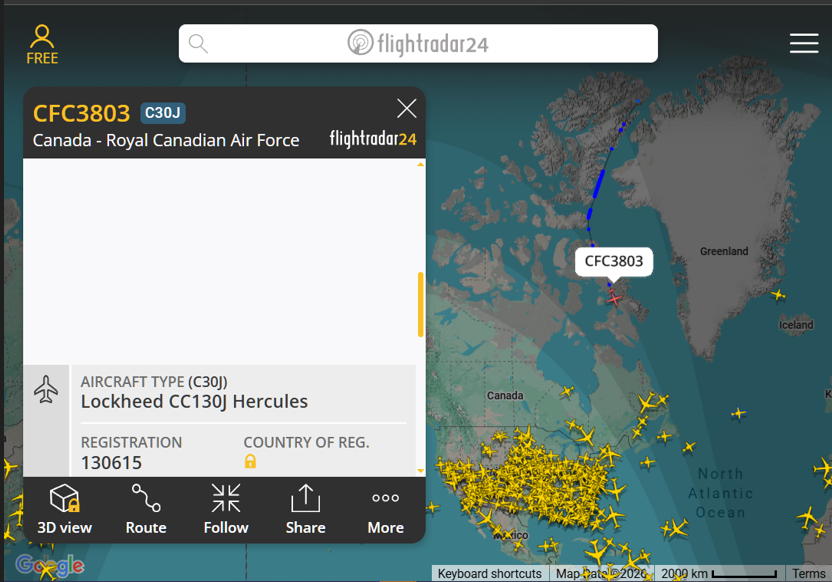
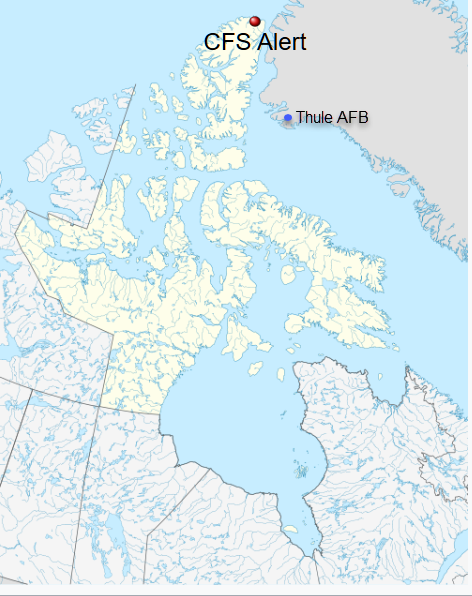
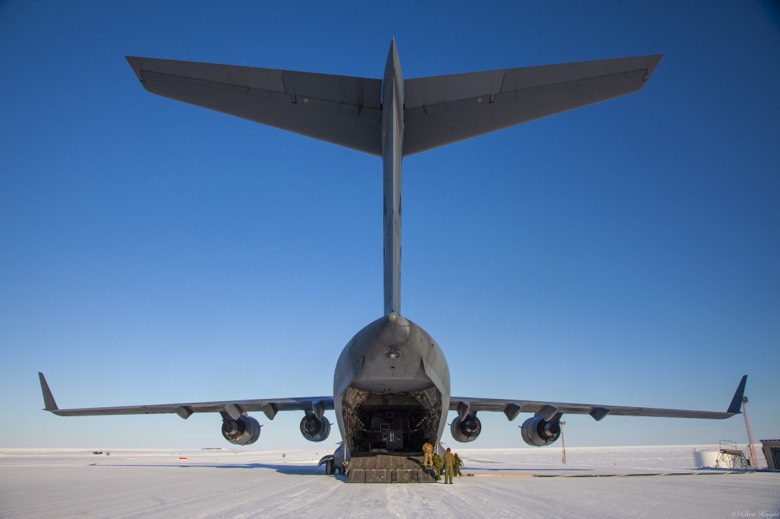
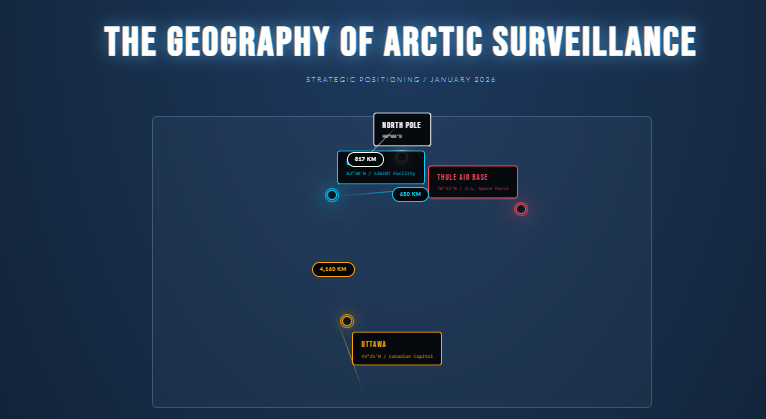
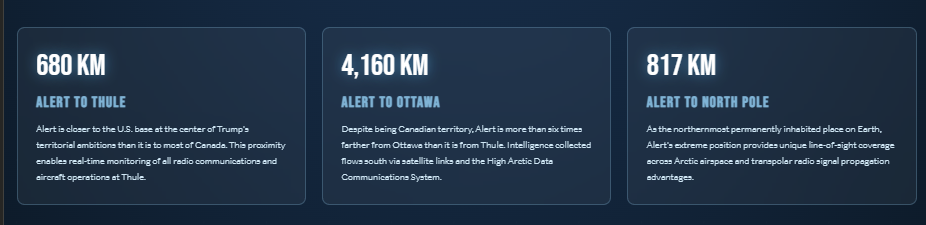
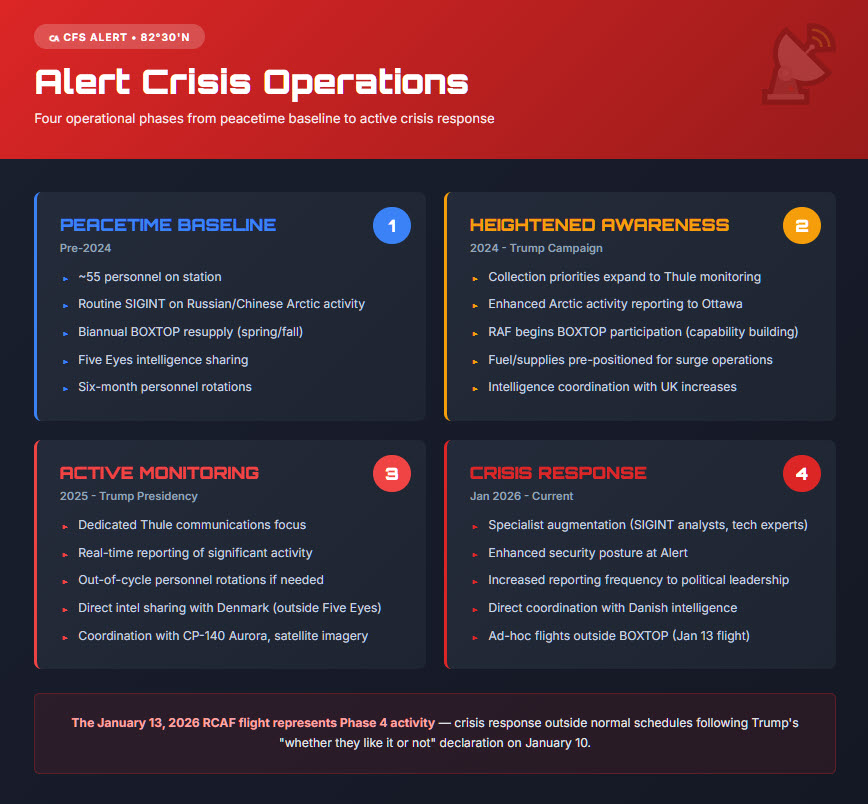
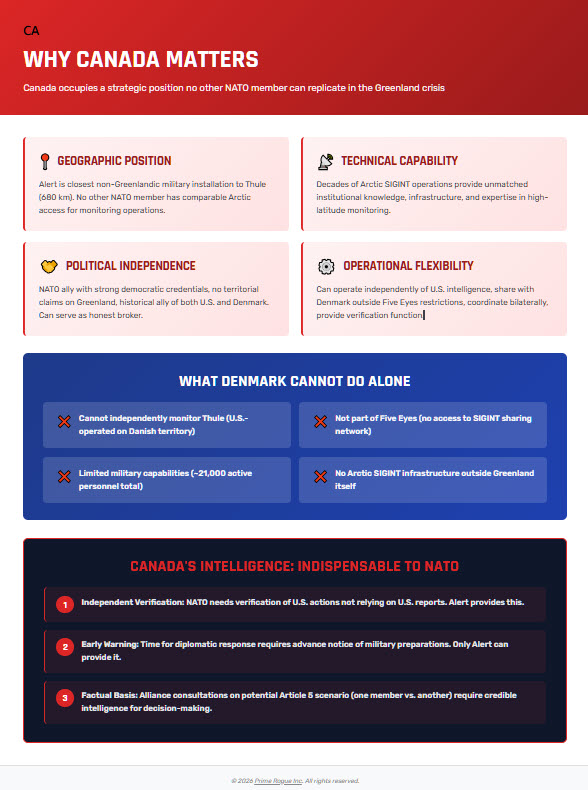
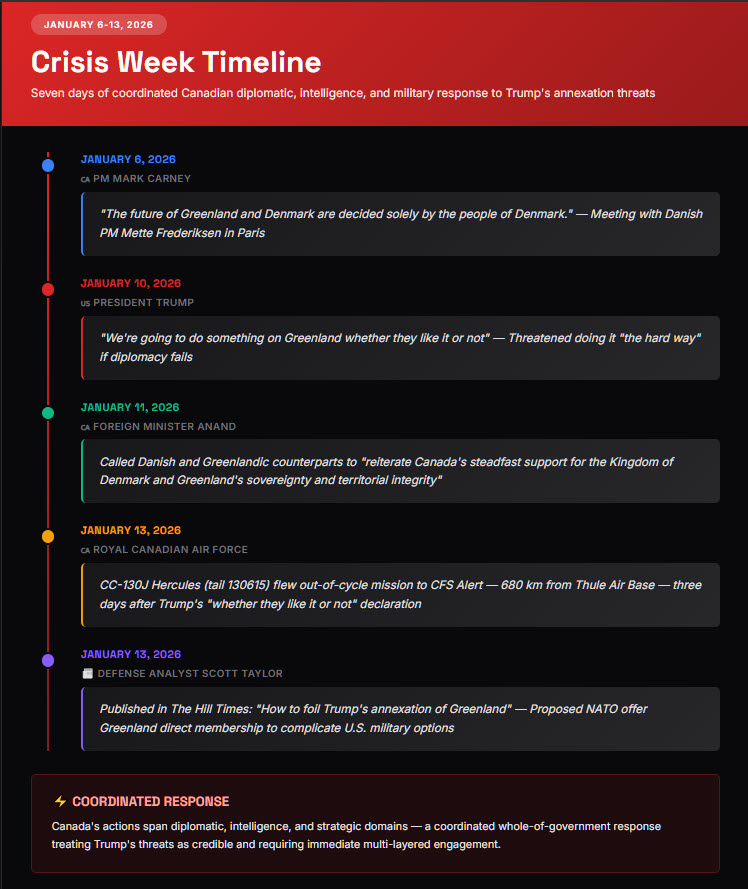
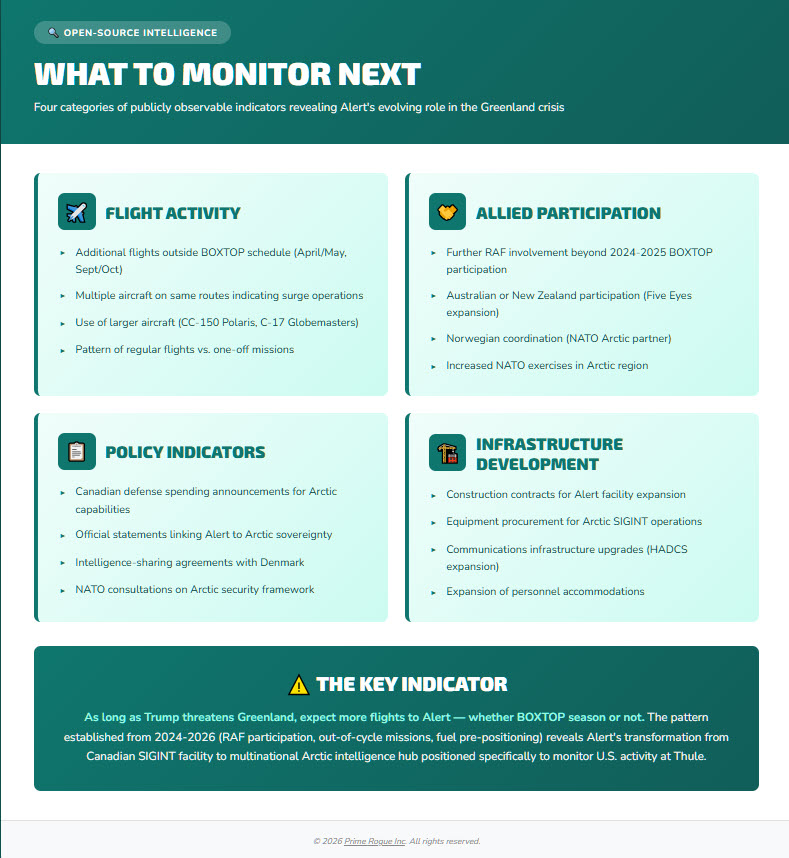
 Canada’s Sovereignty Challenges: Greenland & Trump
 The GIUK Gap, Greenland, and the Battle for Arctic Supremacy: NATO, Russia, and Trump’s Annexation Gambit
 OSINT Briefer: Canada Opens Nuuk Consulate Amid Greenland Crisis
 A Hypothetical U.S. Military Invasion of Greenland – Grand Strategy, Strategy, Operations, and Tactics: A National Security Briefing



[…] and contribute to international discussions. Greenlandic allies like Canada, notably because of CFS Alert being close to Greenland, are critical partners for the Prime Minister of […]