Address
304 North Cardinal St.
Dorchester Center, MA 02124
Work Hours
Monday to Friday: 7AM - 7PM
Weekend: 10AM - 5PM

Address
304 North Cardinal St.
Dorchester Center, MA 02124
Work Hours
Monday to Friday: 7AM - 7PM
Weekend: 10AM - 5PM
Tags: Jeffrey Epstein, Canadian Higher Education, OSINT, Investigative Announcement, Institutional Accountability, McGill University, University of Toronto, Network Analysis
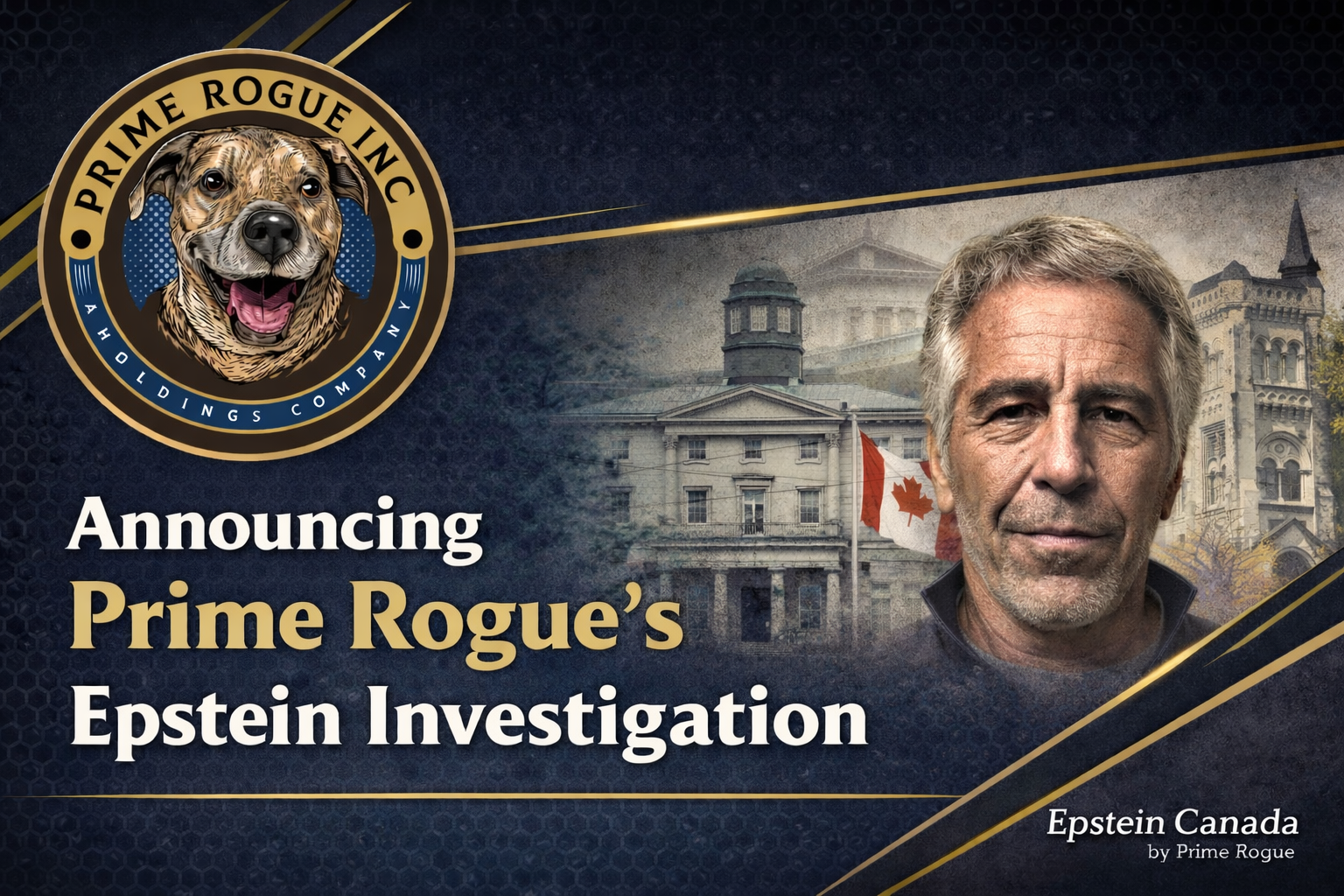
This is a formal announcement that Prime Rogue Inc. has opened an investigative track into Jeffrey Epstein’s relationships with Canadian post-secondary institutions — specifically the funding he directed or facilitated, the individuals within those institutions who maintained contact with him or his network, and the degree to which Canadian universities were aware of — or indifferent to — his status as a convicted sex offender when those relationships were active.
It is now live at Epstein Canada by Prime Rogue Inc!
This investigation is part of a broader analytical effort, rooted in the provenance questions we raised in The Inbox That Wasn’t Seized and the threat mapping we published last July in Intelligence Brief: Epstein’s Network and Canadian Compromise Risk. It is not a standalone project. It is a thread we are pulling because the thread is there, and because no one else appears to be pulling it.
When the Epstein files began releasing in late 2025, the media focus — understandably — landed on the American and British figures who appeared most prominently. The political theatre around Trump, the Prince Andrew photographs, the Bannon texts. These are the names that drive clicks and fill airtime.
Canadian institutions received almost none of that attention.
That absence is worth examining. Not because we have evidence that Canadian universities were central to Epstein’s network. We don’t — not yet. But because the structural conditions for that kind of relationship exist in the Canadian higher education landscape, and because the released files have begun to reveal patterns of institutional engagement that map onto exactly the kind of soft-influence vectors we identified in our July brief.
Epstein was not simply a predator. He was a financier who understood that philanthropy is leverage. He donated to elite universities. He funded research programs. He cultivated relationships with academics, administrators, and alumni networks. He used educational prestige the way he used everything else — as social currency, as access infrastructure, and as a mechanism for building relationships with people who had not yet learned to be cautious around him.
Canadian higher education sits at a specific intersection of vulnerability. The “McGill–Oxbridge pipeline” — the flow of Canadian scholars and administrators into elite UK and American institutions where Epstein was most active — creates adjacency points that are difficult to map from the outside. Bay Street alumni networks overlap with university donor rolls. Canadian academics who spent time at Harvard, Oxford, or Cambridge during Epstein’s period of active engagement may have encountered him or his proxies without that encounter ever appearing in any public record.
We are not assuming wrongdoing. We are mapping the network.
The investigation will focus on three areas:
Funding and philanthropy. Did any Canadian post-secondary institution receive donations, grants, or endowment contributions that can be traced — directly or through intermediary entities — to Epstein or to organizations he controlled? This includes charitable vehicles, shell foundations, and third-party philanthropic vehicles that Epstein was known to use. FINTRAC and CRA records, where accessible, will be part of this analysis.
Personnel and alumni networks. Which Canadian academics, administrators, or alumni maintained correspondence with Epstein or appeared in his contact records, flight logs, or the released email archive? Where did those individuals hold positions? What were their roles? Did any of them have access to student populations or vulnerable individuals?
Institutional awareness. At what point — if any — did Canadian universities become aware of Epstein’s criminal history while continuing to accept his engagement or funding? This is the question that matters most for accountability. Epstein pleaded guilty in 2008. Any institution that maintained a relationship with him after that date made a choice. We want to understand that choice.
Institutions currently under preliminary review include, but are not limited to, McGill University, the University of Toronto, the University of British Columbia, and Western University. This list will expand or contract as the OSINT mapping progresses. We will not name specific individuals until we have sufficient evidence to contextualize the connection.
This investigation will use open-source intelligence techniques consistent with Prime Rogue’s published OSINT methodology. Sources will include the DOJ Epstein Library, the House Oversight Committee releases, Bloomberg’s independently obtained Epstein email archive, publicly available university donor records, CRA charitable registration data, and academic publication networks.
We will file Access to Information and Privacy Act requests with relevant Canadian federal agencies where their records may be responsive. Given our experience with institutional responses to ATIP requests — including the full Glomar we received from FINTRAC on a prior Epstein-related query — we expect this process to be contentious. We will document every request and every response, and we will publish that documentation alongside our findings.
Where we contact individuals named in connection with this investigation, we will provide a reasonable opportunity to respond before publication, consistent with our editorial standards.
This investigation runs in parallel with, but is distinct from, a separate inquiry into Epstein’s ties to American post-secondary institutions, which is being conducted independently by Margot Lanihin. [Details and byline forthcoming.]
Both tracks feed into the broader provenance analysis that began with the Gmail bounce test documented in The Inbox That Wasn’t Seized. The question underneath all of it is the same: how complete is the picture we’ve actually been given, and what does the institutional landscape look like when you start mapping the edges that the official releases don’t reach?
If you have information relevant to this investigation — whether you are a current or former student, staff member, or administrator at a Canadian post-secondary institution, and whether your information relates to Epstein directly or to the broader network of individuals and entities connected to him — we want to hear from you.
Contact us through the secure channels listed on our contact page. We will not publish anything that could identify a source without explicit consent.
Prime Rogue Inc. is a Calgary-based private intelligence and strategic transparency firm. This investigation is part of our ongoing OSINT work on institutional accountability and the Epstein files release. Updates will be published on this site and, where the reporting meets hard-news standards, on The Signal Cage.
 Intelligence Brief: Epstein’s Network and Canadian Compromise Risk
 Canada Refuses to Confirm or Deny Epstein Files: FINTRAC Issues Full Glomar Response
 Top 10 Counterintelligence Threats to Canada: From Foreign Agencies to Bureaucratic Sabotage
 “Neither Confirm Nor Deny”: The Glomar Response and Its Canadian Mutation under the Privacy Act