Address
304 North Cardinal St.
Dorchester Center, MA 02124
Work Hours
Monday to Friday: 7AM - 7PM
Weekend: 10AM - 5PM

Address
304 North Cardinal St.
Dorchester Center, MA 02124
Work Hours
Monday to Friday: 7AM - 7PM
Weekend: 10AM - 5PM
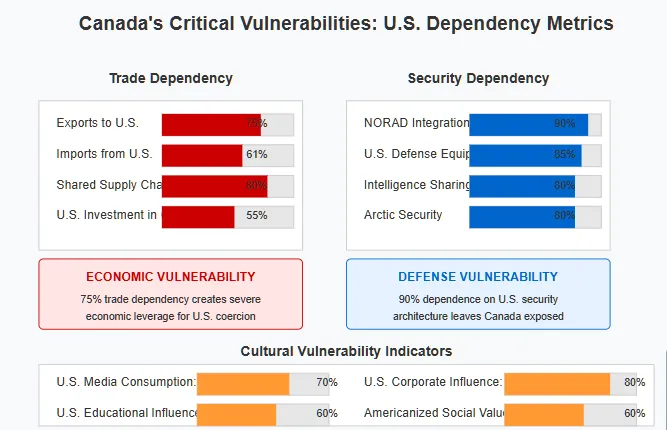
For decades, Canada has built its foreign policy, economy, and security under the assumption that the United States is a stable ally, a reliable trade partner, and a de facto security guarantor. That assumption is now dead.
The latest round of Trump tariffs on Canada—under the false pretext of stopping fentanyl and illegal immigration—signals a fundamental shift in U.S.-Canada relations. These are not just economic penalties; they are political leverage, a reminder that Canada’s economy is deeply entangled with a volatile, unstable neighbor that increasingly sees it as expendable. But tariffs are only the tip of the iceberg. Trump’s public musings about annexing Canada, once dismissed as bluster, now reflect a deeper American impulse—one that sees Canada not as a sovereign ally, but as an economic asset to be controlled, a subordinate state rather than an independent nation.
At the same time, Europe is already moving forward with contingency plans for a world where the United States is unreliable. Trump’s abandonment of Ukraine and his repeated threats to withdraw from NATO have forced Poland and other European nations to consider developing their own nuclear deterrents, recognizing that American protection is no longer guaranteed. Canada, facing an even more direct and immediate threat in the form of economic and political coercion from Washington, must take the same lesson to heart.
The path forward is clear: Canada must stop thinking of itself as an extension of the U.S. economy and security structure and start thinking like Finland.
Finland, for decades, has lived with the knowledge that Russia is an existential threat. Every element of Finnish society—its military, its economy, its infrastructure, even its education system—is built around national resilience and self-sufficiency. The Nordic countries more broadly (Finland, Sweden, Norway, Denmark, and Iceland) have mastered the art of maintaining sovereignty and economic independence despite being geographically close to great powers. Canada has far more in common with these states than it does with the United States.
If Canada does not act now—if it does not break from the illusion of U.S. stability, if it does not secure its own economic and military independence—it will find itself economically subjugated, diplomatically isolated, and possibly even politically threatened.
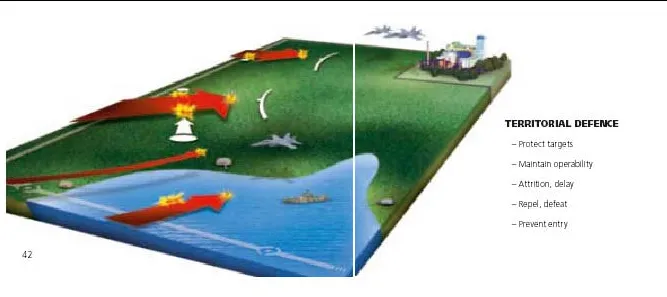
The world is shifting. The Nordic model is no longer just an option—it is a survival strategy. Canada must build a new civil defence paradigm to survive this threat, and model it on the precedent set by the Nordic democracies.
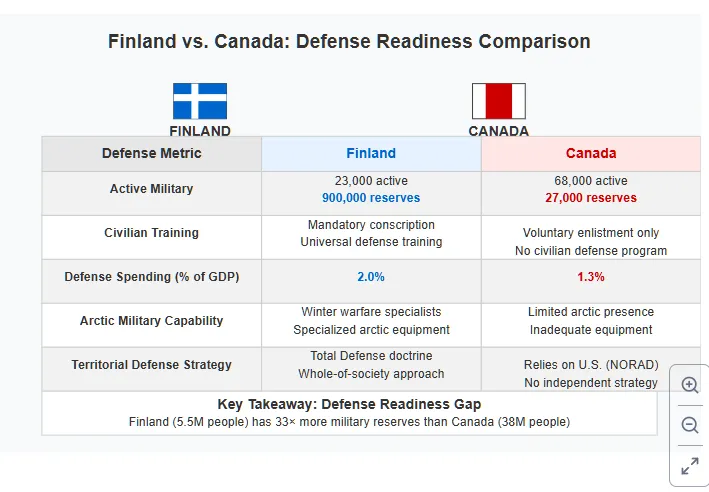
Canada has spent decades assuming that existential threats do not apply to it. Finland assumes the opposite: that existential threats never go away. That difference in mindset is why Finland is one of the most prepared nations in the world—and why Canada remains dangerously exposed.
Finland’s Total Defense model is built on a simple but brutal reality: in a crisis, there is no one coming to save you. Every aspect of Finnish society is designed to function in a worst-case scenario. It does not rely on NATO for protection. It does not assume the European Union will always be stable. And it does not build its security around economic optimism. Instead, it treats resilience as the foundation of sovereignty.
Canada has no equivalent model. If a major economic or security crisis were to occur—whether from U.S. political instability, a global war, or an Arctic conflict—Canada has no serious ability to respond. That must change immediately.
1. Every Citizen is Part of National Defense
Finland does not have a passive population waiting for the government to act in a crisis. Instead, it has a trained, prepared society where national security is a shared responsibility.
2. Infrastructure is Built for Crisis
3. Strategic Stockpiles & Economic Self-Sufficiency
1. Implement a Mass Reserve System
2. Harden Infrastructure Against Political & Economic Instability
3. Build a National Strategic Stockpile
The world is changing. Finland has already adapted. If Canada does not follow suit, it will not survive as a sovereign state.
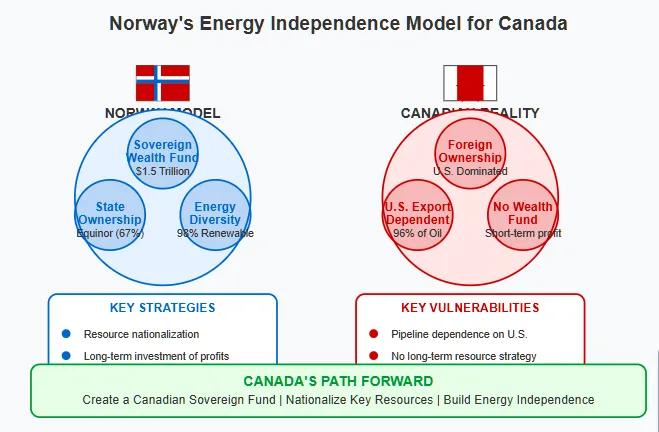
Energy is not just a commodity—it is the foundation of sovereignty. A nation that does not control its own energy supply is not a sovereign state. It is a resource colony.
For decades, Canada has allowed the United States to dictate the terms of its energy exports, treating its vast natural resources as a pipeline to American markets rather than a strategic asset for national security. This arrangement has been tolerated under the assumption that U.S.-Canada relations would always remain stable. That assumption is now dead.
Trump’s latest tariffs and escalating economic pressure on Canada prove that energy dependency is a national security risk. Meanwhile, in Europe, nations like Norway and Finland have built energy policies designed to ensure long-term security, economic stability, and geopolitical leverage. Canada must do the same.
Norway has one of the most successful energy strategies in the world and has immense thorium reserves for future usage. It has avoided the “resource curse” by ensuring that its vast oil and gas wealth is controlled by the state, not foreign corporations.
Canada, by contrast, has no equivalent strategy. Its oil, gas, and energy grids are heavily influenced by U.S. corporate interests. It has no sovereign wealth fund to protect against price fluctuations. It allows external forces—both American and Chinese—to dictate its energy future.
Unlike Norway, Finland has almost no domestic oil or gas production. Instead of being dependent on foreign suppliers, it has developed one of the most diverse and self-sufficient energy portfolios in the world.
Canada has massive untapped potential in nuclear, hydro, and renewable energy but remains shackled to an outdated oil-export economy designed to serve the U.S. market. If the U.S. economy declines—or if Washington imposes further restrictions—Canada’s energy sector will collapse. This is not just an economic issue; it is a matter of national security.
1. Nationalize or Establish Strict State Control Over Key Energy Sectors
2. Invest in Nuclear & Renewables to Reduce U.S. Dependency
3. Take Full Control Over Arctic Energy Resources
If Canada does not act now, it will find itself in a permanent state of economic servitude. The U.S. has already fired the first shot with tariffs. More will come. The only question is whether Canada will be prepared.
For over a century, Canada’s economic survival has been tethered to the United States. That dependency is now an existential liability.
Trump’s tariffs are not a one-off event—they are a preview of a future where American economic instability directly threatens Canada’s survival. The U.S. economy is a house of cards, bloated by debt, geopolitical overreach, and internal political chaos. Any nation that relies too heavily on it will suffer catastrophic consequences when that house finally collapses.
Finland and Sweden have built economic models designed to weather crises, balance free markets with state investment, and ensure long-term national stability. Canada, by contrast, remains exposed to every American market fluctuation, trade war, and political meltdown. That must change now.
Finland and Sweden do not rely on a single dominant trade partner. They have diversified their economies, balanced strategic industries with state oversight, and built buffers against external shocks.
By contrast, Canada’s economic model is dangerously outdated. It relies on:
Norway has one of the most effective economic survival tools in the world: its sovereign wealth fund. Built on oil revenues, it now holds over $1.5 trillion, ensuring long-term economic stability even during downturns.
If Canada had a Norwegian-style sovereign wealth fund, it would have:
1. Sever Trade Dependency on the U.S.
2. Establish a Sovereign Wealth Fund for Economic Stability
3. Build Domestic Supply Chains for Critical Industries
Canada’s economic servitude to the U.S. is a choice. Finland, Sweden, and Norway have proven that nations can break free from dependence and build long-term resilience. The only question is whether Canada has the political will to do the same.
The greatest military threat to Canada is not an invading army—it is strategic neglect.
For decades, Canada has relied on the United States for its national defense. This passive strategy worked as long as the U.S. remained a stable, committed ally. That is no longer the case.
Trump has openly discussed withdrawing from NATO, abandoned Ukraine to Russian aggression, and suggested that U.S. allies must “pay up” or be left defenseless. Canada is not prepared for a world where the U.S. no longer guarantees its security.
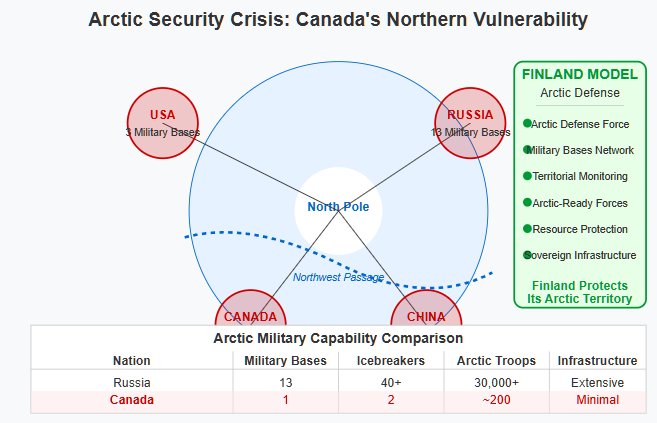
Meanwhile, the Arctic—Canada’s most vulnerable and strategically valuable region—is quickly becoming a geopolitical battleground. Russia, China, and even the United States are moving aggressively to stake claims. If Canada does not take full control over its Arctic security, it will lose it.
Finland’s military doctrine is not built on winning offensive wars—it is built on making invasion too costly to be worth the effort. This is the model Canada must adopt.
Canada, by contrast, has:
The Arctic is no longer an empty expanse of ice—it is one of the most strategically valuable regions in the world. As climate change accelerates, shipping routes, energy reserves, and military positions in the Arctic are becoming the focus of global competition.
If Canada does not immediately establish Arctic military dominance, it risks losing control of its northernmost territory to foreign interests.
1. Establish a Permanent Arctic Defense Force
2. Harden Arctic Infrastructure
3. Reduce Reliance on NORAD & Build an Independent Defense Strategy
The U.S. will not protect Canada’s Arctic. The only question is whether Canada will protect it for itself—or whether it will wait for foreign powers to take control. Canada must build a Civil Defence corps to protect itself from this threat and other.
Canada has spent decades acting as a loyal subordinate in the American-led global order. That era is over.
Trump’s abandonment of Ukraine and threats to withdraw from NATO have forced Europe to reassess its security. Poland is openly discussing acquiring nuclear weapons. Germany and France are debating independent deterrence options. Even Japan and South Korea are reconsidering their dependence on U.S. protection.
The message is clear: American guarantees mean nothing anymore.
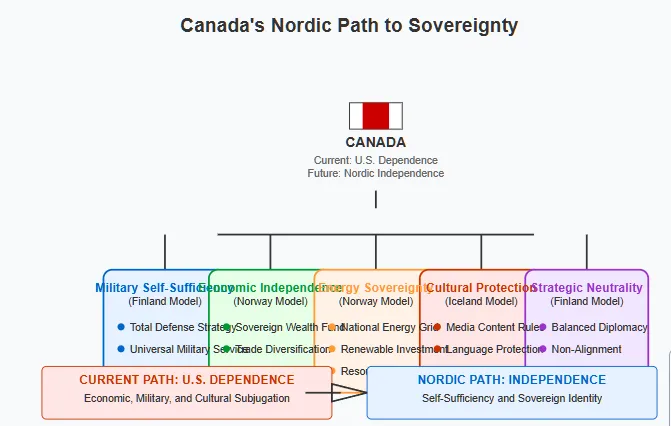
For Canada, this means that blindly following Washington’s geopolitical priorities is no longer a viable strategy. Instead, Canada must adopt the diplomatic playbook of Finland and Iceland—two small nations that have mastered the art of neutrality, strategic autonomy, and global leverage.
Before joining NATO in 2023, Finland spent decades navigating a precarious balance with Russia. Even now, it maintains a strong tradition of strategic autonomy, ensuring that it is not wholly dependent on any single power.
Canada, by contrast, has allowed itself to become fully entangled in U.S. foreign policy decisions. It reflexively supports American interventions, aligns its trade policies with Washington’s agenda, and assumes that U.S. security commitments will always hold. That assumption is no longer valid.
Iceland has perfected a strategic balancing act. As a NATO member without a standing army, it has relied on diplomatic agility, economic leverage, and its strategic location to ensure its security.
Canada, by contrast, acts as if it has no agency in global affairs. It follows U.S. directives on China, Russia, trade agreements, and security partnerships without asserting its own independent interests. This must change.
1. Reduce Dependence on the U.S. Security Umbrella
2. Diversify Diplomatic and Trade Alliances
3. Take Control of Its Own Geopolitical Narrative
The Nordic model is a survival strategy. If Canada fails to adopt it, it will remain shackled to a declining empire with no plan for its own future.
The greatest threat to Canada’s sovereignty isn’t military invasion or economic subjugation—it’s cultural annexation, and it is ongoing as America is interfering in the 2025 Canadian Election.
Trump’s suggestion that Canada should be annexed into the U.S. was dismissed by many as political theater, but it reflects an uncomfortable reality: most Americans already view Canada as an extension of their own country. The problem isn’t just that the U.S. sees Canada as a subordinate state—it’s that Canada has done almost nothing to stop it.
For decades, Canada has allowed its media, education system, and national identity to be dominated by American influence. The result is a slow-motion erosion of what makes Canada distinct. The Nordic countries—especially Finland, Norway, and Iceland—have taken a different approach. They have aggressively protected their language, culture, and media from external influence. Canada must do the same before its national identity is fully absorbed into the American cultural empire. Canada must also restrict the Maple MAGA fifth column which currently operates in the country.
Nordic nations do not assume that cultural survival is automatic. They treat it as a matter of national security.
This is not just a cultural issue—it is a national security issue. If Canada does not actively protect its cultural identity, it will have no ability to resist U.S. political and economic domination in the long run.
1. Massive Investment in Canadian Media & Cultural Production
2. Education Reform to Reinforce Canadian History & Identity
3. Strict Protection of Canadian Cultural & Economic Sovereignty
The fight for sovereignty starts in the classroom, in the media, and in national institutions. If Canada does not act now, it will soon be indistinguishable from the United States—not by conquest, but by neglect.
The collapse of American stability is no longer a distant possibility—it is unfolding in real time.
Trump’s tariffs, threats of annexation, abandonment of allies, and economic brinkmanship are not isolated events. They are the symptoms of a dying empire that no longer values alliances, diplomacy, or stability. Canada, for decades, has functioned as an extension of this empire—assuming that U.S. markets, military protection, and geopolitical leadership would always serve its interests. That assumption is now an existential liability.
The United States will not protect Canada. The United States will not prioritize Canada’s economic future. And if political instability worsens in Washington, Canada may even find itself directly threatened by American expansionist ambitions.
There is only one viable alternative: Canada must embrace a Finland-style model of self-sufficiency, military preparedness, economic independence, and cultural protection.
Finland, Norway, and Sweden have already demonstrated how small nations can survive and thrive in the shadow of great powers.
Canada has the resources, the strategic position, and the political leverage to adopt these same strategies. The only thing missing is the political will.
If Canada continues its current trajectory—remaining economically dependent on the U.S., militarily reliant on NORAD, and culturally absorbed by American media—it will not survive as a truly independent nation.
The U.S. is collapsing. Canada must choose: go down with the empire, or carve out a future on its own terms.
Finland has already prepared for an existential crisis. Why hasn’t Canada?
Canadian Civil Defence is a necessity – not a choice.
 Dassault Rafale vs. F-35, Eurofighter vs. F-35: Can Europe Break Free from U.S. Airpower?
 Portugal Cancels F-35 Order, Canada Reconsiders: Is NATO Breaking Away from U.S. Military Dependence?
 Canada at the Crossroads: NATO Withdrawal or Strategic Realignment with Europe?
 Breaking the Columbia River Treaty: Why the U.S. Just Gambled with the Future of the Pacific Northwest



[…] Stand with Canada against U.S. trade aggression.2️⃣ Fall deeper into U.S. economic dependence—eventually becoming a pawn in America’s […]
[…] the situation will move out of Ottawa’s hands—whether the government acknowledges it or not. If the federal government refuses to adopt a Finnish-style Total Defense policy, then it falls to t… And if the provinces refuse, then ordinary Canadians will begin structuring civilian defense […]
[…] states followed suit. Finland rebooted its total defense concept. Estonia began integrating civilian networks into territorial defense. Germany ran […]
[…] Canada’s strength has never been defined by its military might or economic hegemony. It has relied, historically, on something subtler but equally powerful: institutional coherence — the shared belief that public systems are trustworthy, rational, and fundamentally oriented toward the common good. […]
[…] The United States is no longer a reliable partner. Canada must now choose: strategic sovereignty wit… […]
[…] by a wide margin, the smallest nation by population ever to qualify for a men’s World Cup, breaking the record Iceland set in 2018. They went unbeaten through their entire CONCACAF qualifying campaign, clinching their […]
[…] an Evergreen Defence Actually Looks […]
[…] it clicks. Tonight’s draw showed something in between: enough to get a goal, not enough to break down a defence that had conceded only twice all […]