Address
304 North Cardinal St.
Dorchester Center, MA 02124
Work Hours
Monday to Friday: 7AM - 7PM
Weekend: 10AM - 5PM

Address
304 North Cardinal St.
Dorchester Center, MA 02124
Work Hours
Monday to Friday: 7AM - 7PM
Weekend: 10AM - 5PM
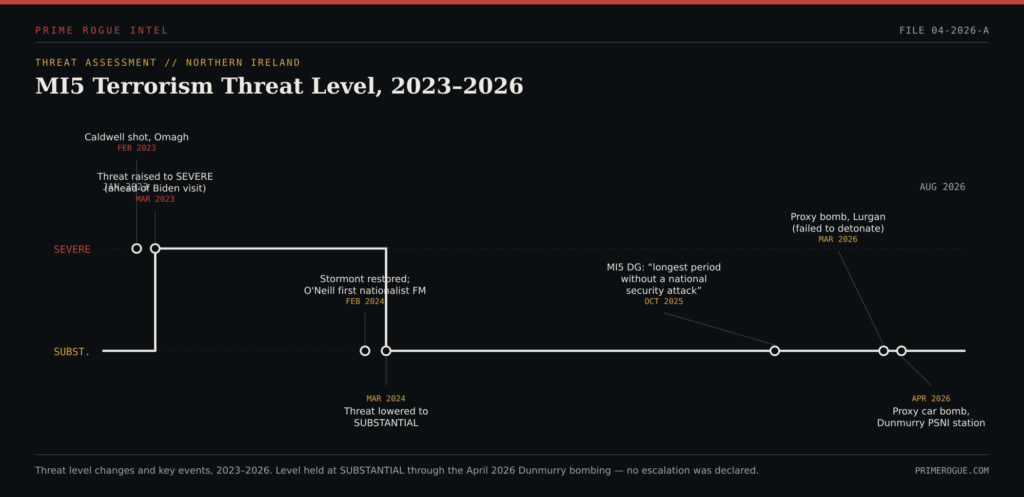
On the night of Saturday 26 April 2026, a delivery driver in west Belfast was hijacked by a masked gunman. A device — described by the New IRA as containing Semtex, an electrical detonator and a timer — was placed in his car, and he was ordered to drive it to Dunmurry police station on the southwestern edge of Belfast, where it exploded in a fireball. Roughly 100 homes were evacuated; residents, including two infants, spent the night in emergency accommodation. It was, surprisingly, non-fatal.
The attack was not an isolated event. Around a month earlier, on 30 March 2026, a near-identical operation targeted a police station in Lurgan, County Armagh: a pizza-delivery driver was hijacked at gunpoint, a device was left in his boot, and he was forced to drive it to the station — though it failed to detonate and was made safe in a controlled explosion.
The New IRA claimed both. The method — coercing a civilian into becoming a proxy “human bomb” — was a deliberate throwback to one of the Provisional IRA’s most notorious tactics of the 1980s. PSNI Chief Constable Jon Boutcher described the Dunmurry bombing as “deliberate, reckless and stupid” and an “absolutely irresponsible, unacceptable act of violence,” adding: “We hoped these days were behind us… We didn’t anticipate this.”
In its claim of responsibility, the group used language directly evoking the Troubles, warning that anyone “collaborating with British crown forces” or giving information to police “will be severely dealt with,” and vowing to continue its campaign “until the British give a declaration to withdraw.” Crucially, the statement also threatened to target officers at their homes — an escalation from station and patrol attacks. A 66-year-old man was arrested under the Terrorism Act days after the Dunmurry blast, and by June 2026 two men had been charged with attempted murder in connection with the two attacks.
The single most telling official response was what did not happen: MI5 did not raise the threat level. Deputy Chief Constable Bobby Singleton noted there had been “absolutely no warning” and that the device showed “murderous intent and capability” still exists and is “regularly deployed” against officers — but stressed the threat was “already… real and… credible” at the “substantial” level. AOL
Commentators also flagged an uncomfortable intelligence question: the New IRA has been heavily penetrated by the PSNI and MI5, yet was able to mount two proxy-bomb operations within weeks without interception — a gap raised directly in the House of Commons during a 27 April 2026 debate on the Dunmurry attack.
The Provisional IRA formally ended its armed campaign in July 2005 and completed decommissioning of its weapons under international verification. For readers unfamiliar with the arc: the 1998 Good Friday (Belfast) Agreement ended three decades of conflict that killed more than 3,600 people; the Provisionals’ 2005 move was the definitive close of that campaign.
But the question of residual structures has never fully gone away. A 2015 joint PSNI–MI5 assessment, commissioned after the Belfast murder of former IRA man Kevin McGuigan, concluded that Provisional IRA structures, including the so-called “Army Council” (PAC), remained in existence in much-reduced form; that the organisation retained access to some weapons; that it was not recruiting or “on a war footing”; and that PIRA members believe the Army Council “oversees both PIRA and Sinn Féin with an overarching strategy.” Critically, then–Northern Ireland Secretary Theresa Villiers told the Commons this strategy was judged to have a “wholly political focus,” and that the IRA “is not involved in targeting or conducting terrorist attacks against the state.”
The PSNI has repeatedly confirmed that this assessment remains unchanged, reaffirming as recently as 2026, in response to correspondence from unionist politicians, that “PIRA members believe that the PAC oversees both PIRA and Sinn Féin,” that the IRA “still has access to weapons,” and that some members conduct counter-intelligence activity. Garda Commissioner Drew Harris has stated An Garda Síochána “do not differ from that view.”
Sinn Féin flatly rejects the characterisation. Party leader Mary Lou McDonald has said “the IRA is gone, has left the stage and is not coming back,” insisting “nobody directs Sinn Féin other than Sinn Féin members.” The analytical bottom line: the PIRA legacy structure is assessed as a dormant, politically-focused shell — not a security threat in the operational sense. The threat lies elsewhere.
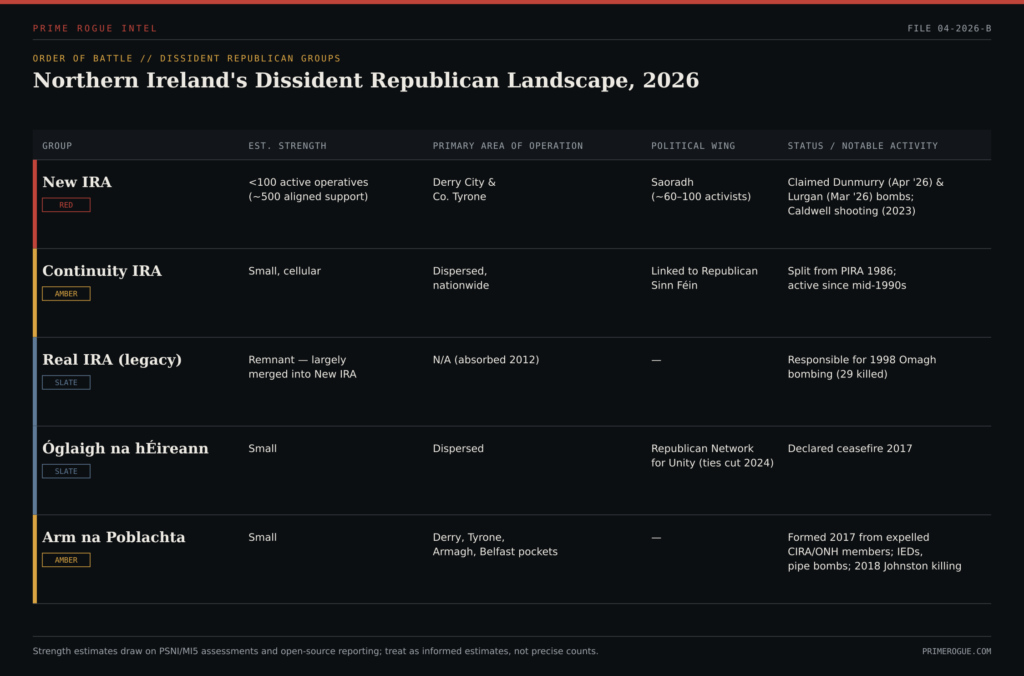
The most significant threats, on both sides of the Irish sovereignty quetion are the dissident republican splinters who rejected the peace process and believe a united Ireland can still be achieved by force as well as loyalist paramilitary groups susceptible to populism as a social technology:
The most significant blow against the New IRA came in 2020’s Operation Arbacia, when MI5 covertly recorded two meetings of the group’s alleged executive in Omagh — where prosecutors say participants discussed kidnapping drug dealers for a £500,000 ransom, bombing campaigns, cyber-attacks and seeking backing from a foreign state hostile to the UK. The operation produced a string of arrests and prosecutions, but MI5 and PSNI sources cautioned even then that it was “pre-emptive” to speak of the group’s end: “It still exists and is still dangerous.”
The event that most sharply illustrates the dissident threat is the attempted murder of Detective Chief Inspector John Caldwell. On 22 February 2023, Caldwell was shot several times in front of his young son at a sports complex in Omagh, moments after coaching a youth football session. He survived but suffered extensive injuries and has since retired from the PSNI on medical grounds. The New IRA claimed responsibility, and the attack directly prompted MI5 to raise the threat level to “severe” in March 2023 – just ahead of President Biden’s visit to mark the Agreement’s 25th anniversary.
Prosecutions have rolled on into 2026. A court heard in August 2025 that the New IRA had planned an earlier attack on Caldwell in the weeks before the shooting, and that other criminal factions allegedly joined the dissident grouping to target him. Eight men were charged with attempted murder; the trial was expected to run into 2026. Several defendants were granted bail on delay grounds; in early 2026 charges against one accused were withdrawn; a 73-year-old man was charged with related offences in November 2025; and three Derry men separately denied charges relating to the written New IRA claim of responsibility posted in Creggan. The case has become a slow-motion barometer of both dissident capability and the difficulty of securing convictions on largely circumstantial evidence.
Stormont is functioning — for now. The power-sharing executive was restored on 3 February 2024 after a two-year DUP boycott over post-Brexit trading arrangements. Michelle O’Neill (Sinn Féin) became the first nationalist First Minister, with the DUP’s Emma Little-Pengelly as deputy First Minister. The symbolism was seismic in a state designed a century ago to guarantee unionist majority rule. But the executive is fractious; the two lead parties have repeatedly clashed, and Assembly elections due in 2027 are already sharpening tensions.
The Windsor Framework remains a running unionist grievance. The Framework replaced the Northern Ireland Protocol in 2023, introducing “green” and “red” lanes to ease GB–NI trade while keeping Northern Ireland aligned to some EU rules to avoid a hard land border. In December 2024 the Assembly held its first “democratic consent” vote; a majority backed continued application of the relevant EU rules, but because all unionist-designated members voted against, it failed the cross-community consent test. That triggered an independent review by Lord Murphy of Torfaen, published on 4 September 2025, whose 16 recommendations the UK government accepted on 16 December 2025. A QUB/LucidTalk poll (3–6 October 2025) found public support for the Framework softening even as outright opposition stayed static — and loyalist survey work (via Let’s Talk Loyalism) found “some support” for renewed street protests over the Irish Sea border.
Sinn Féin’s electoral trajectory is a study in divergence. In the UK general election of July 2024, Sinn Féin held all seven of its Westminster seats, becoming the largest Northern Irish party at Westminster (though it abstains from taking seats). But in the Republic’s general election of 29 November 2024, Sinn Féin won 39 Dáil seats, behind Fianna Fáil (48) and Fine Gael (38), a distant third on a turnout of 59.7%, the lowest in over a century, and was excluded from the new coalition. As the New World’s Gail Walker observed in June 2026, Sinn Féin’s southern support collapsed from a 10–12 point poll lead to “rummaging in the basement of percentages,” with immigration eroding its working-class base. O’Neill maintains she believes a border poll will be held by 2030, calling this a “decade of opportunity”; the UK government counters there is “no realistic prospect” of one. No concrete steps toward a poll have been taken.
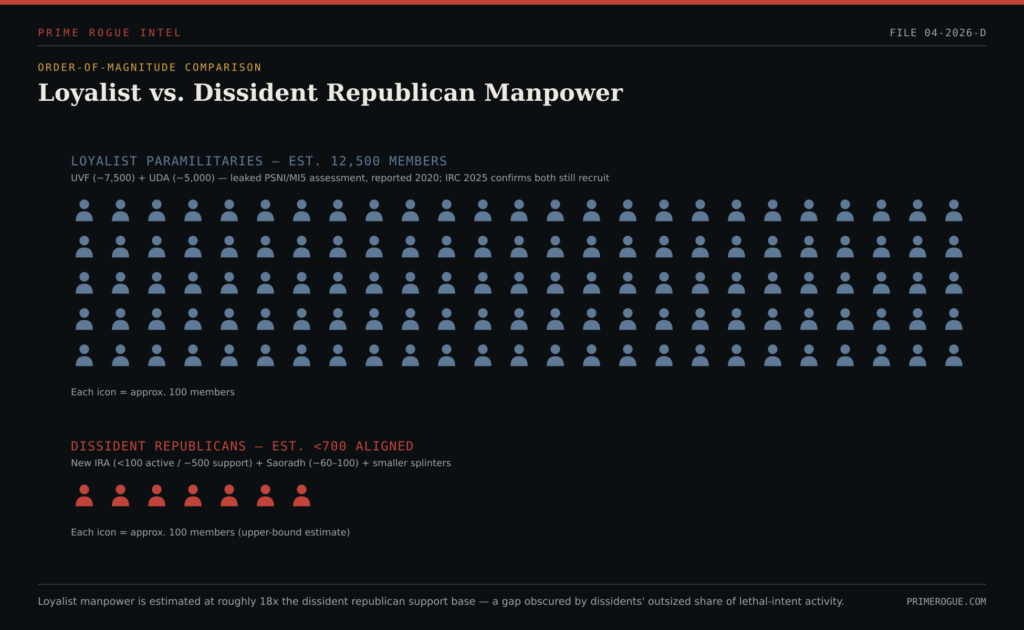
Any assessment of “Troubles 2.0” risk that focuses only on republicans is dangerously incomplete. The main loyalist groups, the Ulster Volunteer Force (UVF) and Ulster Defence Association (UDA), never disbanded. A leaked PSNI/MI5 assessment reported by BBC NI’s Spotlight in December 2020 estimated some 12,500 loyalist paramilitary members — about 7,500 in the UVF and 5,000 in the UDA — noting that although many are inactive, they remain “card carrying” members. The UDA in particular is described as the most fractured, “run like individual fiefdoms.”
Both groups continue to recruit and are heavily enmeshed in organised crime and drug dealing. RTÉ, reporting the Independent Reporting Commission’s February 2025 findings, confirmed the UVF and UDA “continue to recruit and have thousands of members.” Loyalist paramilitary figures were also implicated in the two most serious outbreaks of communal violence in the current window:
The Loyalist Communities Council (LCC) — the umbrella body founded in 2015 to represent the UVF, UDA and Red Hand Commando — temporarily withdrew loyalist support for the Good Friday Agreement in March 2021 over the Irish Sea border, and has continued to warn that the “credible threat” arises if “unionism and loyalism is continually undermined.” Loyalist violence is more likely to manifest as communal rioting and organised-crime turf conflict than as a structured “campaign,” but it is a genuine second axis of instability.
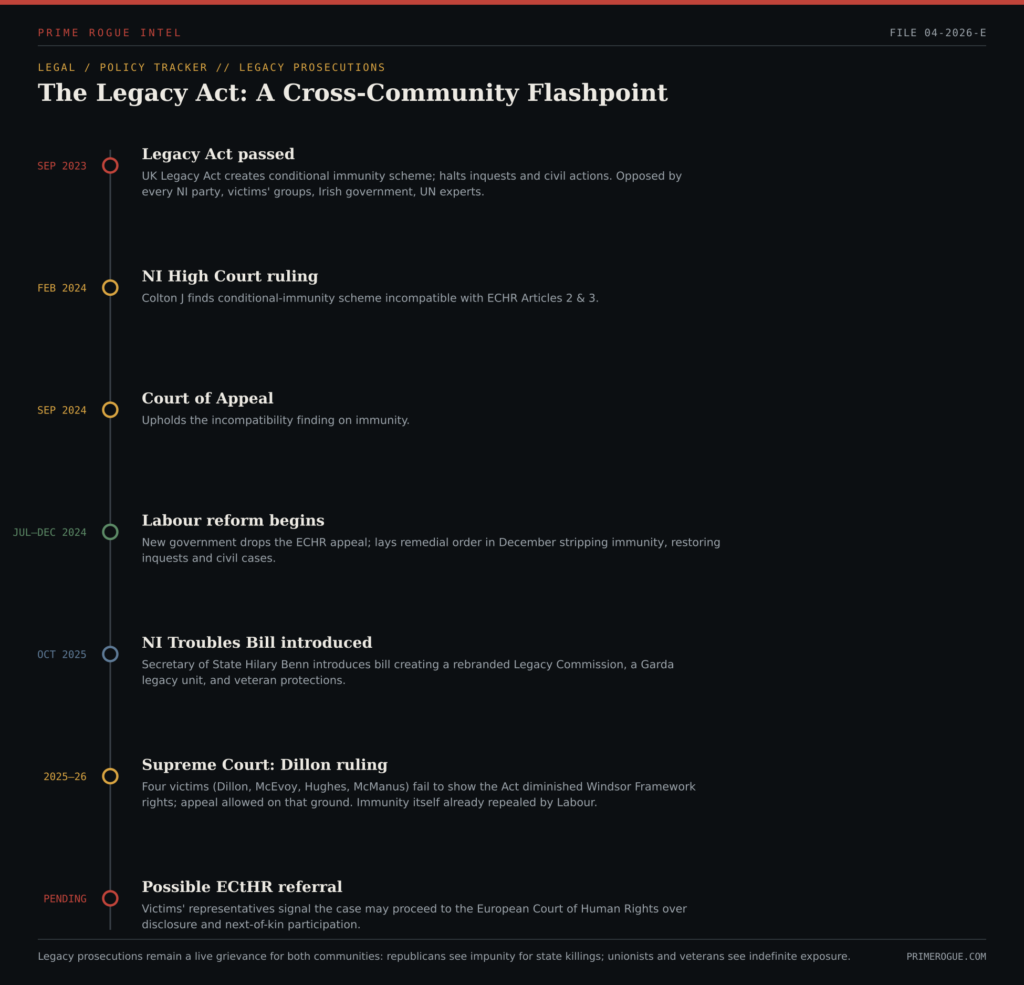
The Northern Ireland Troubles (Legacy and Reconciliation) Act 2023, passed by the Conservative government, offered conditional immunity to Troubles-era perpetrators (security-force members, republicans and loyalists alike) in exchange for cooperation with a new Independent Commission for Reconciliation and Information Recovery (ICRIR), and halted legacy inquests and civil actions. It was opposed by every Northern Ireland party, victims’ groups, the Irish government, and UN human-rights experts.
The courts dismantled its core: the NI High Court (February 2024, Colton J) and Court of Appeal (September 2024) found the conditional-immunity scheme incompatible with Articles 2 and 3 of the ECHR. The incoming Labour government dropped its appeal on the ECHR grounds, and Secretary of State Hilary Benn began repealing the Act — laying a remedial order in December 2024 to strip out immunity and restore inquests and civil cases, then introducing the Northern Ireland Troubles Bill on 14 October 2025 to create a rebranded Legacy Commission, a dedicated legacy unit within An Garda Síochána, and a package of six protections for veterans.
The UK Supreme Court issued its judgment in Dillon and others v Secretary of State for Northern Ireland — the case brought by four Troubles victims (Martina Dillon, John McEvoy, Brigid Hughes and Lynda McManus). The five justices found the applicants had been “unable to establish that the 2023 Act led to a diminution of rights” under the Windsor Framework, allowing the Secretary of State’s appeal on that ground — even as the immunity provisions themselves had already been legislated away by Labour. Victims’ representatives (via Phoenix Law) and the SDLP’s Claire Hanna warned the ruling did not resolve concerns over next-of-kin participation and disclosure, and victims may now take the case to the European Court of Human Rights. Legacy is thus a persistent, cross-community grievance engine: republicans see impunity for state killings; unionists and veterans’ groups see a “witch-hunt” against former soldiers. It fuels the sense of unfinished business that dissidents exploit.
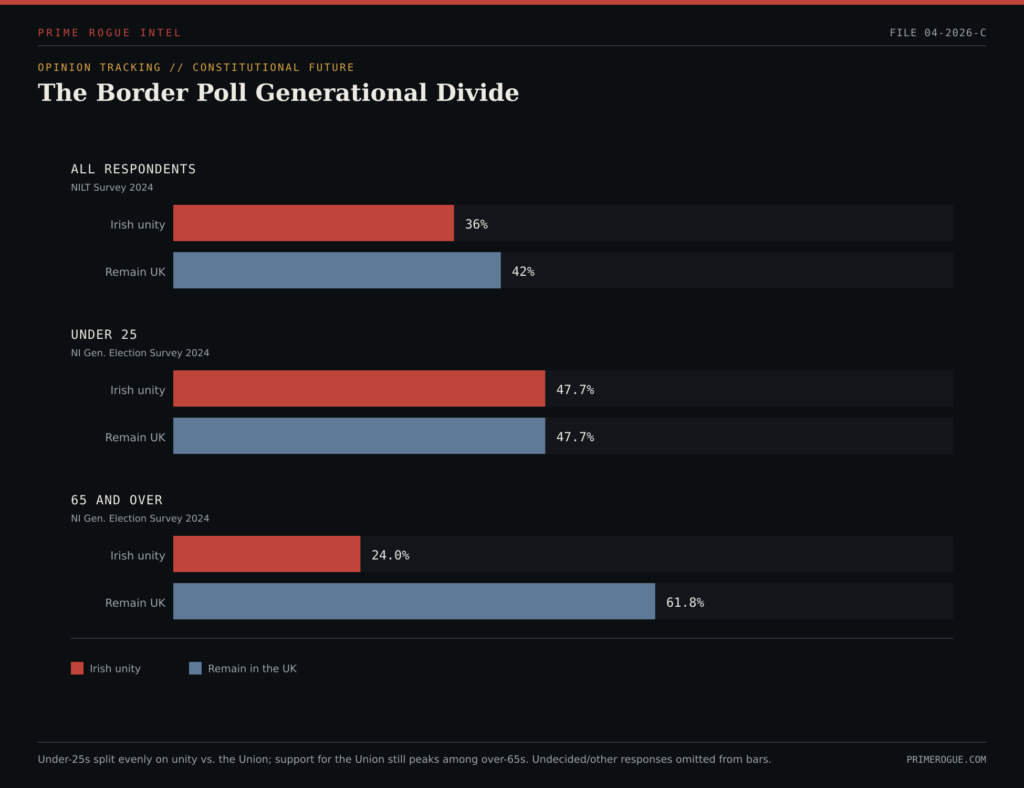
The generation born after 1998 has grown up in relative peace, but the picture is not one of settled reconciliation. The 2024 Northern Ireland Life and Times Survey (1,199 respondents; analysis by QUB’s Prof. Katy Hayward and Dr Ben Rosher) found 36% would vote for reunification versus 42% to remain in the UK — the highest nationalist proportion recorded in the NILT series, with nationalist self-identification rising from 19% in 2020 to 30% in 2024. Younger cohorts skew markedly toward change: in the separate 2024 Northern Ireland General Election Survey (2,034 respondents, Social Market Research), among under-25s expressing a preference, support for Irish unity and remaining in the UK was tied at 47.7% each, while support for the union peaked among over-65s at 61.8%. The constitutional question is generationally live.
On radicalisation, QUB researchers, notably Dr Siobhán McAlister and Dr Gillian Shorter, increasingly reframe dissident and loyalist recruitment of young people as exploitation and child abuse rather than “recruitment,” documenting coercion of youths into rioting to settle drug debts and punishment-style violence. Academic research (including GNET and RUSI work) notes dissidents use digital platforms to reach disaffected youth, while emphasising that the total pool of dissident-aligned young people remains small and geographically concentrated. The Independent Reporting Commission has consistently warned that paramilitary groups still pose a “clear and present danger” to Northern Ireland and has called for a formal disbandment/transition process — appointing an independent expert in 2025 to scope what that might involve.
The most authoritative recent read came from MI5 Director General Sir Ken McCallum, who told his annual threat update at Thames House on 16 October 2025: “Finally on terrorism, Northern Ireland. Communities there are now living through the longest period without a national security attack since the start of the Troubles. We will continue, with the police, to bear down on residual threats and degrade terrorist capabilities.” The 2026 bombings gave that judgment an uncomfortable footnote — but note the careful phrasing: MI5 distinguishes “national security attacks” (large, campaign-defining strikes) from the sporadic, largely non-fatal operations dissidents continue to attempt.
The Independent Reporting Commission (IRC), established by UK–Irish treaty in 2017, documented in its Seventh Report (February 2025) and Eighth Report (December 2025) that paramilitary violence has fallen to historic lows: 2024–25 was the first financial year since records began in 1969 with no security-related deaths, with paramilitary-style assaults reportedly at a 41-year low and shootings at a 17-year low. Yet the IRC warned of “shifting dynamics” — leadership changes, reported splits, possible feuds and deepening organised-crime links — and stressed that intact structures “can be used to facilitate organised crime and other forms of violence.” It has pushed a controversial “twin-track plus group-transition” approach; critics such as historian Brian Feeney argue this amounts to “pandering to paramilitaries.”
Baseline monitoring (now). Treat the MI5 NI-related terrorism threat level as the single most important leading indicator. It has held at “substantial” since March 2024. A move back to “severe” would be the clearest official signal that the security services judge dissident capability and intent to have materially risen. Benchmark: any such change, or any indication MI5 has lost confidence in its penetration of the New IRA.
Watch for a strategic inflection. The New IRA’s explicit threat to target officers at their homes is the key escalation trigger. A successful fatal attack on a serving officer, or any attack outside Northern Ireland (in Great Britain), would mark a strategic shift and should prompt a full reassessment of the “low-intensity” baseline judgment.
Track the political accelerants. Monitor (a) the next Windsor Framework consent vote and loyalist street reaction; (b) legacy litigation, especially any referral of the Dillon victims’ case to the ECtHR, which would keep the impunity grievance alive; and (c) border-poll discourse and Sinn Féin’s electoral fortunes north and south. Each is a slow-burn driver rather than an immediate trigger, but a convergence of all three around the 2027 Assembly elections would raise communal-tension risk.
Do not under-weight the loyalist axis. Anti-immigrant unrest (Belfast 2024, Ballymena 2025, June 2026) is currently the most probable source of mass disorder. Benchmark for concern: any loyalist paramilitary move to formally withdraw from the political process, or organised (as opposed to opportunistic) large-scale rioting with clear paramilitary command involvement.
We assess with high confidence that a wholesale return to Troubles-scale political violence is unlikely over the near-to-medium term but moderately like over the long-term. The dissident republican movement lacks the numbers, community support, weaponry and, above all, the deep security-service un-penetration that made the Provisional IRA a strategic threat. It is small, fragmented, heavily infiltrated, and politically isolated — condemned across the mainstream nationalist spectrum, including by a Sinn Féin First Minister.
We assess with high confidence that sporadic, lethal-intent dissident violence will nonetheless persist with increasing consistency – the 2026 Dunmurry and Lurgan proxy bombs demonstrate residual capability to build viable (if crude) devices and coerce civilians, and the New IRA has signalled intent to escalate to attacks on officers’ homes. The most probable trajectory is therefore chronic low-intensity violence — occasional bombings and shootings targeting the PSNI — punctuating an otherwise stabilising security environment.
The larger short to medium term strategic risk is not a linear “IRA revival” but a compounding of grievances. Windsor Framework friction and loyalist alienation, an unresolved legacy/impunity dispute inflaming both communities, generational shifts toward nationalism amid an unresolved border-poll question, and anti-immigrant communal disorder together create a more combustible backdrop than the raw casualty statistics suggest. The single most likely source of mass disorder in the current period is loyalist-linked street violence, not a republican bombing campaign. The peace holds — but, as the PSNI Chief Constable conceded after Dunmurry, the assumption that “these days were behind us” is one Northern Ireland cannot yet safely make.
 THE PRIME ROGUE INTELLIGENCE INDEX — No. 001: Ireland: The State That Outsourced Its Eyes
 Terrorism in 2025: What to Expect
 El Mencho Killed – Chaos in Mexico in February, 2026 – America Helped Kill the Monster It Fed
 Top 10 Counterintelligence Threats to Canada: From Foreign Agencies to Bureaucratic Sabotage