Address
304 North Cardinal St.
Dorchester Center, MA 02124
Work Hours
Monday to Friday: 7AM - 7PM
Weekend: 10AM - 5PM

Address
304 North Cardinal St.
Dorchester Center, MA 02124
Work Hours
Monday to Friday: 7AM - 7PM
Weekend: 10AM - 5PM

In mid-January, the United States and Denmark were, by the assessment of more than one former NATO ambassador, closer to an actual intra-alliance security crisis than at any point in the organization’s history that didn’t involve an external adversary. Donald Trump had spent weeks refusing to rule out military force to seize Greenland, threatened tariffs of up to 25% on eight European countries for participating in a Danish military exercise on the island, called Denmark’s defence of its own territory “two dogsleds,” and posted an AI-generated image of himself, JD Vance, and Marco Rubio planting an American flag on Greenlandic soil. Greenland’s government, not entirely joking, told residents to stock up on five days of food, water, and fuel. Denmark’s own defence intelligence service flagged the United States, for the first time in its history, as a potential national security threat in a formal assessment. The Danish Defence Committee chair said publicly that an American attack on Greenland would mean war with Denmark and that Denmark would invoke Article 5 against a fellow NATO member.
Then, on 21 January, at Davos, it stopped — abruptly, and by most informed accounts because Trump’s own military and political advisers had persuaded him that an invasion was neither feasible nor survivable for the alliance. He announced a “framework of a future deal” with NATO Secretary General Mark Rutte, dropped the tariff threat, and explicitly ruled out using force. Three months on, with the loudest phase of the crisis behind it, the more useful question isn’t what Trump threatened. It’s what, concretely, has actually happened since — and the honest answer is: less than the rhetoric on either side would suggest, dressed up in enough new institutional packaging to give everyone a face-saving way to call it a resolution.
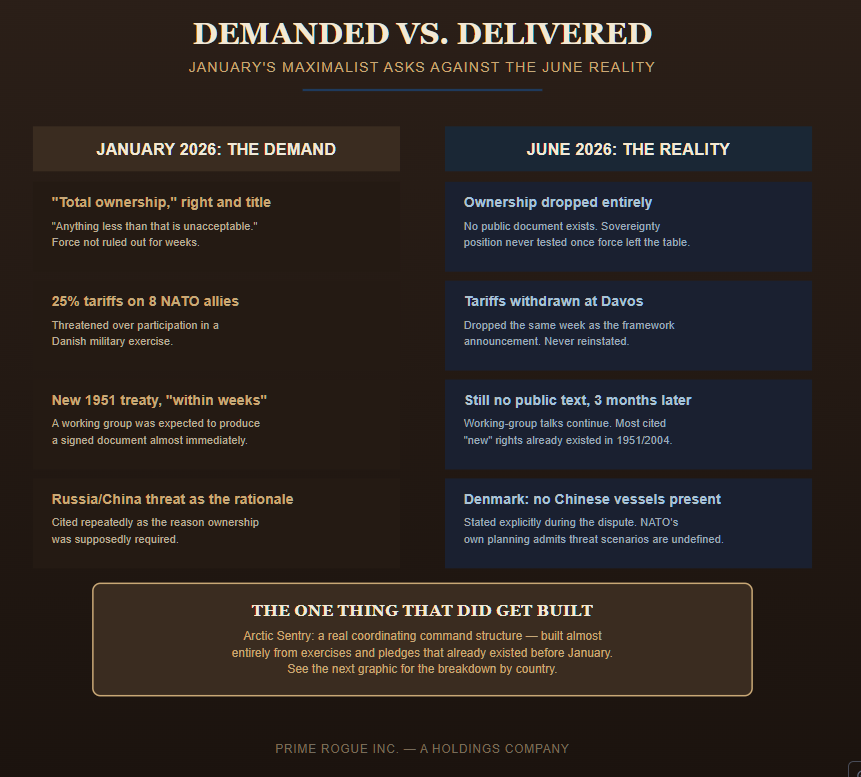
The most tangible institutional product of the crisis is Arctic Sentry, a NATO mission launched on 11 February, almost exactly three weeks after the Davos climbdown. It’s worth being precise about what this actually is, because the framing in most initial coverage oversold it. Arctic Sentry is not a new deployed force. It does not put additional troops in Greenland or anywhere else under a NATO flag on a permanent basis. What it does is take military activities individual allies were already running in the region — Denmark’s Arctic Endurance exercises, Norway’s Cold Response drills — and place them under a single coordinating command structure run out of NATO’s Joint Force Command in Norfolk, Virginia, with American General Alexus Grynkewich as the senior officer attached to the announcement. NATO’s own framing was candid about this: Rutte told reporters the genuinely new element was that “for the first time now we will bring everything we do in the Arctic together under one command,” not that new capability was being generated from scratch.
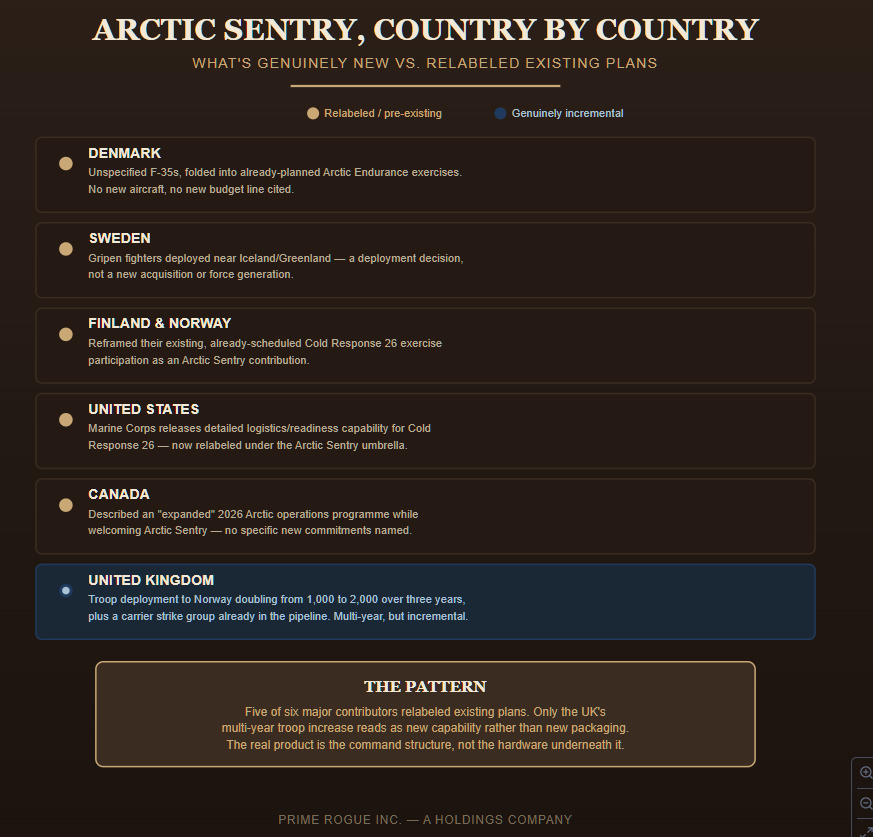
The pattern holds up under closer inspection of individual national pledges in the weeks that followed. Denmark’s contribution was an unspecified number of F-35 jets folded into exercises it had already planned. Sweden deployed Gripen fighters to the Iceland-Greenland corridor. Finland and Norway reframed their participation in the previously scheduled Cold Response 26 exercise as an Arctic Sentry contribution. The U.S. Marine Corps detailed logistics capability for the same exercise, now relabeled. Canada described an “expanded” 2026 Arctic operations programme without specifying new commitments. The United Kingdom’s contribution — doubling troop deployments to Norway from 1,000 to 2,000 over three years, plus a carrier strike group deployment already in the pipeline — is the closest thing to a genuinely incremental commitment among the major announcements, and even that runs on a multi-year timeline rather than an immediate response to the crisis. By March, independent Arctic-policy analysts were openly describing actual new capability commitments as “limited,” with most of what had been announced amounting to consolidation and rebranding of pre-existing national plans rather than new money, new troops, or new hardware specifically generated by the Greenland dispute.
This is not nothing. A unified Arctic command structure that didn’t exist three months ago is a real institutional change, and it gives the alliance a single planning channel for a region that previously ran on a patchwork of bilateral and small-group arrangements. But it is a long way from the kind of dramatic security guarantee the crisis rhetoric implied was at stake, and it was explicitly designed, by NATO’s own officials’ framing, to give Trump something to point to as a win without requiring anyone to actually cede anything new.
The substantive issue underneath the Davos “framework” — what the United States actually gets, in concrete legal and military terms, regarding its presence in Greenland — has moved much more slowly than the diplomatic theatre around it suggested it would. The framework was always built around updating the 1951 US-Danish Agreement Concerning the Defense of Greenland, last meaningfully amended in 2004 to give Denmark and Greenland a formal consent role over new American troop deployments or installations. CNN’s contemporaneous reporting on the Davos announcement made a point that held up well over the following months: much of what Trump described as a breakthrough — “total access” for defence purposes, an open-ended American presence, integration of the proposed Golden Dome missile-defence system — describes, almost word for word, rights the 1951 agreement already grants. A senator’s blunt assessment from the period circulated widely for a reason: there was no single thing the administration said it needed from Greenland that Denmark and Greenland weren’t already willing to grant through the existing treaty structure.
Three months later, no public, signed update to that treaty exists. Discussions about folding the Golden Dome programme into Greenland’s defence architecture continue at the working-group level between Washington, Copenhagen, and Nuuk, but a senator-grade detail from January remains true today: there is still no finalized document, and the working-group process that was supposed to produce one “within weeks” has stretched well past that window without a public text. The ownership question Trump spent January insisting was non-negotiable — “anything less than that is unacceptable” — has effectively dropped out of the public conversation entirely since Davos, not because it was resolved but because nobody involved has had an incentive to revisit it now that the tariff and force threats are off the table.
The clearest throughline across the last three months is that the position Denmark, Greenland, and the rest of NATO held throughout January never actually moved. Danish Prime Minister Mette Frederiksen’s framing from the height of the crisis — “we can negotiate about everything politically: security, investments, the economy. But we cannot negotiate our sovereignty” — remains the Kingdom of Denmark’s stated position without modification. Greenlandic Prime Minister Jens-Frederik Nielsen’s insistence that only Greenland and Denmark hold the mandate to negotiate Greenland’s status has likewise not been walked back or tested by any subsequent American demand to revisit it. NATO’s own spokesperson statements throughout February and March consistently described the alliance’s role as collective Arctic security coordination, not territorial negotiation, with NATO officials on the record stating they did not propose, and were not asked to propose, any compromise of Danish sovereignty during the framework discussions.
This matters analytically because it tells you which side actually had the firmer underlying position once the threat of force and tariffs left the table. Trump’s maximalist demand — ownership, “right, title,” a price Denmark would have to accept or face economic and possibly military consequences — required either active American coercion to succeed or a Danish-Greenlandic decision to capitulate voluntarily. Once coercion was off the table, voluntary capitulation was never seriously on offer, and the diplomatic “framework” that emerged instead was almost entirely built around things Denmark and Greenland were already prepared to discuss before January: enhanced collective Arctic security cooperation, possible integration of American missile-defence assets, and continued operation of the existing Pituffik Space Base under terms not meaningfully different from what already existed.
One detail that received less attention than it deserved across the entire three-month arc: the actual security justification Trump offered for the pressure campaign — that Russian and Chinese activity around Greenland posed an active enough threat to require American ownership rather than continued NATO cooperation — was never clearly substantiated, including by Denmark’s own officials. Danish authorities stated explicitly, during the height of the dispute, that there were no Chinese vessels operating near Greenland at the time. NATO’s own Arctic Sentry planning documents acknowledge that the alliance has not clearly defined specific threat scenarios that would require a new, dedicated allied response beyond contingency planning for hybrid activity, maritime friction in the Greenland-Iceland-UK gap, or a low-probability amphibious scenario. This absence of a clearly demonstrated, escalating threat is itself analytically significant: it suggests the security rationale functioned more as the public-facing justification for a pressure campaign whose actual drivers — resource access, ownership psychology, leverage over a smaller ally — ran in a different direction, a pattern with obvious relevance well beyond this specific case.
The hardest thing to quantify across the last three months, and the thing several European officials and at least one prominent Copenhagen-based analyst flagged early and have had little reason to revise since, is the durable damage to how European allies now calibrate their trust in American security guarantees. A University of Copenhagen international relations professor’s assessment from the height of the crisis — that “closeness and dependency as in the past is not coming back” regardless of how the immediate Greenland dispute resolved — has aged into something closer to consensus among the European officials who lived through January’s tariff threats and force-not-ruled-out rhetoric. Arctic Sentry’s institutional consolidation is real, but it was also accelerated by European and Canadian governments treating it, explicitly in private and somewhat less explicitly in public, as proof that Europe could “handle two flanks at once” — Russia in the east, the Arctic in the north — specifically to undercut the rationale for American ownership claims. That defensive motivation, rather than a shared enthusiasm for deeper integration with Washington, is the actual engine behind much of what got built over the past three months, and it’s a different foundation than the partnership rhetoric in NATO’s official statements implies.
Three months on from Trump’s Davos climbdown, Greenland’s security architecture has changed in exactly the ways that required no one to concede anything they weren’t already willing to discuss, and has not changed in any of the ways Trump spent January insisting were non-negotiable. Arctic Sentry gave the alliance a genuinely new coordinating structure built almost entirely from pre-existing national exercises and pledges. The 1951 treaty update that was supposed to formalize the “framework” remains, three months later, undrafted in public, with the underlying legal relationship essentially unchanged from where it stood before the crisis began. Denmark and Greenland’s sovereignty position never moved, because it was never actually tested by anything beyond rhetoric once force and tariffs left the table. And the security threat that supposedly justified the entire episode remains, by Denmark’s own account, considerably less concrete than the pressure campaign built on top of it. What’s left is a useful case study in how a maximalist demand backed by genuine coercive threats can still produce, once the coercion is withdrawn, almost nothing beyond what would have been available through ordinary diplomacy — plus a meaningfully eroded baseline of trust between allies that no institutional announcement has yet found a way to repair.




[…] renewed Greenland annexation rhetoric and how it intersects with U.S. Arctic […]
[…] signaling” – is accurate (confidence ~85%), as evidenced by Denmark lumping Faroese security under the Greenland crisis response and by Faroese leaders pushing for a louder voice rather than being singled […]
[…] actors, gain confidence in exploiting Israel’s internal instability, Israel finds itself facing a security crisis that goes beyond the immediate military confrontation. The erosion of trust within Israel’s […]
[…] of governments to navigate the delicate balance between secrecy and transparency. Adapting to the changing security landscape requires flexibility and innovation, as well as a commitment to ethical governance and […]
[…] has no equivalent model. If a major economic or security crisis were to occur—whether from U.S. political instability, a global war, or an Arctic […]
[…] are central to the complex story of Canada-Greenland relations and our nation’s place in a changing […]
[…] role in the Greenland crisis exposes a fundamental tension in Western intelligence […]
[…] The United States is now more than $34 trillion in debt, and that number is climbing at an exponential rate. This is no longer just an economic problem—it is a national security crisis. […]
[…] IP Fast Track Program allows defense contractors to secure AI-driven cybersecurity patents within six months, compared to years in the U.S. or […]
[…] and its allies have muzzled critical media through intimidation or co-option. In times of national security crisis, this means domestic media overwhelmingly echo the government’s narrative, leaving the public and […]
[…] isn’t just bad policy—it’s a national security crisis in the […]