Address
304 North Cardinal St.
Dorchester Center, MA 02124
Work Hours
Monday to Friday: 7AM - 7PM
Weekend: 10AM - 5PM

Address
304 North Cardinal St.
Dorchester Center, MA 02124
Work Hours
Monday to Friday: 7AM - 7PM
Weekend: 10AM - 5PM
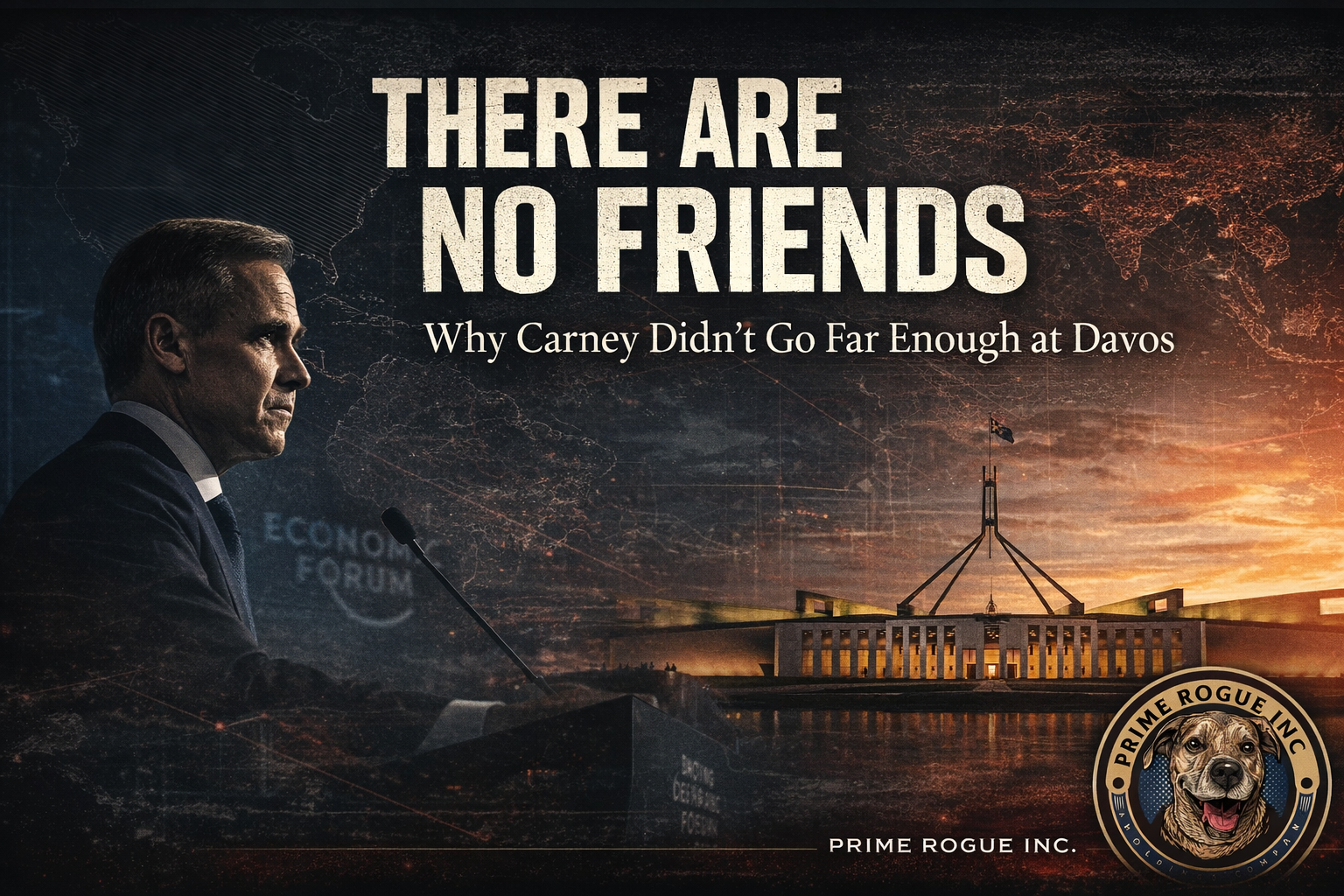
Mark Carney is going to Canberra. He is going to stand in the Australian Parliament and tell a room full of elected officials that the old order is finished and that middle powers need to stop pretending otherwise. It will be received well. The Australians will applaud. The coverage will be respectful. And it will not go nearly far enough.
Because after Carney’s Davos Speech, he is still operating within the frame of a rupture — as though something that worked before has broken, and the job now is repair. That is the wrong frame. The relationship was never what it claimed to be. The system produced this outcome not because Donald Trump is an aberration, but because the system is designed to produce exactly this kind of outcome. And until someone in a Western government says that out loud — not as provocation, but as structural analysis — everything that follows is going to be built on a foundation that doesn’t exist.
This is that statement.
Carney’s Davos speech was the most significant piece of Canadian geopolitical rhetoric in a generation. He said countries “cannot live within the lie” of mutual benefit through integration when that integration becomes the source of subordination. He invoked Václav Havel. He named the pattern without naming the actor. It was, by any measure, a masterful piece of diplomatic signalling.
It was also a response to Trump.
That is the problem. Framing the crisis as a response to Trump — to his tariffs, his annexation rhetoric, his coercive negotiating posture — implies that a different American president would produce a different outcome. It implies that the relationship itself is sound, that the machinery is functional, and that the current friction is the result of one bad operator at the controls.
It is not.
The United States has never been Canada’s friend. This is not a controversial claim in international relations theory — it is the baseline assumption of every serious IR scholar who has studied the bilateral relationship. States do not have friends. They have interests. The US-Canada relationship has functioned well when Canadian interests happened to align with American ones, and it has produced coercion, surveillance, economic manipulation, and cultural dominion when they did not. The alignment was never guaranteed. It was contingent. And contingent relationships do not survive the removal of the conditions that produced them.
Kevin Duska – February 3, 2026
What has changed is not the nature of the relationship. What has changed is that the conditions that made the relationship tolerable have been removed, and Canada is only now confronting what was always underneath.
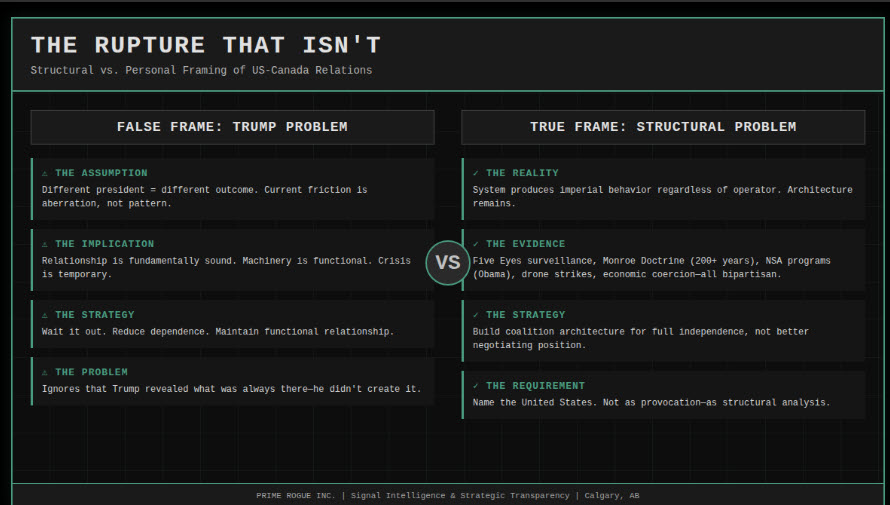
The argument that this is structural rather than personal requires evidence, not just assertion. Here is the evidence.
The surveillance-industrial complex that monitors allied citizens — including Canadians — is not a Trump creation. It is bipartisan infrastructure built over decades, formalized after 9/11, and expanded under every subsequent administration regardless of party. The NSA programs revealed by Edward Snowden in 2013 operated under Obama. The Five Eyes intelligence-sharing arrangements that enabled mass surveillance of allied populations were designed and maintained by the permanent bureaucratic apparatus, not by any single elected government.
The Monroe Doctrine — the foundational principle that the Western Hemisphere is an American sphere of influence — predates the republic’s second century. Trump’s “Trump Corollary” formalizes in a National Security Strategy what has been operational policy for two hundred years: that sovereignty in the Americas is contingent on American approval, and that resources and strategic assets within the Hemisphere are ultimately subject to American control when Washington decides they are.
Iraq was not a Trump war. The drone strike programme was not a Trump programme. The rendition flights that used Canadian airspace were not authorized by a Trump administration. The economic coercion applied to allied nations that pursued independent trade relationships — with China, with the EU, with anyone Washington did not approve of — predates Trump by decades.
The system produces imperial behaviour because of how power is organized south of the border. Exceptionalism is baked into the founding documents. The security apparatus is structurally insulated from democratic oversight. The economic leverage that comes with dollar hegemony is not a policy choice — it is an institutional feature that operates regardless of who is in the White House.
Trump did not create any of this. He revealed it. He made it impossible to deny by doing openly what previous administrations did quietly. And that is useful, because it means the argument for structural decoupling no longer has to overcome the objection that “it’s just one bad president.” It doesn’t matter who comes next. The architecture remains.
This analysis could be dismissed as academic if it were based solely on public reporting and historical precedent. It is not.
Prime Rogue Inc. has documented, through Access to Information and Privacy Act requests filed across federal agencies, a pattern of coordinated surveillance conducted by Canadian government institutions against this organization’s web infrastructure. The Office of the Information Commissioner of Canada, the Department of National Defence, Innovation, Science and Economic Development Canada, and the Royal Canadian Mounted Police have all appeared in server logs accessing Prime Rogue content — repeatedly, systematically, and without disclosure. Prime Rogue Inc has been repeatedly scraped, at scale, by federal departments with no legitimate collection mandates.
This is not speculation. It is sourced from official government records obtained through lawful transparency mechanisms, and Privacy Commissioner complaints.
The relevance here is not self-referential. The relevance is that if a Canadian private intelligence firm publishing openly available analysis on transparency and sovereignty can trigger coordinated monitoring by multiple federal agencies — agencies that operate within a Five Eyes intelligence-sharing framework — then the abstract argument about surveillance infrastructure becomes concrete. The system does not just exist in theory. It operates. It targets. It coordinates. And it does so whether the threat it perceives is foreign or domestic, adversarial or simply inconvenient.
If this is what happens to a Calgary-based firm filing ATIP requests, the question of whether you can trust the Americans to not do worse is not a question. It is a conclusion.
Carney’s position is strategically sound as far as it goes. Build coalitions. Diversify trade. Strengthen the critical minerals relationship with Australia. Court Europe. Visit India. Demonstrate that Canada has options.
All of this is correct. None of it is sufficient.
Because the coalition-building strategy assumes that the goal is to reduce dependence on the US while maintaining a functional relationship with it. That is Carney’s frame, and it is a reasonable frame for a sitting prime minister who has to manage a bilateral relationship that includes a shared border, integrated supply chains, and a military alliance.
But it is not the honest frame. The honest frame is that the relationship is not merely strained — it is fundamentally incompatible with Canadian sovereignty. Not because of Trump. Because of what the US is, structurally, and what it does, institutionally, regardless of who is running it.
The middle-power coalition Carney is building is the right tactical move. What is missing is the strategic acknowledgment that the coalition exists not to negotiate a better deal with Washington, but to make Canada independent of Washington entirely. There is a difference between “we need more options” and “we need to stop pretending this relationship is something it isn’t.” Carney is saying the first thing. He has not said the second.
Kevin Duska – February 3, 2026
Someone needs to say it. Not as provocation. As analysis.
That is what this piece is.
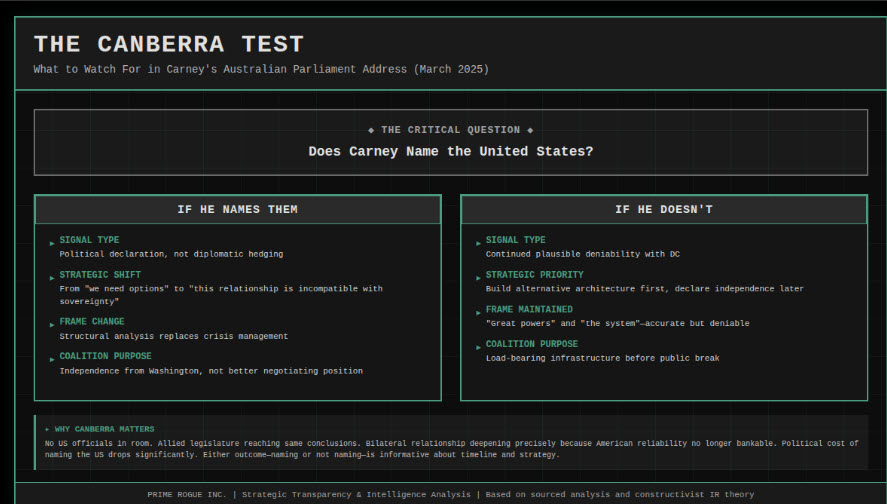
When Carney speaks in the Australian Parliament in March, the single most important thing to observe is not what he says about middle powers, or critical minerals, or the rules-based order. It is whether he names the United States.
In Canberra, the political cost of naming the US drops significantly. There are no American officials in the room. The audience is an allied legislature that is quietly reaching the same conclusions Canada is. The bilateral relationship with Australia is being deepened precisely because both governments understand that American reliability is no longer a bankable assumption.
If Carney names the US explicitly — even obliquely, even in the conditional — it changes the nature of the speech from diplomatic signalling to political declaration. If he does not, it confirms that the hedging is not caution but strategy: build the alternative architecture first, maintain plausible deniability with Washington until the architecture is load-bearing.
Either outcome is informative. Watch for it.
Signal Cage coverage of the Carney visit to Canberra: Civil Defense Canada on structural preparedness: [link] Maple Leaks on the Five Eyes pattern: [link] AI Weapons Watch on the Five AIs Act: [link]






[…] Whether Carney names the United States explicitly in that address — or, as he has done so far, kee… His Davos speech stayed at that level. The parliamentary address, in front of an allied legislature with no American officials in the room, is the first occasion where the political cost of being more direct drops significantly. […]
[…] his request, I met with Prime Minister Mark Carney @MarkJCarney today. We had a very frank discussion in which I made it clear that Albertans will no […]