Address
304 North Cardinal St.
Dorchester Center, MA 02124
Work Hours
Monday to Friday: 7AM - 7PM
Weekend: 10AM - 5PM

Address
304 North Cardinal St.
Dorchester Center, MA 02124
Work Hours
Monday to Friday: 7AM - 7PM
Weekend: 10AM - 5PM
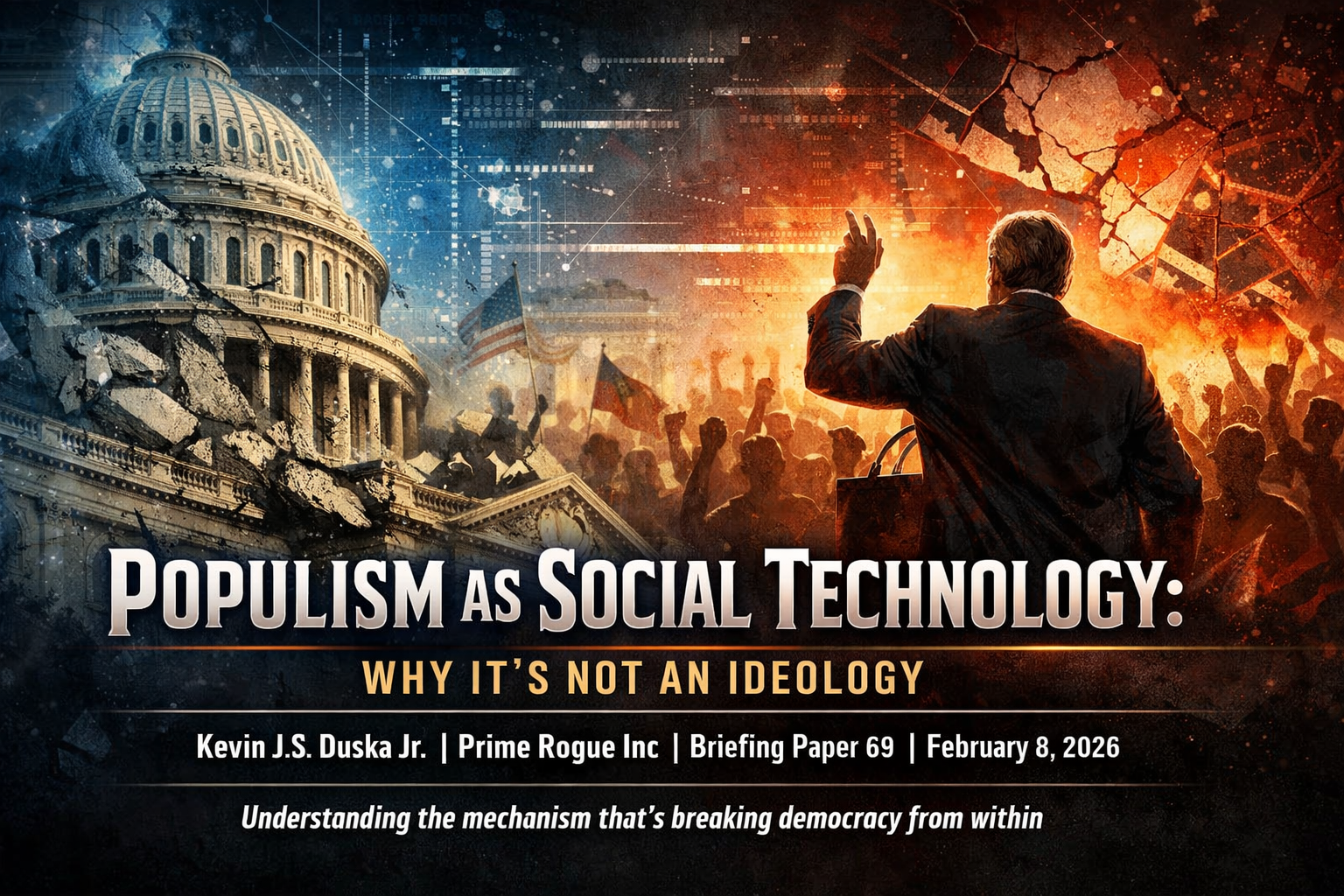
Democracy is dying in dozens of countries simultaneously, and we keep misdiagnosing why. We treat populism like it’s just another political ideology—a set of policy preferences we can argue against, like we argue against socialism or libertarianism or conservatism. We fact-check populist claims. We write op-eds explaining why populist leaders are wrong. We wait for voters to learn from populist governments’ inevitable failures.
None of it works. And it never will, because populism isn’t an ideology at all.
Populism is a social technology—a set of techniques for destroying the shared social facts that make institutions possible. It’s not a position you can argue against. It’s a virus that infects any host ideology and turns it into a weapon against the possibility of democratic disagreement itself.
Understanding this distinction is essential to understanding why January 6th didn’t need a conspiracy, why fact-checking strengthens rather than weakens populist movements, and why democratic institutions have proven structurally defenseless against populist assault. Most urgently, it explains why populism might be democracy’s unsolvable problem.
To understand what populism isn’t, we need to be clear about what ideologies are.
Ideologies make claims about how the world works and how it should work. Socialism claims that collective ownership of production means creates better outcomes than private ownership. Liberalism claims that individual rights and limited government produce human flourishing. Fascism claims that national unity under authoritarian leadership creates strength and purpose. Conservatism claims that traditional institutions contain accumulated wisdom worth preserving.
These are all contestable empirical and normative claims. You can argue about whether they’re true. You can point to evidence for or against them. You can have a good-faith debate about whether Scandinavian social democracy produces better outcomes than American capitalism, or whether traditional family structures are beneficial or restrictive.
Crucially, ideologies can coexist within the same institutional framework. The United States has had socialists, liberals, conservatives, and libertarians all operating within the same constitutional system, accepting the same basic rules about how political competition works. You fight over policy, but you accept that sometimes you’ll lose those fights, and the system continues.
This is possible because ideologies, however much they disagree, share certain social facts: that elections measure legitimacy, that courts interpret law, that institutions have authority derived from agreed-upon procedures. These shared social facts are what the constructivist theorist Alexander Wendt calls “collective intentionality”—the things that exist because we agree they exist, and stop existing when we stop agreeing.
Money is the classic example. A $20 bill has value because we collectively agree it has value. If that agreement breaks down, it’s just paper. Similarly, the Supreme Court has authority because we collectively agree it has authority. Congress can pass laws because we collectively agree it can pass laws. The President has power because we collectively agree on the procedures that grant that power.
Populism doesn’t make claims within this framework. It attacks the framework itself.

Populism has a deceptively simple core operation: it divides the political world into “the people” and “the elites,” and declares that only the former are legitimate.
This sounds like just another political position—privileging popular will over expert judgment, say, or criticizing out-of-touch establishment politicians. But the crucial move is what populism does with this division: it doesn’t just prefer the people over the elites, it declares that the elites are inherently illegitimate and that anything opposing “the people” is by definition corrupt.
Here’s the key: “the people” in populist logic aren’t a demographic group you can point to. They’re not “the working class” or “the majority” or “citizens.” The people are whoever the populist leader says they are—and critically, they’re defined by their opposition to elites, who are whoever disagrees with the populist.
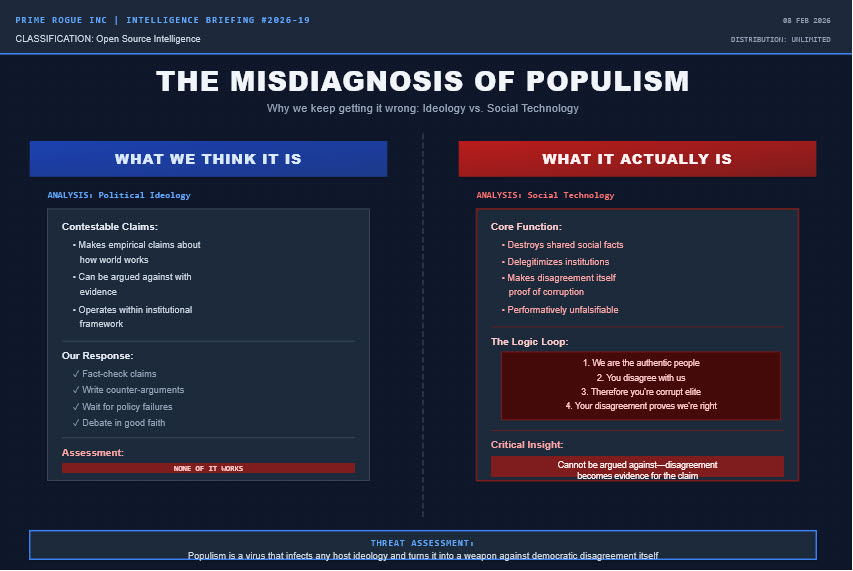
This creates a closed logical loop:
You cannot argue against this logic because disagreement itself becomes evidence for the claim. A socialist can be convinced by evidence that public ownership doesn’t work. A conservative can be convinced that a traditional institution has outlived its usefulness. A liberal can be convinced that individual rights need balancing against collective goods.
But a populist cannot be convinced that “the people” don’t actually want what the populist says they want, because anyone who disagrees is by definition not “the people”—they’re the corrupt elite. The logic is performatively unfalsifiable.
Democratic institutions don’t run on physical force or simple majority rule. They run on shared acceptance of legitimacy. Courts work because both sides in a legal dispute accept that the court has authority to decide. Elections work because both sides accept that whoever wins has the right to govern. Constitutions work because political actors accept them as binding even when following them is inconvenient.
Populism destroys this acceptance by redefining legitimacy itself.
In normal democratic politics, legitimacy comes from following proper procedures. You might think a Supreme Court decision is wrong, but you accept it as legitimate because it followed constitutional processes. You might think an election result is bad, but you accept it as legitimate because it followed electoral rules.
In populist logic, legitimacy comes from alignment with “the will of the people”—and since the populist defines who the people are, only outcomes the populist likes can be legitimate. Any outcome the populist dislikes must be the result of elite corruption, regardless of what procedures were followed.
This is why populists consistently reject election results they lose. It’s not that they’re sore losers (though they are). It’s that accepting a loss would require accepting that “the people” didn’t actually want what the populist said they wanted—which breaks the entire logical structure. The loss must be illegitimate, because “the people” wanting something else is definitionally impossible.
Hungary’s Viktor Orbán has demonstrated this logic with crystalline clarity. After losing Budapest’s mayoral election in 2019, his government stripped the mayor of control over Budapest’s budget, claiming the city was being run by “foreign-backed elites” against the will of “real Hungarians.” When Orbán’s party lost municipal elections in 2019, he didn’t concede that Hungarians had voted against him—he redefined who counted as “real Hungarians.”
Donald Trump did exactly the same thing after the 2020 election. The loss couldn’t be real because “the people” (meaning Trump supporters) couldn’t have lost. Therefore the election must have been stolen. Any evidence to the contrary—court rulings, recounts, Republican election officials certifying results—just proved how deep the corruption went.
This isn’t about particular leaders being dishonest or irrational. It’s about the populist logic functioning exactly as designed. Populism makes institutional legitimacy conditional on outcomes, which makes institutions impossible.
One of populism’s most dangerous features is that it’s not tied to any particular policy agenda. It’s a technique that can be bolted onto any host ideology, left or right, religious or secular, nationalist or internationalist.
Left populism: “The billionaire class has rigged the system against working people. The establishment Democratic Party is corrupt. Real change requires overthrowing elite institutions.”
Right populism: “Coastal elites and globalists have rigged the system against real Americans. The deep state is corrupt. Real change requires overthrowing elite institutions.”
Religious populism: “Secular elites have corrupted our nation’s godly heritage. The establishment has abandoned the faithful. Real change requires overthrowing elite institutions.”
The specific enemies change. The policy prescriptions change. But the structural logic is identical: there are authentic people, there are corrupt elites, and institutions that don’t serve “the people” (as defined by the populist) are illegitimate and must be destroyed or captured.
This is why debating populist policies misses the point entirely. Bernie Sanders and Donald Trump have almost no policy overlap, but they both ran campaigns structured by populist logic. You can agree or disagree with Sanders’ healthcare proposals or Trump’s immigration positions, but the populist framing—corrupt establishment, rigged system, need for a champion of “the people” to overthrow elite institutions—works the same way regardless of content.
India’s Narendra Modi uses Hindu nationalism as his host ideology, claiming that secular elites and Muslim appeasers have betrayed “real India.” Turkey’s Recep Tayyip Erdoğan uses Islamism, claiming that Kemalist secular elites betrayed “real Turkey.” Hungary’s Viktor Orbán uses Christian nationalism and anti-EU sentiment, claiming that liberal cosmopolitan elites have betrayed “real Hungary.”
The host ideologies are completely different. The populist technology is identical.
This explains why populism spreads so efficiently. You don’t need to convince people of a particular worldview—you just need to convince them that (a) they’re “the people,” (b) elites are screwing them over, and (c) institutions that constrain “the people’s will” are illegitimate. The specific content of what “the people” want can be filled in with whatever grievances are locally available.
The events of January 6, 2021 at the U.S. Capitol perfectly illustrate why treating populism as just another political position fundamentally misunderstands the threat.
In the aftermath, investigators, prosecutors, and journalists searched exhaustively for evidence of a coordinated conspiracy—communication between Proud Boys and Oath Keepers and Trump’s inner circle, plans for violence, command structures directing the breach. They found some coordination among particular groups, but nothing approaching a centrally planned coup attempt with clear lines of command.
This absence of a grand conspiracy has led some to minimize what happened. “Just a protest that got out of hand.” “No evidence of organized insurrection.” “Comparing it to a coup is hysterical.”
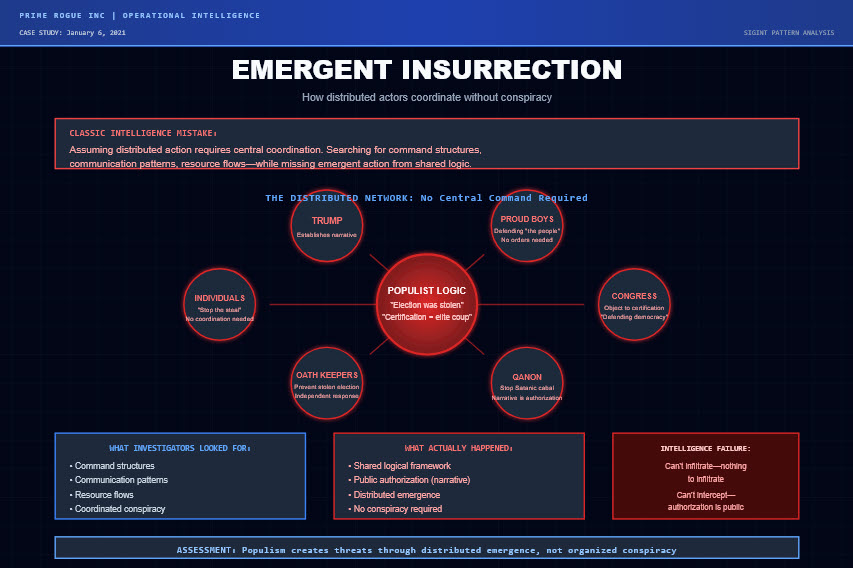
But this analysis makes the intelligence community’s classic mistake: assuming that distributed action requires central coordination. It misses how populist logic enables what we might call emergent insurrection—a coup attempt that emerges from aligned nodes acting independently under shared populist logic, requiring no conspiracy at all.
Here’s how it worked:
Trump and his allies spent months declaring the election stolen, illegitimate, a coup against “the people.” They didn’t need to explicitly call for violence. They just needed to establish that the certification of Biden’s victory on January 6th would be an illegitimate act by corrupt elites overriding the will of “the people.”
The Proud Boys understood from populist logic that they were defending the authentic will of “the people” against elite usurpation. They didn’t need orders from Trump. The logic itself authorized action.
The Oath Keepers understood from populist logic that they were preventing a stolen election from being certified. They didn’t need coordination with the Proud Boys. They were responding to the same logical imperative.
QAnon believers understood from populist logic that they were stopping a Satanic pedophile cabal from stealing democracy. They didn’t need communication with organized groups. The narrative itself was the authorization.
Republican members of Congress objected to electoral certification not because Trump told them to (though some did), but because populist logic said that if “the people” wanted Trump, accepting Biden’s victory would be illegitimate. They were defending “democracy” by overriding election results.
Each node—Trump, organized groups, individual rioters, members of Congress—acted on populist logic that said: “The people want Trump. This certification is elite overriding the people. Stopping it is legitimate.”
No conspiracy needed. No central command required. Just distributed actors following the same logical framework to its natural conclusion.
This is what makes populism so dangerous from an intelligence and security perspective. We train analysts to look for command structures, communication patterns, resource flows—the signatures of organized conspiracy. But populism creates threats through distributed emergence. Thousands of independent actors all reaching the same conclusion (“this must be stopped”) because they’ve all accepted the same populist framing (“the people are being overridden by corrupt elites”).
You can’t infiltrate it because there’s nothing to infiltrate. You can’t intercept communications because the authorization is public—it’s the populist narrative itself. You can’t decapitate it because there’s no single head—remove Trump and the logic remains.
Perhaps the most frustrating feature of populism is that our normal tools for combating misinformation don’t just fail—they actively make the problem worse.
When a populist claims “the election was stolen,” fact-checkers spring into action. They compile evidence: no widespread fraud found, recounts confirmed results, 60+ lawsuits failed, Trump’s own attorney general found nothing, Republican election officials certified the outcome.
This should work. In normal political discourse, when you show someone their claims are empirically false, they either change their position or lose credibility with observers.
But populism doesn’t operate in normal political discourse. Populism operates in an epistemological framework where evidence from elite institutions is inherently suspect.
So when fact-checkers (who work for mainstream media) cite court rulings (elite institutions), election officials (government bureaucrats), and recounts (official processes), populists don’t hear “here’s evidence you’re wrong.” They hear “the elite institutional conspiracy is so complete that every official channel says the election wasn’t stolen—which is exactly what they’d say if it was.”
The fact-checking itself becomes evidence for the populist claim.
This is populism’s epistemic weapon: it creates a closed information loop where contrary evidence strengthens rather than weakens the core narrative. Any institution that contradicts the populist becomes “part of it”—proof that elite corruption runs deep.
Consider how this played out with election fraud claims:
Every piece of contrary evidence just expands the circle of who’s “in on it.” This is why QAnon could grow to encompass ever-more-baroque conspiracies—once you’ve established that elite institutions are fundamentally corrupt, there’s no logical limit to what they might be hiding.
From an intelligence perspective, this is the nightmare scenario: when reality itself becomes contested, when empirical facts become matters of tribal loyalty rather than shared observation, when “do your own research” means “reject any information from official sources.
This is why I, coming from a HUMINT background, find populism uniquely terrifying. Intelligence work requires some shared baseline about what constitutes evidence. You can have sources with different interpretations, but you need agreement that satellite imagery shows what it shows, that intercepted communications say what they say, that financial records reflect actual transactions.
Populism destroys that baseline. In a populist epistemic framework, any information that contradicts “what the people know to be true” must be fabricated. Satellite imagery is doctored. Communications are faked. Records are falsified. And since “the people” know what they know through the populist leader’s interpretation, the populist leader becomes the only reliable source.
This is how autocracy emerges from democracy—not through force, but through the systematic destruction of the possibility of shared facts.
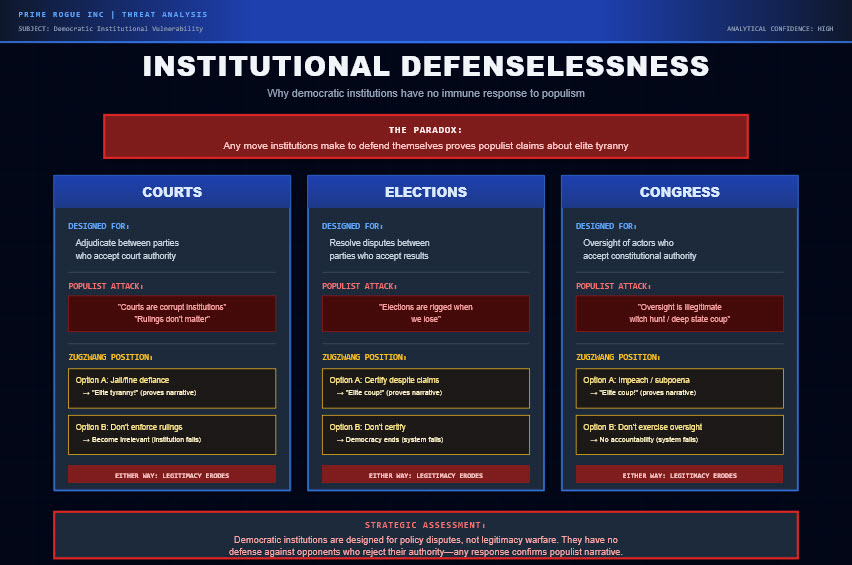
Democratic institutions are designed for policy disputes, not legitimacy warfare. They have no defense against an opponent who rejects their authority to referee disputes.
Courts can adjudicate between parties who disagree about what the law means. But courts can’t defend themselves against opponents who claim courts are inherently corrupt institutions whose rulings don’t matter. When courts try—by jailing or fining those who defy rulings—populists frame this as tyranny, which strengthens their narrative of elite oppression.
Elections can resolve disputes between parties who disagree about policy. But elections can’t defend themselves against opponents who claim elections are rigged when they lose. When election officials try—by certifying results despite objections—populists frame this as elite coup, which strengthens their narrative.
Constitutions can constrain actors who disagree about policy but accept constitutional authority. But constitutions can’t defend themselves against actors who claim the constitution is being weaponized by elites. When constitutional scholars try—by explaining what the constitution actually says—populists frame this as elite gaslighting, which strengthens their narrative.
This is what I call institutional defenselessness: democratic institutions have no immune response to opponents who reject their legitimacy, because any exercise of institutional authority can be reframed as elite tyranny.
Hungary demonstrates this perfectly. Viktor Orbán hasn’t torn up Hungary’s constitution or abolished elections. He’s captured institutions through entirely legal procedures—packing courts, changing electoral rules, controlling media—while claiming at each step that he’s defending “the people” against elite opposition. When Hungarian or EU institutions object, this just proves they’re part of the elite conspiracy against Hungary’s authentic voice.
The genius of this approach is that it uses democratic procedures to destroy democratic accountability. You can’t call it a coup because everything follows legal processes. You can’t call it tyranny because elections continue. But step by step, institutions lose the independence necessary to constrain power, because independence itself is reframed as elite defiance of “the people’s will.”
The United States is further along this path than most Americans realize. When Trump claimed executive privilege to block congressional oversight, that’s normal institutional conflict. When Trump claimed that congressional oversight itself was an illegitimate “witch hunt” by the “deep state” attempting a “coup” against the president, that’s populist delegitimization. When Trump supporters concluded that Congressional subpoenas could be ignored because Congress was an illegitimate elite institution attempting to overthrow “the people’s choice,” democratic accountability became impossible.
This is the populist paradox: democratic institutions cannot defend themselves without proving populist claims correct.
If courts jail populist leaders for defying rulings, populists become martyrs being persecuted by elite institutions. If election officials refuse to certify results based on fraud claims, they confirm that the system is rigged. If congress impeaches a populist president, they prove that elites are attempting a coup against “the people.”
The institution faces an impossible choice: exercise your authority and confirm populist narratives about elite tyranny, or don’t exercise your authority and become irrelevant. Either way, institutional legitimacy erodes.
This is what game theorists would call “zugzwang”—a position where any move worsens your situation, but you must move.
A common response to populism’s rise is to call for “more democracy”—more citizen participation, more direct democracy, more responsive institutions. The logic seems sound: if people feel alienated from elite institutions, bring institutions closer to people.
But this misunderstands what populism does. Populism doesn’t actually want more democracy. It wants the end of institutional constraints on majority will—which is precisely what makes democracy liberal rather than tyrannical.
The distinction matters. Liberal democracy isn’t just majority rule. It’s majority rule constrained by rights, checks, balances, procedures, and institutions that prevent majority tyranny. The Supreme Court can overturn laws passed by elected majorities. The Senate can block House legislation. Courts can protect minority rights against majority wishes. Constitutional amendments require supermajorities.
These constraints exist because the Founders understood that pure majority rule often produces tyranny. If 51% can do whatever they want to 49%, you don’t have democracy—you have periodic rotation of oppression.
Populism systematically attacks these constraints by reframing them as elite obstruction. Why should unelected judges overturn laws passed by elected representatives? Why should procedural rules let minorities block what majorities want? Why should constitutional formalities prevent “the people” from getting what they voted for?
Each question sounds reasonable in isolation. But collectively, they dismantle the institutional complexity that makes democracy workable.
This is why “more democracy” in response to populism often accelerates democratic breakdown. When you remove institutional constraints in the name of responsiveness, you remove the friction that prevents temporary majorities from becoming permanent tyrannies.
Turkey demonstrates this trajectory. Erdoğan came to power through democratic elections promising to make Turkey more democratic and less controlled by secular Kemalist elites. He reduced military influence over politics (good). He expanded civilian control (good). He removed bureaucratic barriers to popular will (sounds good).
But each of these moves, framed as democratization, actually removed institutional constraints on executive power. By the time Turks realized that “more democracy” meant “fewer checks on Erdoğan,” the institutions that could have constrained him had been delegitimized and dismantled.
The same pattern has played out in Hungary, Poland, Venezuela, and is underway in India. Each time, populist leaders promise to remove elite obstacles to popular will. Each time, this means removing institutional independence. Each time, by the time opposition realizes what’s happening, the institutions that could resist have lost the authority to matter.
This is why populism is democracy’s auto-immune disorder. The response to populism—more responsiveness, less elite control, more direct popular will—is exactly what populism uses to destroy democratic institutions.
Populism isn’t a phase. It’s not a backlash that will recede once economic conditions improve or once voters “learn their lesson” from populist failures. It’s a social technology that, once activated, creates self-reinforcing dynamics that are extraordinarily difficult to reverse.
When Trump lost in 2020, many analysts predicted MAGA would fade. When Erdoğan’s party lost municipal elections in 2019, analysts predicted his grip on Turkey was weakening. When Modi’s BJP lost seats in 2024, analysts predicted India was pulling back from Hindu nationalism.
All of these predictions misunderstood the mechanism. Populism doesn’t depend on continuous victory. It depends on continuous delegitimization of institutional alternatives. Every loss is reframed as elite theft. Every constraint is reframed as elite oppression. Every contrary fact is reframed as elite deception.
This means that populism is anti-fragile to its own failures. When populist governments perform badly, populists don’t lose support—they claim elite sabotage. When populist leaders lose elections, they don’t accept defeat—they claim elite fraud. When populist policies fail, they don’t revise course—they claim insufficient populism.
The mechanism is the same across every context:
This is why Viktor Orbán has maintained power for 14 years despite Hungary’s economy stagnating and corruption flourishing. It’s why Erdoğan has maintained power for 21 years despite Turkey’s currency collapsing and inflation soaring. It’s why Modi has maintained power despite religious violence increasing and democratic backsliding accelerating.
Populist voters aren’t stupid. They see the problems. But the populist framework explains problems as evidence of elite power, which justifies more populism, which creates more problems, which proves elite power, which justifies more populism.
The loop is closed.
Understanding populism as social technology rather than ideology reshapes how we should think about nearly every major political crisis.
January 6th wasn’t an aberration or a conspiracy that failed. It was the logical outcome of populist logic reaching its conclusion. When institutions lose legitimacy, violence becomes a reasonable option for “defending democracy.”
MAGA fractures aren’t signs that Trumpism is dying. They’re signs that populist movements eat themselves once they run out of elite enemies and start declaring internal opponents “not real people.” But this doesn’t kill populism—it mutates it.
Global democratic backsliding isn’t coincidence or mimicry. It’s the same social technology spreading because it works—not in making countries prosperous or stable, but in allowing leaders to maintain power despite failure by continuously delegitimizing institutional alternatives.
Climate change denial, anti-vaccine movements, QAnon, election fraud claims—these aren’t separate phenomena. They’re all applications of the same populist epistemic weapon: declaring expert consensus to be elite conspiracy, making contrary evidence into proof of the conspiracy’s depth.
The information warfare challenge isn’t about Russian bots or Chinese influence operations, though those exist. It’s about populism creating populations that are epistemologically prepared to reject any information from institutional sources, which makes them vulnerable to any narrative that confirms elite corruption.
The AI safety challenge isn’t just about technical alignment. It’s about whether AI systems trained on populist content will reproduce populist epistemology, creating feedback loops where AI-generated information further degrades shared reality.
And critically for my work: the transparency warfare challenge isn’t just about government trying to hide information. It’s about populist governments redefining transparency itself as elite control. When I force disclosure through ATIP, populists don’t see accountability—they see unaccountable bureaucratic elites using procedural rules to resist “the people’s will.” When I win in court, I’m not vindicating rights—I’m elite-captured institutions defending an agitator against authentic Canadian interests.
This is what I’m fighting: not just government secrecy, but government secrecy wrapped in populist legitimation that declares transparency itself to be anti-democratic.
I don’t have a solution.
I can explain the mechanism. I can show how it works. I can demonstrate why our current responses fail. But I cannot point to a clear institutional fix for a problem that’s fundamentally about the destruction of institutional possibility itself.
This is the deeply uncomfortable conclusion that analysts keep avoiding: democracy might not be anti-fragile to populism.
Democracy requires losers to accept losses. Populism defines losses as illegitimate.
Democracy requires institutional authority. Populism delegitimizes institutions.
Democracy requires shared facts. Populism makes facts tribal.
Democracy requires loyal opposition. Populism makes opposition into enemies of “the people.”
Democracy requires that power constraints aren’t personal attacks. Populism makes all constraints into elite oppression.
These aren’t problems we can solve with better civic education or economic redistribution or media reform—though all of those might help at the margins. These are fundamental incompatibilities between what democracy needs to function and what populism does to political culture.
Some democracies will survive this. Some won’t. But we need to stop pretending that populism is just another political movement that will fade when its policies fail or when voters learn better. Populism is a social technology for destroying the possibility of institutional democracy, and it’s very good at what it does.
The only question is whether we can develop equally effective social technologies for defending democratic institutions before populism delegitimizes them past recovery.
I don’t know if we can.
But understanding what we’re actually fighting—not bad policies, not authoritarian personalities, but a mechanism for destroying shared social reality—is the necessary first step.
Kevin Duska is an intelligence professional and scholar of international politics who completed undergraduate and graduate studies in International Relations at McGill University and the Ohio State University specializing in constructivist theory, national security, narrative management, and institutional breakdown. He runs Prime Rogue Inc., a geopolitical risk analysis and private intelligence firm, and is an avid user of the Canadian Access to Information regime in his anti-surveillance and pro-transparency activism. His forthcoming book Echo State: The Logs Can’t Lie Yet (Autumn 2026) examines mass surveillance and transparency warfare in the age of institutional collapse.
 Trump’s Fentanyl WMD Order: Economic Warfare, Law Enforcement Overreach, and North American Sovereignty at Risk
 The MAGA Purge and the Whistle: How Laura Loomer’s Loyalty Crusade Targets Tucker Carlson’s Epstein Codebreaking
 The Arctic Flight That Reveals NATO’s Greenland Strategy
 Deciphering the JFK Files: An Intelligence Analysis of What to Expectv



[…] records regarding social service implications of rapid employment changes in Tumbler […]