Address
304 North Cardinal St.
Dorchester Center, MA 02124
Work Hours
Monday to Friday: 7AM - 7PM
Weekend: 10AM - 5PM

Address
304 North Cardinal St.
Dorchester Center, MA 02124
Work Hours
Monday to Friday: 7AM - 7PM
Weekend: 10AM - 5PM

Every few months, a new foreign interference story breaks somewhere in the Western world, and every few months the public reaction follows the same arc: shock that it happened, confusion about how it happened, and a search for the single dramatic mechanism that must be responsible — a hacked server, a bought politician, a viral disinformation campaign. Those mechanisms exist and they matter. But they are not where most foreign interference actually lives. Most of it lives somewhere far less cinematic: inside diaspora communities, working through cultural associations, language newspapers, hometown associations, and family ties that stretch back across a border the authoritarian state in question has no intention of letting go of.
This is not a new tactic. It is one of the oldest tools in the authoritarian playbook, and it remains effective for the same reason it always has — it doesn’t require breaking any laws that most democracies have gotten around to writing, it exploits relationships that are completely legitimate ninety-five percent of the time, and it puts the burden of proof on exactly the people least equipped to bear it: immigrants and their children, who came to a new country specifically to get away from the reach of the state now trying to reach them anyway.
Authoritarian and one-party states have a structural problem democracies don’t: a meaningful fraction of their most capable, most internationally connected, and often most critical citizens leave. Dissidents, journalists, academics, business owners who got tired of paying bribes, religious and ethnic minorities, students who studied abroad and didn’t come home — they all end up somewhere else, and somewhere else is usually a democracy with rule of law, a free press, and elections.
From the perspective of the state they left, this is not a closed chapter. It’s an open liability. A diaspora community is, depending on how you choose to look at it, a reservoir of potential opposition voices with an international platform, a source of remittances and investment the home economy may depend on, a constituency that influences how the host country’s foreign policy gets shaped, and a population that can be mobilized — through community organizations, religious institutions, and family pressure — in ways a foreign ministry could never accomplish through official channels alone.
That combination of threat and opportunity is exactly why diaspora communities get sustained attention that a one-off disinformation campaign doesn’t. You don’t run an influence operation against a diaspora community. You maintain a relationship with it, indefinitely, the same way you’d maintain a relationship with any other strategic asset.
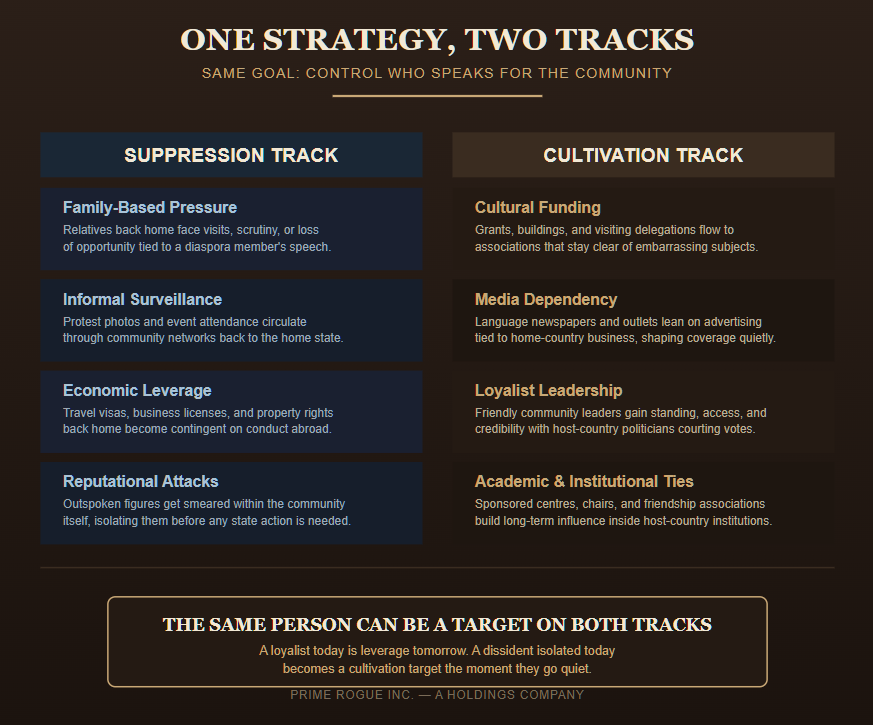
The popular image of foreign interference involves intelligence officers and dead drops. The reality is duller and more durable. It looks like a hometown association that receives a building, a grant, or a visiting delegation from the consulate, conditional — implicitly, rarely explicitly — on the association steering clear of subjects the home government finds embarrassing. It looks like a language newspaper in a Western city that depends on advertising from businesses with home-country ties, and adjusts its editorial line accordingly without anyone ever issuing a directive. It looks like a community leader who wants to visit aging parents back home, or who has a sibling running a business there, weighing that visit against whatever they’re about to say at a public event.
It looks like surveillance that doesn’t require a single piece of malware — a photograph from a protest forwarded through a community messaging group, a name mentioned at a religious gathering, a rumour that someone’s family back home received a visit from local officials shortly after that person spoke at a rally abroad. None of this needs to be coordinated centrally to be effective. It needs to happen often enough, visibly enough, that everyone in the community understands the rules without anyone having to state them. That ambient, decentralized quality is what makes this form of interference so resistant to the kind of investigation built for catching a specific bad actor doing a specific bad thing.
And it works in both directions. Authoritarian states don’t only suppress diaspora dissent — they actively cultivate loyalist diaspora organizations, fund cultural centres and academic positions, sponsor friendship associations, and court community leaders who become genuinely valuable conduits of influence precisely because they have real standing in the community and real relationships with host-country politicians courting that community’s votes. The loyalist and the dissident often live in the same neighbourhood, attend the same events, and represent two sides of the identical strategy: shape what the community says by shaping who gets to speak for it.
Democracies are bad at this fight for reasons that are themselves somewhat admirable. A government that starts treating an entire ethnic or national community as a security concern because some of its members maintain ties to an authoritarian regime is a government on the fast track to discrimination, and diaspora communities know this history intimately — many of them left precisely because a state decided their entire group was suspect. Any policy response has to thread a needle between protecting people from transnational repression and not recreating the logic of collective suspicion that drove many of them to leave in the first place.
This produces a predictable failure mode: host-country institutions either do almost nothing, treating the whole subject as too politically sensitive to touch, or they overcorrect into exactly the kind of blanket suspicion that damages trust with the community whose cooperation they actually need. Neither failure mode helps the people inside these communities who are the actual targets — the activist whose family is threatened, the academic who self-censors a research topic, the local politician who quietly drops a community event after a complaint routed through an unofficial channel.
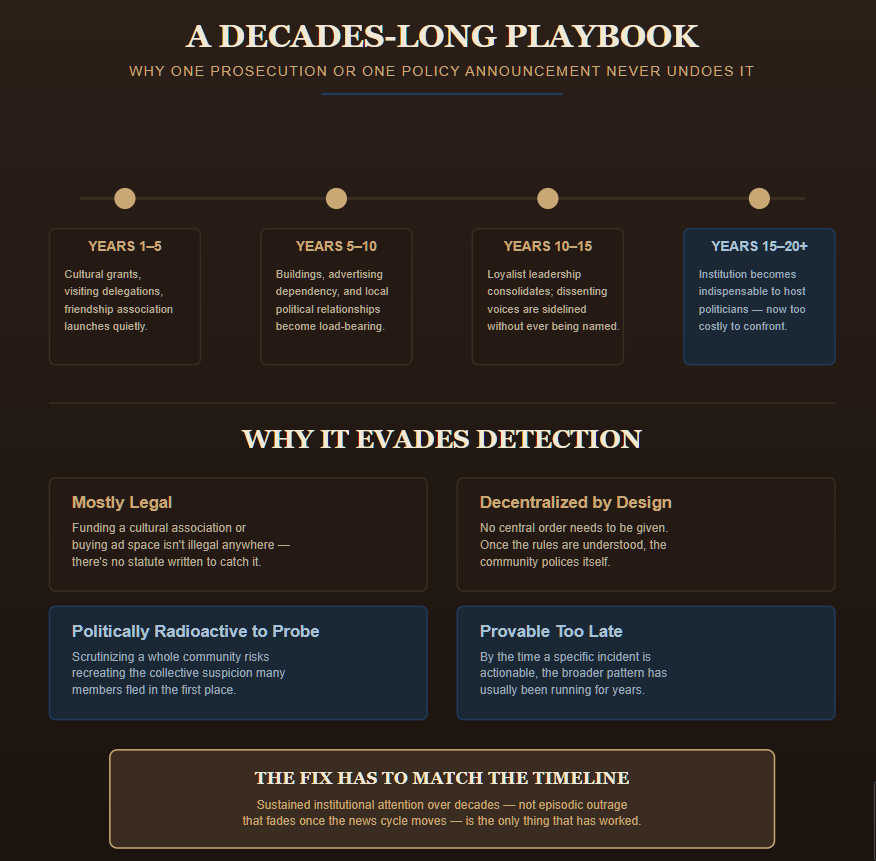
The other structural problem is jurisdictional. Most of the conduct described above is either fully legal — funding a cultural association is not illegal anywhere — or sits in a grey zone that existing foreign agent registration and lobbying transparency laws were not built to catch, because those laws were designed with conventional lobbying and conventional espionage in mind, not the slow cultivation of an entire community’s social infrastructure. By the time a specific incident is provable enough to act on, the broader pattern has usually been running for years.
The headline cost of this kind of interference is the dramatic case — the dissident attacked, the activist’s family detained back home, the community leader who turns out to have been an informant for years. Those cases matter and deserve the attention they get. But the larger cost is quieter and almost never makes the news: an entire category of political speech that simply doesn’t happen, because the people most qualified to make it have learned, correctly, that making it carries a cost their host country can’t fully protect them from.
This is a loss for the host country as much as for the diaspora community itself. Democracies depend on people with direct, lived knowledge of authoritarian systems to inform public debate, shape policy, and warn of risks before they metastasize. When that knowledge gets suppressed at the source — not through censorship by the host government, but through pressure applied from abroad that the host government can’t or won’t counter — the country loses access to some of its most valuable expertise on the exact authoritarian states it most needs to understand.
One of the more uncomfortable facts about this dynamic is how little it depends on ideology. States with almost nothing else in common — different religions, different economic systems, different geopolitical alignments, sometimes outright adversaries of each other — converge on strikingly similar diaspora playbooks once they reach a certain size and a certain number of citizens living abroad. The instruments vary slightly: some regimes lean harder on family-based pressure, others on funding cultural infrastructure, others on cultivating loyalist business networks that become genuinely indispensable to a host country’s local economy. But the underlying logic — treat the diaspora as an extension of domestic politics rather than a population that left it — shows up again and again, independent of whether the regime in question calls itself communist, monarchist, theocratic, or a managed democracy.
This matters for how the issue gets discussed in Western media and policy circles, where it’s often filtered through whichever geopolitical rivalry happens to be dominant at the time. Treating this as a story about one specific country, rather than a recurring structural pattern that a wide range of states reach for independently, makes the problem look smaller and more partisan than it actually is. It also makes it easier for any single state accused of the practice to dismiss the accusation as politically motivated, since the conversation rarely acknowledges that the same playbook is running, in parallel, out of capitals that have nothing to do with each other and would never coordinate on anything else.
A useful test for any analyst or journalist covering this space: if the proposed explanation for a community organization’s behaviour only makes sense for one specific country’s diaspora, it’s worth checking whether the same dynamic shows up in two or three completely unrelated diaspora communities tied to completely unrelated regimes. If it does — and it usually does — the story isn’t really about that one country. It’s about a method that happens to be available to any state with a large enough diaspora and enough patience to use it.
There’s no single fix for a problem this structurally embedded, but there are durable principles that hold regardless of which authoritarian state or which diaspora community is involved.
Transparency requirements that focus on funding flows and foreign agent activity, rather than on community identity, target the actual mechanism without recreating collective suspicion. Disclosure of foreign funding to cultural organizations, media outlets, and advocacy groups lets a community see for itself which of its own institutions have strings attached, without a government having to point fingers at any specific ethnic or national group.
Protection mechanisms need to be built for the individual, not the community. A dissident who can report transnational harassment to a dedicated channel that takes the report seriously, without that report becoming a pretext for surveilling the entire community around them, gets actual protection. A blanket security posture toward an entire diaspora gets neither protection nor trust.
And perhaps most importantly: host countries need to understand that the relevant timeline for this threat is measured in decades, not news cycles. A cultural association cultivated over twenty years, a community newspaper’s advertising base built over fifteen, a loyalist organization’s standing with local politicians built over a decade of ribbon-cuttings and donations — none of that gets undone by a single policy announcement or a single high-profile prosecution. Matching that time horizon with sustained institutional attention, rather than episodic outrage that fades once the news cycle moves on, is the only thing that has ever actually worked against this kind of patient, structural interference.
Diaspora communities aren’t a vulnerability because anything is wrong with them. They’re a vulnerability because they sit, structurally, between two states with very different interests in how that community behaves — and one of those states has had decades of practice turning that position into leverage. Understanding foreign interference as something that happens primarily through servers and bots misses where most of the actual work gets done: in community halls, language newspapers, family messaging groups, and the quiet calculation every diaspora activist makes before they decide whether a particular sentence is worth saying out loud. Any serious accounting of foreign interference has to start there, because that’s where the authoritarian states themselves started a long time ago.
Populism as Social Technology: Why It’s Such a Danger in 2026






[…] their data, they deserve to know. Dr. Boda has been publicly pushing for expanded powers to address foreign interference in Saskatchewan’s elections. We are giving him documented grounds to use whatever powers he […]
[…] its Sayanim, Mossad could not operate.” Another report notes the Sayanim pool is drawn from diaspora communities and even holds foreign passports (enabling agents to travel cheaply under local […]
[…] for Disinformation: The G7 nations established the Rapid Response Mechanism in 2018 to counter foreign disinformation and interference. Germany is a core participant. For the 2025 summit, a joint RRM team will be active, scanning for […]
[…] Canada’s own RRM (Rapid Response Mechanism) has already flagged disinformation campaigns run by foreign agents targeting Canadian policymakers. For example, one Chinese-linked network on WeChat spread anti-Canadian […]
[…] previous elections, Alberta’s role was predictable. But in 2025, foreign interference, nationalist radicalization, and the Trump-Poilievre dynamic are making Alberta one of the most […]
[…] cultural organizations, consular networks, and diasporic surveillance initiatives have increasingly targeted Kurdish communities, Gülenists, and academics critical of the regime. Combine that with Canada’s silence on […]
[…] are independent, consistent, specific, and contemporaneous with the most acute period of foreign interference activity targeting Alberta in recorded […]
[…] Eyes intelligence agencies will start leaking reports about “foreign interference” targeting any candidate who challenges American […]
[…] Foreign Influence & Disinformation: CSIS monitors and counters foreign state interference or inf… the summit. Canada’s 2018 G7 in Charlevoix led to a G7 Rapid Response Mechanism to share analysis of foreign influence threats – an initiative to which CSIS contributes intelligence. In its 2022 public report, CSIS noted the spread of misinformation and disinformation by state and non-state actors (e.g. during the 2022 protests in Canada) aimed at undermining public trust. Drawing on such lessons, CSIS will be alert to any influence campaigns or cyber-enabled disinformation aimed at the 2025 summit. […]
[…] cross-agency intelligence work. Her clearance revocation suggests that the Trump administration is targeting not just foreign policy professionals — but those who turned the lens […]
[…] Gaza flotilla raid, Israeli public diplomacy officials coordinated directly with Australian Jewish community organizations, the local United Israel Appeal chapter, Zionist student groups, and communal boards, to mobilize […]
[…] Most of the funding went to contractor salaries and “logistics.” USAID’s own internal audit showed that only 4% of PLE’s funds actually reached target communities. […]