Address
304 North Cardinal St.
Dorchester Center, MA 02124
Work Hours
Monday to Friday: 7AM - 7PM
Weekend: 10AM - 5PM

Address
304 North Cardinal St.
Dorchester Center, MA 02124
Work Hours
Monday to Friday: 7AM - 7PM
Weekend: 10AM - 5PM
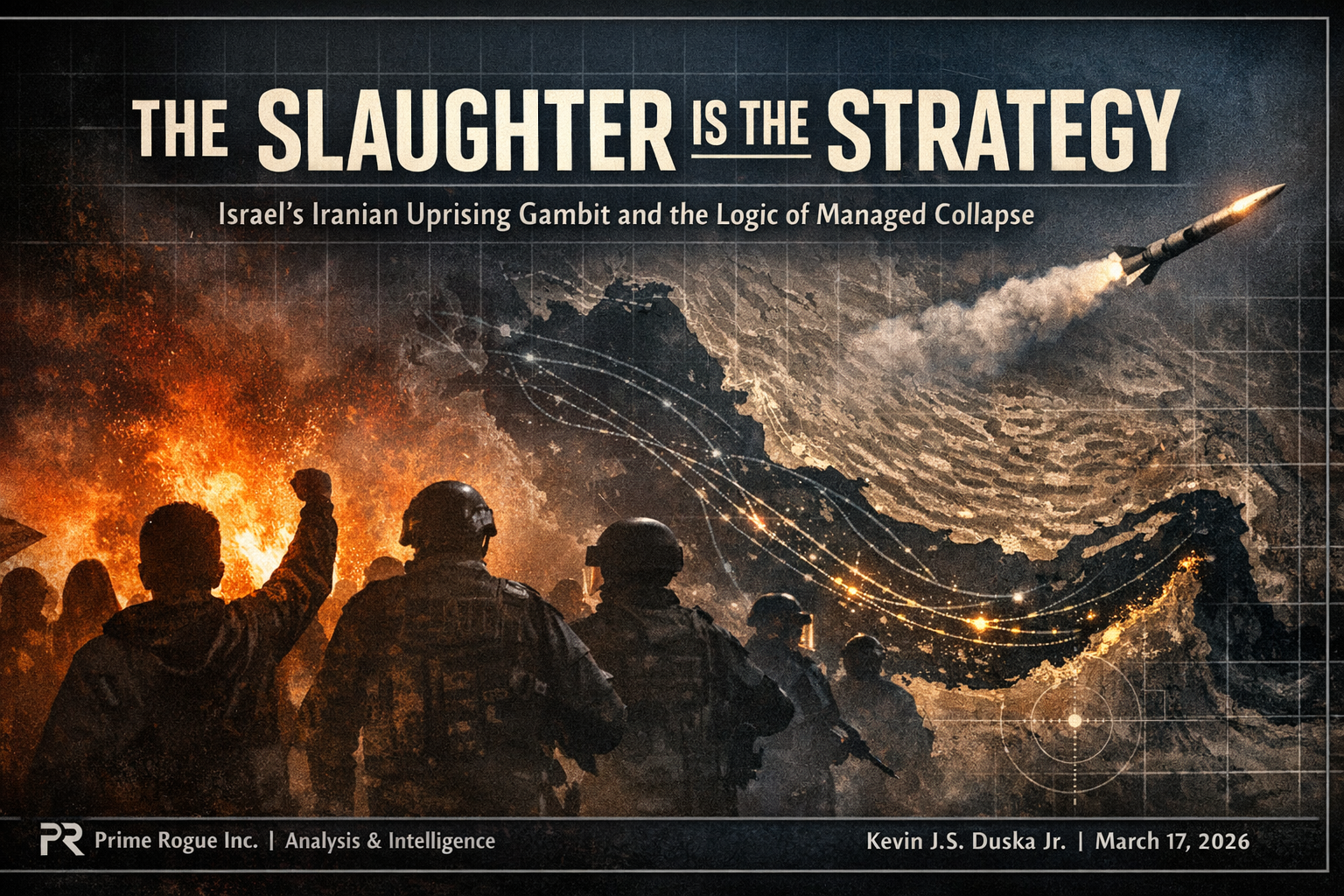
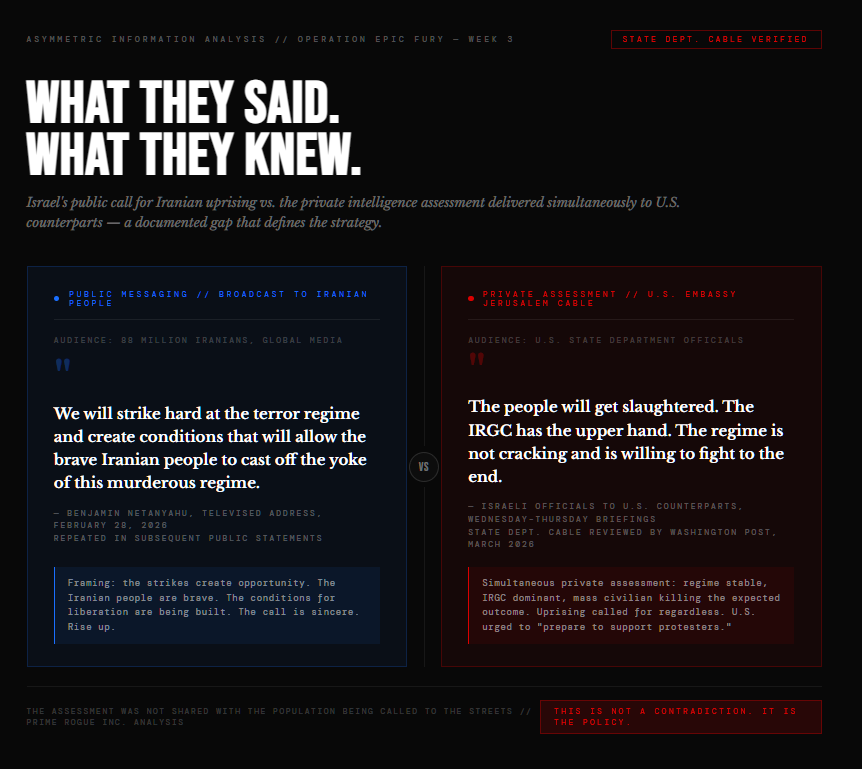
A State Department cable reviewed by the Washington Post and authenticated by two U.S. officials contains one of the most clarifying sentences to emerge from the three-week-old Iran war embodied by Operation Epic Fury. Israeli officials, privately briefing their American counterparts, assessed that if Iranian protesters take to the streets in response to Israeli public calls for an uprising,
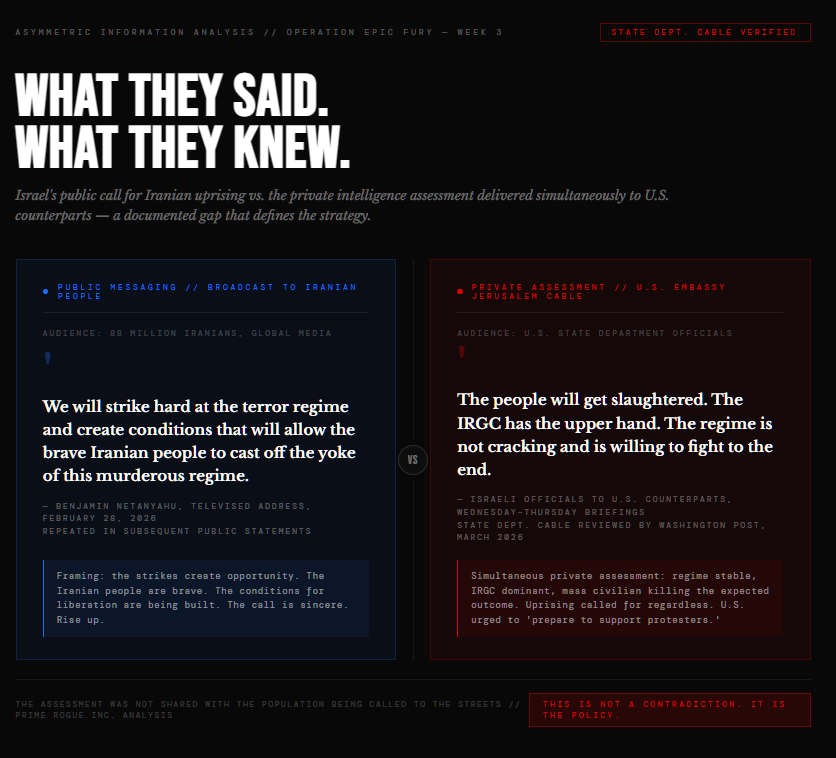
“the people will get slaughtered.”
Israeli officials briefing American counterparts regarding the ongoing conflict in Iran
They said it anyway. They’re still saying it.
This is not a contradiction. It is the policy.
Understanding why requires setting aside the comfortable frame of Israeli miscalculation — the idea that Jerusalem overestimated the regime’s fragility, called for a revolution it couldn’t deliver, and is now managing an embarrassing gap between rhetoric and reality. That reading treats the slaughter as an unintended consequence. The more coherent reading, the one that aligns with Israel’s documented strategic doctrine over decades, is that the slaughter is a feature. That the massacre of Iranian civilians by their own government is, from Israel’s operational standpoint, a strategic input — not a failure mode.
This piece argues that Israel is running a managed population disruption strategy: a form of fourth-dimensional warfare in which civilian deaths at the hands of the Islamic Republic are not collateral damage to be minimized but leverage to be maximized. The goal is not liberation. The goal is fragmentation.
Strip the diplomatic language and the cable is saying three things simultaneously.
First: the regime is not cracking. Israel’s own intelligence assessment — delivered privately, meaning without audience management — concludes that the Islamic Revolutionary Guard Corps “has the upper hand,” that the regime is “willing to fight to the end,” and that Supreme Leader Mojtaba Khamenei is “more aligned” with IRGC hard-liners than his assassinated father. The hope that killing Ali Khamenei would “sow more chaos” within the regime has not materialized.
Second: any popular uprising will be crushed with mass lethal force. The IRGC suppressed the January protests with a body count the West condemned internationally. The infrastructure for mass civilian killing — the Basij alone numbers approximately one million, per Israeli estimates — remains intact. Israeli officials assess that the regime would massacre protesters at scale without hesitation.
Third: Israel wants the uprising to happen anyway. They are publicly calling for it, they urged the U.S. to prepare support mechanisms for protesters, and this posture has not changed despite their private assessment of the likely outcome.
The cable does not say Israel wants the uprising to succeed. It says Israel wants the uprising. Those are different things.
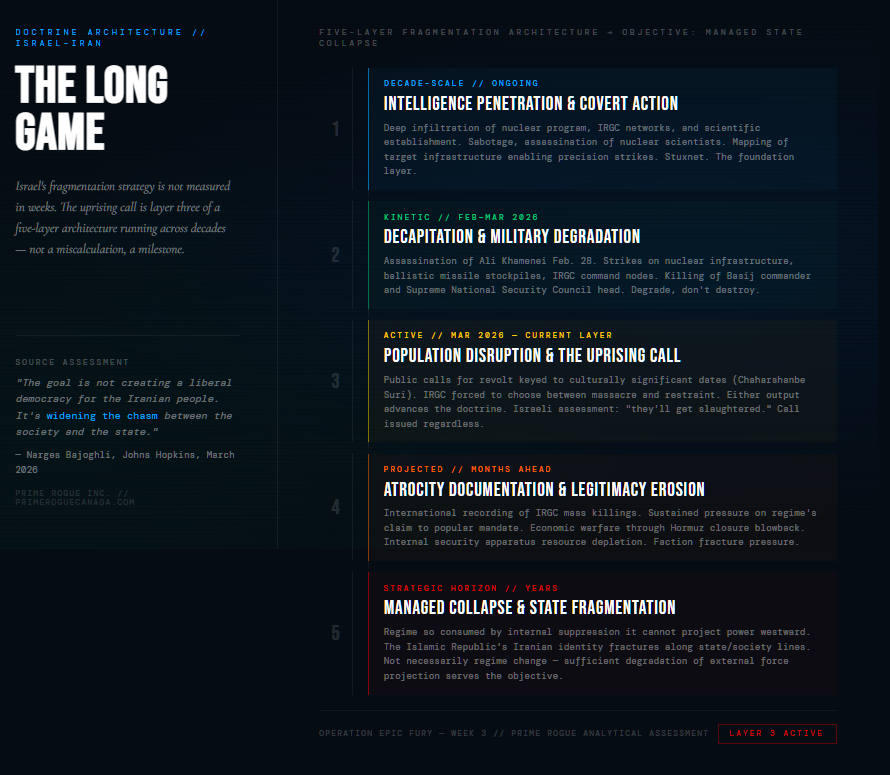
Narges Bajoghli, an Iran scholar at Johns Hopkins, named it directly in her response to the cable: Israel’s decades-long objective has been “the fragmentation of Iran” and “state collapse.” She identified the mechanism clearly. “One of the ways of achieving that is creating more opportunities in which the guns of the state get turned onto the population. The goal is not creating a liberal democracy for the Iranian people. It’s widening the chasm between the society and the state.”
This is not a fringe academic interpretation. It is a structural reading of Israeli strategic behavior that is consistent with the public record.
Israel’s national security doctrine has always treated the Islamic Republic as an existential threat — not merely a hostile state but an ideological system whose survival is incompatible with Israeli security. That doctrine produces a set of strategic preferences that are internally coherent even when they appear callous or contradictory to outside observers. The goal is not a post-Islamic Republic Iran that is democratic, stable, and friendly. The goal is an Iran that cannot project power westward. State collapse serves that goal. Persistent internal fragmentation serves that goal. A regime perpetually occupied with gunning down its own population serves that goal.
An uprising that gets massacred does not fail to serve Israeli strategic interests. It advances them — so long as the massacre further erodes the regime’s legitimacy, exhausts IRGC operational capacity, generates international pressure, and deepens the alienation between Iranian civil society and the clerical-military establishment.
The public call to revolt is not a sincere invitation to revolution. It is a pressure tool designed to put the regime in an impossible position: either the IRGC stands down and looks weak, or it massacres civilians and looks monstrous. Either outcome serves the fragmentation strategy. The slaughter is not the failure state. The slaughter is one of the intended outputs.
There is a dimension to this that the diplomatic language of the cable obscures but doesn’t eliminate: the people being asked to take mortal risk have not been shown the Israeli intelligence assessment telling them they will be killed if they do.
Benjamin Netanyahu stood before cameras and told the Iranian people his country was striking “to create conditions that will allow the brave Iranian people to cast off the yoke of this murderous regime.” Reza Pahlavi, the exiled crown prince, called for Iranians to take to the streets during Chaharshanbe Suri, the ancient Persian fire festival. Commemorations of the festival have historically been sites of anti-regime expression. The messaging has been consistent, coordinated, and pitched at maximizing street mobilization.
None of that messaging included the Israeli intelligence assessment that the IRGC has the upper hand and will massacre anyone who shows up.
That asymmetry — we know you’ll be slaughtered, we’re calling for the uprising anyway, and we’re not telling you what we know — is the operational signature of a strategy that treats Iranian civilians as instruments rather than as people whose survival is a constraint on acceptable tactics.
Suzanne Maloney of Brookings named the ethical dimension without flinching: “The Iranian people are at grave risk at the moment from the regime, and it would be unfortunate if they were used as pawns in an effort to try to further inflame the situation.” The use of “unfortunate” is doing a lot of diplomatic lifting. The more direct formulation is: knowingly encouraging civilians toward lethal confrontation with a superior armed force, while concealing your own assessment that they will be killed, is not a policy failure. It is a policy choice.
The dominant frame in Western commentary — that Israel badly miscalculated the regime’s resilience — deserves interrogation rather than acceptance.
The miscalculation narrative runs as follows: Israel expected the assassination of Ali Khamenei to fracture the regime. It didn’t. Israel expected the combined US-Israeli bombing campaign to degrade the regime’s capacity to suppress internal dissent. It hasn’t. Israel expected the Iranian population to rise up. They haven’t, at scale. Therefore, Israel got the strategic calculus wrong.
This reading has the virtue of being orderly and face-saving. It positions Israeli officials as optimists who overestimated their leverage rather than as strategists who were comfortable with the prospect of mass civilian death. It also happens to be inconsistent with the documented record of Israeli intelligence penetration of Iran — which Brookings’ own Maloney called “impressive” — and with the historical sophistication of Israeli strategic planning in the Iranian theatre.
The people who spent a decade mapping Iranian nuclear infrastructure well enough to execute precision strikes on it did not fail to model IRGC institutional resilience. They modeled it. Their private assessments, as relayed in this very cable, show they knew the IRGC had the upper hand. The question is not whether they miscalculated. The question is what they were actually calculating for.
The most coherent answer: the bombing campaign was never primarily designed to topple the regime from the outside. It was designed to create conditions — economic stress, security sector overextension, military degradation, Basij resource commitment to internal suppression — under which the regime becomes increasingly brittle over time. Not collapse now. Managed decay. The uprising call is part of that architecture: it forces the IRGC to choose between suppression and restraint, depletes internal security resources, generates international documentation of atrocities, and adds another layer to the long-term project of eroding the social contract between the Islamic Republic and the Iranian population.
That is a coherent strategy. It is not a miscalculation.
The Trump administration’s position is worth examining on its own terms because it shows how the fragmentation logic migrates from Israeli strategic doctrine into American operational behavior.
Trump initially called on Iranians to “take over your government.” He has since walked that back to acknowledging that “they literally have people in the streets with machine guns, machine-gunning people down if they want to protest.” That evolution tracks the cable’s assessment and suggests the U.S. intelligence community is feeding the White House the same picture: the regime is stable enough to kill en masse, and calling for an uprising you can’t support is a liability.
But the White House’s formal statement in response to the leaked cable is revealing. The spokesperson said Trump “doesn’t like to see suffering anywhere, including in Iran, where the terrorist regime was slaughtering protesters before the president intervened.” The passive construction — “the terrorist regime was slaughtering protesters” — positions the regime as the sole author of civilian death. The decision to encourage those same protesters toward the streets, while holding intelligence assessments that the regime would kill them, is laundered out of the causal chain.
This is not a mistake in messaging. It is the logic of the strategy applied to communications: the regime is responsible for the deaths its own security forces commit, regardless of what external pressure created the conditions under which those deaths occurred. It is a framework that makes population disruption strategies perpetually deniable at the level of direct causation even while being fully intentional at the level of strategic design.
The U.S. has also effectively admitted the original war aims are not achievable. Officials confirmed they are “no longer pursuing the overthrow of Iran’s entrenched clerical and military establishment.” That is an extraordinary concession after three weeks of bombing. It does not stop the bombing. What it signals is that the goalposts have moved from regime change to regime degradation — which is, incidentally, a description of the fragmentation strategy Israel has been running for decades.
The strategic picture has additional complexity that the uprising narrative tends to crowd out. Iran closed the Strait of Hormuz at the start of the war. Twenty percent of the world’s oil and LNG passes through that chokepoint. Top U.S. allies rejected Trump’s demand to send warships to help reopen it on Monday. Energy prices are elevated. Recession risk is real and rising.
The regime’s decision to close Hormuz is the single most consequential leverage play available to Tehran short of nuclear weapons use, and they exercised it immediately. That decision is not the behavior of a government on the verge of collapse. It is the behavior of a government that has done its strategic calculus and concluded that it can absorb the military pressure while inflicting sufficient economic pain on the international system to constrain American and Israeli freedom of action.
The IRGC is still launching ballistic missiles and drones “everywhere they want to,” per the Israeli assessment in the cable. The new supreme leader, Mojtaba Khamenei — described as wounded but still functional and “more aligned” with IRGC hard-liners — appears to have consolidated enough authority to maintain regime coherence. The Basij commander and the head of Iran’s Supreme National Security Council were killed Tuesday in what Israel characterized as a significant strike. These are real degradation effects. They have not translated into regime fragility.
The gap between tactical success and strategic outcome is the defining feature of this conflict at week three. Israel and the U.S. are winning engagements. They are not winning the war. That gap is what makes the population disruption strategy increasingly central — because if you cannot break the regime militarily, you work to make it break itself.
The cable is a data point that illuminates a trajectory, not just a moment.
If the Israeli assessment is accurate — regime consolidating, IRGC dominant, new supreme leader hard-line — then the war has a structural problem that more bombing does not solve. The kinetic campaign can continue to degrade military infrastructure, but it has demonstrably not destabilized the regime’s internal control architecture.
The population disruption track is therefore likely to intensify. More public calls for uprising. More Chaharshanbe Suri-style mobilization attempts. More targeting of Basij and internal security infrastructure. More information operations designed to widen the gap between Iranian civil society and the clerical establishment. And more private acknowledgment, in cables that will eventually leak, that Israel knows the likely outcome for the people it is encouraging toward the streets.
This is the geometry of managed collapse: slow, layered, calibrated degradation of the social contract between a state and its population, executed over years rather than weeks, using military pressure, economic warfare, and population disruption in combination. It does not require the revolution to succeed today. It requires that today’s failed revolution make tomorrow’s more likely.
The Iranian people are both the target and the medium of this strategy. The guns of the state turned on the population are the mechanism. The international documentation of those massacres is the output.
There is a word for encouraging civilians toward lethal confrontation while concealing your assessment that they will be killed, in service of a long-term strategy in which their deaths are instrumentally useful. That word is not “miscalculation.”
Confidence: High
The Washington Post cable is not primarily evidence of Israeli strategic overreach. It is a window into the operational logic of a population disruption strategy that has been a documented component of Israeli Iran doctrine for decades. The private assessment that protesters will be slaughtered does not contradict the public call for an uprising. It is downstream of it. The slaughter is the strategic input — it erodes regime legitimacy, overextends IRGC capacity, generates international documentation of atrocities, and deepens the alienation between Iranian civil society and the Islamic Republic.
The “miscalculation” framing serves everyone with equanimity to protect: it makes the Israeli strategic establishment look like optimists rather than architects, and it positions the deaths of Iranian civilians as unfortunate externalities rather than intended leverage. The cable does not support that reading. The decades-long documentary record of Israeli Iran strategy does not support that reading.
The war is three weeks old. The regime is consolidating. The fragmentation clock is running on a much longer timeline than the news cycle. Watch for the following indicators: escalation of information operations targeting IRGC rank and file; attempts to fracture the relationship between the Basij and the regular armed forces; intensified targeting of internal security infrastructure specifically (as distinct from military targets); and continued public calls for street mobilization keyed to culturally significant dates.
The uprising they’re calling for is not the one they’re expecting. The one they’re expecting is what they want.
Related Coverage:
Kevin J.S. Duska Jr. is President of Prime Rogue Inc., a Calgary-based private intelligence and strategic transparency firm.
 What Is Hasbara? Israel’s Public Diplomacy Machine, Explained
 Operation Lion’s Roar: Joint US-Israeli Strikes on Iran, February 28, 2026 – 0826 UTC – Situation Report 1
 The Iran Ceasefire is 48 Hours Old and Already Falling Apart – April 10, 2026
 The Hormuz Cycle, Cycle Six: A Seizure, a Near-Deal, and the Toll Authority Nobody Recognizes



[…] each other’s nation-building narratives. In practice, that has translated to deep cooperation in defense and intelligence. Canada is a member of the Five Eyes intelligence alliance and, tellingly, has a special […]
[…] — indicators of kinetic impact but severity unknown. Iran’s immediate retaliation has been primarily directed at Israel, but also includes Gulf-based US installations and the territories of American allies in the […]