Address
304 North Cardinal St.
Dorchester Center, MA 02124
Work Hours
Monday to Friday: 7AM - 7PM
Weekend: 10AM - 5PM

Address
304 North Cardinal St.
Dorchester Center, MA 02124
Work Hours
Monday to Friday: 7AM - 7PM
Weekend: 10AM - 5PM
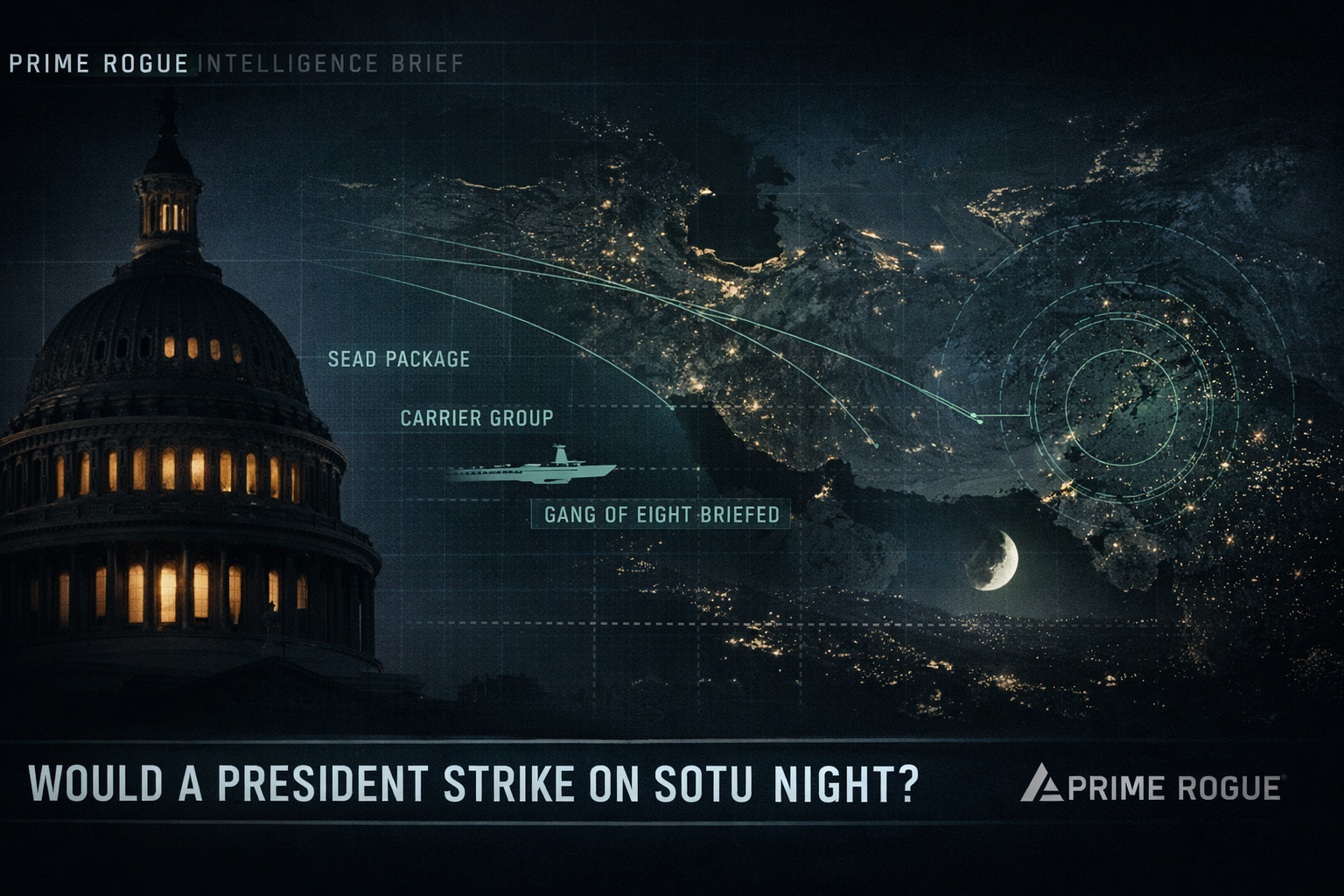
The open-source indicators surrounding tonight’s State of the Union — a dedicated 42-aircraft SEAD package, Gang of Eight briefed today, two carrier strike groups within range, Wild Weasel F-16CJs carrying first-combat-use Angry Kitten EW pods, and a First Quarter moon setting over Tehran at midnight — form a pre-strike architecture that is either the most elaborate coercive pressure campaign in a generation, or the real thing. The Tuesday timing sounds insane. It may not be. Here’s why.
As Donald Trump steps to the podium tonight for his 2026 State of the Union address, a question is circulating in national security and intelligence circles that the mainstream press is dancing around: is this the night?
Not a rhetorical question. An operational one.
The United States has assembled what analysts at multiple think tanks are calling the most significant military buildup in the Middle East since the Iraq War. Two carrier strike groups. Dozens of advanced fighter jets at forward bases. A 42-aircraft suppression of enemy air defenses package — including 24 F-16CJ Wild Weasels carrying the Angry Kitten electronic warfare pod with AI capabilities in what may be its first operational combat deployment — positioned specifically to blind and destroy Iranian radar networks.
All of it pointed at Iran. All of it assembled in the past six weeks.
And the State of the Union is tonight.
Let’s acknowledge the obvious: launching a military strike on a Tuesday night, with US equity markets opening in roughly 14 hours, is not how these things are supposed to work.
Historical precedent is clear. Libya 1986: weekend. Gulf War 1991: Wednesday, but with weeks of congressional authorization and global market preparation. Iraq 2003: Thursday, after a months-long buildup with UN debates, Congressional vote, and full media preparation. Syrian strikes 2017, 2018: weekends. Operation Midnight Hammer, the US strike on Iranian nuclear facilities in June 2025: a single overnight operation.
The conventional wisdom is that presidents avoid military action during market hours — or immediately before them — because the shock to oil markets, currency markets, and equity futures creates cascading economic instability that undermines the political case for the action itself. A $15-20 spike in crude oil overnight, S&P futures down 3-4%, VIX spiking above 40: these are self-inflicted wounds.
So the Tuesday question is legitimate. Why would anyone do this?

